
Executive Overview
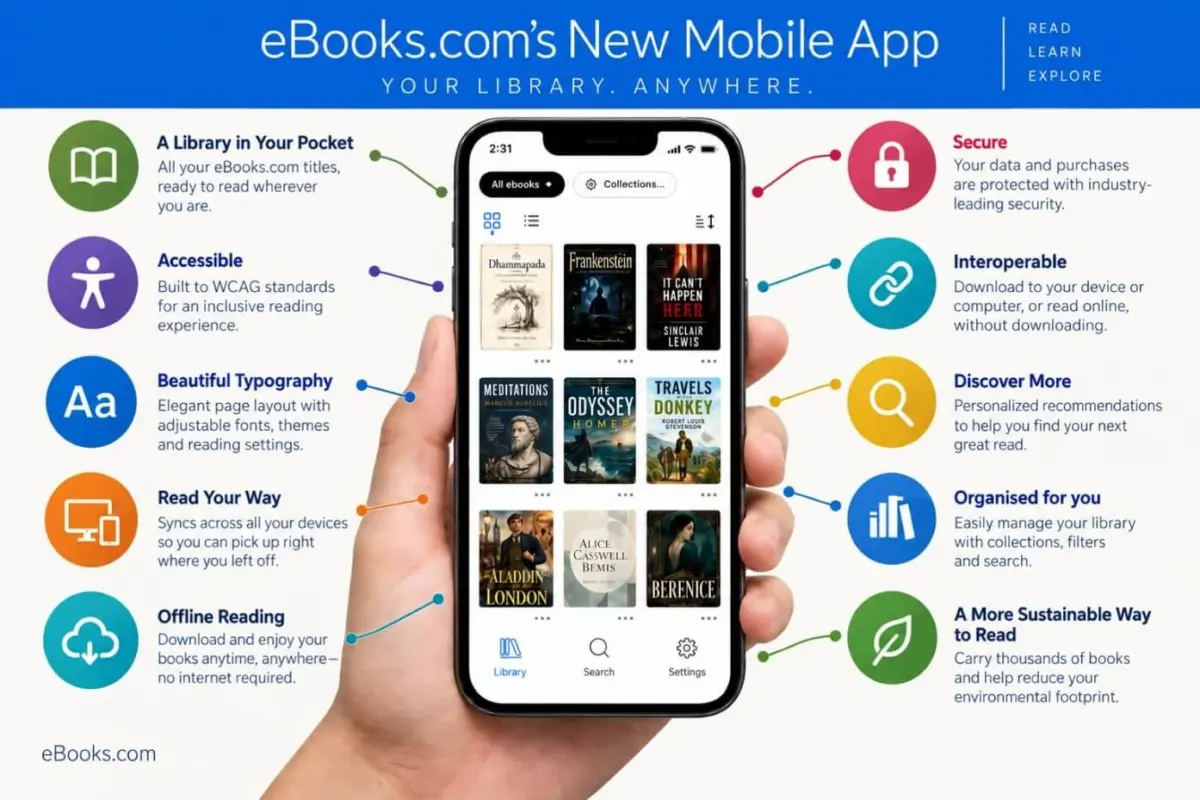
In a significant strategic move for the digital publishing industry, eBooks.com has officially launched its completely redesigned, next-generation mobile reading applications for both iOS and Android platforms. Developed through an ambitious and collaborative Australian-European partnership, these new apps represent the cornerstone of a broader, company-wide technological modernization. This sweeping overhaul transitions the prominent digital bookstore away from legacy frameworks and toward an open, standards-based ecosystem designed to meet the evolving demands of modern readers, publishers, and institutional clients alike.
The fresh wave of development is not limited to mobile app stores. Alongside the new iOS and Android applications, eBooks.com has rolled out a suite of interconnected ecosystem upgrades. These include the implementation of the advanced Readium LCP (Literacy Content Protection) digital rights management system, the release of a high-performance browser-based Online Reader, and comprehensive desktop support for the widely acclaimed Thorium reading application.
By leveraging cutting-edge engineering from the European Digital Reading Lab (EDRLab) and Sweden’s digital publishing specialists Colibrio, eBooks.com has constructed a reading environment that seamlessly handles everything from casual fiction novels to complex, layout-heavy academic textbooks, fixed-format EPUBs, rich audio-visual media, and manga. Furthermore, the platform places an unprecedented emphasis on digital inclusivity, integrating native operating system screen-readers with deeply customizable typography controls tailored to individuals with dyslexia and other visual or reading preferences.
Read Also
Detailed Chronology: The Evolution of eBooks.com’s Modernization
The rollout of the new mobile applications and the concurrent platform enhancements did not happen in a vacuum. It represents the culmination of a multi-year engineering effort aimed at future-proofing one of the web’s oldest independent ebook retail and distribution services.
Phase 1: Moving Beyond Legacy Frameworks
For years, digital reading apps were often plagued by siloed ecosystems, proprietary DRM schemes, and rigid formatting constraints that struggled to render complex digital publications accurately. Publishers of academic works, graphic novels, and children’s literature frequently encountered roadblocks when trying to deliver their works across multiple devices without losing design integrity. Recognizing these friction points, eBooks.com initiated a long-term architectural pivot toward open standards. The goal was simple yet technically daunting: create a unified reading backend capable of delivering consistent, high-fidelity typography and layout rendering across web browsers, desktop computers, and mobile operating systems.
Phase 2: The Transcontinental Collaboration
To bring this vision to life, eBooks.com formed strategic alliances with premier European digital reading organizations. The company partnered with Colibrio, a Swedish software development firm renowned for its high-performance digital publishing engines capable of fluidly handling complex typography and rendering engine demands. Simultaneously, the platform integrated standards spearheaded by the European Digital Reading Lab (EDRLab), an organization globally recognized for promoting open, interoperable, and accessible digital reading formats.
This Australian-European synergy allowed the development teams to bypass the limitations of traditional, in-house app frameworks. Instead, they built a modular architecture anchored on the Readium software stack. This collaboration ensured that the final mobile applications were not only fast and feature-rich but also strictly adherent to modern web and publishing standards.
Phase 3: Ecosystem Integration (Readium LCP & Thorium)
Before releasing the mobile apps to the public, eBooks.com systematically laid the infrastructure to support them. Crucial to this process was the adoption of Readium LCP, an open-source, user-friendly DRM alternative designed to protect copyright without frustrating consumers with cumbersome passwords, tracking scripts, or restrictive hardware lock-ins.
Complementing the mobile apps, the company introduced a completely overhauled Online Reader, allowing users to open and read books directly within any modern web browser without installing additional software. Additionally, eBooks.com established robust compatibility with Thorium Reader, the premier desktop application for Windows, macOS, and Linux built by EDRLab. This created a synchronized reading experience where a user’s library, bookmarks, and progress could theoretically be bridged across environments governed by open standards.
Phase 4: The Official Global Launch
Culminating these preparatory phases, the new iOS and Android applications made their official debut on digital app stores. Available now for iPhone, iPad, and a diverse array of Android smartphones and tablets, the apps immediately began rolling out to existing and new customers globally, marking a definitive new chapter in the company’s operational history.
Supporting Context & Metrics: Navigating the Modern Digital Publishing Landscape
To fully understand the significance of eBooks.com’s platform overhaul, one must examine the broader shifts occurring within the global ebook and digital content markets.
The Demand for Format Versatility
Historically, standard reflowable EPUB files dominated digital reading platforms. However, the modern publishing market demands much higher versatility. Consumers increasingly purchase and consume diverse media formats that push the boundaries of standard rendering engines:
- Fixed-Format EPUBs & Textbooks: Academic, professional, and children’s literature often rely on exact page layouts, side-by-side text and imagery, and specialized mathematical or scientific notation. Traditional readers frequently butcher these layouts. The integration of Colibrio’s rendering technology allows eBooks.com’s new apps to preserve these intricate designs flawlessly.
- Manga and Graphic Novels: With the global explosion of manga popularity, mobile reading apps must support right-to-left pagination, panel-by-panel zooming, and high-resolution image rendering without experiencing lag or memory crashes.
- Audio-Visual Integration: Modern educational and narrative books increasingly incorporate embedded audio clips and interactive video elements, requiring media-rich EPUB support built directly into the core reader.
Accessibility as a Market Imperative
Digital accessibility is no longer an afterthought or a "nice-to-have" feature; it is a legal requirement and an ethical baseline. According to global health estimates, roughly 15% to 20% of the global population experiences some form of reading difficulty, ranging from visual impairments to neurological conditions like dyslexia.
Traditional ebook apps have frequently fallen short by offering rudimentary font-scaling options that break page structures. By building its apps with granular typographic controls—such as adjustable word and line spacing, custom margin padding, specialized dyslexic-friendly fonts, and deep integration with OS-level screen readers like Apple’s VoiceOver and Google’s TalkBack—eBooks.com has positioned its platform at the cutting edge of inclusive design.

The Rise of Open Standards (Readium vs. Proprietary Silos)
For over two decades, the digital book market has been heavily fragmented by proprietary ecosystems (such as Amazon’s Kindle or Apple Books), which lock users into specific hardware and software channels. While these walled gardens offer convenience, they limit consumer choice and place independent publishers and bookstores at a structural disadvantage.
By championing Readium LCP, eBooks.com is part of a growing international movement advocating for interoperability. LCP allows independent booksellers to offer secure digital content that users can open on a variety of preferred apps and devices, mirroring the open nature of physical books while maintaining robust publisher copyright protections.
Official Statements and Leadership Vision
The transition to this modern technological infrastructure is viewed by company leadership as an existential necessity for continued growth and market leadership in an increasingly competitive digital arena.
Stephen Cole, founder of eBooks.com, articulated the core philosophy guiding the massive platform overhaul:
"Our new reading platform is a delight to use. It’s bristling with useful features and is built with a clear focus on accessibility, simplicity, and interoperability. It will support eBooks.com’s continued growth for years to come."
Cole placed special emphasis on the unprecedented level of accessibility engineering baked into the new mobile applications, noting the extensive steps taken to accommodate diverse user needs:
"I am especially proud of the apps’ attention to the needs of readers with disabilities. The new apps integrate with the assistive technologies built into iOS and Android, including VoiceOver and TalkBack. But they also provide extensive additional controls over typography and presentation. Readers can alter text size, typeface, spacing, alignment, colors, margins, and other aspects of the page. We have also developed reading options intended to make ebooks more comfortable for people with dyslexia and other reading or visual preferences."
Industry analysts have praised these remarks, pointing out that independent digital retailers must differentiate themselves through superior user experience, privacy, and accessibility if they are to carve out sustainable market share away from dominant tech conglomerates.
Future Outlook: What Lies Ahead for eBooks.com and Open Publishing
As the ink dries on the launch of the iOS and Android apps, stakeholders across the digital publishing industry are already looking toward the horizon to gauge the long-term impact of eBooks.com’s strategic pivot.
1. Expansion of Institutional and Educational Markets
With its newfound capacity to flawlessly render complex textbooks, fixed-format layouts, and academic journals while adhering to strict institutional security via Readium LCP, eBooks.com is ideally positioned to expand deeper into the lucrative university, library, and corporate learning markets. Institutional buyers have long sought open-standard alternatives to restrictive campus digital bookstores, and this platform upgrade provides a formidable contender.
2. Continued Feature Iteration and Cross-Platform Synchronization
Software development in the modern era is never truly finished. Engineering teams from Colibrio, EDRLab, and eBooks.com are expected to roll out subsequent updates focusing on even tighter cross-device synchronization. Users can anticipate seamless cloud bookmarking, synchronized reading streaks, and annotation sharing that moves effortlessly between the newly launched mobile apps, the web-based Online Reader, and the Thorium desktop client.
3. Fostering a Healthier Independent Publishing Ecosystem
By throwing its full weight behind open standards like Readium and LCP, eBooks.com is actively strengthening the independent publishing supply chain. As authors and small-to-medium publishing houses seek alternatives to platform monopolies, robust, standards-compliant distributors like eBooks.com offer a vital lifeline. The success of these new apps could serve as a blueprint for other independent digital retailers looking to modernize without sacrificing their openness or customer-centric ethos.
Conclusion
The simultaneous rollout of eBooks.com’s iOS and Android reading apps, alongside its broader infrastructural modernization, signals a maturation point for open-standard digital publishing. By fusing advanced Swedish software engineering, European digital reading standards, and an uncompromising commitment to universal accessibility, eBooks.com has successfully modernized its platform. For readers navigating an increasingly digital world, the result is a faster, cleaner, infinitely more inclusive, and deeply enjoyable reading experience across every screen imaginable.



Comments
Facebook App ID not configured. Please add it in the Customizer.