
Executive Overview
In the meticulously calibrated ecosystem of commercial fiction, particularly the mystery and thriller genres, structural perfection is often marketed as the holy grail of storytelling. Aspiring novelists are bombarded with advice on beat sheets, snowflake methods, and exhaustive outlines that account for every narrative twist before a single chapter is drafted. Yet, an unintended side effect haunts this hyper-calculated approach: predictability. When an author knows the exact identity of the murderer by page ten, a subtle psychological leakage occurs. Clues are broadcast too early, pacing becomes rigid, suspense is flattened, and the narrative trajectory feels mechanical rather than organic to the reader.
Jane Brookwood, author of the Raven-Verse Mysteries, discovered the antidote to this structural paralysis the hard way—through a brutal, baptism-by-fire debut. Spanning an astonishing 400,000 words generated across four ground-up rewrites and two rigorous editing passes, Brookwood’s rapid immersion into commercial publishing forced her to confront the limitations of over-management. The breakthrough arrived not when she tightened her grip on the steering wheel, but when she let go.
By reframing unresolved plot holes—long viewed by writers as structural failures—as deliberate, high-stakes creative gambits, Brookwood unlocked a dynamic approach to narrative tension. This article examines the anatomy of organic mystery writing, the psychological mechanics of trusting the subconscious mind, and the practical frameworks authors can use to harness narrative chaos without losing control of their plots. Through an exploration of Brookwood’s journey with her debut and her ongoing work on The Hanged Man, we explore why leaving intentionally cast "lifelines" in early chapters is the secret to keeping both the writer and the reader genuinely guessing.
Read Also
Detailed Chronology: From Over-Planning to Creative Surrender
The Trap of the Hyper-Outlined Manuscript
Every seasoned mystery author recognizes the trap. You construct a magnificent house of cards, mapping out timelines, alibis, motive, and opportunity down to the minute. You know where the weapon is hidden, who owned the poison, and how the detective will piece it all together in the final chapter.
The danger lies in the execution. When the author’s brain is saturated with the solution, the illusion of discovery vanishes. In trying to control the narrative pacing, writers often overcompensate by dropping heavy-handed hints disguised as subtle clues. The result is a narrative that feels manufactured. The reader senses the invisible strings pulling the characters from scene to scene, eroding the suspension of disbelief.
The Trial-by-Fire Debut
For Brookwood, this tension reached a boiling point during the creation of her debut novel. Entering the commercial fiction arena demanded an extraordinary volume of output and revision. The process was exhausting: four complete rewrites from scratch, complemented by two intense structural editing passes.
As the word count swelled toward 400,000 cumulative words, the physical and mental toll of obsessively monitoring plot architecture began to break down her creative defenses. Fighting to force her narrative into a rigid, predetermined framework left her burnt out. It was in this crucible of creative exhaustion that a vital paradigm shift occurred.
Rebranding the Plot Hole
When an editor flagged two unresolved threads in her manuscript as weak points, Brookwood’s initial reaction was classic left-brain panic. Her instinct was to scramble for a mechanical, logical patch—a tidy explanation to sweep the messy plot tails under the rug and preserve the illusion of a flawless blueprint.
Instead, a moment of profound creative fatigue led to a liberating realization: We’re just making this up.
Instead of viewing an unresolved thread as a planning failure, Brookwood decided to treat it as an open question with no predetermined answer. She stopped forcing the action to adhere strictly to the outline and allowed her characters autonomy. The transformation was immediate. Freed from the constraints of mechanical pacing, the characters began to drive the narrative, behaving in unexpected, suspicious ways that organically suggested their own resolutions.
Supporting Context & Metrics: The Psychology of the "Messy Middle"
The Mechanics of Subconscious Storytelling
Cognitive psychology and creative writing theory often intersect around the concept of incubation. When writers obsess over every structural detail, they engage the analytical, executive-functioning areas of the brain—systems excellent for organizing data, but notoriously rigid when it comes to imaginative leaps.
When an author intentionally leaves a loose end dangling without a pre-planned solution, they force the subconscious mind to go to work. Under the constructive duress of an unresolved plot puzzle, the brain continuously background-processes character motivations, thematic resonances, and narrative payoffs.
- The 10-Chapter Threshold: Brookwood notes that it typically takes about ten chapters to truly begin "feeling" the architecture of a new story. Before this threshold, the writer is often building scaffolding. Once the emotional undertow of the narrative takes hold, however, intentionally cast "lifelines" transform into organic assets.
- The Shifting Room Effect: When an author does not fully know how a narrative thread will tie up, the suspense on the page remains genuinely unpredictable. The traditional "elephant in the room"—the predictable destination toward which all mystery novels march—dissolves because the room itself is constantly shifting under the weight of spontaneous character choices.
Scaling Up: Applying Chaos to The Hanged Man
In transitioning to the second book in her series—featuring a high-stakes opening-day murder, a densely layered web of red herrings, and an expanded cast of suspects—Brookwood consciously raised the bar. Rather than retreating to the safety of hyper-outlining, she leaned further into her newfound methodology, gleefully scattering unresolved threads throughout her early chapters.
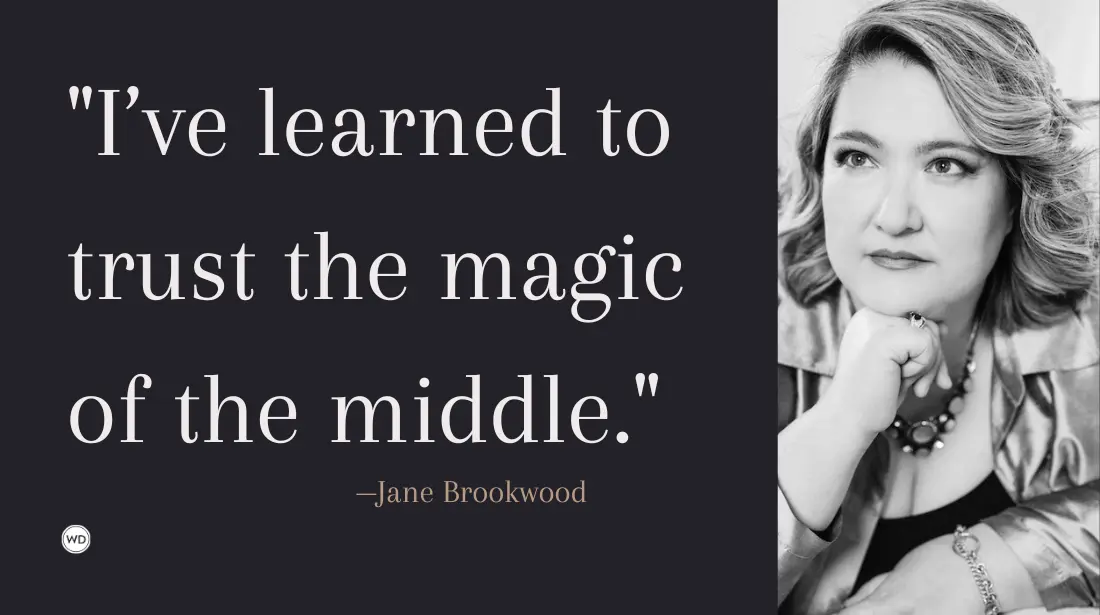
By trusting the "magic of the middle," she discovered that these spontaneous complications did not derail the manuscript; rather, they provided the raw materials needed to construct a labyrinthine, deeply immersive mystery that outsmarted even her own authorial foresight.
Official Statements & Authorial Insights
Reflecting on the psychological shift required to write dynamic mysteries, Jane Brookwood emphasizes that embracing uncertainty is not an excuse for sloppy writing, but an invitation to deeper creative authenticity.
"When you shift your mindset, a loose end is no longer a planning failure. It becomes a lifeline," Brookwood explains. "The moment I stopped forcing things, the characters practically walked off the page and suggested the solutions themselves. The subconscious mind does incredible work under duress, provided you give it the freedom to play."
This philosophy challenges the pervasive narrative in writing workshops and craft books that equates a clean outline with literary excellence. While structural frameworks serve a purpose during early ideation, Brookwood argues that true narrative tension is born in the friction between what the author plans and what the characters demand.
"We’re just making this up, after all," she notes with characteristic candor. "By trusting the writing, trusting your characters, and leaning into the suspense of the unknown, those messy loose ends will surprise you. They won’t just tie your story together—they’ll bring it to life."
Future Outlook: The High-Wire Toolkit for Mystery Writers
Adopting a high-wire style of mystery writing—where plot threads are generated organically without immediate resolution—requires a delicate balance. To prevent organic narrative tension from degenerating into total plot chaos, writers must cultivate systematic tracking habits.
Essential Strategies for Managing Organic Plot Threads
- The Loose-End Ledger: Maintain a dedicated running document where every spontaneous, unresolved thread, odd character behavior, or dangling clue is recorded chronologically alongside the chapter in which it appeared.
- The Backburner Review: Every five chapters, review your ledger not to force an immediate solution, but to assess how the newly introduced chaos interacts with the core mystery investigation. Let your characters ruminate on these anomalies organically.
- The Retroactive Payoff Audit: During your second draft pass, examine your ledger of lifelines to ensure that every intentionally cast thread connects meaningfully to the climax. The goal is to ensure the reader feels the thread was planted with brilliant foresight, even if it was discovered in the heat of the writing moment.
As the mystery and thriller genres continue to evolve, readers increasingly crave narratives that feel alive, unpredictable, and psychologically authentic. By moving away from rigid mechanical outlines and embracing the productive anxiety of the unknown, authors can break free from predictability. The future of mystery writing belongs to those brave enough to drop the steering wheel, trust their characters, and watch where the loose ends lead.
(For readers interested in exploring Jane Brookwood’s application of these principles in practice, her latest release, The Hanged Man, is available now.)




Comments
Facebook App ID not configured. Please add it in the Customizer.