
Executive Overview
Timed to coincide with the high-stakes cultural migration of Armory Week—when thousands of international dealers, curators, and collectors converge on New York City—a quiet, highly intimate artistic collision is unfolding behind an unmarked door in the East Village. For the first time since the artist’s death in 2004, the private studio workspace occupied by Pop art giant Tom Wesselmann during the final decade of his life has been opened to the public.
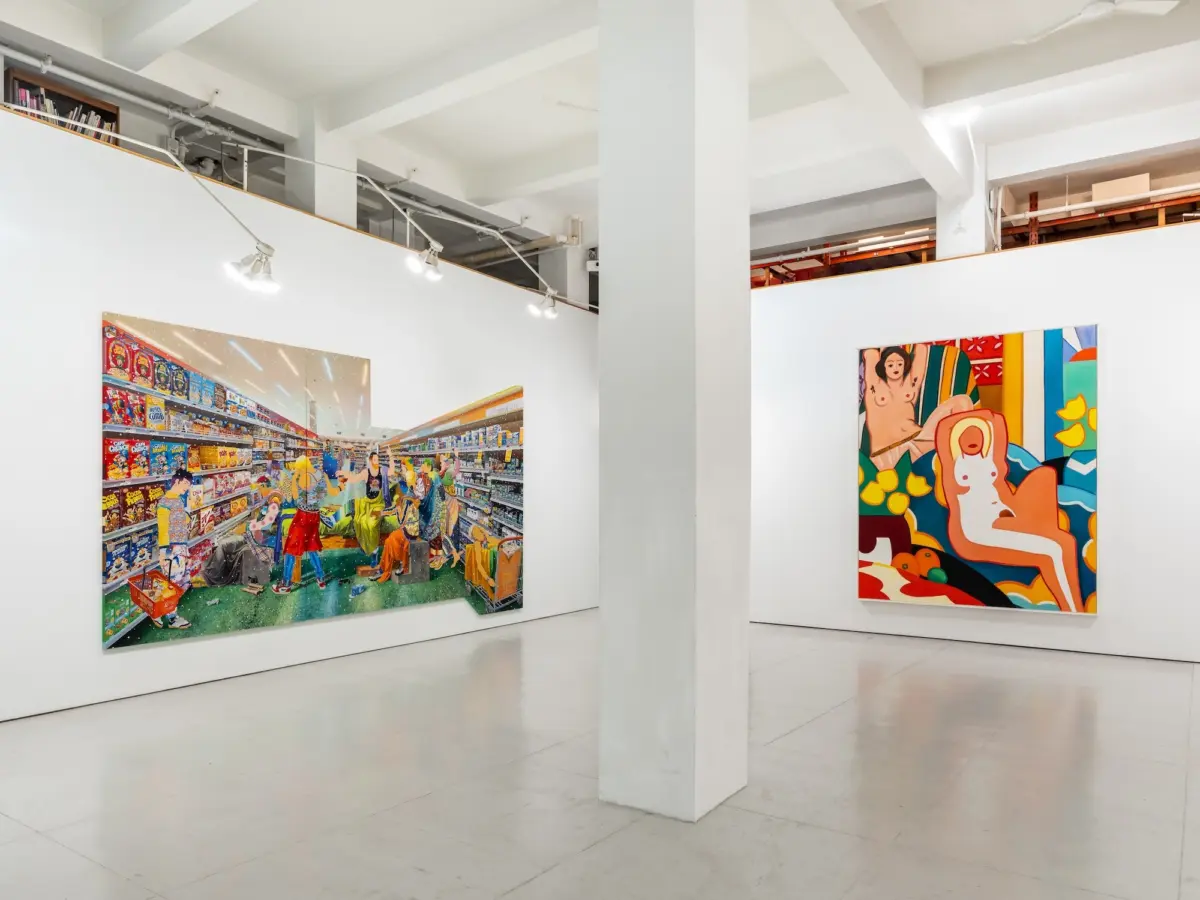
At the center of this unprecedented intervention is a generational and cross-cultural dialogue: the estate of Tom Wesselmann has partnered with Japanese American contemporary artist Tomokazu Matsuyama for a site-specific exhibition titled Wesselmann X Matsuyama. Open to the public by appointment through September 27, the exhibition features seven defining works by Wesselmann spanning from the 1960s to 2003, juxtaposed against five recent, labor-intensive canvases by Matsuyama created between 2024 and 2026.
Stepping into Wesselmann’s 4,000-square-foot sanctuary is not merely an exercise in viewing art within a white cube; it is a profound archeological experience. The physical workspace remains charged with the presence of its former master. Paint tubes, worn brushes, and even a pair of custom-labeled work gloves—marked meticulously as "TR" and "TL" for Tom’s right and left hands—litter the environment. For Matsuyama, working within the ghost-filled architecture of his predecessor is both a humbling honor and an uncanny disruption. "It’s like wearing someone else’s underwear and saying it’s mine!" Matsuyama joked during a walkthrough of the space.
Read Also
Yet, beneath the humor lies a rigorous, deeply researched exploration of consumerism, art-historical appropriation, the politics of domestic space, and the evolution of the shaped canvas. This exhibition serves as a vital case study in how contemporary practices can reanimate historical legacies without resorting to hagiography.
Detailed Chronology: From Parisian Palaces to an East Village Sanctuary
The intellectual seeds for this unlikely pairing were sown across the Atlantic during the planning of the blockbuster 2024 exhibition Pop Forever, Tom Wesselmann &… at the Fondation Louis Vuitton in Paris. That ambitious institutional survey took a revisionist approach to the Pop canon. Rather than isolating Wesselmann within his historical mid-century silo, the exhibition deliberately bookended his output with foundational Pop peers and red-hot contemporary practitioners, including Derrick Adams, Jeff Koons, Mickalene Thomas, and Tomokazu Matsuyama.
The Fondation Louis Vuitton show established a critical bridge, positioning Wesselmann not as a historical relic, but as an active progenitor of contemporary visual culture. As noted by critics during the Paris run, the strategy successfully entangled Wesselmann’s market and critical reception with the vanguard of the 21st-century art world.
When the exhibition concluded, the synergy between Wesselmann’s estate—represented by Jeffrey Sturges—and Matsuyama did not dissipate; it intensified. Impressed by the depth of Matsuyama’s engagement with Wesselmann’s visual vocabulary, the estate extended an invitation to stage a follow-up project. However, instead of deploying these works within a conventional commercial gallery, the stakeholders chose a far more radical venue: Wesselmann’s former East Village studio.

Matsuyama accepted the challenge, embarking on an exhaustive research phase that he admits "took longer than creating the paintings." The result is a tightly curated suite of five works by Matsuyama, three of which were conceptualized and executed specifically for the studio space. These pieces engage in a direct, visual conversation with seven historical Wesselmann works, creating a temporal feedback loop that bridges the apex of 1960s American consumer capitalism with our hyper-connected, globalized present.
Supporting Context & Metrics: Market Dynamics and Materiality
To fully appreciate the weight of Wesselmann X Matsuyama, one must examine the intersection of material labor and market valuation that underpins both artists’ practices.
Market Standings
Both artists command significant, albeit distinct, positions in the secondary and primary markets:
- Tom Wesselmann: A titan of the original Pop art movement, Wesselmann’s market has experienced steady institutional reassessment. Approximately 65 of his works have broken the $1 million threshold at auction. However, his historical auction peak stands at a relatively modest $10.7 million, achieved at Sotheby’s New York in 2008. Given his foundational role alongside contemporaries like Andy Warhol and Roy Lichtenstein, many market analysts view Wesselmann’s pricing as historically undervalued, offering robust upside potential.
- Tomokazu Matsuyama: A darling of the contemporary Asian and international secondary markets, Matsuyama’s career auction high currently stands at $647,125, set at Sotheby’s Hong Kong in 2023. With 33 works achieving six-figure results at auction, Matsuyama represents a powerhouse of contemporary painting, characterized by complex studio production and high demand among global collectors.
The Evolution of the Shaped Canvas and Visual "Steroids"
Wesselmann was a pioneer of the shaped canvas—breaking away from the tyrannical rectangle to mirror the contours of consumer objects, billboards, and female anatomy. Matsuyama adopts this very format for his new works in the studio exhibition, but pushes the compositional density to hyperbolic extremes.
If Wesselmann’s masterworks were "chock-full" of consumer goods and art-historical nods, Matsuyama’s canvases are Wesselmann’s methodology "on steroids." A single Matsuyama painting often collapses centuries of global visual history into one hyper-saturated plane. His canvases weave together direct references to Henri Matisse, Yves Klein, James McNeill Whistler, Raphael, and Pieter Claesz alongside traditional Japanese textile patterns and corporate iconography.
This conceptual clash is most vividly realized in the exhibition’s central spatial juxtaposition:
- Wesselmann’s Still Life #35 (1963): A monumental 16-foot-wide masterwork that canonizes everyday American consumerism through a stark arrangement featuring a supermarket loaf of bread, a pack of cigarettes, and a six-pack of Royal Crown cola.
- Matsuyama’s We the People (2025): Positioned on the opposing wall, this slightly larger canvas acts as a contemporary, globalized echo of Wesselmann’s still life. It explicitly quotes Jacques-Louis David’s neoclassical masterpiece The Death of Socrates (1787)—housed at the Metropolitan Museum of Art—but relocates the dramatic demise of the Greek philosopher to the fluorescent-lit aisles of a modern big-box store like Costco. In Matsuyama’s telling, Socrates is no longer drinking state-mandated hemlock; instead, he ingests a bowl of colorful Froot Loops, while institutional shelves in the background groan under the weight of modern diabetes medications. It is Western moral philosophy filtered through late-stage consumer excess.
The Intimacy of Domesticity: The "Bedroom Paintings"
No exploration of Wesselmann’s legacy is complete without confronting the erotic tension of his output, a theme powerfully underscored by the inclusion of two works from his infamous "Bedroom Paintings" series.

Initiated in 1967, the "Bedroom Paintings" disrupted conventional boundaries by combining hyper-zoomed-in fragments of women’s anatomy with the mundane objects found on a nightstand. Yet, Wesselmann did not shy away from autobiography or shocking intimacy. Included in the current studio exhibition is Bedroom Painting #19 (1969), a candid, borderline pornographic canvas that prominently features an image of the artist’s own erect penis.
This domestic voyeurism provides a profound psychological bridge to Matsuyama’s own artistic trajectory. When Matsuyama first immigrated to New York City, he spent hours poring over American interior design magazines. He was struck by a profound cultural dichotomy: the American eagerness to aggressively expose the intimacies of the domestic sphere to public gaze, contrasted sharply with Japanese cultural norms that treat the home as a strictly guarded, private sanctuary.
Displaying these sexually charged, deeply personal domestic works inside the actual room where Wesselmann lived, ate, and worked creates an almost dizzying layer of meta-narrative. The studio itself becomes a living "Bedroom Painting," dissolving the barrier between the creator, the creation, and the viewer.
Official Statements & Critical Reception
The genesis and execution of Wesselmann X Matsuyama have sparked conversations among curators and estate representatives regarding the future of artist-to-artist dialogues.
Reflecting on the extensive preparation required for the exhibition, Matsuyama noted the staggering amount of historical scholarship that went into his new paintings. "The research took longer than creating the paintings," Matsuyama remarked, acknowledging the layers of art-historical excavation required to converse with Wesselmann’s rigorous compositions.
Jeffrey Sturges, representing the Tom Wesselmann Estate, expressed genuine astonishment at the rigor of Matsuyama’s approach during their collaborative evolution: "I was surprised at the depth at which you went into it."
Addressing the broader landscape of contemporary exhibitions that pair historical figures with living practitioners, Sturges offered a sharp critical observation on curatorial fatigue: "You see a lot of shows pairing artists, but it’s not always clear what they bring beyond what two solo exhibitions might."

However, Sturges believes that Wesselmann X Matsuyama transcends the tired tropes of institutional matchmaking precisely because of its site-specific nature. Immersed in the physical aura of Wesselmann’s personal effects, the exhibition avoids feeling like a calculated commercial pairing and instead operates as an active, breathing critique.
Future Outlook: A Temporary Proposal or a New Curatorial Paradigm?
As Armory Week brings a flood of transient capital and speculative energy to New York City, Wesselmann X Matsuyama stands in quiet, recalcitrant defiance of the standard art fair hustle. Operating strictly by appointment—accessible via inquiries to [email protected]—the exhibition limits foot traffic to preserve the sacred atmosphere of the East Village workspace.
Whether this exhibition will travel to other institutions remains an open question. Both Matsuyama and Sturges remain circumspect about exporting the concept. Much of the exhibition’s psychological power is inextricably bound to the physical geography of Wesselmann’s studio—the very brushes he held, the exact floors he paced, and the lingering scent of turpentine. To strip these works from this environment and place them in a neutral, white-walled museum or gallery would risk neutralizing their potency.
Yet, Sturges refuses to close the door entirely on future iterations, describing the current New York presentation with a knowing smile: "It’s a proposal. I think it’s an exciting way to see art."
For collectors, curators, and historians fortunate enough to secure an appointment before the exhibition closes on September 27, Wesselmann X Matsuyama offers a rare masterclass in artistic lineage. It demonstrates that when a contemporary mind deeply interrogates the ghosts of the past within their own true sanctuary, the result is not imitation, but a vital, disruptive, and unforgettable dialogue across time.


Comments
Facebook App ID not configured. Please add it in the Customizer.