
Executive Overview
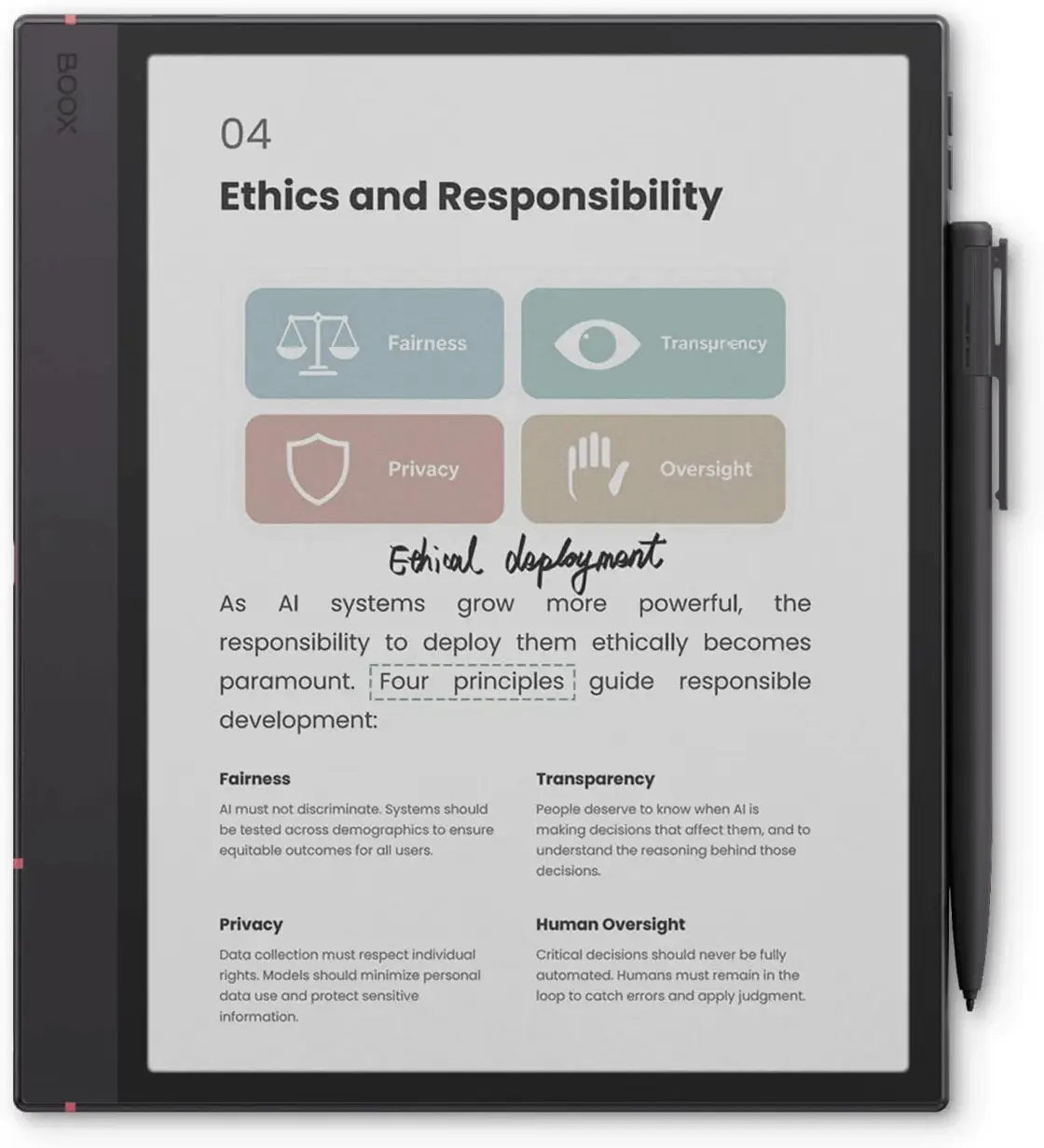
The portable technology landscape has long demanded a delicate balance between the eye-fatiguing clarity of conventional LCD/OLED screens and the genuine, paper-like ergonomics required by modern digital note-takers. Enter Onyx Boox, a manufacturer that has consistently pushed the boundaries of E Ink innovation. Just days after its official announcement, the next-generation Onyx Boox Note Air 6C has arrived on the market, bypassing extended pre-order phases to land directly on digital shelves, including Amazon.
Positioned as a high-performance productivity tablet built to execute heavy workflows without compromising visual comfort, the Note Air 6C brings several key upgrades to the table. Most notably, it pairs a state-of-the-art 10.3-inch Kaleido 3 color E Ink screen with a lightning-fast 4nm octa-core processor, 6GB of RAM, and expanded storage capabilities. Operating on Android 16 with full, uninhibited access to the Google Play Store, this device aims to blur the lines between a traditional e-reader and a fully functional, highly capable Android tablet.
However, beneath the polished marketing and snappy performance metrics lie subtle hardware choices that continue to spark debate among dedicated e-paper enthusiasts. From its transition to a WACOM-backed Inksense stylus configuration to its recycled industrial design architecture, the Note Air 6C presents a fascinating study in iterative hardware evolution. This comprehensive report explores every facet of the new device, breaking down its technical specifications, software ecosystem, and broader implications for the e-paper industry.
Read Also
Detailed Chronology of the Release
The rollout of the Onyx Boox Note Air 6C marks another rapid deployment cycle for a company known for aggressive iteration. Understanding how this device moved from factory floors to consumer doorsteps highlights Onyx’s streamlined global supply chain and aggressive market strategy.
The Quiet Unveiling
Unlike major consumer electronics giants that rely on grand, months-long media circuses, Onyx Boox tends to favor targeted, swift announcements aimed directly at power users, tech bloggers, and e-reader communities. The Note Air 6C was officially unveiled in mid-September, catching many industry observers by surprise given how recently its predecessor generation had saturated the market.
By leveraging digital-first PR channels, the company bypassed traditional retail gatekeepers, immediately setting up distribution channels across key global regions. Within days of the initial specification sheet dropping online, verified retail links—prominently featuring an Amazon listing—went live, allowing early adopters to secure units immediately.
From Announcement to Availability
The transition from announcement to immediate availability underscores a broader shift in how niche technology hardware is commercialized. Rather than generating artificial scarcity through limited drop windows, Onyx capitalized on immediate demand. Early inventory allocations on Amazon began moving swiftly, driven by a core demographic of digital artists, enterprise professionals, and academics who rely on large-format e-paper for daily workflows.
This rapid-fire launch strategy allows Onyx to test real-world user feedback in real time, though it also raises questions regarding software stability and hardware refinement upon day-one delivery—a hurdle that modern Android-powered e-readers frequently navigate through rapid post-launch firmware patches.
Technical Specifications and Hardware Architecture
At the heart of the Onyx Boox Note Air 6C is a robust hardware overhaul designed to eliminate the sluggishness that historically plagued color E Ink displays. Every component has been chosen to maximize processing speed, visual fidelity, and tactile satisfaction.
Display Technology: Kaleido 3 Meets Anti-Glare Engineering
The visual centerpiece of the Note Air 6C is its 10.3-inch color E Ink display driven by Kaleido 3 technology. For black-and-white content—such as academic papers, novel text, and monochrome PDFs—the screen delivers a crisp, razor-sharp 300 PPI clarity that rivals physical paper. When shifting to full-color documents, magazines, or annotated notebooks, the resolution adjusts to a vibrant 150 PPI, capable of rendering 4,096 distinct colors.
To counteract the inherent light-dimming nature of color E Ink filter layers, Onyx has integrated a dual-tone adjustable front light system. Users can seamlessly blend warm and cool lighting temperatures to match their ambient environment, ensuring comfortable reading sessions whether in a brightly lit office or a pitch-dark room. Furthermore, the display is sealed beneath an anti-glare flat cover-lens, minimizing distracting reflections from overhead light sources.

Performance and Processing Power: The 4nm Leap
Historically, color E Ink tablets struggled with ghosting, slow page refreshes, and stuttering UI navigation due to underpowered chipsets struggling to push complex color layers. The Note Air 6C changes this narrative dramatically by housing an upgraded 4nm octa-core processor paired with 6GB of RAM.
This processing horsepower is further amplified by BOOX Super Refresh (BSR) technology. BSR is a proprietary hardware-software integration that drastically improves page transitions, scrolling fluidity, and cursor responsiveness. According to hardware benchmarks, BSR increases page-turn speeds by an impressive 40% to 45% compared to older iterations while aggressively mitigating visual ghosting artifacts.
Storage and Memory Expansion
For professionals managing extensive digital libraries, document archives, and multimedia applications, storage constraints can be a dealbreaker. The Note Air 6C equips users with 64GB of internal storage, providing ample room for thousands of e-books, documents, and heavy APK files.
Crucially, unlike many competitors that have abandoned expandable storage in the name of slim profiles, Onyx has retained a microSD card slot, allowing users to expand their storage capacity up to a staggering 2TB. Whether housing massive local comic book collections or extensive audio file libraries for text-to-speech workflows, storage limitations are virtually non-existent.
Stylus Integration: The Shift to WACOM and Inksense
One of the most notable hardware evolutions—and a point of intense discussion among purists—surrounds the stylus architecture. The Note Air 6C has officially confirmed the use of WACOM technology, moving away from legacy BOOX EMR configurations. It utilizes the Inksense stylus, the same precision instrument seen across Onyx’s current generation of specialized e-notebooks.
While the Inksense stylus delivers exceptional pressure sensitivity, low latency, and a natural drag mimicking ink on paper, industry analysts point out that this hardware consistency is largely the result of Onyx recycling its established industrial design framework across multiple generations. While some critics may view this design conservatism as a lack of exterior innovation, it ensures a reliable, tried-and-true physical chassis that fits comfortably into existing accessory ecosystems.
Software Ecosystem: Android 16 and Google Play Integration
Hardware specifications are only as good as the software driving them. In this regard, the Onyx Boox Note Air 6C separates itself from closed-ecosystem alternatives like standard Kindle or Kobo devices by running on Android 16 with uninhibited access to the Google Play Store.
The Open Android Advantage
Running a modern version of Android opens up limitless possibilities for productivity and entertainment. Users are not locked into a single bookstore ecosystem; they can seamlessly install and sync applications such as:
- Reading & Research: Kindle, Kobo, Google Play Books, Libby, and Hoopla.
- Cloud Storage & Sync: Google Drive, Microsoft OneDrive, Dropbox, and Box.
- Note-Taking & Collaboration: OneNote, Evernote, WPS Office, and Notion.
- Communication & Browsing: Outlook, Gmail, Slack, and Google Chrome.
Tailored Tablet-Style UI
Recognizing that running standard smartphone or tablet apps on an E Ink screen can sometimes yield clunky user experiences, Onyx has engineered a customized, tablet-style user interface. The UI features highly customizable widgets, a dedicated app dock for quick multitasking, and granular, per-app optimization settings.
Through the Boox optimization menu, users can manually adjust refresh modes (e.g., Regal, X Mode, Balanced, Fast) for individual applications. This ensures that a fast-scrolling web browser renders smoothly using heavy ghost-clearing algorithms, while a static e-reader app prioritizes maximum text contrast and battery conservation.
Supporting Context & Metrics
To fully understand the market positioning of the Onyx Boox Note Air 6C, it is helpful to examine the broader e-paper market dynamics and technical benchmarks that define the current era of digital paper technology.
Comparative Market Performance Metrics
| Feature / Metric | Onyx Boox Note Air 6C | Standard E-Readers (Monochrome) | Traditional LCD/OLED Tablets |
|---|---|---|---|
| Screen Size | 10.3 Inches | 6.0 – 7.8 Inches | 10.0 – 11.0 Inches |
| Display Technology | Kaleido 3 Color E Ink | Carta 1200 / 1300 | IPS LCD / AMOLED |
| B&W Resolution | 300 PPI | 300 PPI | 264+ PPI |
| Color Resolution | 150 PPI | N/A (Monochrome) | Full Color (Native) |
| Processor & RAM | 4nm Octa-Core / 6GB | Dual-Core / 1GB–2GB | High-End Octa-Core / 8GB+ |
| Operating System | Android 16 (Google Play) | Proprietary / Linux | iPadOS / Android / Windows |
| Battery Life | Weeks (Usage-dependent) | Weeks to Months | Hours to 1–2 Days |
| Eye Strain Factor | Extremely Low (Reflective) | Extremely Low | High (Backlit Emissive) |
The Rise of Color E-Paper in Enterprise and Academia
For years, color E Ink was dismissed as a novelty due to washed-out pastel tones, sluggish refresh rates, and expensive manufacturing costs. However, the maturation of Kaleido 3 technology has transformed color e-paper into a viable medium for professional workflows. Medical professionals reviewing color-coded anatomical charts, engineers examining architectural blueprints, and students highlighting textbooks in vibrant yellow, green, and pink can now do so without staring into the punishing, blue-light-emitting matrix of an iPad or Galaxy Tab.
Expert Perspectives and Industry Commentary
The launch of the Note Air 6C has generated significant discourse within the digital reading community. Industry veterans have weighed in on what this release signifies for the future of portable productivity.
Michael Kozlowski, editor-in-chief at Good e-Reader and a veteran analyst of the e-paper space with over fifteen years of industry documentation, notes that Onyx’s relentless pacing is reshaping consumer expectations:
"Onyx Boox continues to outpace traditional competitors by refusing to wait for static hardware cycles. By integrating advanced 4nm processors and modern Android operating systems into large-format color E Ink frames, they are turning e-readers into bona fide desktop replacements for mobile professionals. While recycling industrial design elements allows them to hit the market quickly and reliably, the true triumph of the Note Air 6C lies beneath the hood—where BSR technology finally makes color E Ink snappy enough for daily multitasking."
Other tech commentators emphasize the growing divide between walled-garden ecosystems (like Amazon Kindle) and open-platform hardware manufacturers like Onyx. While closed ecosystems prioritize absolute simplicity and subsidized hardware pricing, open Android tablets cater to power users who demand absolute control over their files, applications, and cloud workflows.
Future Outlook: Where is E-Paper Heading?
The rapid commercialization and adoption of devices like the Onyx Boox Note Air 6C point toward a very clear trajectory for the future of portable computing.
Convergence of Productivity and Eye Health
As remote work, digital classrooms, and screen fatigue continue to dominate modern life, consumer demand for health-conscious technology is skyrocketing. Devices that eliminate blue-light emission while offering the full computational power of mainstream operating systems will inevitably capture a larger share of the enterprise and academic markets.
The Horizon of Color E Ink
Looking beyond Kaleido 3, the industry is already looking toward emerging full-color reflective technologies (such as Advanced Color ePaper / ACeP) that promise richer saturation and higher resolution color layers without sacrificing the reflective nature of E Ink. Until those technologies achieve mass-market commercial viability at scale, hybrid devices like the Note Air 6C represent the absolute pinnacle of what is possible in modern e-paper engineering.
Final Verdict
The Onyx Boox Note Air 6C is not a radical reinvention of the form factor, but rather a masterclass in refinement. By combining a stellar 10.3-inch Kaleido 3 screen, blistering 4nm processing speeds, expandable storage, and the boundless potential of Android 16, Onyx has delivered a formidable productivity tool. Whether upgrading from an older monochrome e-reader or transitioning away from eye-straining LCD tablets, professionals and book lovers alike will find the Note Air 6C to be a deeply capable, highly versatile addition to their daily workflow.





Comments
Facebook App ID not configured. Please add it in the Customizer.