
Executive Overview
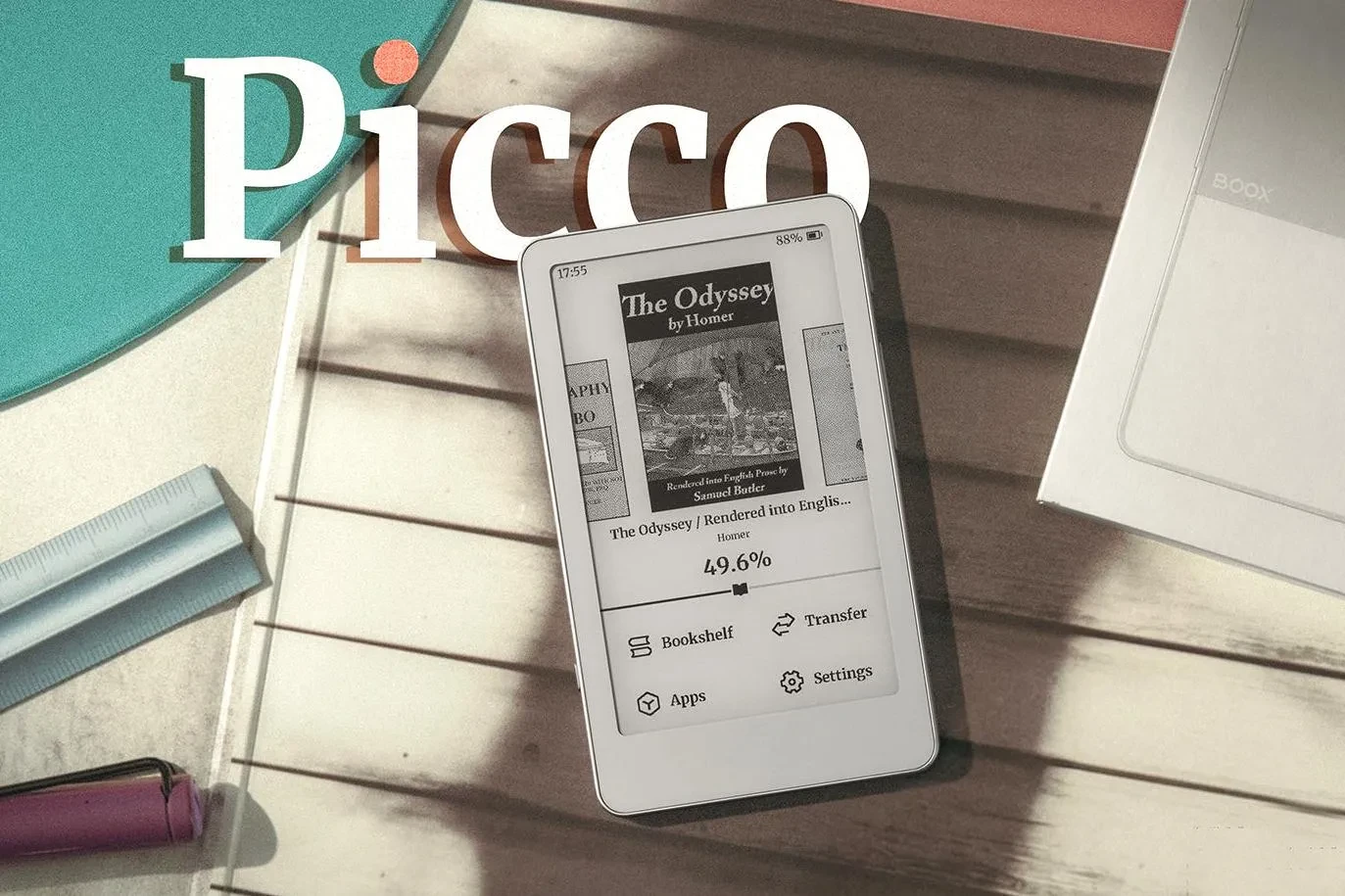
The global e-reader market has long been dominated by mainstream juggernauts producing standardized devices—ranging from pocket-sized 6-inch screens to expansive 10-inch note-taking tablets. Yet, a persistent sub-segment of consumers continues to yearn for the minimalist philosophy of early electronic reading devices: pocketability, distraction-free reading, offline independence, and a feather-light physical footprint. Enter the Onyx Boox Picco, a niche, ultra-compact e-reader priced aggressively at $99.
Measuring a mere 105.5 x 62 x 5.5 mm and tipping the scales at an astonishing 58 grams, the Picco is engineered to disappear into a pocket, functioning as a dedicated companion for literature enthusiasts on the move. However, the device is much more than a scaled-down traditional e-reader. It represents a fascinating intersection of modern E Ink engineering, open-platform content philosophy, and a newly formalized strategic partnership between Onyx Boox and firmware developer Crosspoint.
Operating entirely outside the walled gardens of dominant ecosystem heavyweights like Amazon Kindle and Kobo, the Picco completely eschews Digital Rights Management (DRM) book compatibility. Instead, it leans heavily into a self-contained reading ethos. Out of the box, it is loaded with 129 pre-formatted copyright-free classics (41 works of fiction and 88 non-fiction titles), boasts an integrated web app ecosystem housing 252 custom wallpapers tailored for its unique display dimensions, and relies on an expansive sideloading capability that supports virtually every major open e-book format.
Read Also
This investigative feature provides a comprehensive analysis of the Onyx Boox Picco. We will explore its hardware architecture, software ecosystem, the unfolding implications of its Crosspoint firmware integration, and how it carves out a distinct space in an increasingly homogenized portable technology landscape.
Detailed Chronology and Technical Evolution
From Concept to Commercialization: The Making of the Picco
The conceptualization of the Onyx Boox Picco marks a strategic shift for a company historically recognized for pushing the technological envelope with large-screen, Android-powered E Ink tablets equipped with robust processors, styluses, and open Google Play Store access. The Picco scales things back dramatically, stripping away the heavy Android overhead in favor of a streamlined operating environment designed for pure, unadulterated reading performance and maximum power efficiency.
The evolution of the device traces back to the refinement of small-form-factor E Ink panels. Historically, manufacturers struggled to build micro-readers that did not feel toy-like or suffer from severe compromises in screen resolution, front-light uniformity, and battery life. Onyx Boox overcame these hurdles by selecting a high-density 3.97-inch monochrome E Ink screen.
With a resolution of 480 x 800 pixels and a sharp 235 PPI (Pixels Per Inch), the Picco delivers crisp typographic rendering that punches well above its weight class. Text scaling on Homer’s The Odyssey or classic Victorian literature appears exceptionally clean, mitigating the pixelation often found in older micro-E Ink implementations.
The Crosspoint Partnership: Unveiling the Firmware Architecture
One of the most significant revelations accompanying the commercial release of the Picco is the formalization of Onyx Boox’s partnership with Crosspoint. For months, industry analysts tracking firmware strings and system repositories noted overlapping architectural elements between emerging minimalist devices and standard Onyx configurations.
The latest BOOX firmware updates definitively settle the matter. System code now explicitly acknowledges that Crosspoint owns the core firmware architecture running underneath the Picco’s user interface. This technical reality is further underscored on the corporate front, with Onyx Boox now officially listed as a verified technological partner on Crosspoint’s primary corporate homepage.
While the Picco functions fundamentally as a specialized hardware fork of Crosspoint’s core operating framework, it retains signature Onyx flourishes—specifically in its seamless Over-the-Air (OTA) update mechanism. Users can execute firmware upgrades natively over Wi-Fi without requiring a companion smartphone application or a tethered USB connection to a host computer.
This partnership signals an intriguing industry trend: established giants of the E Ink ecosystem are increasingly willing to license or co-develop specialized, lightweight firmware forks to target hyper-niche product categories where heavy, resource-intensive operating systems are counterproductive.
Supporting Context, Hardware Metrics, and Software Ecosystem
Hardware Specifications Breakdown
To truly understand the Picco, one must examine its internal and external engineering choices. Every design decision prioritizes physical minimalism and operational longevity.
- Display: 3.97-inch Monochrome E Ink screen with a resolution of 480 x 800 and 235 PPI.
- Frontlight: Dual-color front lighting system featuring independently adjustable warm and cool LEDs, easily toggled via a dedicated physical shortcut button.
- Processing & Memory: Powered by an unspecified, highly efficient processor paired with an included 16 GB storage card. Remarkably, the storage architecture supports micro-expansion up to a staggering 2 TB, allowing users to store massive offline libraries of documents, books, and media.
- Connectivity: Equipped with built-in Wi-Fi and Bluetooth capabilities. Notably, the device omits a traditional USB-C physical data transfer cable in the retail box; data management must be executed wirelessly via the BOOX Tiles app or the native web management interface.
- Power Management: Driven by a modest yet highly capable 920 mAh battery. Given the low-power draw of a 3.97-inch monochrome E Ink screen and the absence of a power-hungry full Android background framework, this battery capacity yields exceptional standby and active reading endurance.
- Physical Dimensions & Weight: Measures 105.5 x 62 x 5.5 mm and weighs an ultralight 58 grams.
The Walled-Garden Exclusion and the Open-Content Approach
A defining characteristic—and potential point of friction—for prospective buyers is that the Picco does not support DRM-protected e-books. Consequently, users cannot natively log into ecosystems tied to Amazon Kindle, Kobo, or Apple Books to download copyrighted commercial titles.

However, Onyx Boox has engineered a clever workaround to ensure the device is not shipped as an empty shell. Embedded within the Picco’s companion web application is a full, copyright-free EPUB bookstore. This proprietary repository grants users instant access to a vast catalog of classic literature and public domain works right out of the box.
Furthermore, the Picco’s web application employs a streamlined, basic login architecture designed for frictionless onboarding. Beyond the built-in bookstore, the device thrives on open sideloading. Users are free to load their own personal libraries and external documents directly onto the device—a mechanism that also facilitates the consumption of non-DRM, community-sourced, or independently acquired files.
Broad Format Support and Utility Applications
Unlike closed ecosystems that force users to convert files into proprietary formats (such as Amazon’s historical push for AZW or Kobo’s reliance on EPUB), the Picco behaves like a universal digital book reader. Its native rendering engine supports an exhaustive list of file extensions:
- Standard E-Book Formats: EPUB, MOBI, AZW3, AZW, AZW5, FB2, FB2.ZIP, FB3, FBZ, TXT, PDB, PRC, RTF, HTML, XHTML, HTM, and CHM.
Beyond reading, the device includes a suite of lightweight productivity tools designed for micro-tasking without distractions:
- Pomodoro Timer: For structured study and reading sessions.
- Todo List: For basic personal task management.
- Countdown Timer: For time-boxed activities.
Official Statements and Industry Perspective
While Onyx Boox has historically maintained a guarded approach to releasing granular hardware specifications—often leaving chipset details to teardown specialists and firmware analysts—industry observers have been vocal about the strategic positioning of the Picco.
Market analysts note that the $99 price point places the Picco in direct competition with budget-oriented e-readers, yet its form factor carves out a completely distinct vertical. According to mobile device researchers tracking the E Ink sector, consumers are experiencing "feature fatigue" from heavily gamified, notification-heavy tablets. The rise of ultra-minimalist, single-purpose reading devices reflects a broader cultural movement toward digital detox and intentional consumption.
Furthermore, the formal acknowledgment of the Crosspoint firmware partnership highlights a maturing B2B hardware-software ecosystem. Crosspoint’s foundational architecture allows hardware manufacturers like Onyx to bypass the exorbitant costs of building an operating system from scratch for experimental form factors, accelerating time-to-market while ensuring stability and optimized power management.
Future Outlook: Where Does the Picco Fit in the Modern Reading Landscape?
The launch of the Onyx Boox Picco raises compelling questions regarding the future trajectory of portable reading technology. As smartphones grow increasingly massive—frequently exceeding 6.5 to 7 inches—and pull users into endless loops of social media notifications, the appeal of a dedicated, pocket-sized, distraction-free reading tool has never been stronger.
The Rise of Micro-Readers
The Picco proves that high-resolution E Ink technology can be successfully miniaturized without sacrificing typographic clarity. The inclusion of a warm/cool frontlight system on a device of this scale demonstrates that manufacturers are no longer treating budget or micro-devices as "cheap alternatives," but rather as precision instruments tailored for specific use cases—such as reading during commutes, quick reference checks, or late-night reading sessions where a glowing smartphone screen strains the eyes.
Challenges and Ecosystem Expansion
Despite its many strengths, the Picco faces distinct hurdles on the path to mass adoption. The strict exclusion of DRM-protected content means mainstream readers deeply entrenched in the Kindle or Kobo ecosystems will find the device difficult to integrate into their daily habits without friction.
However, for power users, students, researchers, and classic literature enthusiasts who rely on DRM-free archives, open-format documents, and extensive personal libraries, the combination of expandable storage (up to 2 TB), wireless management via web apps, and a featherlight 58-gram chassis makes the Picco an irresistible proposition.
As Onyx Boox continues to refine its partnership with Crosspoint through OTA firmware updates, we can anticipate further optimization of the Picco’s web app ecosystem, expanded wallpaper management, and potentially new software integrations that bridge the gap between desktop management and ultra-portable E Ink hardware.
Ultimately, the Onyx Boox Picco stands as a bold, refreshing reminder that sometimes the best technological advancement is knowing what to leave out. By stripping away corporate walled gardens, heavy operating system bloat, and unnecessary distractions, Onyx has delivered a pure, pocket-sized portal to the written word.





Comments
Facebook App ID not configured. Please add it in the Customizer.