
Executive Overview
Television revivals and self-referential callbacks have become a staple of modern franchise world-building, yet few series manage to systematically interrogate their own past mythos quite like Paramount+’s Star Trek: Strange New Worlds. In the penultimate episode of its fourth season, titled "Once La’an a Time," the creative team executed a high-risk narrative gambit: a direct return to the whimsical, literary-infused reality first established in the universally recognized first-season outlier, "The Elysian Kingdom."
While Season 1’s foray into this fairy-tale simulation was anchored by the emotional stakes of M’Benga’s efforts to save his terminally ill daughter, Rukiya, the Season 4 revisit attempts a broader, more complex balancing act. It pairs heavy psychological deconstruction with high-fantasy pastiche. The result is a textually dense hour of television that showcases the series’ supreme strength in ensemble character work while simultaneously exposing the narrative fatigue of a season heavily saturated in stylistic, reality-bending escapades.
This comprehensive review explores the structural mechanics of the episode, tracing the journey of the U.S.S. Enterprise crew through the whimsical yet perilous constructs of The Kingdom of Elysian. We will analyze the trajectory of character arcs—particularly the long-overdue emotional reckoning for La’an Noonien-Singh—while contextualizing the episode within the broader thematic tapestry of Strange New Worlds Season 4.
Read Also
Detailed Chronology of an Inter-Dimensional Pastiche
The Premise: Revisiting Rukiya’s Literary Universe
The conceptual foundation of The Kingdom of Elysian dates back to the formative days of Strange New Worlds’ inaugural season. In that initial encounter, localized sentient entities residing within a spatial nebula gifted young Rukiya M’Benga—temporarily suspended within the ship’s transporter buffer—a manifested realization of her favorite children’s book. Crucially, the simulation did not merely replicate the text; it mapped out the complex internal fanfiction Rukiya had synthesized in her imagination. This included romantic pairings ("shipping") between characters who historically never shared a page in the original publication.
When the Enterprise crew is once again plunged into this fantastical construct in Season 4, Episode 9, the framing device undergoes a distinct ideological shift. Unlike the first-season incarnation, where the crew was entirely consumed by their fantasy personas without immediate awareness of their true identities, the current iteration forces a hybrid state. Characters oscillate between their Starfleet behavioral baselines and their elaborate fairytale counterparts.

Dr. Joseph M’Benga, carrying the institutional memory of the original incident, once again finds himself cast in the role of the reluctant historian. He is forced to brief a bewildered crew as they materialize on a localized topological anomaly: a floating planar disk traversing the interstellar void. In a moment of meta-textual self-awareness, the narrative acknowledges the absurdity of its own physics, drawing amused groans from the bridge officers who find themselves navigating a universe that gleefully rejects Newtonian mechanics.
Narrative Mechanics: Prophecy, Puppetry, and Dragons
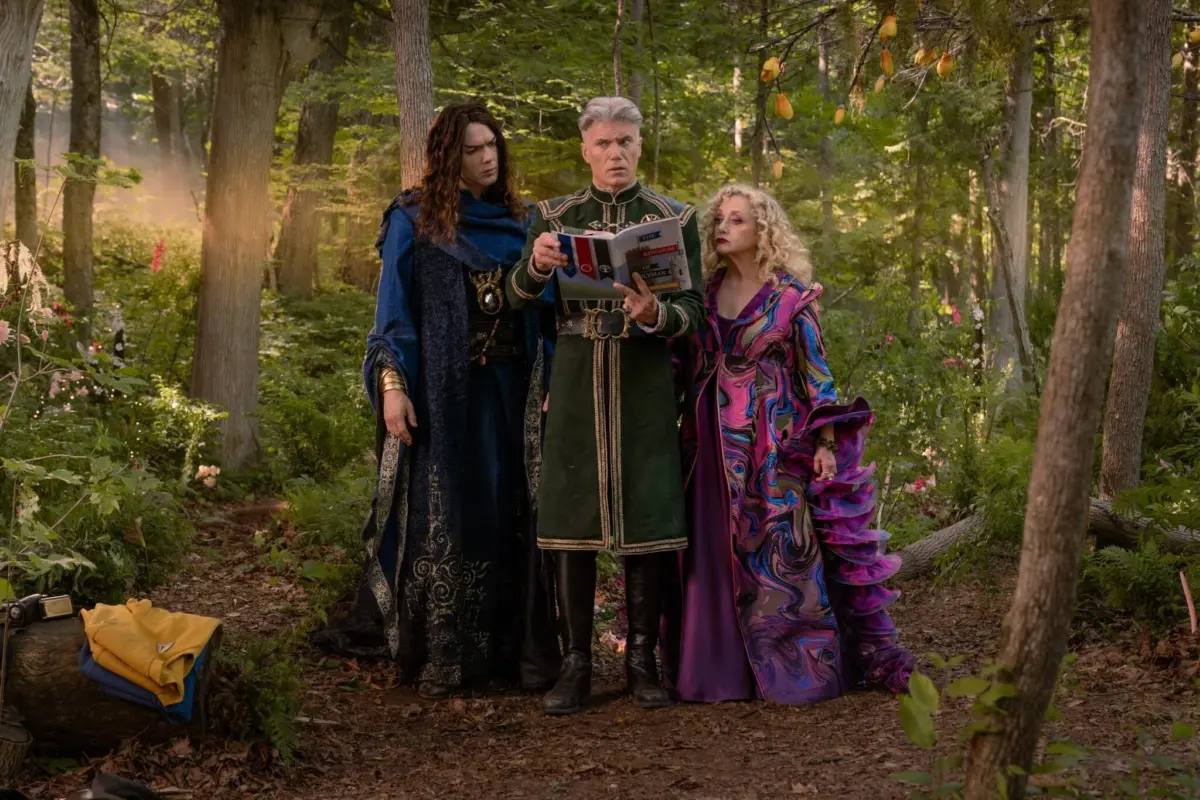
The narrative thrust of the episode revolves around an intricate web of royal intrigue, prophecy, and inter-dimensional matchmaking. Queen Neve—portrayed with a magnetic, sharply comedic malice by Celia Rose Gooding—rules over the Elysian landscape with an iron fist and a wardrobe fit for a high-fashion runway. Convinced that the Starfleet officers are metaphysical "shadows" of the Elysian populace, Neve attempts to orchestrate a cosmic convergence.
According to a local prophecy, the meeting of shadow and light will precipitate absolute dominion. To achieve this, Neve seizes control, locking away Captain Christopher Pike (Anson Mount) and Commander Spock (Ethan Peck). She tasks the immortal historian Pelia (Carol Kane)—whom Pike cleverly identifies to the monarch as "Benny Russell," a brilliant, deeply layered Easter egg tying back to Star Trek: Deep Space Nine’s legendary structural masterpiece "Far Beyond the Stars"—with authoring an unauthorized literary sequel. Pelia’s reaction to her forced writing assignment is a masterclass in eccentric comedic timing, anchoring the otherwise chaotic narrative stakes in genuine performance art.
Simultaneously, secondary character dynamics unfold with varying degrees of narrative weight. Sir Adya (played by Melissa Navia as an alternate-universe Erica Ortegas) and Z’ymira the Huntress (Rebecca Romijn as Una Chin-Riley) engage in brisk, witty banter that pays direct homage to Rukiya’s original speculative pairings. However, the script occasionally stumbles in giving these subplots adequate room to breathe.
The climax converges on a theatrical confrontation where Neve successfully forces the union of La’an Noonien-Singh and Princess Thalia (Christina Chong in a dual performance). In a classic genre pivot that defies rational diegesis, Queen Neve transforms into a magnificent, roaring red dragon. While the internal logic of this sudden transformation remains delightfully flimsy, the sheer visual splendor of the creature validates the long-standing cinematic adage that practical or digital dragons consistently elevate high-fantasy spectacles.

Supporting Context & Metrics
Season-Long Saturation and Genre Fatigue
To properly contextualize "Once La’an a Time," one must evaluate the macro-architectural pacing of Strange New Worlds Season 4. While the series has justifiably earned critical acclaim for its structural agility—seamlessly pivoting from hard-hitting, politically charged military dramas like "Orders of Magnitude" to unbridled comedic farce—Season 4 has arguably leaned too heavily into high-concept conceptual experiments.
| Episode Identifier | Narrative Focus / Genre Style | Critical Reception Tone |
|---|---|---|
| Human Best Friend | Character-driven ethical drama with comedic undertones | Mixed to Positive |
| Level-Five Transporter Accident | High-concept workplace comedy & technological malady | Polarizing |
| Like Chronitons Through the Hourglass | Time-dilation puzzle with deep emotional beats | Highly Favorable |
| Once La’an a Time | High-fantasy pastiche & psychological breakthrough | Mixed |
The cumulative weight of "Human Best Friend," "Level-Five Transporter Accident," and "Like Chronitons Through the Hourglass" established an environment wherein the audience’s tolerance for goofy, reality-altering escapades was thoroughly tested. Consequently, even though "Once La’an a Time" boasts exceptional technical craftsmanship, its arrival near the tail end of a comedy-heavy season muted its immediate impact, framing it for some critics as derivative rather than revolutionary.
Character Development: Healing the Wounds of La’an Noonien-Singh
Despite structural misgivings regarding the episode’s A-plot pacing, its true thematic victory lies in the long-awaited rehabilitation of La’an Noonien-Singh’s character arc. Throughout Season 4, La’an has functioned as the crew’s resident "Ms. Crankypants"—burdened by perpetual frustration, unresolved trauma, and an increasingly defensive psychological armor.
"Once La’an a Time" explicitly uses the magical realism of the Elysian construct as an externalized therapeutic sandbox. The narrative strongly implies that the mysterious, god-like entities responsible for the original simulation—or perhaps an evolved, benevolent Rukiya operating from a higher plane of existence—have engineered this scenario specifically to force La’an to confront her internal rage. Through her dual portrayal of the bitter Starfleet security chief and the valiant Princess Thalia, Christina Chong delivers an emotionally grounded performance that bridges the gap between sword-and-sorcery camp and genuine psychological breakthroughs.
The swordfight sequence between La’an and her fairytale counterpart serves as a brilliant visual metaphor for internal conflict: she is literally fighting the defensive constructs of her own psyche. When the dust settles, the character emerges visibly lighter, having discarded the suffocating cynicism that defined her journey across the season’s earlier installments.

Official Statements & Production Insights
While executive producers Akiva Goldsman and Henry Alonso Myers have remained tight-lipped regarding the exact logistics of the Season 4 narrative pipeline, behind-the-scenes production notes highlight the deliberate effort to honor Star Trek’s rich history of theatrical experimentation.
Speaking on the challenges of mounting a full-scale fantasy genre pastiche within the rigid confines of a sci-fi episodic template, the production design team emphasized the logistical hurdles of transforming the sterile, utilitarian corridors of the U.S.S. Enterprise into a tapestry of medieval royalty, gothic dungeons, and whimsical wilderness. Jan Thijs and John Medland, the lead unit photographers for the episode, noted that lighting a traditional Starfleet set to mimic the golden, high-contrast glow of classical fantasy cinema required an entirely recalibrated approach to on-set color grading and practical fixture placement.
Furthermore, the creative ensemble noted that the decision to bring back The Kingdom of Elysian was born out of a desire to reward long-term franchise loyalists. By weaving in subtle nods to literary classics—most notably The Princess Bride (evidenced by Prince Dashing’s beige ensemble, stylistic posturing, and a direct nod to the iconic line "As you wish")—the writers aimed to construct a love letter to storytelling itself.
However, this homage came with inherent narrative risks. As noted by several cultural critics reviewing the episode, invoking masterpieces like The Princess Bride or deep-canon mythos like Benny Russell invites unfavorable direct comparisons, occasionally highlighting the structural flimsiness of the Enterprise’s fairy-tale diversion when measured against timeless cinematic pillars.
Future Outlook: The Evolution of Strange New Worlds
As Star Trek: Strange New Worlds prepares to close out its fourth season and looks toward its heavily anticipated future iterations, episodes like "Once La’an a Time" offer a valuable roadmap for the series’ ongoing identity.

The episode proves that Strange New Worlds remains unrivaled in its willingness to take structural leaps of faith. The confidence required to dismantle the tonal integrity of a prestige science-fiction drama in favor of theatrical swordplay, royal wizardry, and literal dragon transformations is a testament to a creative team that refuses to let its universe grow stagnant.
Yet, looking forward, the overarching fan and critical consensus suggests a necessary calibration for Season 5. While standalone romps and genre-bending exercises are part of the foundational DNA of the Star Trek franchise—dating back to the original series’ Chicago gangster simulations and The Next Generation‘s holodeck malfunctions—future seasons would benefit from a more disciplined distribution of comedic episodes. Ensuring that high-concept pastiches are balanced evenly with serialized character continuity and hard science fiction will be vital to maintaining the show’s narrative momentum.
Ultimately, "Once La’an a Time" secures its place in the Strange New Worlds canon not merely as a goofy sequel, but as a pivotal psychological stepping stone for one of its most complex officers. Whether the fan-favorite Elysian universe will ever make a third appearance remains to be seen, but the crew of the Enterprise has officially proven that they can slay dragons, survive cursed swamps, and—most importantly—heal the invisible wounds they carry deep within the stars.



Comments
Facebook App ID not configured. Please add it in the Customizer.