
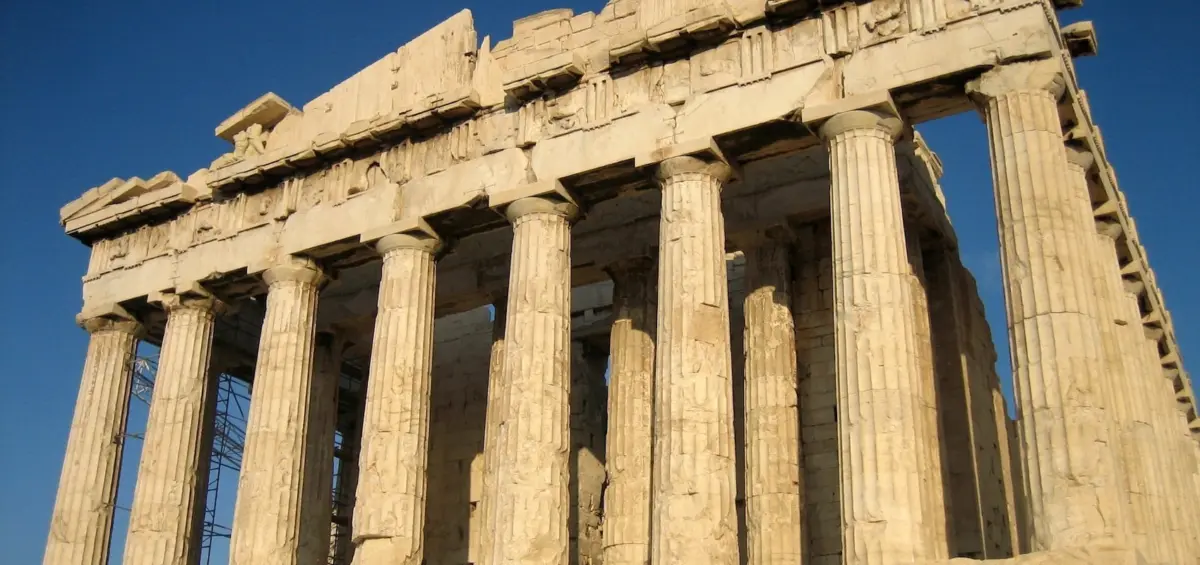
In an era defined by profound cultural anxieties and institutional introspection, a major new intellectual intervention has arrived to challenge the prevailing narrative of civilizational decline. The Golden Thread: A History of the Western Tradition—a massive, two-volume synthesis authored by distinguished historians James Hankins and Allen C. Guelzo—offers an ambitious reimagining of 2,500 years of human history. Published by Encounter Books, Volume I (The Ancient World and Christendom, spanning 1,308 pages) and Volume II (The Modern and Contemporary West, spanning 880 pages) represent a concerted effort to restore civic memory and re-engage younger generations with the foundational texts and historical milestones of the West.
Retailing at $120 per volume, the work is explicitly tailored for independent learners, homeschooling cohorts, and classical "Great Books" curricula. Rather than apologizing for the Western tradition, Hankins and Guelzo have crafted a vibrant, unapologetic defense of civilization itself. They define it not merely as a mechanism for material survival, but as a protected public space—a city square—where the human spirit can flourish in its natural yearning for order, beauty, and truth.
This comprehensive review-essay explores the structural architecture of The Golden Thread, evaluating its historiographical claims, its deliberate pushback against contemporary cultural pessimism, and its prospective impact on modern civic education.
Read Also
Detailed Chronology of The Golden Thread
Divided neatly between two distinct historical epochs and intellectual sensibilities, The Golden Thread operates as a chronological relay race, passing the torch of Western continuity from classical antiquity through to the shadow of the post-Cold War era.
Volume I: The Ancient World and Christendom (James Hankins)
James Hankins, renowned for his authority on Italian Renaissance humanism, launches his sweeping narrative with the Battle of Marathon in 490 B.C. and carries the reader through to the intellectual crosscurrents of the 1520s.
- Classical Foundations: The volume begins with authoritative treatments of ancient Greece and Rome. Hankins demonstrates a rare gift for narrative clarity, rendering the political, military, and artistic shifts of Athens and the Roman Republic accessible and compelling to modern minds.
- The Synthesis of Faith and Empire: Moving past classical antiquity, Hankins navigates the complex religious transformations of late antiquity. His masterly syntheses of Byzantine history and the rapid, volatile rise of Islam provide critical context for how Greco-Roman institutions adapted, survived, or fractured under the pressure of new monotheistic empires.
- The Renaissance Peak: The volume culminates in the rich intellectual landscape of fifteenth-century Florence and the early sixteenth century, drawing poignant comparisons between the political philosophies of Niccolò Machiavelli and St. Thomas More. Through carefully selected visual art and architectural analyses, Hankins roots his historical storytelling in tangible aesthetic achievements.
Volume II: The Modern and Contemporary West (Allen C. Guelzo)
Allen C. Guelzo, a preeminent historian of nineteenth-century America and the Civil War, picks up the mantle beginning with the Protestant Reformation.
- Reformation and Enlightenment: Guelzo provides a deeply sympathetic, intellectually rigorous exploration of Martin Luther and John Calvin, laying the groundwork necessary to understand the intellectual DNA of the American Founding Fathers.
- The Fracturing of Tradition: As the narrative pushes into the nineteenth century, Guelzo charts the introduction of disruptive ideological forces—the theories of Marx, Engels, Darwin, and Lamarck—that fundamentally challenged traditional paradigms of human nature and societal order.
- The American Experiment and the 20th Century: Guelzo navigates philosophical crosscurrents, such as the influence of Pyrrhonism on Michel de Montaigne, alongside sharp miniature essays on baroque composers like Bach, Monteverdi, and Vivaldi. The volume concludes at the close of the twentieth century, with America’s victory in the Cold War and the fall of the Berlin Wall. The final image of the book—a photograph of the New York skyline featuring the Twin Towers—stands as a poignant monument to an era whose immediate sequel remains unwritten.
Supporting Context & Metrics: The Crisis of Transmission
To understand the urgency behind The Golden Thread, one must examine the pedagogical landscape of the late twentieth and early twenty-first centuries. For decades, the humanities have struggled under the weight of self-referential academic pessimism. As famously exemplified by Harold Bloom’s 1994 work The Western Canon, the study of high literature frequently devolved into a mournful funeral dirge, presenting great books not as enduring fountains of wisdom, but as artifacts of a self-destructing civilization.

[Traditional Cultural Transmission]
       │
       ├── Inventio (Discovery)
       ├── Traditio (Generational Transmission)
       ├── Translatio (Cultural/Linguistic Transfer)
       └── Renovatio (Revival & Renewal)
Hankins and Guelzo reject this defeatist framework. Instead, they conceptualize tradition as a dynamic, four-part historical process:
- Inventio: The initial discovery of a cultural, philosophical, or artistic truth.
- Traditio: The active passing down of that discovery through successive generations, subject to organic evolution.
- Translatio: The transfer of tradition across linguistic, geographic, or societal boundaries.
- Renovatio: The periodic revival or renewal of a waning or dormant tradition.
By treating history as a living process rather than a static museum exhibit, the authors counter what they term "an improper and uncivilized humility"—a pervasive cultural self-hatred taught in modern institutions that encourages citizens to view their historical inheritance exclusively through the lens of historical grievances.
The publication arrives at a time of severe demographic and institutional shifts. With a combined page count exceeding 2,100 pages and priced at $240 for the two-volume set, The Golden Thread is an unabashedly elite, heavy-duty educational resource. It targets a burgeoning counter-establishment: the growing millions of families engaged in homeschooling, classical Christian academies, and independent Great Books programs who remain hungry for a coherent, unblemished account of their civilizational roots.
Official Statements & Intellectual Perspectives
The philosophical underpinnings of The Golden Thread have ignited conversations among contemporary critics, highlighting contrasting visions of what civilization is meant to achieve.
In their joint introduction, Hankins and Guelzo provide the programmatic definition that anchors the entire project:
"A civilization is a space, so to speak, in which people may breathe. It creates a public forum, a city square, in which they may do something other than tremble and labor for simple survival… The human spirit cannot be captured simply by the way we earn bread or avoid massacre; there is a natural yearning after order, after beauty, after truth. Civilization celebrates that yearning, encourages it, and provides the means by which it may flourish, and the means by which it can be protected from harm."
This definition purposefully synthesizes classical humanism with Christian and Enlightenment ideals, framing political order and the rule of law as essential prerequisites for artistic and scientific genius.

However, the work has also drawn scrutiny from various ideological corners. Critics on the political left argue that such grand narratives gloss over the structural violence, imperialism, and systemic exclusions—such as slavery in classical Greece and Rome—that historically accompanied Western achievements. Conversely, some traditionalist and hard-right commentators question whether a defense rooted in American-style classical liberalism is robust enough to withstand the severe institutional decay and moral fragmentation of the twenty-first century.
Hankins, writing from a quietly Catholic perspective, occasionally slips into a defensive posture in Volume I, pre-emptively addressing modern academic critiques regarding ancient social structures. Guelzo, meanwhile, shoulders the formidable burden of synthesizing the modern era, where the trajectory of European and American civilization becomes profoundly ambiguous following the cataclysms of the World Wars.
Future Outlook: Can the Golden Thread Hold?
As cultural polarization intensifies and institutional trust hits historic lows, the question of how to educate the rising generation in civic virtue remains unresolved. The Golden Thread does not offer a naive return to mid-century triumphalism; rather, it provides an intellectual anchor for those who believe that a society without historical memory is structurally incapable of self-governance.
The success of Hankins and Guelzo’s masterwork will ultimately be measured not by standard academic reviews, but by its utility in the trenches of alternative education—around homeschool kitchen tables, in burgeoning classical charter schools, and among young adults seeking alternatives to modern nihilism.
The Western tradition has weathered barbarian invasions, religious schisms, and ideological totalitarianisms before. Whether the "golden thread" mapped out across these two thousand pages can withstand the internal cynicism of the modern West remains the defining cultural question of our time. For now, The Golden Thread provides an indispensable map for anyone willing to retrace the steps of the architects of the free world.





Comments
Facebook App ID not configured. Please add it in the Customizer.