
Executive Overview
To understand the modern American political landscape is to navigate a labyrinth of historical grievances, economic anxieties, and cultural transformations. Over the past several decades, the United States has been tested by systemic inequities, consecutive economic recessions, and the collective psychological toll of the COVID-19 pandemic. These compounding crises fractured the nation’s socio-political cohesion and created the volatile atmospheric conditions that propelled unconventional figures to the presidency.
Yet, beneath the surface of traditional partisan polarization—driven by debates over tax policy, immigration, and institutional norms—lies a more subterranean, supernatural currents. As the 2024 election cycle intensified, a startling phenomenon became impossible to ignore: a vibrant, deeply held belief among significant voting blocs that modern American politics is a literal battlefield contested by demonic entities and spiritual principalities.
While mainstream political analysts focus on polling data, gerrymandering, and economic indicators, a growing contingent of religious and political leaders operates under a framework of political demonology. Far from viewing elections through the lens of secular policy debates, these actors frame civic engagement as an apocalyptic struggle between divine order and demonic subversion. This worldview, anchored in movements like Christian Nationalism and the "Seven Mountain Mandate," rejects the foundational American principle of the separation of church and state, seeking instead to establish "dominion" over the pillars of civil society.
Read Also
Examining this phenomenon requires moving past the dismissive view that references to "demonic forces" are merely rhetorical hyperbole. For millions of Americans, these entities are tangible, malevolent actors manipulating institutions, culture, and governance. Tracing the historical roots, theological architecture, and contemporary manifestations of political demonology reveals how deeply spiritual warfare has permeated the architecture of modern American democracy.
Detailed Chronology: The Evolution of Dominion Theology and Political Demonology
The convergence of supernatural theology and hardball American politics is not an overnight development; it is the product of a decades-long evolution that gained significant momentum in the late 20th century.
The 1980s: The Genesis of Modern Dominionism
The roots of contemporary dominion theology trace back to the turbulent sociopolitical landscape of the 1980s. As the religious right mobilized in response to the sexual revolution, the legalization of abortion, and shifting gender norms, theologians and political strategists sought a comprehensive framework to unify disparate conservative Christian factions.
It was during this era that terms like "dominion" crystallized, drawing directly from Genesis 1:28, where humanity is commanded to exercise "dominion" over the earth. Rather than viewing faith as an exclusively private matter, dominionists interpreted this passage as an active mandate to subdue secular societal structures under biblical law. Concurrently, theologians such as C. Peter Wagner began formalizing the concept of spiritual mapping and territorial spirits—the belief that specific geographical regions and institutions are controlled by high-ranking demonic powers. In his foundational work Dominion!, Wagner asserted that "Satan has polluted the land and cursed it," deploying demonic forces to "block the freedom of heaven flowing to earth." Overcoming this resistance, Wagner argued, required believers to adopt a "Do whatever it takes!" posture to reclaim secular authority.
The 1990s to 2010s: Institutionalizing the Seven Mountain Mandate
As the new millennium approached, dominion theology evolved from abstract academic theory into a strategic operational plan known as the "Seven Mountain Mandate." Formulated in the mid-2000s by figures like Lance Wallnau and the late Bill Bright, this framework identified seven primary spheres of cultural influence that Christians must "occupy" to effect national transformation:
- Religion
- Family
- Education
- Government
- Media
- Arts and Entertainment
- Business
This mandate provided a clear blueprint for political action. Tele-evangelists, spiritual advisors, and grassroots activists began organizing not merely to win elections, but to purge these institutional "mountains" of what they perceived as occult and demonic corruption.
The 2016–2024 Election Cycles: Mainstreaming the Supernatural
The election of Donald Trump served as a watershed moment for this movement. Despite his unconventional personal background, Trump welcomed prominent charismatic and pentecostal leaders into his inner circle, establishing an Evangelical Executive Advisory Board featuring figures like Paula White-Cain, Lance Wallnau, and the late Charlie Kirk.
During this period, political demonology transitioned from the fringes of televangelism into mainstream political discourse. Concepts like the "Jezebel Spirit"—an entity weaponized by believers to discredit pro-choice policies, female political leaders, non-heteronormative relationships, and trans rights—became standard vernacular in certain political rallies and prayer networks. By the 2024 election cycle, the language of spiritual warfare was no longer a fringe abstraction; it was a driving mobilization tool for millions of voters convinced that a democratic defeat meant yielding the nation to literal forces of darkness.
Supporting Context & Metrics: The Anatomy of the "Other"
To comprehend the grip of political demonology, one must examine the sociological mechanics of how human beings process fear and alterity. Ideas about demons do not emerge in a vacuum; they coalesce around the aspects of society that induce profound discomfort, challenging the dominant in-group’s perception of self.
The Psychology of Alterity
Sociologically and psychologically, when cultural shifts challenge established hierarchies regarding race, sexuality, gender roles, and class disparities, those in power frequently experience existential anxiety. When these demographic and cultural realities fail to align with a group’s idealized self-image, the non-conforming elements are categorized as the "Other."
Because human beings and their associated in-groups naturally construct narratives of inherent goodness, opposing viewpoints or marginalized identities cannot simply be viewed as politically incorrect or misguided. Instead, they are pushed entirely outside the boundaries of shared humanity, becoming enshrouded in demonic symbolism.
The Evolution of the "Jezebel Spirit"
A primary case study in this process is the modern deployment of the "Jezebel Spirit." While often characterized by believers as an ancient, persistent biblical demon, historical analysis reveals a remarkably recent provenance. The entity rarely appeared in evangelical literature before the 1980s, when religious coalitions mobilized around anti-abortion advocacy.
Initially deployed to demonize the pro-choice movement, the portfolio of the Jezebel Spirit rapidly expanded. As cultural battlegrounds shifted, the entity was seamlessly adapted to represent crises of traditional masculinity, the rise of women in political leadership, and the mainstreaming of LGBTQ+ rights. In this framework, complex sociological debates over civil rights and bodily autonomy are flattened into a cosmic struggle against a singular, malicious spirit.
Official Statements and Theological Frameworks
The rhetoric of political demonology is articulated explicitly in the writings, sermons, and public statements of its most prominent architects. Examining their own words reveals a coherent, if radical, theological system that explicitly rejects secular governance in favor of spiritual conquest.
-
C. Peter Wagner on Spiritual Warfare: In Dominion!, Wagner outlines the necessity of aggressive spiritual positioning, writing:
"Satan has polluted the land and cursed it. Satan has deployed high-ranking demonic powers to darken the spiritual atmosphere over society and to block the freedom of heaven flowing to earth… To take back the United States, those who agree with Wagner must ‘Do whatever it takes!’"
-
Lance Wallnau on National Destiny: In his 2016 book God’s Chaos Candidate, televangelist and self-described Christian nationalist Lance Wallnau articulated the existential stakes of American politics from a spiritual perspective:
"America plays a huge role in the world as a force for freedom and the preaching of the Gospel. So much so that Satan considers taking this nation down to be his number one priority. With us removed, hell can advance against the church globally."
This perspective dismantles the traditional conceptual barrier of the separation of church and state. Within the theological worldview of Christian Nationalism and dominionism, secularism is not a neutral constitutional framework designed to protect religious pluralism; it is perceived as a spiritual vacuum that invites demonic occupation. Consequently, dismantling the wall of separation is viewed not as a constitutional violation, but as an urgent act of national and spiritual preservation.
Future Outlook: Navigating the Intersection of Faith and Democracy
The presence of political demonology in contemporary American life raises critical questions about the future stability of the nation’s democratic institutions. History, however, offers both caution and perspective.
1. Recognizing Historical Precedent
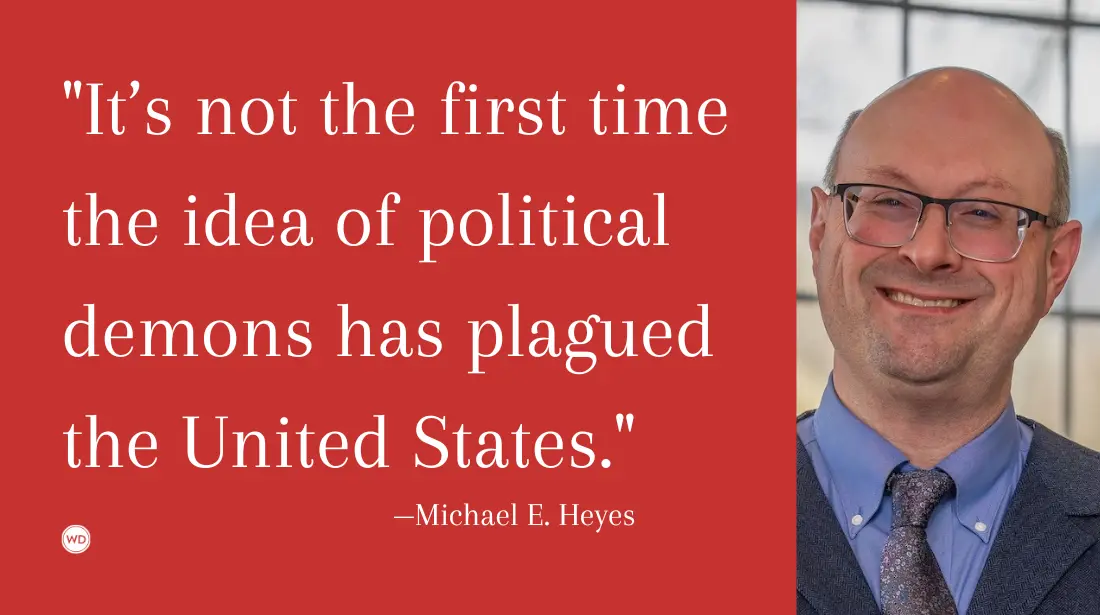
Americans have integrated supernatural and demonic narratives into political crises from the nation’s inception to the present day. From the anti-Catholic rhetoric surrounding the "Papal Beast" during the Revolutionary War, to the shadowy conspiracies of demon-worshipping spiritualists alleged to have influenced Abraham Lincoln, to the widespread "Satanic Panic" of the 1980s during a period of severe economic and social strain, supernatural thinking has frequently surged during times of profound national anxiety.
Recognizing this history yields two vital conclusions:
- First, the presence of demonic framing in modern politics does not signify an unprecedented, irreversible descent into madness; rather, it reflects a recurring American coping mechanism during periods of intense cultural stress. Assuming our era is entirely unique risks driving even more extreme, fatalistic political polarization across the aisle.
- Second, this will not be the last time supernatural entities are invoked in political discourse. As technological disruption, demographic shifts, and economic uncertainties continue to challenge the status quo, political demonology will likely resurface in new iterations.
2. The Path Forward
Forewarned is forearmed. For journalists, political scientists, and citizens alike, understanding the theological and psychological underpinnings of political demonology is essential. It shifts the analytical framework from treating these phenomena as inexplicable anomalies to recognizing them as structured, historically rooted belief systems.
Democracy relies on the premise that political opponents are fellow citizens with competing visions of the public good, reachable through debate, compromise, and the ballot box. When political opponents are reclassified as literal agents of demonic forces, compromise becomes apostasy, and democratic norms lose their binding authority. Addressing this challenge requires robust civic education, transparent institutional governance, and an empathetic understanding of the deep-seated cultural anxieties that drive voters to seek supernatural certainties in an uncertain world.





Comments
Facebook App ID not configured. Please add it in the Customizer.