
Executive Overview
The 1980s represent a distinct, unrepeatable golden age for cinematic fantasy. Long before the polished, computer-generated epochs of the 2000s standardized the genre, the fantasy films of the Reagan era were characterized by a raw, unpolished, and frequently eccentric energy. They relied on physical craftsmanship, practical creature effects, and an unbridled pulp sensibility.
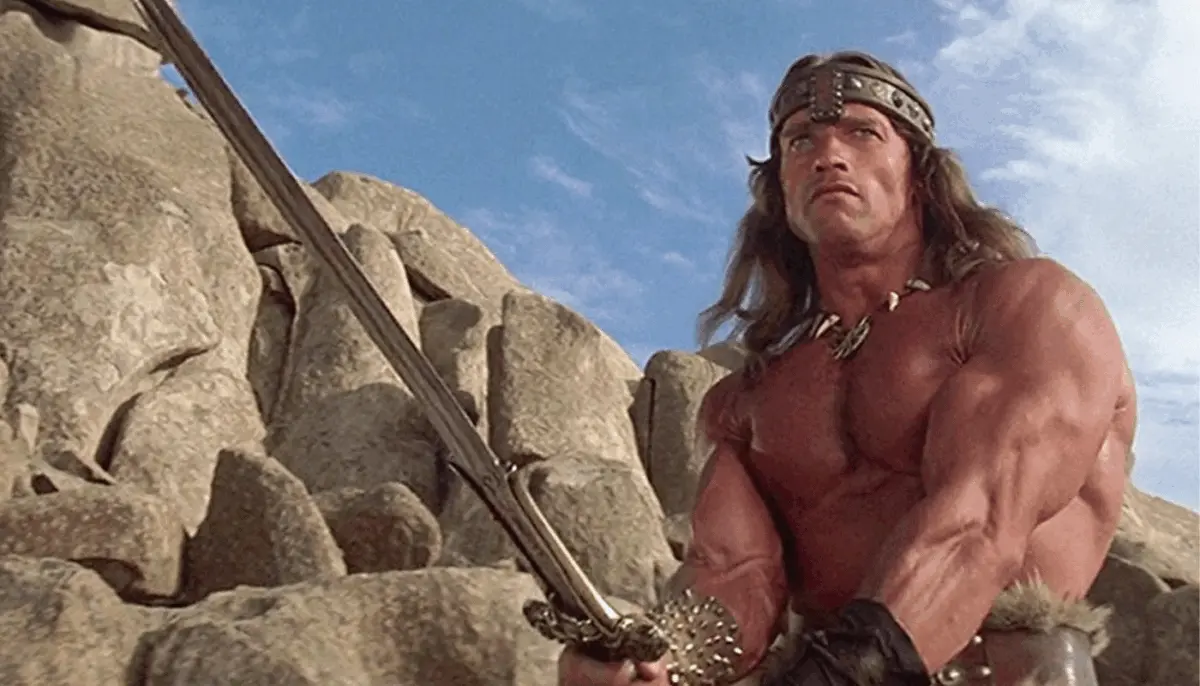
Within this historical framework, the Conan duology occupies a foundational space. While John Milius’s 1982 Conan the Barbarian established a surprisingly nuanced, somber meditation on grief, fatalism, and masculine isolation, its 1984 sequel, Conan the Destroyer, steered the franchise into entirely different territory. Directed by veteran Hollywood craftsman Richard Fleischer, Conan the Destroyer traded the original’s brooding philosophical weight for a colorful, fast-paced, comic-book-inspired romp.
Though met with mixed commercial returns and middling critical reception upon its release, Conan the Destroyer has evolved into a fascinating cinematic artifact. It captures the unique structural tensions of mid-1980s studio fantasy: a precarious balancing act between high-art costume design, bizarre cosmic horror, and unabashedly cheesy B-movie tropes. This retrospective examines the film’s narrative mechanics, its vibrant ensemble cast, its production politics, and its surprisingly far-reaching pop-cultural footprint.
Read Also
Detailed Chronology: The Quest for the Horn of Dagoth
The narrative of Conan the Destroyer picks up with the still-grieving Cimmerian adventurer, once again brought to life by Arnold Schwarzenegger. Burdened by the loss of his beloved Valeria from the events of the first film, Conan is wandering the wastes when he crosses paths with the forces of Shadizar.
The Royal Trap
Conan and his thieving companion Malak are ambushed and subsequently cornered by Queen Taramis of Shadizar, played with chilling, aristocratic menace by Sarah Douglas (famous for her work in Superman II). Taramis offers the grieving barbarian an impossible incentive: she claims to possess the arcane capability to resurrect Valeria, reuniting Conan with his lost love.
The price for this resurrection is a high-stakes escort mission. Conan must protect Taramis’s innocent, virginal niece, Princess Jehnna (portrayed by Olivia d’Abo of The Wonder Years), into the perilous domain of the sorcerer Toth-Amon. Their objective is to retrieve an enchanted magical jewel, the key to revealing the missing horn of Dagoth the Dreamer—Shadizar’s patron deity, immortalized as a monument of impossible physical perfection.
Unknown to Conan, however, the entire expedition is an elaborate double-cross. Queen Taramis has no intention of honoring her bargain; she plans to sacrifice her niece to awaken Dagoth and rule over the ensuing chaos. Meanwhile, Taramis’s loyal Captain of the Guard, Bombaata (portrayed by NBA legend Wilt Chamberlain), is secretly tasked with guarding Jehnna’s ritual purity while orchestrating Conan’s assassination the moment the magical jewel is secured.
Assembling the Fellowship and Infiltrating Toth-Amon’s Lair
To complete the quest, Conan amasses a colorful band of mercenaries and mystics:
- Malak the Thief: A cowardly rogue played by Tracey Walter (recognizeable as "Bob the Goon" from Tim Burton’s Batman).
- Akiro the Wizard: The wise, eccentric spellcaster reprised by veteran actor Mako.
- Bombaata: The towering, brooding Captain of the Guard.
- Zula: An indomitable Amazon warrior brought to life by pop icon Grace Jones in her cinematic breakout.
Upon nearing their destination, the sorcerer Toth-Amon (Pat Roach, best remembered as the giant, bald German mechanic in Raiders of the Lost Ark) uses dark magic to kidnap Princess Jehnna, whisking her away to his crystalline palace floating in the center of a misty lake.
The fellowship gives chase, culminating in a memorable confrontation inside a labyrinthine hall of mirrors. There, Conan battles a monstrous, ape-like beast (also played by Pat Roach). By shattering the mirrors, Conan blinds and disorients the creature before hurling his broadsword to impale Toth-Amon, successfully rescuing Jehnna and recovering the jewel.
The Descent and Betrayal
Guided by Jehnna’s mystical intuition, the party ventures into an ancient, subterranean tomb. Placing the magical jewel upon a stone altar reveals the hidden horn of Dagoth. Simultaneously, Akiro translates a chilling wall inscription, warning that the re-emergence of Dagoth will spell absolute destruction for the world.
As the group attempts to flee an awakening horde of Dagoth’s forgotten priesthood, the treacherous Bombaata springs his trap. He recaptures Jehnna and buries Conan and his companions alive deep within the temple ruins.
The Climax in Shadizar
Escaping their subterranean tomb through raw muscle and arcane intervention, Conan and his allies race back to Shadizar just as the sacrificial rites for Princess Jehnna are reaching their climax. Queen Taramis triumphantly places the horn upon the statue of Dagoth, setting the cataclysmic events in motion.
In the ensuing chaos:
- Conan engages Bombaata in a brutal, fatal duel, emerging victorious.
- Zula launches a lethal spear through Taramis’s deceitful vizier, temporarily disrupting the ritual.
The disruption angers the slumbering god. The pristine statue of Dagoth comes to life, mutating rapidly into a towering, Lovecraftian nightmare (portrayed in an uncredited role by wrestling legend André the Giant). Dagoth swiftly executes Queen Taramis by impaling her on his horn.
The remaining members of "Team Conan" wage a desperate battle against the cosmic beast. Their standard attacks prove entirely useless until Conan leaps onto the creature and wrenches the horn directly from its forehead, shattering its life force and plunging the monster into death.
With the crisis averted, Princess Jehnna ascends the throne as queen, offering prominent court positions to Zula, Akiro, and Malak. She also offers her hand in marriage to Conan, inviting him to rule by her side. Still bound by his grief for Valeria and convinced of his own prophetic destiny, Conan politely declines. Accepting only a chaste, respectful kiss, he rides off into the horizon toward new misadventures, leaving Mako’s iconic narration to tease an eventual kingship: “…but that is another story.”
Supporting Context & Production Metrics
Released in the summer of 1984, Conan the Destroyer operated under specific financial and creative parameters that directly influenced its final aesthetic.
| Production Metric / Detail | Description / Data |
|---|---|
| Production Budget | Estimated at $30.1 million |
| Box Office Gross | Approximately $31 million worldwide |
| Director | Richard Fleischer (replacing John Milius) |
| Composer | Basil Poledouris (returning to score) |
| Costume Design | John Bloomfield |
| Key Literary Adaptations | Tor Books novelization by Robert Jordan; Marvel Comics two-part adaptation (1984); Graphic novel The Horn of Azoth (1990) by Roy Thomas and Gerry Conway. |
Financially, the film performed modestly, recouping its budget but failing to ignite the box office in the manner of its predecessor. Critical reception was similarly divided. Reviewers like Roger Ebert noted the tonal shift, appreciating the film’s accessible, tongue-in-cheek fantasy adventure style compared to the grim solemnity of the 1982 original.
Critical Analysis: A Shift in Tone, Politics, and Aesthetics
The Comic-Book Aesthetic vs. Philosophical Grimness
While Conan the Barbarian was a near-operatic exploration of revenge and existential philosophy, Destroyer operates on the logic of a Saturday-morning pulp magazine. It leans heavily into recurring gags—such as Conan punching a camel (a callback to the first film) and subsequently punching a horse.
The supporting characters also reflect this lighter approach. Malak functions primarily as a comedic coward, whining at danger and advising retreat, while Zula and Akiro provide theatrical, larger-than-life performances. Yet, this campy veneer is precisely what makes the film an enduring rewatchable classic for fans of B-movie cinema.
Costume Design and Visual Spectacle
One of the undisputed triumphs of Conan the Destroyer is its costume and set design. John Bloomfield’s work on the wardrobe is exceptional. Eschewing simple exploitation, the skimpy outfits worn by the cast—particularly Queen Taramis’s avant-garde leather, fur, and feather ensembles—are constructed with structural integrity that complements the performers’ physiques rather than purely titillating the audience.
Similarly, the architecture of Shadizar, with its stark white marble and patinated metal tracery, evokes the haunting illustrations of Middle-earth by Alan Lee, lending the production a surprising visual richness.
The Cosmic Horror of Dagoth
The film’s creature design deserves special recognition for its bold transition from high-art aesthetic to grotesque cosmic horror. The conceptual leap from the seductive, beautiful statue of Dagoth to the rubbery, terrifying 1950s-style monster embodies the Lovecraftian tradition of deceptive divinity. It stands as one of the most delightfully shocking creature reveals in 1980s fantasy cinema.
Official Statements & Industry Reception
Reflecting on the film’s production years later, key participants noted the distinct shift in directorial vision. Richard Fleischer, known for helming grand-scale adventures like 20,000 Leagues Under the Sea (1954) and Fantastic Voyage (1966), brought a classic Hollywood pacing to the project, deliberately ensuring the film appealed to a younger demographic.
Writers associated with the franchise, such as Roy Thomas and Gerry Conway, expressed mixed feelings regarding the final theatrical cut, choosing to channel their original narrative concepts into the 1990 graphic novel adaptation, Conan the Barbarian: The Horn of Azoth. Nevertheless, Arnold Schwarzenegger’s commitment to the role cemented his physical dominance in the action-fantasy genre.
Future Outlook and Enduring Legacy
Despite its mixed reception in 1984, Conan the Destroyer has secured a permanent footprint in popular culture, influencing media across multiple platforms:
- Literary and Comic Adaptations: The film inspired a widely read novelization by legendary fantasy author Robert Jordan, as well as multiple comic book adaptations by Marvel.
- Multicultural Pop Icons: The film served as a critical stepping stone in Grace Jones’s transition into a multimedia icon, embedding her warrior persona, Zula, into the fabric of 1980s counterculture.
- Lexicon of Speculative Fiction: The name "Dagoth" transcended the film, leaving a lasting linguistic legacy in speculative fiction. It surfaced as the name of a Zerg vizier in Blizzard’s 1998 strategy masterpiece StarCraft, and as the iconic antagonist Dagoth Ur in Bethesda’s acclaimed 2002 RPG The Elder Scrolls III: Morrowind.
- The Continuing Quest for King Conan: Discussions surrounding a legacy sequel starring Arnold Schwarzenegger as an aging monarch—frequently discussed under the working title King Conan or The Legend of Conan—have periodically resurfaced in Hollywood, keeping the cinematic lineage of Robert E. Howard’s creation alive for modern audiences.
As the sword-and-sorcery cycle of the 1980s continues to be reassessed by contemporary critics and fans, Conan the Destroyer remains a shining exemplar of unapologetic pulp entertainment—flawed, fascinating, and endlessly fun.



Comments
Facebook App ID not configured. Please add it in the Customizer.