

Executive Overview
In November 2025, the northern shores of Nantucket became the site of a rare and monumental arrival. A fifty-foot, 104,000-pound sperm whale washed ashore—the first of its kind to strand on the historic island in over two decades. Tipping the scales at roughly fifty-two tons, or the equivalent of eight adult African elephants, the leviathan presented an immediate, compounding crisis for local authorities, marine biologists, and the community at large.
It was a logistical nightmare wrapped in an ecological tragedy. How does one move a half-million-pound mass inland for a necropsy when it defies every conventional method of heavy transport known to municipal engineers?
This stark, real-world spectacle serves as the anchor for poet and global health researcher Gretchen Williams’s award-winning work, "How to Move the Dead," which has been selected as the Poem of the Week. A poetry finalist for the 2026 Perkoff Prize, Williams uses the stranded whale not merely as an object of ecological curiosity, but as a profound metaphor for human grief. Through the lens of the whale’s final voyage—dragged fifty miles offshore and returned to the deep—Williams explores how society grapples with the intractable, the unmovable, and the dead things we are forced to carry, whether they are physical remains, fading relationships, or the quiet trauma of personal memory.
Read Also
Detailed Chronology: From Stranding to Return
The sequence of events surrounding the Nantucket sperm whale reads like a modern maritime epic, bridging the worlds of environmental administration, public fascination, and eventual closure.
Day One: The Discovery
In the raw, frigid days of late November 2025, beachgoers along Nantucket’s north shore encountered the massive, leaden silhouette of the sperm whale arched limply in the surf. The creature lay with its mouth agape—cut off mid-call, frozen in a "forever yawn" against the rhythmic beating of the waves. Almost immediately, crowds gathered. Locals and tourists alike transformed the grim scene into an impromptu site of mourning, scattering flower petals and singing coastal hymns for an "anointed mariner that crested two worlds in life, now dispatched into another."
Days Two and Three: The Logistics of the Impossible
As the initial shock faded, authorities faced a grueling practical dilemma. To determine why the whale died, scientists needed to transport the beast inland where it could be safely pried apart. Yet, as Williams observes in her poem, “there’s no machinery this side of creation powerful enough to transport a carcass that heavy anywhere across land.”
Compounding the problem were human interlopers. Officials were forced to saw off the whale’s lower jaw to deter prize hunters and relic-seekers from hacking away its teeth. Small, initial excisions taken directly on the beach revealed gnarled scar tissue, but no immediate or obvious lethal pathogen or acute injury.
Days Four and Five: The Final Voyage
Left rotting in the open, the carcass quickly became both an environmental hazard and an unseemly public spectacle. With land transport ruled out, authorities devised an operation rooted in maritime brute force.
On the fifth day, a heavy-duty excavator looped a thick tether around the whale’s massive tail. Hauling and shifting the dead weight, workers managed to guide it back into the water, where it was lashed to a high-powered tugboat. The vessel churned out fifty miles offshore—deep enough to ensure the massive tide would not simply wash the remains back ashore. Jettisoned down into the dark abyss where it had spent its life, the deep-dive feeder was returned to the ocean reliquary.
Supporting Context & Metrics: The Science and the Artist
The Author’s Background: Bridging Public Health and Poetic Grace
Gretchen Williams’s unique perspective on this event stems from a career deeply immersed in both biological systems and human resilience. Working in global health equity, Williams holds a Master of Science from the Harvard T.H. Chan School of Public Health and is a certified guide with the Association of Nature and Forest Therapy.
Her multidisciplinary background informs her poetry, which has previously appeared in the Mississippi Review and has been supported by prestigious fellowships including the Bread Loaf Writers’ Conference, the Kenyon Review Writers Workshop, the Virginia Center for the Creative Arts, and the Massachusetts Audubon Society. Originally from central Virginia and currently based in western Massachusetts, Williams possesses a rare ability to translate systemic, institutional challenges into intimate, emotional truths.
By the Numbers: The Nantucket Stranding
- Species: Sperm Whale (Physeter macrocephalus), an endangered marine mammal.
- Length: 50 feet.
- Weight: 104,000 pounds (52 tons).
- Comparative Scale: Equal to approximately 8 adult African elephants or 29 midsize sedans.
- Geographic Anomaly: The first sperm whale to strand on Nantucket in over 20 years.
- Distance to Final Resting Place: 50 miles offshore.
Official Statements & Scientific Findings
In the immediate aftermath of the stranding, local marine authorities were tight-lipped regarding the cause of death, citing decomposition and the immense logistical challenges of performing a necropsy on an exposed beach. However, subsequent investigations by marine mammal pathologists shed light on a sobering reality.
Subsequent scientific analysis determined that the majestic animal was likely killed by the long-term, compounding effects of a ship strike. In modern waters, interactions between megafauna and commercial vessels represent a tragic, anthropogenic epilogue to countless marine lives.
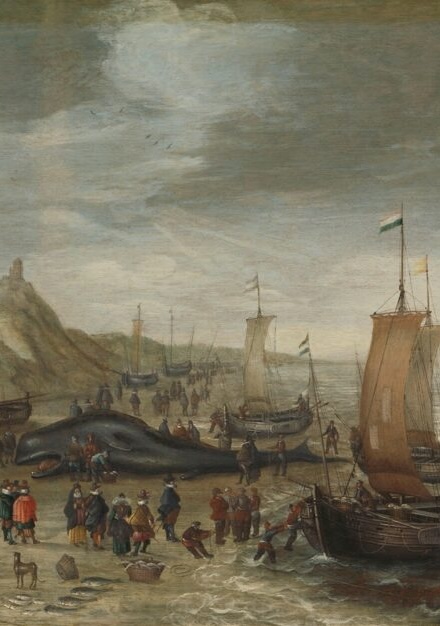
Williams notes in her author’s reflection that the event became a meditation on how human beings approach seemingly impossible obstacles:
"This poem explores the ways we often try to address seemingly intractable problems or situations and how what seems like solely an issue of logistics at first glance may instead be a matter of will—a practice in the motions required to release just about anything."
This sentiment bridges the gap between the whale’s plight and the human condition. The logistical hurdle of clearing a 104,000-pound carcass from a public beach mirrors the heavy, awkward burdens individuals carry in their personal lives—burdens that defy easy categorization or clean disposal.
Textual Analysis: "How to Move the Dead"
Williams’s poem is built on a brilliant, devastating pivot halfway through its lines. After detailing the logistical nightmare of the Nantucket stranding—the sawed-off jaw, the flower petals, the excavator, and the tugboat churning fifty miles out to sea—the speaker turns the lens inward:
Like how you carry any dead thing: a broken housecat from the
middle of the road, the getaway plan long abandoned but tough
to shake off, a paper-thin marriage stock-still in its sickbed.
Hands slick with blood and marked by scars of mottled memory.
The poem transitions from a civic and ecological event to an exploration of private grief. The whale becomes an emblem for all the dead weights we accumulate across a lifetime: failed relationships, abandoned dreams, and the physical remains of pets or loved ones.
The language here is tactile and visceral. Hands are "slick with blood," marked by the scars of memory. The final stanza captures the universally awkward, agonizing posture of letting go:
Cradling whatever remains to the curb, to the shoreline, to an
uncertain threshold—released into the next world. Searching
for words, a short prayer offered in eulogy. Eyes casting about,
trying to look anywhere but down, as you let go.
Just as authorities had to tow the whale far enough out to sea to ensure it would not return with the tide, the grieving individual must push their losses far enough away to break the cycle of recurring pain. We look anywhere—at the horizon, at the sky, at our shoes—trying to avoid looking directly at the finality of the drop.
Future Outlook: Environmental Implications and Literary Resonance
The 2025 Nantucket stranding and Williams’s poetic response arrive at a critical juncture in our relationship with the natural world. As maritime traffic increases and ocean temperatures shift, large marine mammal strandings are drawing heightened scientific scrutiny. Understanding the mechanics of ship strikes and anthropogenic mortality is vital for protecting endangered species like the sperm whale.
Simultaneously, works like "How to Move the Dead" elevate these ecological events into cultural milestones. By winning acclaim and capturing the attention of literary institutions like the Missouri Review, Williams’s poem ensures that the whale’s journey does not end at the bottom of the ocean floor fifty miles off Massachusetts.
Instead, the leviathan surfaces again in the collective consciousness—reminding us that whether we are managing the municipal logistics of a fifty-ton carcass or navigating the silent wreckage of a personal loss, the hardest part is never the weight itself, but finding the will, the machinery, and the courage to finally let go.





Comments
Facebook App ID not configured. Please add it in the Customizer.