
Executive Overview
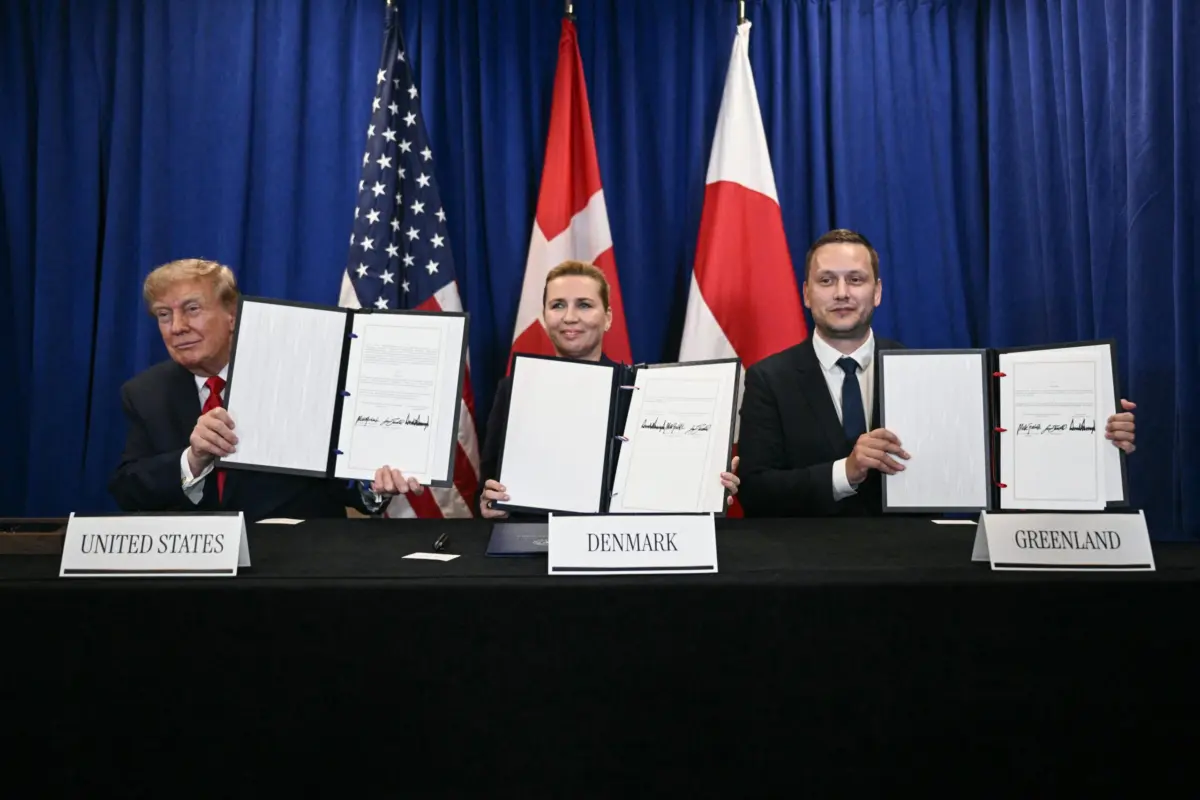
President Donald Trump’s aggressive, months-long campaign to assert American control over Greenland has reached a diplomatic resolution—at least for the time being. On Tuesday, during the high-stakes backdrop of the United Nations General Assembly in New York, President Trump signed a comprehensive tripartite security agreement alongside leaders from Denmark and its semi-autonomous territory, Greenland.
The freshly minted accord outlines a significantly expanded United States military footprint across the strategically vital Arctic island. Crucially, the text of the treaty explicitly reaffirms the “sovereignty and territorial integrity” of both Denmark and Greenland. This provision serves as a definitive legal and diplomatic counterweight to the annexation rhetoric that has dominated transatlantic relations since Trump returned to the Oval Office.
For nearly two years, the White House pursued a relentless campaign regarding the world’s largest island, oscillating between proposals to purchase the territory, rumored financial incentives aimed at swaying local public opinion toward secession, and thinly veiled threats of military intervention. These maneuvers triggered widespread consternation across European capitals, leading to unprecedented counter-deployments of allied European troops to the Arctic territory.
Read Also
While Tuesday’s signing ceremony at the United Nations successfully de-escalates an escalating geopolitical crisis, international observers remain divided over whether the agreement marks a permanent strategic pivot or merely a temporary tactical pause in a larger, legacy-driven campaign. With pressing domestic midterm elections looming and ongoing military entanglements in the Middle East, the White House has accepted the security pact as a diplomatic victory. However, foreign policy analysts caution that the underlying strategic pressures drawing Washington toward the Arctic remain entirely unchanged.
Detailed Chronology: From Real Estate Ambition to Arctic Brinkmanship
To fully understand the weight of Tuesday’s U.N. agreement, one must trace the rapid escalation of tensions that brought Washington, Copenhagen, and Nuuk to the brink of a diplomatic rupture.
The Opening Salvo: The Return to Office
Upon reclaiming the presidency, Donald Trump immediately revived a concept first floated during his initial term in office: the acquisition of Greenland. Framing the Arctic territory through the lens of absolute national security necessity, the administration argued that melting polar ice caps, opening northern sea lanes, and aggressive maneuvers by foreign adversaries like Russia and China necessitated direct U.S. ownership.
Initially dismissed by many foreign policy traditionalists as standard rhetorical hyperbole, the administration’s posture quickly hardened. By late autumn, senior administration officials were openly debating mechanisms to bypass Danish sovereignty. These discussions reportedly included proposals for direct financial subsidies intended to sway Greenlandic residents to vote for independence from Denmark and subsequently seek annexation by the United States.
Escalation and the Threat of Force
By January of the following year, the rhetoric escalated from economic coercion to overt military posturing. In a press briefing that stunned international allies, President Trump made his intentions unmistakable. Addressing reporters regarding the intransigence of the Danish government—which repeatedly emphasized that Greenland is not for sale—Trump drew a clear binary choice.
"If we don’t do it the easy way," Trump stated during a widely circulated exchange, referencing various purchase and inducement schemes, "we’re going to do it the hard way."
The implicit threat of unilateral force against a fellow NATO member state sent shockwaves through the transatlantic alliance. The North Atlantic Treaty Organization, founded on the principle of collective defense and mutual respect for member-state borders, found itself confronting an existential internal crisis.
The European Response
The reaction from European capitals was swift and alarmed. Fearing that Washington might attempt a fait accompli in the high north, several European nations took the extraordinary step of deploying small contingents of military personnel to Greenland. These deployments were designed less to mount a conventional defense against the U.S. military and more as a symbolic tripwire—a physical manifestation of European solidarity intended to deter unilateral American adventurism and force the White House back to the negotiating table.
Behind closed doors, frantic diplomatic channels swung into motion. Danish Prime Minister Mette Frederiksen and Greenlandic Premier Múte B. Egede maintained a united front, insisting that while they welcomed enhanced security cooperation with their American allies, their constitutional relationship and territorial integrity were non-negotiable.
Months of Discreet Negotiations
Following the diplomatic firestorm of January, the rhetoric cooled into formal, albeit tense, bilateral and trilateral negotiations. U.S. diplomats, intelligence officials, and military planners engaged in rigorous talks with their Danish and Greenlandic counterparts. The core challenge for negotiators was finding a formula that allowed President Trump to claim a tangible "win" regarding American strategic interests in the Arctic, while preserving the sovereignty of the Kingdom of Denmark.
Those months of grinding diplomatic labor culminated on Tuesday at the United Nations General Assembly, where the finalized text was formally unveiled and signed by the heads of state.
Supporting Context & Strategic Metrics
The intense focus on Greenland is not merely a product of diplomatic theater; it is driven by hard geographical, economic, and military realities that make the Arctic one of the most critical geopolitical frontiers of the 21st century.
The Geopolitical Significance of the Arctic
As global temperatures rise and polar ice recedes, the Arctic is undergoing a fundamental transformation. Historically impassable shipping lanes—such as the Northwest Passage and the Northern Sea Route—are opening up for increasingly longer periods each year. These routes promise to slash maritime transit times between Asia, Europe, and North America by up to 40%, fundamentally altering global trade economics.
Furthermore, Greenland sits atop vast, largely untapped reserves of critical minerals and rare earth elements, including neodymium, praseodymium, dysprosium, and terbium. These elements are indispensable for the manufacturing of advanced electronics, renewable energy technologies, and next-generation military hardware. Currently, global supply chains for these materials are heavily dominated by adversarial nations, giving Greenland immense strategic value in the race for economic and technological independence.
Military Architecture: Thule Air Base and Beyond
The United States is not a stranger to Greenlandic soil. The U.S. military has maintained a presence on the island since World War II, formalized during the Cold War under a 1951 defense agreement between Washington and Copenhagen.
The crown jewel of this presence is Pituffik Space Base (formerly known as Thule Air Base), located in the northwestern corner of the island. Pituffik hosts a crucial installation of the U.S. Space Force’s Ballistic Missile Early Warning System, designed to detect incoming intercontinental ballistic missiles (ICBMs) targeting North America.
+-----------------------------------------------------------------+
|              STRATEGIC ASSETS IN THE ARCTIC REGION              |
+--------------------------+--------------------------------------+
| Asset                    | Strategic Function                   |
+--------------------------+--------------------------------------+
| Pituffik Space Base      | Early missile warning & space        |
|                          | surveillance operations              |
| Polar Shipping Routes    | Shorter maritime transit between     |
|                          | Atlantic & Pacific basins            |
| Rare Earth Minerals      | Critical inputs for defense tech &   |
|                          | green energy transition              |
+--------------------------+--------------------------------------+
The new security agreement signed on Tuesday is expected to significantly expand upon this existing footprint. While specific details regarding troop numbers and new base locations remain classified, defense analysts anticipate an increase in rotational U.S. air and naval assets stationed on the island, enhanced radar intelligence-gathering capabilities, and joint exercises designed to counter rising Russian and Chinese activity in the circumpolar north.
Official Statements and Diplomatic Reactions
The signing ceremony at the United Nations General Assembly was accompanied by carefully choreographed statements from all three participating governments, reflecting both the relief of a crisis averted and the lingering sensitivities of national sovereignty.
The White House Perspective
Speaking to reporters following the signing, President Trump framed the agreement as a historic triumph for American security and hemispheric defense.
"We have reached a fantastic understanding that guarantees the safety and security of the entire Arctic region," Trump remarked. Just a week prior, he had described the overarching goal as a "dream come true" for the United States.
Administration officials emphasized that the agreement achieves all of Washington’s primary strategic objectives—securing northern approaches, countering foreign adversaries, and cementing a dominant U.S. security posture—without the necessity of economic friction or military confrontation with NATO allies.
Copenhagen and Nuuk Respond
In stark contrast to Washington’s framing of the deal as a conquest of ambition, the leaders of Denmark and Greenland emphasized the cooperative and protective nature of the accord.
Danish Prime Minister Mette Frederiksen issued a joint statement with Greenlandic Premier Múte B. Egede, underscoring that the treaty explicitly reinforces international law and the UN Charter.
"This agreement strengthens our collective security within the framework of our enduring alliance," the statement read. "Crucially, it reaffirms what has never been in doubt: the sovereignty and territorial integrity of Greenland and the Kingdom of Denmark remain inviolable."
Premier Egede added during a separate press briefing in Nuuk that the people of Greenland look forward to a partnership built on mutual respect and equal status, ensuring that Greenlanders retain a decisive voice in the economic and security developments shaping their homeland.
Future Outlook: Is the Arctic Safe for the Long Term?
While Tuesday’s signing ceremony successfully brought down the immediate geopolitical temperature, foreign policy experts and regional analysts warn against complacency.
The Legacy Factor
Throughout his political career, Donald Trump has frequently prioritized high-profile, legacy-defining victories over traditional, quiet diplomacy. His obsession with acquiring Greenland was widely viewed by historians and political scientists as an attempt to match the territorial expansions of past American presidents, such as the purchase of Alaska or the acquisition of the Louisiana Purchase.
Because the newly signed U.S.-Denmark-Greenland security pact relies on expanded access and military cooperation rather than a formal transfer of land or sovereignty, it fundamentally preserves the legal status quo. For an administration driven by grand gestures, the question remains whether this compromise will satisfy the president’s long-term ambitions.
Competing Pressures on the Horizon
Furthermore, the political landscape in Washington is shifting rapidly. The White House is currently managing a complex matrix of foreign policy crises, including ongoing military engagements in the Middle East, while simultaneously preparing for high-stakes midterm congressional elections. These immediate political and geopolitical distractions undoubtedly played a role in the administration’s willingness to accept a security pact rather than pursue a prolonged annexation struggle.
However, as those domestic and international pressures evolve, analysts caution that the underlying drivers of the administration’s Arctic policy—melting ice, accessible resources, and great-power competition with Beijing and Moscow—will only intensify.
Whether President Trump will ultimately claim this agreement as a permanent win and move on, or whether the demand for full territorial ownership will re-emerge before the conclusion of his term, remains one of the most compelling questions in contemporary geopolitics. For now, the Arctic sky is clear, the alliance is intact, and the leaders of the Western world have earned a brief respite from the brink.





Comments
Facebook App ID not configured. Please add it in the Customizer.