
Executive Overview
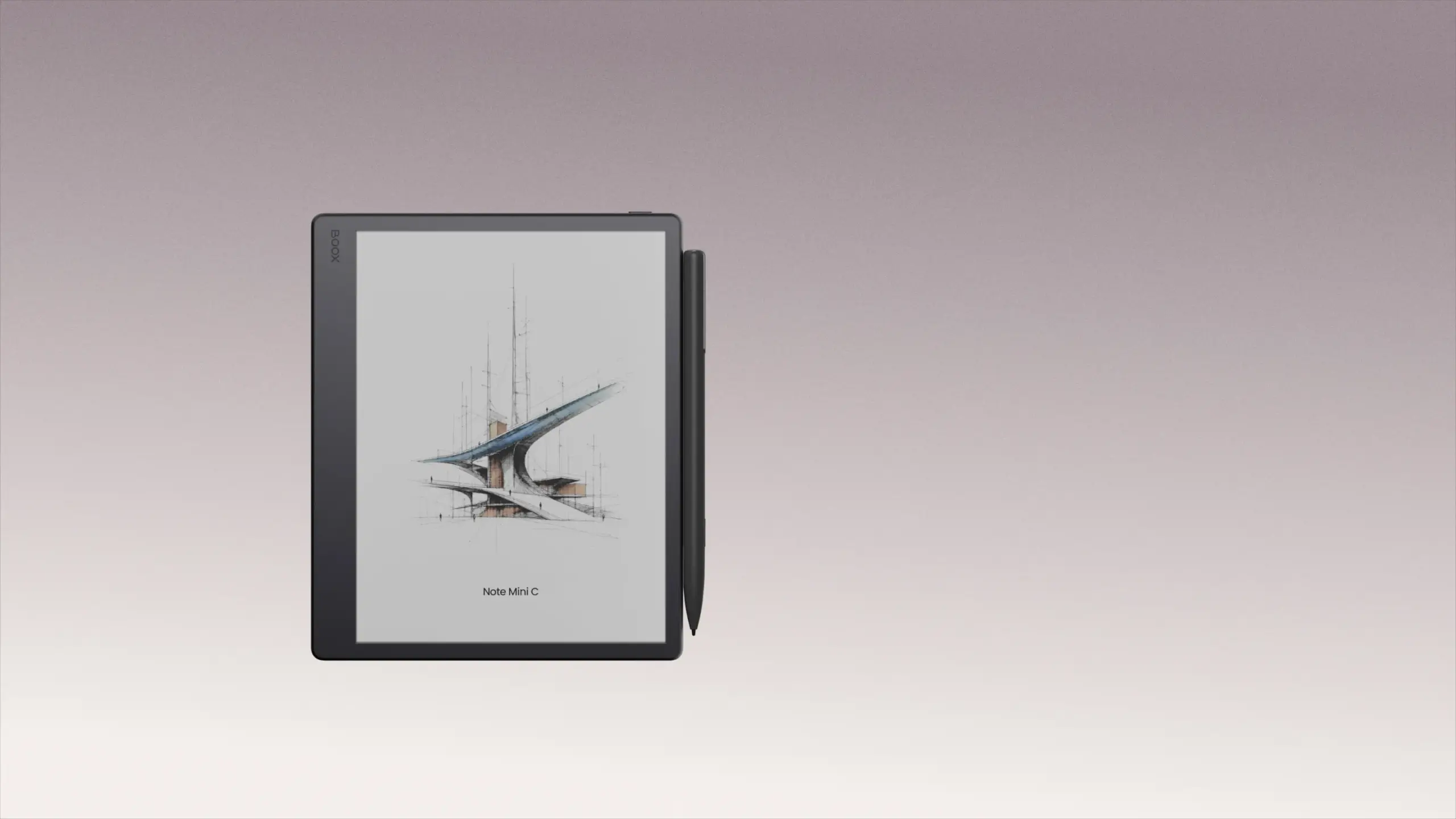
The portable e-paper market has officially entered a new phase of functional maturation with the announcement of the BOOX Note Mini C. Unveiled alongside a broader hardware refresh that includes the larger Note Air6 C, the phone-sized Palma 3, and the ultra-portable Picco, the Note Mini C arrives as a strategic answer to a persistent industry demand: a genuinely pocketable, one-handed digital notebook that does not compromise on color fidelity, processing power, or software versatility.
Priced at $549 and available immediately through the official BOOX Store, this 8.52-inch color E Ink device targets mobile professionals, field researchers, and students who require an unencumbered workflow away from traditional desks and blinding back-lit LCD/OLED screens. By integrating an advanced Kaleido 3 color panel, robust Android 16 architecture, expanded storage options, and cutting-edge peripheral support—such as Bluetooth 6.0 and the proprietary BOOX InkSight magnetic active stylus—the Note Mini C positions itself as a compelling alternative to more restrictive single-purpose e-paper notebooks like the reMarkable line.
This deep-dive report explores the device’s technical specifications, contextualizes its place in the modern E Ink ecosystem, analyzes its performance benchmarks, and evaluates its long-term potential for enterprise and academic deployment.
Read Also
Detailed Chronology: The Evolution to Android 16 and Kaleido 3 in a Mini Form Factor
To understand the engineering achievement behind the Note Mini C, one must look at the recent timeline of the electronic paper industry. For years, manufacturers struggled to balance screen real estate with portability. Standard 10.3-inch and 13.3-inch E Ink tablets offered expansive digital canvases for reading and writing, but proved unwieldy for quick, standing notes, public transit commuting, or true one-handed operation. Conversely, 6-inch and 7-inch e-readers lacked the workspace necessary for complex annotations, split-screen multi-tasking, and detailed sketching.
The Bridge Between Form and Function
The intermediate 8-inch to 9-inch segment emerged as the sweet spot for portable productivity. However, early entries in this category frequently suffered from sluggish refresh rates, low-tier processors that choked on modern Android operating systems, and monochromatic displays that limited the viewing of annotated charts, highlighted documents, and web pages.
The introduction of the Note Mini C represents the culmination of several years of hardware convergence:
- The Maturation of Kaleido 3 Technology: E Ink’s Kaleido 3 color filter technology finally reached a threshold of brightness, contrast, and color saturation acceptable to professional users. While black-and-white text maintains a pristine 300 ppi resolution, the 4,096-color palette delivers enough vibrancy to make digital planners, color-coded notes, and media-rich PDFs genuinely usable.
- The Leap to Android 16: Historically, E Ink devices lagged several generations behind mainstream smartphones and tablets regarding operating system versions. By launching straight into Android 16 with full Google Play Store integration out of the box, BOOX has bypassed the security, app compatibility, and synchronization hurdles that plagued older e-reader models.
- Refining the Physical Ergonomics: Measuring a mere 6mm in thickness and weighing just 300 grams, the Note Mini C achieves a structural slenderness previously reserved for non-digitizer book readers. The inclusion of flat glass protection and a dual-tone front light ensures that device durability matches its aesthetic appeal.
Supporting Context & Metrics: Hardware Architecture and Peripheral Ecosystem
A device intended for professional-grade workflows requires more than just an attractive screen; it demands computational muscle. Under the hood, the BOOX Note Mini C breaks away from the underpowered specifications traditionally associated with electronic paper products.

Processing Power and Memory Configuration
- Processor: An octa-core 2.9 GHz processor drives the system, providing rapid app launches and effortless rendering of large architectural files, vector graphics, and massive spreadsheet documents.
- Memory (RAM): 6GB of LPDDR RAM ensures smooth multitasking, allowing users to run an enterprise chat client, a PDF reader, and a digital notebook concurrently without hitting performance bottlenecks.
- Internal Storage: 64GB of built-in flash storage accommodates thousands of textbooks, audio notes, and heavy documents.
- Expandable Storage: Addressing a major pain point for mobile professionals who manage massive offline libraries, BOOX has included a physical microSD card slot supporting memory expansion up to a staggering 2TB.
Display and Visual Comfort Metrics
- Screen Size: 8.52 inches, providing an optimal balance between viewing area and physical footprint.
- Resolution: 300 ppi for black-and-white content (text, line drawings, monochrome documents) and 150 ppi for color elements rendered via the Kaleido 3 filter array.
- Front Light: Integrated dual-tone front lighting allows color temperature adjustment (warm to cool lighting), ensuring eye comfort in zero-ambient-light environments like flights or late-night study sessions.
- Refresh Technology: Equipped with BOOX Super Refresh (BSR) technology, the device minimizes the notorious ghosting artifacts typical of color E Ink panels, enabling smooth scrolling through web pages and fluid note-taking.
Ergonomics, Connectivity, and Power Management
- Stylus Integration: The package includes the BOOX InkSight magnetic active stylus, featuring a dedicated functional side button for quick erasing or tool switching. The stylus docks magnetically alongside the device, which ships with a striking orange magnetic folio case.
- Biometrics and Audio: Security is handled swiftly via a fingerprint-enabled power button for seamless biometric login. Audio playback and voice dictation are supported by built-in dual speakers.
- Connectivity Standards: Moving past older hardware protocols, the tablet incorporates Bluetooth 6.0, ensuring ultra-low-latency connections to wireless keyboards, mice, and audio headsets.
- Battery Capacity: A 3,150mAh battery powers the system. Due to the inherent power efficiency of E Ink technology—where power is drawn primarily during screen refreshes rather than sustained pixel illumination—this battery capacity easily translates to days, if not weeks, of moderate to heavy mobile use.
Official Statements and Industry Positioning
In evaluating market reception, industry analysts and company representatives emphasize the device’s role as a productivity liberation tool. While devices manufactured by competitors like reMarkable prioritize a distraction-free, hyper-minimalist writing experience, they often lock users into proprietary cloud ecosystems and strip away functional versatility.
BOOX has chosen the opposite path. By retaining open Android integration, the company appeals directly to professionals who cannot afford to be siloed.
"The modern professional is not tethered to a single desk, nor do they rely on a single software application," noted industry analysts observing the launch. "By pairing the eye-safe, glare-free benefits of E Ink with the limitless application ecosystem of Android 16, BOOX has created a pocket workstation that adapts to the user’s workflow rather than forcing the user to adapt to the hardware."
At $549, the Note Mini C occupies the upper tier of the portable e-reader market. However, industry insiders argue that when factoring in the cost savings of expandable storage, the inclusion of the active stylus, the magnetic folio case, and the elimination of recurring subscription paywalls for core software features, the total cost of ownership remains competitive against high-end tablet alternatives from Apple and Samsung—particularly for users suffering from chronic digital eye strain.
Future Outlook: The Impact on Mobile Productivity and E-Paper Adoption
The release of the BOOX Note Mini C signals a broader shift in how computing hardware is conceptualized for mobile knowledge workers. As burnout from high-frequency, high-nit LCD screens grows, the demand for passive-matrix display alternatives continues to accelerate.
Key Trends to Watch:
- Mainstream Enterprise Adoption of Color E Ink: With color fidelity reaching usable commercial standards (4,096 colors at 300 ppi monochrome sharpness), industries that rely on visual data—such as logistics management, field engineering, interior design, and digital editing—are increasingly replacing traditional tablets with E Ink alternatives.
- The Shrinking Form-Factor Standard: The success of the Note Mini C and its sibling devices (Palma 3 and Picco) suggests that the future of digital notes is pocket-sized. Users no longer wish to carry dedicated laptop replacements when an 8-inch device can handle 80% of daily field tasks.
- Open vs. Closed Ecosystem Wars: As consumers push back against walled-garden productivity devices, hardware manufacturers that embrace open operating systems—such as BOOX with Android 16—are poised to capture market share from closed-ecosystem competitors.
Conclusion
For those who have found larger e-readers too cumbersome to carry or alternative pocket note-takers too functionally restricted, the BOOX Note Mini C presents a comprehensive, high-performance solution. Available today for $549 via the official BOOX Store, it bridges the gap between traditional analog notebooks and modern mobile computing, setting a new benchmark for what pocket-sized electronic paper can achieve.





Comments
Facebook App ID not configured. Please add it in the Customizer.