
In the volatile landscape of the American Revolution, the seat of the fledgling United States government was a fluid, highly mobile entity. While history commonly associates the revolutionary capital with Philadelphia—and later, Washington, D.C.—the Continental Congress was frequently forced into sudden, chaotic retreats to evade advancing British forces. Among these temporary administrative sanctuaries, one stands out for its extreme brevity: Lancaster, Pennsylvania.
On September 27, 1777, Lancaster served as the official capital of the United States for a single day. Fleeing the imminent capture of Philadelphia by British General Sir William Howe, more than two dozen delegates of the Second Continental Congress hauled vital government archives into the interior of Pennsylvania. Gathering inside the local courthouse, they convened for a matter of hours, managed immediate wartime logistics, addressed urgent pleas from General George Washington, and promptly voted to pack up and move further west across the Susquehanna River to York.
Nearly 250 years later, this ephemeral chapter has transformed from an obscure footnote into a point of profound civic pride. Lancaster is officially recognized as one of only nine cities to have ever held the title of U.S. capital. Today, the community commemorates its historic twenty-four hours in the spotlight through annual "Capital Day" festivities. Yet, looking beyond the modern celebrations, Lancaster’s brief tenure as the epicenter of American governance sheds light on the precarious, logistical tightrope the Continental Congress walked during the darkest hours of the War of Independence.
Read Also
/https://tf-cmsv2-smithsonianmag-media.s3.amazonaws.com/filer_public/d5/41/d54193b7-aca9-4f18-9695-1cf52589cd9c/view-of-lancaster.jpg)
Detailed Chronology: The Road to a One-Day Capital
The Panic of September 1777
The events leading to Lancaster’s brief status as the national capital began in the late summer of 1777. The Second Continental Congress had been operating out of Philadelphia—the symbolic heart of the rebellion and the birthplace of the Declaration of Independence. However, British strategy under General William Howe aimed squarely at decapitating the rebellious government by capturing its capital.
Rather than marching directly overland from New York, Howe loaded his forces onto transports, sailed down the Atlantic coast, and landed his army at the head of the Chesapeake Bay in July 1777, preparing to march northward. George Washington, commander in chief of the Continental Army, was left guessing at the enemy’s destination. Lacking reliable scouts who had been diverted to the northern theater, Washington’s forces were outmaneuvered at the Battle of Brandywine Creek on September 11, 1777.
Though the Continental Army was defeated rather than destroyed, the defensive line protecting Philadelphia collapsed. By mid-September, the threat to the city became acute. On September 14, Congress prudently resolved that if forced to evacuate Philadelphia, Lancaster would serve as their designated rallying point.
/https://tf-cmsv2-smithsonianmag-media.s3.amazonaws.com/accounts/headshot/meilan_headshot2.png)
The Midnight Warning and the Circuitous Exodus
The situation escalated from strategic planning to frantic panic on September 18, 1777. Lieutenant Colonel Alexander Hamilton, serving as an aide-de-camp to Washington, was tasked with destroying mills along the Schuylkill River to impede the British advance. While executing these orders, Hamilton narrowly escaped British gunfire that claimed the life of one of his men and the loss of his horse.
Realizing that British troops were poised to enter Philadelphia that very night, Hamilton dispatched an urgent letter to Continental Congress President John Hancock. “If Congress have not yet left Philadelphia, they ought to do it immediately without fail,” Hamilton warned.
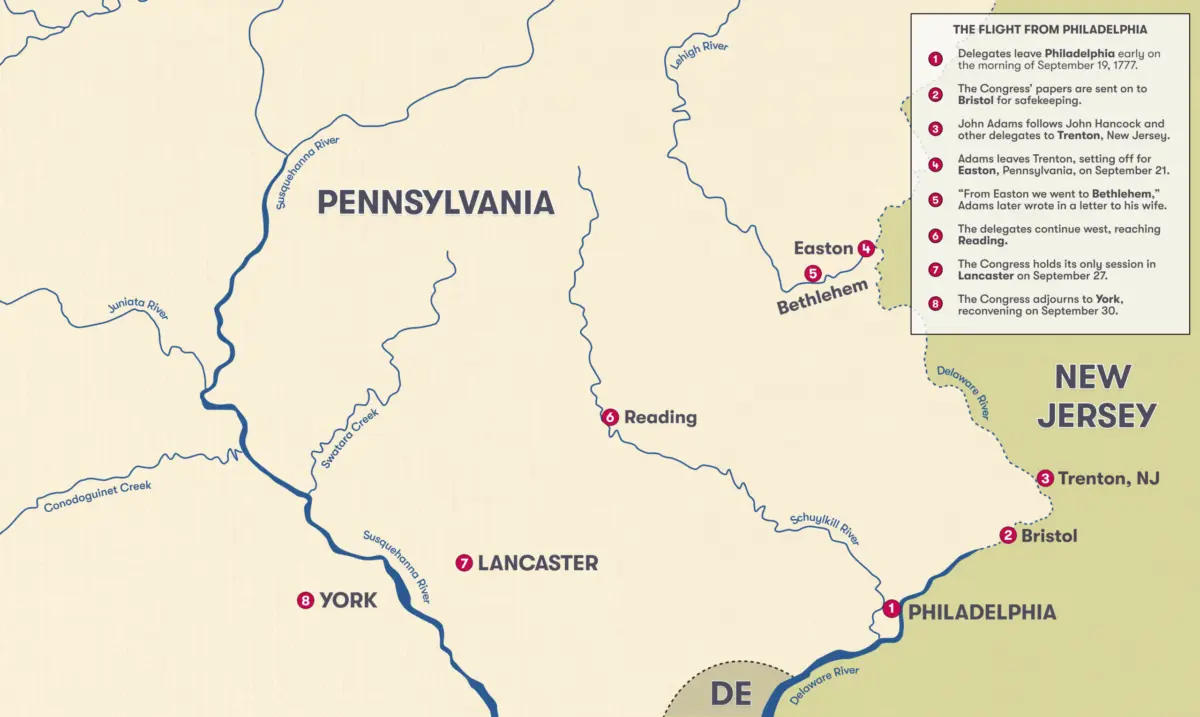
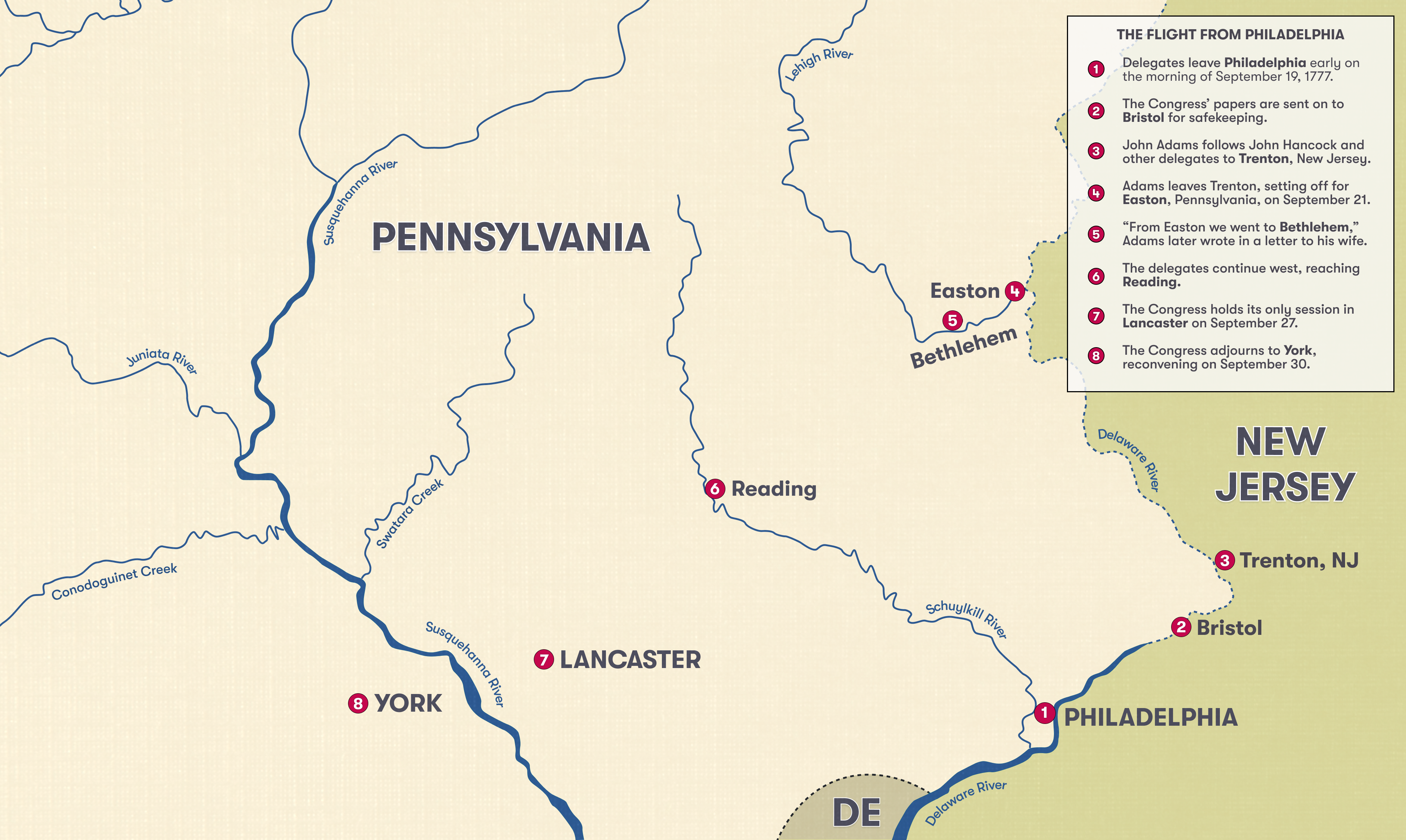
The message triggered a chaotic early-morning exodus. On September 19, delegates were roused from their beds. John Hancock and key administrators loaded critical congressional records, treasury documents, and war office papers into wagons. Recognizing that documents were far more valuable than the politicians themselves, the leaders took a deliberately circuitous route to avoid enemy patrols. Massachusetts delegate John Adams noted that while the direct road was barely 88 miles, their detour through New Jersey and back across the Delaware River at Easton stretched the journey to nearly 180 miles.
:focal(750x500:751x501)/https://tf-cmsv2-smithsonianmag-media.s3.amazonaws.com/filer_public/d5/41/d54193b7-aca9-4f18-9695-1cf52589cd9c/view-of-lancaster.jpg)
Simultaneously, ordinary citizens, loyalists, and patriots fearful of British retribution fled westward. Lancaster, already the largest inland city in the colonies, quickly reached maximum capacity, with refugees camping out on public commons and surrounding farm fields.
The Three-Hour Session at the Courthouse
On September 26, 1777, General Howe’s forces marched into Philadelphia, initiating a brutal nine-month occupation. The following morning, September 27, 28 delegates representing 11 states assembled inside Lancaster’s courthouse at 10:00 a.m.
The session was remarkably brief—lasting only about three hours—and its official record occupies barely a single page in the Journals of the Continental Congress. Despite the brevity, the delegates addressed critical wartime business. They reviewed two major communications:
- A Grievance from Thomas Conway: An army officer who had fought at Brandywine complained about a French colleague’s promotion, planting the early seeds of the infamously factional "Conway Cabal," which would later attempt to undermine Washington’s leadership.
- A Desperate Plea from Washington: Writing on September 23, the commander in chief reported that at least 1,000 of his soldiers were entirely barefoot and suffering through brutal marches. He requested immediate seizures of shoes, blankets, and provisions from the local populace.
The Congress readily obliged Washington, voting to requisition supplies from local citizens, specifically targeting those of "disaffected and equivocal characters"—loyalists and political moderates.
However, as the delegates looked around Lancaster, they realized the town’s geographic vulnerability. Situated relatively close to Philadelphia with no major natural barriers stopping an aggressive British advance, Lancaster was deemed too exposed. Before the afternoon session concluded, the delegates made a decisive pivot: they voted to pack up their papers once more and cross the wide, bridge-less Susquehanna River to York, Pennsylvania. Lancaster’s time as the capital of the United States was over almost as quickly as it began.
Supporting Context & Metrics: Lancaster’s Revolutionary Footprint
To fully understand why Lancaster was chosen—even for a single day—historians look to the city’s unique socio-economic landscape during the 1770s.
/https://tf-cmsv2-smithsonianmag-media.s3.amazonaws.com/filer_public/b5/5d/b55d4330-0a3c-4b38-aa78-9411a3102568/courthouse.jpg)
Key Metrics and Facts:
- Population: Approximately 3,000 residents in 1775, making it the largest inland settlement in the American colonies.
- Industrial Hub: Home to numerous ironworks, mills, and specialized rifle shops that produced the legendary Lancaster long rifles utilized by the Continental Army.
- The "Exclusive Club": Lancaster is one of only nine cities to have officially served as the U.S. capital (joining Philadelphia, Baltimore, Lancaster, York, Princeton, Annapolis, Trenton, New York City, and Washington, D.C.).
- Duration of Capital Status: Exactly one day (September 27, 1777).
A Divided Community
While Lancaster was a vital arsenal and supply depot for the patriot cause, it was far from a monolith of revolutionary fervor. The region hosted a complex demographic mosaic:
- German Immigrants: Many Pennsylvania Germans had recently arrived in North America and felt little ideological alignment with the rebellion against the Crown.
- Pacifist Communities: Sizable populations of Quakers and Anabaptists (including the Amish) practiced pacifism, refusing to bear arms or actively support military engagements.
- Loyalists: A vocal minority retained allegiance to King George III, making local intelligence-gathering and supply-requisitioning a delicate balancing act for the revolutionary leadership.
Despite these internal divisions, Lancaster’s robust infrastructure—featuring a functioning courthouse, numerous taverns, and secure storage facilities—made it the most logical emergency waypoint for a government on the run.
Official Statements and Expert Insights
Modern historians and museum directors emphasize that while Lancaster’s tenure as the seat of government was a historical blip, its broader contributions to the American Revolution were foundational.
/https://tf-cmsv2-smithsonianmag-media.s3.amazonaws.com/filer_public/c5/d3/c5d3b2b1-8c38-4446-8f22-51cd149a30a3/john_nixon_reading_the_declaration_of_independence_to_the_peop-3d34070c8034df7031369d30bcaa18b6.jpg)
-
Stephanie Townrow (Director of Interpretation and Exhibitions, LancasterHistory):
"It wasn’t that hard for the British to get to Philadelphia, and the delegates realized that if it wasn’t that hard for them to get to Philadelphia, it wasn’t going to be that hard for the British to get to Lancaster either… It was very insignificant in the larger scheme of wartime for locals at the time, but it represents our community’s vital role in sheltering the government under imminent threat."
-
Adam Zurn (Author of Capital Day: Lancaster and the Revolution):
/https://tf-cmsv2-smithsonianmag-media.s3.amazonaws.com/filer_public/72/b2/72b2c0cc-fe91-4142-adc6-73b722dc4321/washington_and_lafayette_at_the_battle_of_brandywine.jpg)
"That makes Lancaster a member of a very exclusive club. We were the third capital, and we were the one to shelter Congress when it was under imminent threat. We often think that there are these armies, and the people for the most part are just witnesses to that, but in actuality, the events of the war directly shaped locals’ everyday lives."
-
Jim McClure (Historian and Journalist on Pennsylvania History):
Commenting on the historical myths surrounding various temporary capitals (such as debates between Lancaster and York over capital legacy), McClure notes: "Academics outside of the region aren’t even aware of some of these local claims, but the regional pride keeps the narratives alive and thriving centuries later."
/https://tf-cmsv2-smithsonianmag-media.s3.amazonaws.com/filer_public/b5/7f/b57fa185-d41a-4d96-b51c-771f8dc0c058/the_flight_of_the_congress_bm_186808084556.jpg)
Future Outlook and Legacy
Today, physical remnants of Lancaster’s single-day capital status are scarce. The original courthouse where the Continental Congress convened burned down in 1784, though artifacts such as a Windsor chair and a Pennsylvania coat of arms that hung in the chamber have survived and are preserved by LancasterHistory.
What began as an emergency wartime evacuation has evolved into a celebrated cultural tradition. Fueled by the momentum of the 1976 United States Bicentennial, Lancaster established "Capital Day," an annual community festival held every September to commemorate the city’s 1777 moment in the national spotlight.
As the nation approaches its 250th anniversary (Semiquincentennial), local organizers are scaling up these traditions. The annual Capital Day events—featuring colonial walking tours, historical re-enactments, period trivia, costume contests, and parades featuring everything from local marching bands to children walking miniature horses—bridge the gap between dry academic history and public celebration.
/https://tf-cmsv2-smithsonianmag-media.s3.amazonaws.com/filer_public/08/74/0874c41c-e084-4594-be36-be33c6b79791/iiif-public_law_lljc008_03820755-full-pct_1000-0-default.jpg)
Ultimately, Lancaster’s twenty-four hours as the capital of the United States serves as a powerful metaphor for the resilience of the early American republic. In September 1777, the nation’s leaders were exhausted, outmaneuvered, and physically displaced. Yet, by packing their documents into wagons and fleeing into the Pennsylvania interior, they preserved the institutional continuity of the revolution. Lancaster did not hold the government for long, but by serving as a safe harbor during the darkest hour of the Philadelphia campaign, it helped keep the American experiment alive.


Comments
Facebook App ID not configured. Please add it in the Customizer.