
Executive Overview
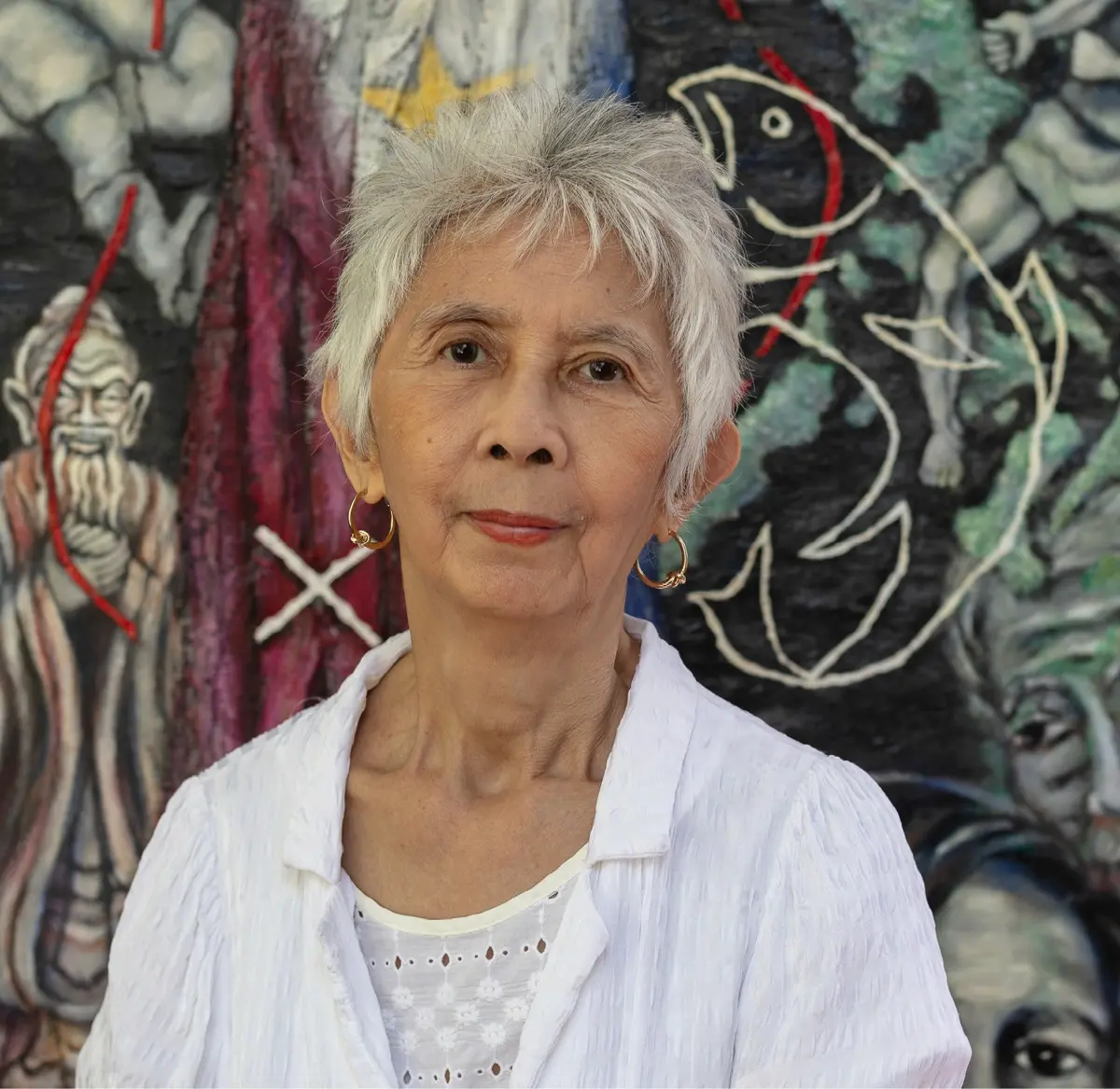
In a landmark moment for Southeast Asian contemporary culture, veteran Filipina artist, curator, and activist Imelda Cajipe Endaya has been officially conferred the Order of National Artists of the Philippines for Visual Arts. At 77 years of age, Endaya’s historic designation on September 1 marks a monumental turning point for the nation’s highest cultural honor: she is the very first woman to receive the distinction in the Visual Arts category since the inception of the accolade in 1972.
The conferment, recommended jointly by the Cultural Center of the Philippines (CCP) and the National Commission for Culture and the Arts (NCCA), celebrates a rigorous, uncompromising career spanning over five decades. Endaya’s multifaceted practice—comprising social realist painting, radical printmaking, and immersive mixed-media installations—has continuously challenged the sociopolitical bedrock of the Philippines. For more than fifty years, her art has confronted systemic gender disparity, labor exploitation, national identity crises, and the harrowing displacement experienced by the global Filipino diaspora.
Endaya’s elevation to National Artist does more than honor an individual creative pioneer; it serves as a long-overdue institutional reckoning within a historically patriarchal art establishment. By anchoring her personal lens and domestic realities to broader national struggles, she has fundamentally rewritten the vocabulary of Philippine modern art. Her recognition sends a resounding message across the archipelago and international art circles alike: feminist art is foundational, enduring, and central to the nation’s cultural consciousness.
Read Also
Detailed Chronology: Five Decades of Artistic and Social Resistance
The Formative Decades: 1970s–1980s
Imelda Cajipe Endaya’s entry into the Philippine art scene coincided with one of the most politically volatile periods in modern Southeast Asian history: the declaration of Martial Law under President Ferdinand Marcos Sr. In the early 1970s, as state censorship sought to silence dissent, Endaya aligned her creative output with the burgeoning Social Realism movement.
Between 1970 and 1976, she actively participated in the Philippine Association of Printmakers, honing a medium traditionally valued for its reproducibility and potential for broad public distribution. Printmaking allowed her to experiment with visual narrative, moving away from Western-centric abstract formalism toward a direct, figurative engagement with everyday Filipino realities.
As the decade progressed, Endaya’s work expanded into mixed-media installations that incorporated indigenous textiles, domestic objects, and consumer debris. This stylistic choice was deliberate: by integrating materials historically relegated to "women’s work" or domestic labor into high art spaces, she disrupted traditional hierarchies of fine art. Her works from this era laid bare the intersection of martial law oppression, economic poverty, and the patriarchal structures subjugating Filipina women.
Institutional Building and Curation: 1990s–2000s
Beyond her personal studio practice, Endaya emerged as a formidable cultural organizer, writer, and curator. Recognizing that women artists were routinely marginalized in mainstream gallery circuits and historical surveys, she co-founded Kasibulan (Kababayan sa Sining at Linang), a pioneering collective dedicated to nurturing women visual artists in the Philippines. Kasibulan became a vital incubator for feminist critique, providing exhibition spaces, mentorship, and solidarity for generations of women practitioners.
Endaya’s commitment to institutional critique and archival preservation also led to her role as a co-founder of Pananaw: Philippine Journal of Visual Arts. Through critical writing and editing, she helped shape the theoretical discourse surrounding contemporary Philippine art. Her leadership extended into public service when she served on the NCCA Committee on Visual Arts from 1995 to 2001, where she successfully advocated for greater institutional support for regional artists, indigenous crafts, and women’s contemporary art initiatives.
International Ascendancy and Landmark Retrospectives: 2020s–Present
The past several years have seen a massive resurgence of global critical interest in Endaya’s oeuvre, culminating in international exhibitions and monumental institutional surveys.
In 2022, the Cultural Center of the Philippines hosted her landmark career retrospective, Pagtutol at Pag-asa (Refusal and Hope). The exhibition served as an exhaustive testament to her legacy, tracing her journey from the protest art of the 1970s to contemporary reflections on migration and global capitalism. The retrospective solidified her status not only as a historical figure, but as an artist whose past concerns—such as the commodification of domestic helpers and overseas Filipino workers (OFWs)—remained chillingly relevant.
Endaya’s international footprint expanded significantly in the mid-2020s. Following a critically acclaimed exhibition at Silverlens gallery in New York, her works were showcased on global stages including S.E.A. Focus in Singapore and Art Basel Hong Kong. These presentations introduced international collectors and curators to her distinct visual idiom, where local domestic spaces double as sites of fierce geopolitical resistance.
Supporting Context & Metrics: The Significance of the Order of National Artists
The Pinnacle of National Recognition
Established by Presidential Decree No. 1001 in 1972, the Order of National Artists (Orden ng Pambansang Alagad ng Sining) is the highest state honor bestowed upon Filipino artists, musicians, writers, and architects. Administered jointly by the CCP and the NCCA, the award recognizes individuals who have made distinct and significant contributions to the development of Philippine arts and letters.
To be named a National Artist is to attain a status akin to a living national treasure. Laureates receive a grand collar symbolizing their status, a cash award, a monthly life pension, medical and hospitalization benefits, and a state funeral and burial at the Libingan ng mga Bayani (Heroes’ Cemetery).
Breaking the Gender Barrier in Visual Arts
Despite the profound contributions of women to Philippine art history—ranging from early modernist painters to contemporary installation artists—the Visual Arts category of the Order of National Artists had remained an exclusively male domain for over five decades. Previous recipients in this division comprise an illustrious list of historical titans, including Fernando Amorsolo, Carlos "Botong" Francisco, Vicente Manansala, Arturo Luz, J. Elizalde Navarro, Hernando R. Ocampo, Ang Kiukok, and BenCab, among others.
Endaya’s conferment corrects a glaring historical imbalance. For fifty-two years, the narrative of Philippine visual art leadership was structurally coded as male. By breaking this concrete ceiling at age 77, Endaya opens the door for future generations of women whose works tackle the intersections of gender, politics, and identity, signaling to cultural boards and award committees that feminist artistic labor is foundational to the national canon.
Institutional Footprint: Global Museum Holdings
Endaya’s enduring impact is reflected in the permanent collections of major cultural institutions across the Philippines and Asia. Her works are housed in:
- Bangko Sentral ng Pilipinas (Central Bank of the Philippines)
- Cultural Center of the Philippines (CCP)
- Philippine National Art Gallery (National Museum of the Philippines)
- National Gallery of Singapore
- Metropolitan Museum of Manila
- Okinawa Prefectural Museum (Japan)
- Fukuoka Asian Art Museum (Japan)
These institutional holdings ensure that her socio-political critiques remain accessible to scholars, students, and the global public for generations to come.
Official Statements and Artistic Philosophy
The Realities of Domesticity and Resistance
Endaya’s artistic philosophy has always been rooted in the immediate, tangible realities of everyday life, particularly the lived experiences of Filipino women. In an interview with Artforum concerning her works featured at Silverlens gallery, she explained the core motivation behind her immersive installations and collage paintings:
"I wanted to insert a part of my reality into the painting."
This methodology rejects the ivory tower of high-modernist abstraction. By introducing real-world elements—such as lace curtains, laundry, religious icons, newspaper clippings, and passports—Endaya transforms the canvas into a socio-political theater. Her works examine how global capitalism and domestic labor intersect, particularly highlighting the plight of Filipina domestic workers scattered across the globe as part of the diaspora.
Breaking the Glass Ceiling
Upon receiving news of her conferment, Endaya released a statement reflecting on the historic weight of the award. While deeply grateful for the recognition, her primary focus remained fixed on the future of women’s art in the Philippines and the institutional work that remains unfinished:
"People say I have just broken a glass ceiling. There should be more successful women artists after me."
Her words underline a lifelong dedication to mentorship and collective empowerment. Throughout her career, Endaya has viewed individual success not as an isolated achievement, but as a collective victory for the feminist movement within the Philippine art community.
Future Outlook: The Legacy of Imelda Cajipe Endaya
As Imelda Cajipe Endaya steps into her new role as a National Artist, the ripple effects of her recognition are already being felt across the Philippine cultural landscape. Her historic conferment forces a long-overdue institutional introspection regarding how artistic excellence, historical value, and gender equity are evaluated by state and private bodies alike.
Inspiring the Next Generation
The immediate future of Philippine contemporary art stands to benefit immensely from this milestone. Younger generations of women, non-binary, and marginalized artists now possess an undeniable institutional precedent at the highest level of state recognition. Endaya’s lifelong ethos—that art must be socially engaged, politically fearless, and deeply rooted in community—serves as a vital compass for contemporary practitioners navigating an increasingly complex global art market.
Preserving a Radical Archive
Efforts are currently underway among academics, curators, and cultural workers to further archive and study Endaya’s extensive output. From her early printmaking days with the Philippine Association of Printmakers to her transnational installations reflecting on migrant labor, her body of work offers an unvarnished visual history of the Philippines from the 1970s onward.
Ultimately, Imelda Cajipe Endaya’s designation as a National Artist is more than an award; it is a permanent fixture in the history of Philippine liberation and cultural identity. By daring to paint the kitchen, the protest march, and the global migrant ship with equal gravity, she transformed everyday resistance into immortal art—and in doing so, forever changed the face of the Philippine nation.

Comments
Facebook App ID not configured. Please add it in the Customizer.