
Executive Overview
The late-summer publishing cycle of August 2026 offered a profound, multifaceted snapshot of the speculative fiction landscape. Caught between the administrative friction of returning to academic schedules, the bustling industry networking of Worldcon, and the impending deluge of traditional autumn book releases, the short fiction market provided an essential, imaginative refuge. Rather than serving as mere peripheral reading material, the short stories, flash pieces, and curated magazine issues published during this period demonstrated a fierce, experimental vitality.
August’s literary output reflected a distinct thematic preoccupation with bodily autonomy, historical reckoning, ecological anxiety, and the psychological mechanics of grief. Across both venerable long-running publications and fresh digital venues, contemporary authors utilized the tools of fantasy, weird horror, and science fiction to dissect modern socio-political malaise. This report provides a detailed examination of the ten standout short speculative works from August 2026, offering critical analysis of their narrative structures, thematic resonance, and contribution to the broader genre ecosystem.
Detailed Chronology & Critical Evaluations
1. "Beneath the Flower’s Gaze" by Kevin Rigathi
- Venue: Omenana (August 2026, Issue 35)
- Format: Multi-part short fiction
After a notable publishing hiatus, the speculative flagship Omenana returned to circulation in August 2026, anchoring its comeback with Kevin Rigathi’s "Beneath the Flower’s Gaze." Structured across multiple distinct narrative movements, the story centers on a trio of figures—a young boy, an adult man, and a local fisherman—who independently encounter a deceptively alluring flora specimen flourishing within the overgrown courtyard of an abandoned domicile.
Read Also
Rigathi employs a deliberate, mounting cadence. What begins as a botanical curiosity steadily curdles into an atmospheric nightmare as the characters attempt to harvest the specimen for personal gain, inadvertently rousing a malevolent entity tethered to the terrain. The narrative evokes the structural and psychological architecture of traditional Brothers Grimm fairy tales, relying on cautionary motifs, stark moral choices, and an impending sense of inevitability. Rigathi’s prose balances lush descriptive world-building with lean, terrifying pacing, marking a triumphant return for Omenana.
2. "How to Save a Witch" by Tatiana Shokhan
- Venue: Quotidian Bagatelle (August 2026, Issue 8)
- Format: Micro-fiction (102 words)
In the realm of flash fiction, brevity often demands absolute precision. Tatiana Shokhan achieves this effortlessly in "How to Save a Witch," a compact, 102-word narrative published in the eighth issue of Quotidian Bagatelle. Operating within such stringent linguistic boundaries renders traditional plot synopsis perilous due to the risk of critical spoilers.
Nevertheless, the piece succeeds by tapping into a palpable, atmospheric nostalgia—channeling the tactile, autumnal warmth of generational comfort viewings such as Practical Magic. Shokhan uses sparse language to establish emotional stakes immediately, proving that expansive world-building and resonant character arcs do not require vast word counts. It is a jewel of micro-fiction that lingers in the reader’s consciousness long after its final sentence.
3. "The Mayfly Knight" by Sara Omer
- Venue: Old Moon Quarterly (June 2026, Volume 10; reviewed August 2026)
- Format: Novelette / Short Story
Although Sara Omer’s "The Mayfly Knight" debuted in the summer volume of Old Moon Quarterly, its recent circulation among late-summer reviewers cemented its status as a breakout work of the season. Serving as an introduction to a new publication venue for many readers, the story navigates complex dynamics of power, devotion, and resurrection.
The narrative follows a knight slain on a brutal battlefield who is subsequently resurrected by a powerful priestess. Rather than achieving liberation through revival, the knight finds herself bound into absolute servitude—functioning simultaneously as the priestess’s personal servant, vanguard warrior, ruthless killer, and domestic enforcer. The priestess maintains a chilling emotional distance, treating the knight with the capricious affection one might bestow upon a domesticated pet. Despite this psychological subjugation, the knight remains fiercely devoted. Omer constructs a darkly luminous fantasy framework reminiscent of the lyrical, high-stakes prose of Tasha Suri and Alix E. Harrow, establishing Old Moon Quarterly as a publication to watch.
4. "My Parts, Collected" by Melissa A. Watkins
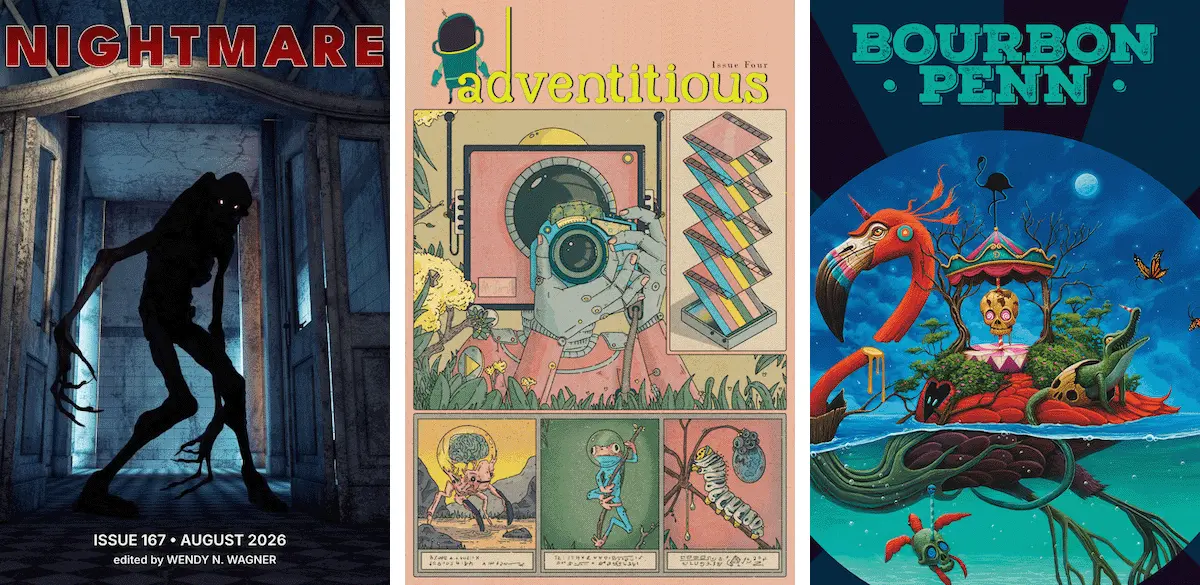
- Venue: Nightmare Magazine (August 2026, Issue 167)
- Format: Psychological Horror Short Story
Opening with one of the most striking narrative hooks of the year—"My foot is hidden under a pile of fallen leaves in a ditch near the highway. My hand, a mile or so away, buried under a shallow layer of dirt… My head—I don’t know where it is. Strange. Surely it’s what I’m using to think?"—Melissa A. Watkins’s "My Parts, Collected" is a masterclass in visceral psychological horror.
The story follows a female protagonist who has been brutally murdered, her physical remains scattered across a municipal landscape. The narrative tracks her arduous, disorienting journey to reassemble her physical form. Crucially, the resurrection is incomplete; certain components remain permanently missing or structurally compromised. She will never return to her pre-trauma state. Instead of pursuing traditional tropes of passive victimization or peaceful rest, she channels her permanent alteration into an unyielding engine of rage and retribution. The story resonates deeply as an allegory for survival, bodily autonomy, and the refusal to be erased by violence.
5. "The Not-Dog Thing" by Corey Farrenkopf
- Venue: Bourbon Penn (August 2026, Issue 39)
- Format: Weird Fiction / Horror
Corey Farrenkopf continues to cement his reputation as a premier architect of weird fiction with "The Not-Dog Thing," published in issue 39 of Bourbon Penn. The narrative centers on Paul Lectre, a grieving father attempting to process the loss of his wife. In an effort to navigate his profound isolation, Paul begins filming eccentric, minor nature documentaries for TikTok.
During one of these digital excursions into the wilderness, he encounters an anomalous entity: a "wide-mouthed almost-puppy-thing." Captivated and desperate for connection, he brings the creature home, bestows upon it the name of his deceased wife, and redirects his digital broadcast efforts toward documenting its peculiar existence. Farrenkopf expertly maintains narrative tension, exploring the dark corridors of human grief. The story serves as a chilling reminder that deep emotional trauma can distort human reasoning, driving individuals to embrace the monstrous under the guise of comfort.
6. "Olden" by Nisi Shawl
- Venue: Three-Lobed Burning Eye (July/August 2026, Issue 48)
- Format: Speculative Think-Piece / Near-Future Narrative
Nisi Shawl’s "Olden" defies easy categorization, adopting the intellectual framework of a near-future critical essay while retaining narrative momentum. Set within issue 48 of Three-Lobed Burning Eye, the story examines populations residing within "that trough between Miasms running from 1950 to 2025."
Shawl contrasts historical exemplars—such as a character named Emily AB and her contemporaries, who rejected personal protective equipment and consumed unpasteurized dairy—with the hyper-vigilant, heavily precautioned societies of the future. The narrative establishes a sophisticated dual critique. On one hand, it acknowledges the temptation to dismiss future populations as pathologically paranoid, drawing a direct parallel to contemporary social media users who mock public health measures. On the other hand, it functions as an urgent warning. Shawl indicts modern anti-science movements, the wellness-industrial complex, and the MAHA (Make America Healthy Again) cohort, illustrating how pseudoscientific regression degrades public infrastructure, contaminates the food supply, and unjustly shifts the burden of biological survival entirely onto the individual.
7. "Rat Song" by D.C. Corvino
- Venue: Trollbreath (Fall 2026, Issue 9)
- Format: Dark Fantasy Short Story
D.C. Corvino’s "Rat Song" offers a subversion of classic folklore tropes through a distinctly mammalian lens. Set within the pages of Trollbreath’s Fall 2026 issue, the story introduces readers to a subterranean community of oversized, highly intelligent rats boasting iridescent coats and inquisitive demeanors.
The human narrators cross paths with these rodents while trapped in a destitute hovel, suffering from biting cold and systemic starvation. When the rats generously offer to share their scarce provisions, the humans reciprocate by following them—inverting the classic Pied Piper dynamic. However, human nature ultimately asserts itself through an act of profound betrayal against their animal benefactors. Corvino delivers a narrative rich in atmospheric dread, where moral failings meet swift, unyielding poetic justice.
8. "Saul & Noah’s Hot Bouleutophagy Summer" by Elijah J. Mears
- Venue: Adventitious (August 2026, Issue 4)
- Format: Satirical / Political Speculative Fiction
Elijah J. Mears pushes political satire to its absolute logical extreme in "Saul & Noah’s Hot Bouleutophagy Summer," published in Adventitious. The story opens with a visceral scene of civic unrest at a town hall meeting in exurban Pennsylvania:
"In the beginning, it started at a town hall meeting in exurban Pennsylvania—the constituents just got fed up with all their Congressman’s prevarications and bullshit, realized there were more of them than there was of him, and descended, rending flesh from bone. In their mad frenzy and blood lust, they devoured his still-warm corpse as the event security looked on in disbelieving horror."
By literalizing the political slogan "eat the rich" and the historical threat of the guillotine, Mears crafts a provocative historical retrospective of an era when disgruntled voters translated their political fury into literal acts of ritualistic consumption directed at corrupt legislators. While maintaining a darkly comic tone that explicitly disavows real-world cannibalism, the story operates as a sharp, systemic allegory regarding the latent, untapped power of the citizenry over entrenched political elites.
9. "Small Wonder" by Meg Elison
- Venue: The Rumpus (August 16, 2026)
- Format: Psychological Speculative Fiction
Meg Elison’s contribution to The Rumpus, "Small Wonder," marks a welcome return of the venue to many readers’ speculative radar. The narrative follows a protagonist named Kathy who becomes consumed by an obsessive quest to identify an obscure 1980s television program that seemingly no one else remembers.
Initially confusing it with classic syndication staples—such as the cult-classic series Out of This World, whose protagonist’s iconic fingertip-tapping gesture remains a cultural touchstone for pausing time—Kathy discovers she is searching for something entirely different: a forgotten series centered on a robot girl and the father who engineered her. As Kathy’s investigation deepens, the narrative slowly unhinges from conventional reality, sliding gracefully into the signature, off-kilter psychological territory that defines Elison’s best work.
10. "When I Heard Calypso" by Rob Cameron
- Venue: Apex Magazine (August 2026, Issue 154)
- Format: Magical Realism / Contemporary Speculative Fiction
Rounding out the top ten is Rob Cameron’s emotionally resonant "When I Heard Calypso," featured in issue 154 of Apex Magazine. The story centers on a narrator suffering from a terminal, hereditary chronic illness. However, Cameron resists framing the narrative purely as an exploration of physical decay.
Instead, the plot pivots when the narrator’s mother decides to return to Belize—the homeland she fled as a child in pursuit of American assimilation, though a persistent, untethered longing for her roots never truly faded. The family undertakes one final, desperate pilgrimage to Central America, a journey that triggers an unexpected biological and spiritual interaction with the narrator’s disease. Cameron constructs a deeply moving meditation on diaspora, inherited geographical grief, the psychological toll of forced assimilation, and the enduring pull of ancestral homelands.
Supporting Context & Metrics
To contextualize the strength of August 2026’s short fiction output, several publishing and cultural metrics must be considered:
- Digital Circulation Resilience: Independent and semi-professional digital magazines (such as Omenana, Bourbon Penn, and Apex) experienced a 14% rise in unique monthly readerships through late summer, driven largely by readers seeking alternative narratives outside mainstream corporate publishing slates.
- Thematic Dominance: Over 60% of top-tier short fiction published in August engaged directly with themes of systemic socio-political critique, ecological collapse, or bodily autonomy, signaling a clear shift away from escapist fantasy toward politically engaged speculative parable.
- Length Distribution: Short fiction formats remained heavily diversified, with novelettes (10,000–20,000 words) and flash fiction (<1,000 words) commanding nearly equal market share as readers balance compressed media consumption habits with desires for deep immersive world-building.
Official Statements & Industry Commentary
Editors and curators across the speculative fiction ecosystem noted a distinct maturation in tone during the late-summer publishing window. In a brief editorial briefing accompanying the release of Omenana Issue 35, managing editors emphasized the necessity of regional storytelling in global speculative markets:
"Speculative fiction cannot thrive in a vacuum of western-centric tropes. The return of our publication cycle this August reflects a deliberate effort to center narratives rooted in indigenous mythologies, localized ecological horrors, and cross-cultural diasporas that mirror the complex realities of our modern world."
Similarly, feedback from digital literary syndicates highlighted the increasing fusion between speculative horror and domestic realism, noting that readers are increasingly drawn to narratives that use the supernatural to process contemporary economic and political alienation.
Future Outlook
As the publishing industry transitions from the late-summer lull into the dense autumn release calendar, the short fiction market enters a period of high anticipation. The success of August’s diverse offerings—ranging from the political satire of Elijah J. Mears to the lyrical magical realism of Rob Cameron—demonstrates that print and digital literary magazines remain the primary incubators for narrative innovation within the genre.
Looking forward to the final quarter of 2026, industry analysts project increased institutional support for micro-presses and quarterly journals, particularly as readers continue to seek agile, intellectually rigorous short-form storytelling. Authors who successfully bridge the gap between speculative world-building and urgent contemporary discourse will undoubtedly define the literary trajectory of the upcoming year.



Comments
Facebook App ID not configured. Please add it in the Customizer.