
For decades, Kyle Chandler has been a fixture of prestige television and major motion pictures, cultivating a diverse, highly respected filmography that spans the length of modern entertainment history. Eschewing the conventional trappings of A-list celebrity—avoiding grueling, superficial press tours, viral soundbites, and red-carpet spectacles—Chandler has forged a career defined strictly by the gravity of his work. While his cultural footprint is permanently anchored by his iconic, Emmy-winning portrayal of Coach Eric Taylor in the critically acclaimed sports drama Friday Night Lights, his broader career resists single-note categorization. From stoic government officials in Super 8 and Zero Dark Thirty to corporate sleaze in The Wolf of Wall Street, Chandler remains an actor’s actor.
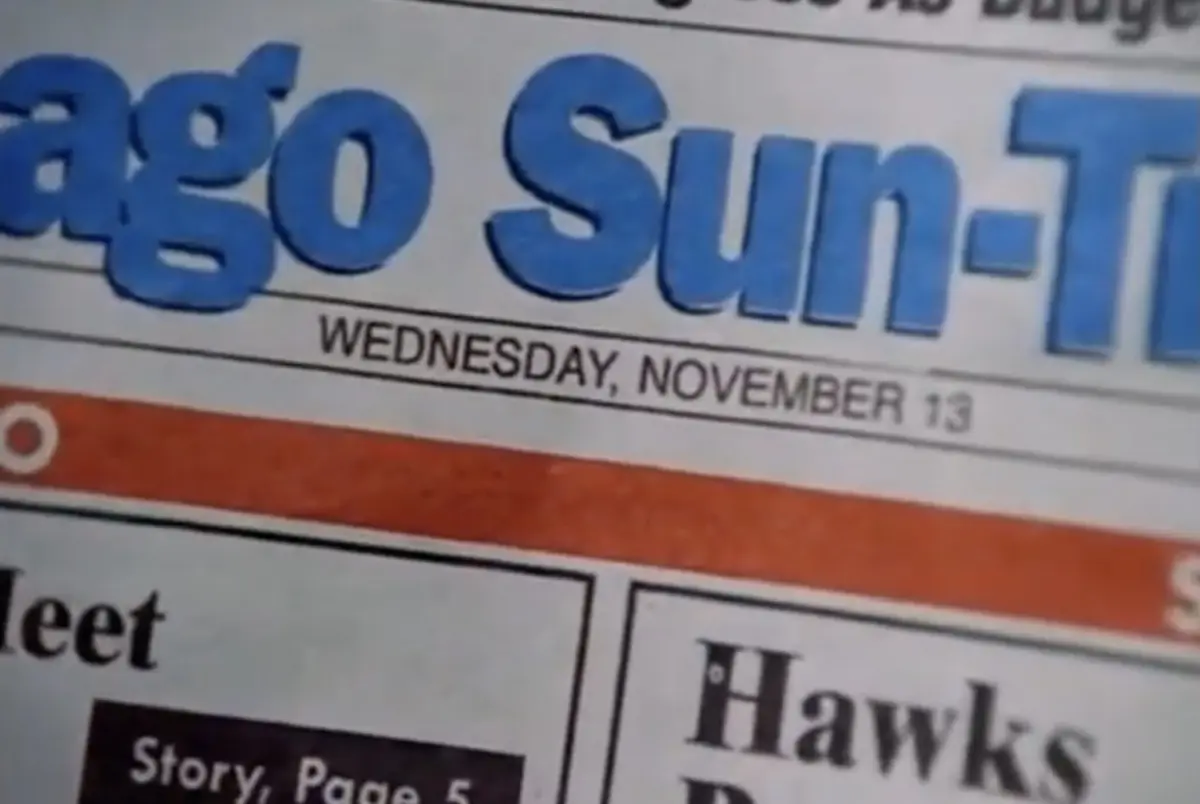
Yet, a dedicated faction of television historians and nostalgia enthusiasts argue that Chandler’s true legacy was struck years before he stepped onto the Dillon Panthers turf. His quintessential television performance remains Gary Hobson: the unwitting, mild-mannered stockbroker who opens his Chicago hotel door each morning to a pristinely folded copy of the Chicago Sun-Times dated tomorrow, accompanied by an enigmatic, orange feline companion of ambiguous temporal and divine origin.
As Early Edition approaches its milestone 30th anniversary this September, the series stands as a fascinating artifact of late-1990s network television. Far from being a mere relic of early-Internet-era CBS programming, the show offers a profound masterclass in episodic moral philosophy. It presents a world where extraordinary powers are not weaponized for global domination or self-aggrandizement, but channeled into the agonizingly human, unglamorous labor of helping total strangers. Though currently trapped in domestic streaming limbo, the series warrants critical reevaluation, nostalgic celebration, and, ideally, a long-overdue digital restoration and streaming revival.
Read Also
Detailed Chronology: The Genesis and Evolution of Early Edition
The Premise and the Pilot
Created by Ian Abrams, Bob Brush, and Patrick Q. Page, Early Edition debuted on CBS on September 28, 1996. The narrative framework was deceptively simple yet brilliantly catalytic: Gary Hobson, recently divorced and struggling to adjust to a solitary existence at the historic Blackstone Hotel in Chicago, suddenly finds himself the recipient of tomorrow’s newspaper today.
Lacking any elaborate origin narrative or superhero suit, Hobson is thrust into the role of a municipal savior. The rules governing the paper’s delivery are rigid: it arrives every morning at 6:30 AM, regardless of Gary’s geographic location, and it details catastrophes, crimes, and personal tragedies scheduled to occur in the Windy City over the next twenty-four hours.
The origin of this temporal anomaly is intentionally shrouded in ambiguity. While characters throughout the series uncover hints of a clandestine, quasi-supernatural lineage of "paper holders"—revealing that Gary was chosen because his childhood life was saved by a previous recipient—the show steadfastly refuses to offer neat, dogmatic answers. Gary’s burden is thrust upon him by forces unknown, leaving him to grapple not with why he has been chosen, but what he intends to do with the tragic knowledge laid at his feet.
Key Evolutionary Phases of the Series
- The Stockbroker Era (Seasons 1–2): The initial phase of the series focuses on Gary’s uneasy transition from high-powered finance to municipal intervention. Alongside his sharp-witted, legally blind coworker Marissa Clark (Shanesia Davis-Williams) and his cynical, money-obsessed friend Chuck Fishman (Fisher Stevens), Gary attempts to balance the demands of the paper with his old life. Chuck constantly schemes to exploit the paper for personal financial gain—such as betting on horse races or dabbling in insider trading—serving as a pragmatic foil to Gary’s escalating moral compulsion to help others.
- The Expansion of the Inner Circle: Following Chuck’s departure at the end of Season 2, the show organically expanded its core dynamic. Marissa officially quits the corporate grind to become Gary’s full-time dispatcher and moral anchor, while Detective Patrick Quinn (Paul Ben-Victor) enters the fold, adding an institutional layer of police procedural tension to Gary’s clandestine operations.
- The Community Anchor Era (Seasons 3–4): Recognizing the logistical necessity of a permanent base of operations, Gary eventually transitions from the Blackstone Hotel to running a neighborhood bar. This narrative shift cemented Early Edition’s thematic core: Gary was no longer just a transient do-gooder passing through hotel rooms; he was a literal and figurative "third space" anchor, weaving himself directly into the fabric of the Chicago community he sought to protect.
Supporting Context & Metrics: The 1990s Landscape of Existential Anxiety
To fully comprehend the cultural resonance of Early Edition, one must examine the socio-cultural zeitgeist of the late 20th century. Paradoxically, an era officially remembered as a period of unprecedented economic stability and post-Cold War optimism was, culturally, drowning in acute existential dread.

The Cynicism of 90s Media
An analysis of the dominant cinematic and televisual landscapes reveals an overarching cultural psychosis characterized by institutional mistrust and apocalyptic anxiety:
- Disaster and Extinction Thrillers: The box office was dominated by systemic annihilation narratives, including Deep Impact, Twister, Dante’s Peak, Armageddon, and 12 Monkeys.
- Paranoia and Institutional Collapse: Television and film reflected a deep-seated suspicion of authority structures, popularized by The X-Files, The Fugitive, and The Matrix.
- Technological Dystopia: The dawn of the digital age bred profound technological anxieties, as evidenced by Terminator 2: Judgment Day, The Arrival, and Johnny Mnemonic.
- The Sitcom Reckoning: Even lighter fare leaned heavily into misanthropy. The decade culminated with cultural touchstone sitcoms like Seinfeld, whose infamous series finale literally placed its protagonists on trial for being morally bankrupt narcissists.
+-------------------------------------------------------------------------+
|                  THE 1990s MEDIA POLARIZATION METRIC                    |
+---------------------------+---------------------------------------------+
| Dominant Cinematic Genre  | Apocalyptic Disasters, Tech-Dystopia,       |
|                           | Anti-Authoritarian Paranoia                 |
+---------------------------+---------------------------------------------+
| Dominant Sitcom Tone      | Irony, Misanthropy, Narcissism              |
+---------------------------+---------------------------------------------+
| Romantic Comedy Trope     | Capitalist Perils, Deception, Social Flight |
+---------------------------+---------------------------------------------+
| The Antidote Niche        | "Do-Gooder" Episodic Dramas                 |
|                           | (*Early Edition*, *Quantum Leap*,           |
|                           |  *Due South*, *Northern Exposure*)          |
+---------------------------+---------------------------------------------+
Against this backdrop of systemic cynicism, network television carved out a vital counter-genre: the episodic morality play centered on the premise that ordinary individuals can heal fractured communities one localized act of kindness at a time. Series like Quantum Leap, Due South, and Northern Exposure shared a spiritual DNA with Early Edition. They featured ticking clocks, fish-out-of-water protagonists, and an unshakeable belief in the compounding moral interest of small deeds—a thesis famously validated in Quantum Leap’s transcendent finale, where Sam Beckett learns that every minor life saved ripples outward exponentially across history.
The Economics of Locational Authenticity
Early Edition distinguished itself through an uncompromising commitment to geographic realism. Eschewing the industry standard practice of shooting Chicago-set narratives on West Coast backlots or in Vancouver, the production filmed extensively on location in the Windy City.
For Chicagoans, who have historically guarded their architectural and cultural identity against lazy cinematic facsimiles (a frequent critique leveled even at contemporary hits like Chicago Hope), this authenticity was transformative. The Chicago Sun-Times was not a generic prop; it was an active participant in the city’s topography. The show utilized the city’s soaring skyscrapers, freezing winter winds, and distinct neighborhoods not merely as backdrops, but as vital characters that shaped the narrative gravity of Gary Hobson’s weekly trials.
Official Statements and Critical Perspective
While industry retrospectives often categorize Early Edition alongside faith-based programming of the era—largely due to its syndication history on networks like the Hallmark Channel and Fox Family, where it kept company with Touched by an Angel and Dr. Quinn, Medicine Woman—such reductive labeling misses the show’s secular sophistication.
Media scholars and cultural critics have increasingly pointed out that Early Edition operates on a plane distinct from dogmatic religious television. Unlike contemporaries that leaned heavily on explicit theological declarations, Gary Hobson’s journey is defined by existential inquiry rather than divine certainty.
In a retrospective essay examining the series’ structural philosophy, cultural critic Leah Schnelbach noted:

"Never mind being a big deal hero—being a decent human being is work. You don’t get powers or cheat codes or a narrative that skips to the interesting parts. And that’s what shows like Early Edition were always poised to remind us. It’s impossible to stream anywhere at the moment, which is a shame. On its thirtieth birthday, I’d say a little revival is well overdue."
Furthermore, the show’s refusal to provide easy answers regarding the metaphysics of the newspaper elevates its ethical framework. Gary Hobson does not help people because he is fulfilling a divine quota or securing a ticket to heaven; he helps people because he holds the information, and to look away from suffering with foreknowledge of its occurrence is a moral failure. The existential burden belongs entirely to the individual.
Future Outlook: The Case for a 30th-Anniversary Revival
As television enters an era dominated by hyper-serialized grimdark antiheroes, cosmic cinematic universes, and relentless reboots of exhausted intellectual properties, the absence of Early Edition from the modern streaming ecosystem feels like a glaring omission.
+-------------------------------------------------------------------------+
|                  STRATEGIC OUTLOOK: EARLY EDITION REBOOT                |
+-------------------+-----------------------------------------------------+
| Current Status    | Unavailable on major subscription streaming platforms|
+-------------------+-----------------------------------------------------+
| Milestone Horizon | 30th Anniversary (September 28, 2026)               |
+-------------------+-----------------------------------------------------+
| Market Opportunity| High demand for comforting, character-driven moral  |
|                   | procedurals ("Cozy TV" demographic)                 |
+-------------------+-----------------------------------------------------+
| Recommended Path  | Digital remastering, AVOD/SVOD licensing roll-out,  |
|                   | followed by a modern legacy sequel/reboot concept   |
+-------------------+-----------------------------------------------------+
The logistical barriers to rediscovering the series are frustratingly archaic. Rights fragmentation between CBS/Paramount and legacy distribution channels has left the four-season, 90-episode run trapped in standard-definition physical media obscurity, save for fragmented, low-resolution clips circulating on YouTube.
However, the cultural climate of the mid-2020s is uniquely primed for a resurgence of the "cozy procedural" with moral weight. Audiences fatigued by apocalyptic prestige dramas increasingly seek narrative comfort anchored in ethical integrity and community stewardship.
As September 28, 2026, approaches—marking exactly three decades since Gary Hobson first stepped out of his Blackstone Hotel room to find tomorrow’s news waiting for him—the television industry faces an open invitation. Whether through a long-awaited digital remastering for streaming platforms or a legacy sequel acknowledging the enduring legacy of Chicago’s most reluctant guardian, Early Edition remains an essential masterclass in empathy.
The paper arrives tomorrow, detailing the fractures in our world. The only remaining question is identical to the one posed thirty years ago: What are you planning to do about it?

Comments
Facebook App ID not configured. Please add it in the Customizer.