
Executive Overview
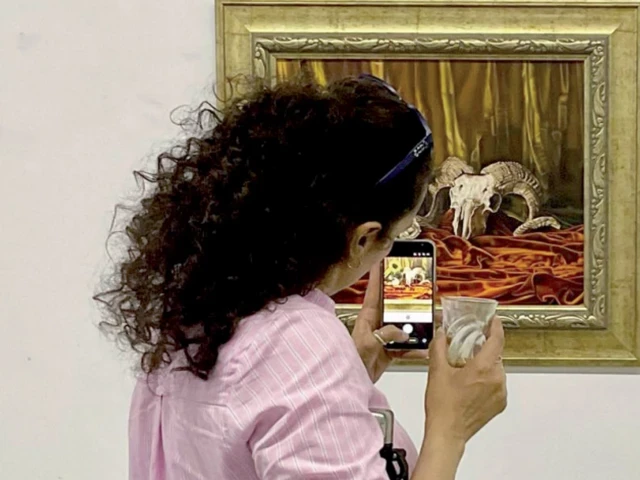
The contemporary art landscape in Pakistan has long served as a vital mirror reflecting the complexities of socio-political dynamics, collective memory, and individual trauma. However, it is rare for an exhibition to turn the analytical lens inward with such unrelenting, raw precision. Entering the minimalist, contemplative spaces of the Sanat Initiative in Karachi, visitors are immediately confronted with Morbid Curiosities, the latest solo exhibition by distinguished Karachi-based artist Scheherazade Junejo.
Curated as a deeply intimate, multi-layered self-investigation, Morbid Curiosities brings together nearly a year of rigorous creative labor, synthesizing three distinct yet profoundly interconnected bodies of work: A Wrinkle, The Infinite Loop, and Glass Animals. Spanning diverse mediums—including still-life compositions, figurative pieces, intricate drawing, and tactile embossing—the exhibition maps Junejo’s existential navigation through the thresholds of memory, genetic inheritance, bodily contradictions, and the inevitable psychological shifts of aging.
For Junejo, this exhibition marks a critical watershed moment in a career spanning close to two decades. Having established a widely recognized and commercially successful signature visual identity over the past 16 to 17 years, the artist made the courageous choice to dismantle her own aesthetic conventions. Morbid Curiosities is not merely a showcase of new works; it is a profound artistic rebirth. It captures the transition from young adulthood into the nuanced, unyielding complexities of middle age. By embracing the darker, more uncomfortable aspects of human consciousness, Junejo challenges both herself and her audience to move beyond the superficial pursuit of aesthetic comfort, stepping instead into the vulnerable, often unsettling terrain of authentic self-interrogation.
Read Also
Detailed Chronology & Structural Breakdown of the Exhibition
Developed meticulously over a nine-to-ten-month incubation period, Morbid Curiosities is structured as a tripartite journey. Each segment functions as a distinct psychological chamber, addressing fundamental existential inquiries: Who am I? Where am I going? And what am I going to become? Rather than offering neat narrative resolutions, Junejo’s triptych maps the cyclical, obsessive, and frequently contradictory nature of human thought and memory.
1. A Wrinkle: The Visual Archive of the Overthinking Mind
The first component of the exhibition, A Wrinkle, serves as the psychological entry point into Junejo’s internal landscape. Characterized by intensive, repetitive mark-making, this series acts as a direct visual translation of an overactive, ruminative mind.
In A Wrinkle, ideas are not presented as fully formed conclusions; instead, they are continuously revisited, interrogated, dismantled, and reconstructed. The repetitive strokes mirror the human tendency to loop through past decisions, unresolved conflicts, and existential anxieties. Through this obsessive drafting and mark-making, Junejo elevates the neurological experience of anxiety and rumination into a sublime visual language, creating a physical record of thoughts that refuse to settle.
2. The Infinite Loop: Navigating Genetic and Material Inheritance
Moving deeper into the exhibition, The Infinite Loop expands the investigative scope from immediate psychological states to the broader, inescapable frameworks of material and genetic inheritance. Here, Junejo examines how past generations echo within the contemporary self.
This body of work explores the cyclical nature of human behavior, familial conditioning, and the biological traits passed down through lineage. The "loop" implies a sense of entrapment, yet it also offers an opportunity for awareness. By confronting the repetitive patterns embedded in her own genetic and material history, Junejo attempts to decode the invisible forces that shape personal identity, questioning how much of the self is truly autonomous versus inherited.
3. Glass Animals: The Fragility of Memory and Bodily Contradictions
The final section of the exhibition, Glass Animals, introduces a striking juxtaposition between strength and fragility, physical form and emotional residue. Drawing on figurative elements and still-life arrangements, this body of work addresses the delicate, easily shattered nature of memory and the inherent contradictions of the human body.
The metaphor of glass—transparent yet razor-sharp, resilient yet prone to catastrophic fracture—encapsulates Junejo’s view of human vulnerability as one ages. As the physical body undergoes inevitable transformations, the psychological self must adapt to these shifting boundaries. Glass Animals captures the tension between the desire to preserve delicate memories and the brutal reality of their decay, culminating in an exploration of emotional exposure and resilience.
Supporting Context & Metrics: Artistic Evolution and the Karachi Art Scene
To fully comprehend the significance of Morbid Curiosities, one must examine the context of Scheherazade Junejo’s trajectory within the contemporary Pakistani art ecosystem. Over the last seventeen years, Junejo cultivated a distinct, highly identifiable artistic vocabulary—one that resonated strongly with collectors and critics alike. In the commercial art market, establishing a recognizable "signature style" is often treated as the ultimate marker of success; it provides brand consistency and market stability.
However, artistic stagnation often lurks behind commercial safety. Junejo’s decision to disrupt her own visual signature represents a rare act of creative bravery. This evolution reflects a broader shift within Karachi’s vibrant contemporary art community, where artists are increasingly rejecting rigid commercial categorizations in favor of raw, authentic psychological exploration.
Technical Synthesis and Medium Diversity
Morbid Curiosities showcases Junejo’s technical versatility across a wide array of mediums:
- Still Life: Utilized to anchor abstract emotional concepts within tangible, everyday objects, imbuing them with heavy symbolic weight.
- Figurative Pieces: Employed to map the anatomical and psychological shifts associated with bodily aging and identity formation.
- Drawing and Embossing: Serving as tactile, low-relief mediums that require physical pressure and precision, mirroring the emotional friction of the creative process.
The following data breakdown outlines the structural and thematic parameters of the exhibition:
| Exhibition Parameter | Detail / Metric |
|---|---|
| Venue | Sanat Initiative, Karachi |
| Featured Artist | Scheherazade Junejo |
| Development Period | 9 to 10 months of intensive studio practice |
| Core Structure | 3 Interconnected Bodies of Work (A Wrinkle, The Infinite Loop, Glass Animals) |
| Career Milestone | Marks a deliberate break from a 16–17 year established signature visual style |
| Primary Mediums | Still life, figurative works, drawing, and embossing |
| Central Theme | Self-investigation, identity evolution, memory, and inherited experiences |
Official Statements and Critical Insights
Speaking candidly with The Express Tribune, Scheherazade Junejo elaborated on the conceptual underpinnings and psychological impetus driving Morbid Curiosities. She emphasized that while the three bodies of work possess distinct visual narratives, they are fundamentally unified by a singular, relentless drive toward self-discovery.
"The narrative of the three bodies of work is a little different, but in a way, it is the same. It is a self-investigation," Junejo explained during her interview.
Detailing the core philosophical questions that steered her creative process over the ten-month period, the artist noted:
"The exhibition revolves around fundamental questions of identity and existence: ‘Who am I? Where am I going? And what am I going to become?’"
Addressing the monumental shift in her artistic practice after nearly two decades of working within a familiar visual paradigm, Junejo reflected on the natural catalysts of human aging and psychological maturation:
"My signature, which has become my work and my identity through my work, has changed a lot with this work. Growing older naturally brings changes in one’s thought process, experiences, and questions. This is a kind of transition from young adulthood to adulthood, middle-aged life. So, the questions go into more depth."
Furthermore, Junejo highlighted that engaging with darker, more uncomfortable emotional spaces requires a level of artistic maturity and personal confidence that she has only recently unlocked. Rather than shying away from distressing or difficult realizations, she has chosen to lean into them.
"For me, the exhibition ultimately reflects a willingness to confront the self rather than simply present aesthetically pleasing images. Its three parts move between the exposed surface of thought, the contradictions of the body, and the fragile world of memory," she concluded.
Art critics and cultural observers visiting the Sanat Initiative have echoed these sentiments, noting that Morbid Curiosities succeeds precisely because it refuses to pander to commercial demands for easy beauty. Instead, it offers an uncompromising look at the psychological friction of growing older, cementing Junejo’s status as one of the most intellectually fearless contemporary artists operating in Pakistan today.
Future Outlook: The Legacy and Trajectory of Morbid Curiosities
As Morbid Curiosities continues its run at the Sanat Initiative, its reverberations are already being felt across Pakistan’s broader cultural sector. The exhibition serves as a timely reminder of the vital role contemporary art plays in processing the invisible, internal shifts of human existence. In a society frequently preoccupied with external turbulence—political volatility, economic shifts, and social transitions—Junejo’s inward gaze offers a necessary sanctuary for collective and individual reflection.
Looking forward, the stylistic rupture demonstrated in Morbid Curiosities signals an exciting new chapter in Scheherazade Junejo’s artistic career. By successfully shedding the protective skin of her earlier, highly commercialized aesthetic, she has opened up vast new territories for future exploration. The technical mastery she displayed in handling embossing, intricate mark-making, and figurative deconstruction suggests that her upcoming projects will likely delve even deeper into the intersection of somatic memory and abstract psychological states.
For the Karachi art scene, Junejo’s exhibition serves as an inspiring blueprint for artistic longevity. It demonstrates that true mastery lies not in the uncritical repetition of past successes, but in the courage to unlearn, destabilize, and relentlessly interrogate the self. As Morbid Curiosities closes its chapter at Sanat Initiative, its legacy will endure as a benchmark for introspective contemporary art—proving that the most profound journeys an artist can undertake are those that venture into the dark, uncharted waters of one’s own mind.


Comments
Facebook App ID not configured. Please add it in the Customizer.