
Executive Overview
In the fast-paced, perpetually shifting landscape of modern fashion, few design houses dare to challenge the very fabric of materiality quite like ANREALAGE. Founded by visionary Japanese designer Kunihiko Morinaga, the avant-garde brand has long blurred the boundaries between high art, textile science, and futuristic engineering. At Paris Fashion Week—which commenced on September 29—ANREALAGE once again upended industry norms by debuting its 2027 “SKIN” collection. The centerpiece of this provocative showcase: a series of revolutionary color-changing dresses engineered in partnership with E Ink, the pioneer of electronic paper technology.
This creative union merges traditional Japanese textile craftsmanship with cutting-edge, low-power material science. By integrating E Ink Prism 3 technology into six bespoke garments, ANREALAGE has transcended the traditional limitations of static fashion. No longer is a garment’s aesthetic locked into a singular, permanent state woven during its production. Instead, through programmable color-shifting surfaces, a single dress can seamlessly transform into multiple distinct outfits right before the observer’s eyes.
This deep-dive report explores the mechanics of this groundbreaking collaboration, detailing the technical architecture of E Ink Prism, the artistic philosophy of Kunihiko Morinaga, and the broader implications this partnership holds for sustainability, personalization, and the future of wearable technology.
Read Also
Detailed Chronology: From Concept to the Paris Runway
The journey toward the 2027 “SKIN” collection did not happen overnight. It represents the culmination of years of experimentation by Morinaga, who has consistently used technology—ranging from ultraviolet-reactive dyes and photochromic fabrics to augmented reality and spatial sound—to question how humans perceive clothing.
The Genesis of the "SKIN" Collection
Long before models stepped onto the Paris runway in matching blue scalloped-sequin dresses, the ANREALAGE team and E Ink engineers began laying the groundwork for a textile revolution. Traditional digital displays, such as the LED or OLED screens often seen in experimental tech-wear, suffer from severe limitations in the fashion space: they are heavy, rigid, fragile, require continuous high-voltage power sources, and emit blinding light that clashes with the organic aesthetic of haute couture.
To bypass these hurdles, Morinaga turned to E Ink. Unlike conventional glowing panels, E Ink technology is reflective, mimicking the natural way ink sits on paper. It relies on ambient environmental light to communicate color and pattern, making garments look and feel natural under the harsh glare of runway spotlights and flashing paparazzi cameras alike.
The Paris Fashion Week Reveal
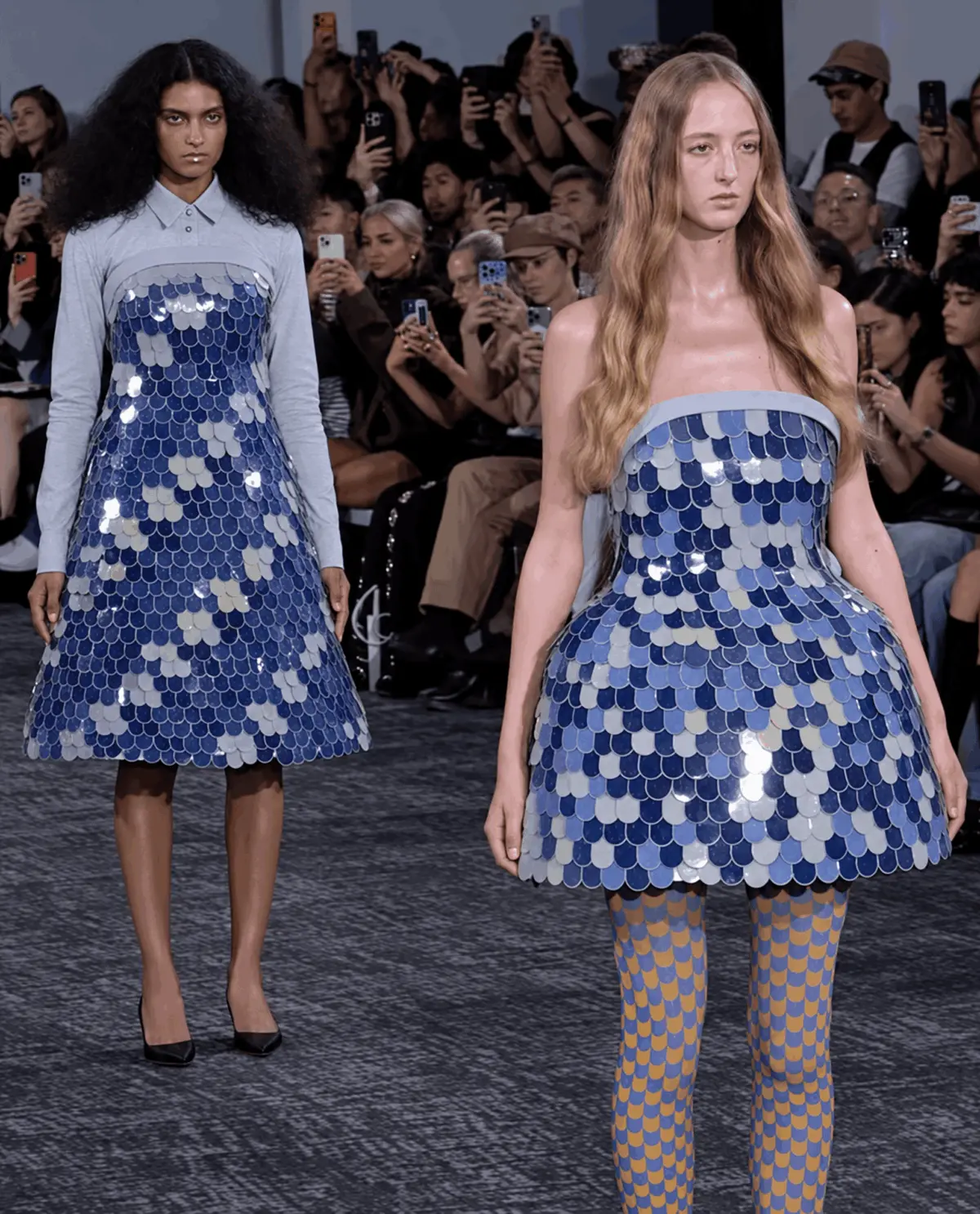
On September 29, the global fashion capital held its collective breath as the first models took to the runway. At first glance, the garments appeared as stunning, masterfully tailored pieces of traditional haute couture: architectural silhouettes adorned with intricate blue scalloped sequins.
However, as the models paused under the lights, the garments underwent a breathtaking metamorphosis. The scales shifted, altering the visual texture and color profile of the dresses in real-time. Photographers scrambled to capture the moment as the garments morphed into entirely new stylistic iterations without a single thread being altered or a single garment being swapped backstage. The presentation proved that programmable materials could achieve the fluidity, grace, and elegance demanded by high fashion.
Technical Anatomy: Inside the E Ink Prism-Infused Garments
To understand the magnitude of the ANREALAGE and E Ink collaboration, one must examine the intricate engineering required to adapt industrial electronic paper for human wear.
The Scale-Like Architecture
For the “SKIN” collection, each color-changing dress was constructed using approximately 1,000 to 2,000 individual E Ink Prism elements. Rather than deploying a monolithic, flat screen across the torso—which would destroy the drape, flexibility, and comfort of the garment—designers arranged the electronic segments in an overlapping, scale-like pattern.
This meticulous arrangement serves a dual purpose:
- Aesthetic Harmony: The scale-like design mimics natural biological forms (such as reptile skin or fish scales), tying directly into the collection’s “SKIN” motif while hiding the modular nature of the technology.
- Mechanical Flexibility: By breaking the display down into thousands of smaller, articulate pieces, the fabric retains enough elasticity and drape to move fluidly with the human body during a runway walk.
What is E Ink Prism?
E Ink Prism is a dynamic material technology originally developed to bring programmable color and patterned surfaces to objects of all shapes and sizes. While early iterations of electronic paper were strictly black-and-white and reserved for e-readers like the Kindle, modern advancements have unlocked sophisticated color manipulation and multi-shade capabilities.
The core physics of E Ink technology rely on electrophoresis—the movement of charged pigment particles suspended in a clear microcup or microcapsule fluid under the influence of an electric field.

- Reflective Display: Because it reflects ambient light rather than generating its own illumination, E Ink Prism avoids the artificial glare of digital screens, ensuring garments look authentic in natural and studio lighting.
- Bistable Properties: One of the most remarkable features of E Ink is its bistable nature. An image or color state remains permanently in place without continuously drawing electrical current. Energy is consumed only when the display actively transitions from one state to another. This efficiency makes it remarkably practical for wearable applications, where battery weight and longevity are critical concerns.
Supporting Context & Metrics: The Intersection of Fashion and Sustainability
While the visual spectacle of Paris Fashion Week captured the headlines, the underlying currents of the ANREALAGE x E Ink collaboration speak to a much larger global conversation: sustainability, fast-fashion fatigue, and the circular economy.
The Sustainability Crisis in Modern Apparel
The fashion industry is notoriously one of the most resource-intensive and polluting sectors in the world. Consumers are increasingly pressured to purchase vast quantities of clothing to keep up with hyper-accelerated micro-trends. The carbon footprint associated with manufacturing, dyeing, shipping, and ultimately discarding millions of tons of textiles annually has pushed designers to seek radical alternatives.
How Programmable Textiles Redefine Sustainability
By embedding E Ink Prism technology into garments, ANREALAGE introduces a profound paradigm shift: multiplexed utility through a single physical asset.
- Wardrobe Multiplication: A single dress equipped with E Ink scales can theoretically manifest dozens, if not hundreds, of different visual patterns, colors, and textures.
- Reduced Material Consumption: Instead of purchasing ten distinct dresses for ten different occasions, a consumer could own one foundational garment that adapts its digital skin to suit the environment, the mood, or the event.
- Zero-Waste Dyeing: Traditional textile coloring requires massive amounts of water, toxic chemical dyes, and energy-heavy washing processes. Electronic paper bypasses traditional dyeing for the dynamic portions of the garment, shifting the environmental cost from chemical manufacturing to clean, programmable electronic rendering.
Official Statements and Industry Perspective
The partnership has generated significant buzz across both the technology and fashion sectors, bridging two industries that have historically operated in isolated silos.
Naoki Sumita, President of E Ink Japan, emphasized the philosophical alignment between the two entities during the post-show press rollout:
"ANREALAGE has a long history of combining craftsmanship, technology, and imagination in ways that challenge how we see everyday materials. That ethos closely aligns with E Ink’s vision of transforming traditionally static surfaces into dynamic, expressive experiences. This collaboration demonstrates how E Ink Prism can unlock new possibilities for personalization, movement, and visual expression."
Kunihiko Morinaga, the creative force behind ANREALAGE, has long maintained that clothing should act as a second skin—not merely a static covering, but a living, breathing interface between the human body and the external world. By incorporating E Ink’s advanced material science into the 2027 collection, Morinaga has transformed wearable art into an interactive medium where the wearer becomes the author of their own aesthetic in real-time.
Future Outlook: Where Do We Go From Here?
The debut of the “SKIN” collection at Paris Fashion Week marks a watershed moment, but it is merely the opening chapter for programmable fashion. As we look toward the future, several critical vectors will dictate how this technology evolves from exclusive runway haute couture into broader commercial markets.
1. Miniaturization and Durability Improvements
For E Ink fashion to transition from high-end runway pieces to ready-to-wear consumer markets, the underlying hardware must become even more rugged, washable, and affordable. Future iterations will likely focus on seamless integration into everyday washable textiles, allowing users to safely launder garments without damaging the delicate micro-circuits powering the electronic scales.
2. Consumer-Controlled Customization via Mobile Apps
Imagine walking down the street in a jacket or dress that changes its pattern based on your smartphone’s playlist, the weather outside, or your immediate emotional state. As Bluetooth and near-field communication (NFC) modules shrink and become more energy-efficient, the ability for wearers to instantly program their outfits via mobile applications will become the next logical frontier.
3. Expanding Beyond Dresses into Accessories
While ANREALAGE proved the concept using stunning floor-length dresses, the applications for E Ink Prism extend far beyond haute couture. Industry analysts predict rapid adoption in:
- Luxury Handbags and Wallets: Accessories that can alter their aesthetic texture and color to match changing wardrobes on the fly.
- Automotive Interiors: Customizable dashboard panels and seat fabrics that reflect personalized moods or branding.
- Smart Consumer Electronics Cases: Protective covers that transform their exterior appearance dynamically.
Conclusion
The collaboration between E Ink and ANREALAGE at Paris Fashion Week is much more than a clever gimmick designed to turn heads on the runway. It is a visionary glimpse into a future where the line between software and textile dissolves entirely. By proving that electronic paper can drape, move, and breathe with the human body, this partnership has laid the groundwork for a more sustainable, expressive, and infinitely adaptable era of human clothing. As the technology matures, we may soon live in a world where our wardrobes are no longer defined by what we buy, but by what we choose to imagine.


Comments
Facebook App ID not configured. Please add it in the Customizer.