
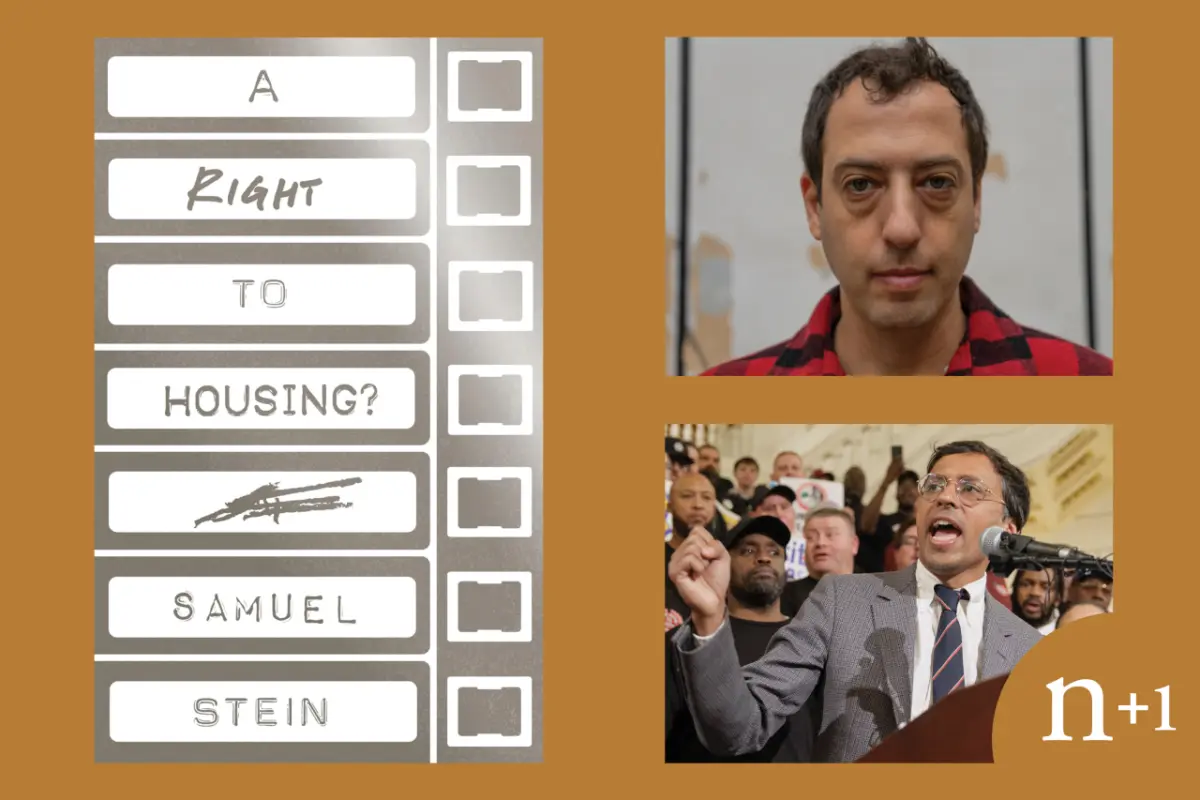
The contemporary crisis of housing accessibility has evolved from a localized urban inconvenience into a systemic, global emergency. Across major metropolitan centers, the foundational premise that shelter constitutes a basic human right has been systematically eclipsed by the relentless pressures of financialization, speculative real estate development, and institutional neglect. It is within this volatile socio-political landscape that urban scholar Samuel Stein returns with his highly anticipated new volume, A Right to Housing?, published by Verso.
To mark the launch of this critical work, literary and political journal n+1 is hosting a public celebration and discussion on Tuesday, September 8. Stein will be joined in conversation by former n+1 co-editor and prominent political figure Nikil Saval at the n+1 office located in Greenpoint, Brooklyn. This event—free, accessible, and accompanied by refreshments—serves as more than a standard book launch; it functions as an intellectual rallying point for activists, tenants, urban planners, and policymakers grappling with the intractable housing quagmire of the twenty-first century.
Early critical reception for A Right to Housing? indicates that Stein’s latest contribution will immediately enter the canon of essential reading for housing justice movements. Scholars and authors such as Gail Radford (Modern Housing in America), David Madden (In Defense of Housing), and Amanda Huron (Carving out the Commons) have lauded the book for its unsparing intellectual rigor, tactical relevance, and profound engagement with the structural impossibilities of modern housing policy.
Read Also
This comprehensive report examines the upcoming event within the broader context of Stein’s intellectual trajectory, the structural drivers of the modern housing crisis, the perspectives of the key participants, and the long-term outlook for housing justice movements in the United States and beyond.
Detailed Chronology: The Evolution of Urban Housing Politics and the Path to A Right to Housing?
To understand the urgency of Samuel Stein’s A Right to Housing?, one must trace the historical trajectory of how shelter transitioned from a social good to a speculative asset class. The intellectual architecture of modern housing advocacy was forged in the mid-twentieth century, an era when post-war social democracies briefly experimented with large-scale public housing, rent regulations, and urban planning designed to de-commodify domestic space. However, the subsequent decades witnessed a coordinated neoliberal rollback. Through policies of urban renewal, austerity, and the deregulation of real estate markets, governments systematically dismantled the social safety net, leaving housing increasingly vulnerable to global capital flows.
Samuel Stein emerged as a defining voice of the post-2008 generation of urban critics. Following the subprime mortgage crisis—which exposed the predatory underpinnings of the American mortgage market and displaced millions of working-class families—urban scholarship shifted its focus toward real estate statecraft. Stein’s previous work, including his influential 2019 book Capital City: Gentrification and the Real Estate State, mapped the ways in which municipal governments transitioned from administrative bodies serving residents into municipal real estate brokerages maximizing property values and developer windfalls.
The conceptual progression from Capital City to A Right to Housing? reflects a maturation of Stein’s analytical framework. While Capital City diagnosed how the real estate state operates, A Right to Housing? confronts the existential dilemmas and political paradoxes of demanding structural change within a system structurally hostile to de-commodified space. The book captures the contradictions of advocating for a "right to housing" in a legal and economic order built upon private property rights and capital accumulation.
The announcement of the September 8 launch event at the n+1 office represents a culmination of this ongoing discourse. n+1, known for its incisive cultural and political critique, has long provided a intellectual home for writers addressing the material crises of contemporary capitalism. Pairing Stein with Nikil Saval—a writer deeply attuned to the intersections of labor, urban space, and political organizing—ensures that the conversation will transcend abstract theoretical debate, grounding itself in the tactical realities facing contemporary urban social movements.
Supporting Context & Metrics: The Anatomy of the Contemporary Housing Crisis
The publication of A Right to Housing? arrives at a moment of unprecedented housing precarity across the United States. To fully appreciate the weight of Stein’s arguments and the discussions expected at the Greenpoint event, one must examine the macroeconomic indicators, systemic metrics, and socio-economic pressures defining the current housing conjuncture.
The Affordability Gap and Rent Burden
According to data compiled by the Harvard Joint Center for Housing Studies, the number of cost-burdened households—those spending more than 30 percent of their income on housing—has reached historic highs. More than half of all renters in the United States now fall into this category, with a staggering proportion classified as severely cost-burdened (spending over 50 percent of their income on rent and utilities). This affordability crisis is not isolated to coastal mega-regions like New York City, San Francisco, or Boston; it has metastasized into secondary and tertiary markets, driven by corporate landlord acquisitions, short-term rentals, and stagnant wages relative to construction and land costs.
The Financialization of Shelter
At the heart of Stein’s critique is the phenomenon of financialization—the increasing dominance of financial actors, metrics, and motives in the operation of the housing market. In the wake of the 2008 foreclosure crisis, private equity firms, real estate investment trusts (REITs), and institutional investors swept up hundreds of thousands of single-family homes and multi-family apartment complexes. By treating residential housing primarily as yield-generating assets for pension funds and global wealth portfolios, these entities systematically drive up rents, defer necessary maintenance, and displace long-term community members.
The Illusion of Supply-Side Solutions
Mainstream economic orthodoxy frequently posits that the housing crisis is exclusively a product of supply shortages, arguing that simple deregulation and accelerated market-rate construction will naturally correct pricing imbalances through "trickle-down" mechanisms. Stein, alongside other critical urban theorists, challenges this simplistic narrative. While physical units are undeniably necessary, building luxury developments in gentrifying neighborhoods often accelerates displacement, alters neighborhood demographics, and inflates surrounding land values without alleviating the acute need for deeply affordable, rent-stabilized, or socially owned housing.
The Legal and Constitutional Vacuum
Unlike healthcare or education in various international contexts, housing lacks an explicit, enforceable constitutional guarantee in the United States. While international human rights frameworks, such as the United Nations Universal Declaration of Human Rights, recognize adequate housing as a fundamental component of an adequate standard of living, American jurisprudence heavily privileges property rights and landlord prerogatives over tenant security. This legal vacuum leaves tenants vulnerable to arbitrary evictions, retaliatory landlord practices, and structural homelessness.
Official Statements and Critical Perspectives
The anticipation surrounding A Right to Housing? is underscored by endorsements from leading housing scholars, activists, and critics who have engaged with Stein’s manuscript. These perspectives illustrate the book’s dual utility as both a theoretical interrogation and an activist toolkit.
Gail Radford, author of Modern Housing in America, emphasizes the practical application of Stein’s work for frontline organizers:

"Highly recommended for activists of all stripes, but a must-read for everyone who has struggled to instantiate a human right to housing."
Radford’s praise highlights Stein’s ability to bridge the gap between high-level macro-political critique and the grassroots realities of tenant organizing, rent strikes, and legislative advocacy campaigns.
David Madden, co-author of In Defense of Housing, points to the timeliness of the work within the current political economy:
"A deeply thoughtful and provocative exploration of housing politics in the current conjuncture."
Madden’s assessment speaks to Stein’s capacity to read the shifting terrain of post-pandemic urban politics, where inflation, interest rate fluctuations, and post-lockdown real estate shifts have generated new forms of urban vulnerability and resistance.
Perhaps most revealing is the perspective offered by Amanda Huron, author of Carving out the Commons:
"What a pleasure to see inside the doubting mind of Samuel Stein as he grapples with the impossibility of our housing quagmire. If you too have the uncomfortable suspicion that solving housing might be hopeless: read this book."
Huron’s commentary touches on a vital psychological and political dimension of contemporary housing activism: the pervasive sense of despair that accompanies fighting an entrenched, multi-billion-dollar real estate apparatus. By openly confronting the systemic "impossibility" of the housing quagmire rather than offering empty, technocratic optimism, Stein provides a sobering yet generative roadmap for radical imagination.
Future Outlook: The Horizon of Housing Justice
As urban populations continue to swell and the contradictions of real-estate-driven capitalism intensify, the trajectory of housing politics will largely determine the future livability of cities. The dialogue between Samuel Stein and Nikil Saval on September 8 is poised to touch upon several critical horizons for the future of housing justice:
1. The Social Housing Renaissance
One of the most promising shifts in contemporary urban politics is the resurgent interest in social housing—housing removed from the speculative market and managed under public, cooperative, or community stewardship. Initiatives such as the "Green New Deal for Public Housing" and statewide campaigns for social housing development represent vital attempts to break the binary between broken public housing models and predatory private markets. Stein’s work interrogates the institutional hurdles and political battles necessary to scale these models effectively.
2. The Militant Tenant Movement
Institutionalized legislative reform has frequently proven insufficient in the absence of robust counter-power. The resurgence of militant tenant unions, coordinated rent strikes, and anti-eviction defense networks across American cities demonstrates that working-class tenants are increasingly organizing at the point of consumption. Future housing victories will likely depend on the consolidation of these grassroots formations into permanent political blocs capable of challenging municipal real estate regimes.
3. Legislative Battles at the Municipal and State Levels
While federal housing policy remains mired in congressional gridlock, municipal and state arenas have become laboratories for progressive housing legislation. From statewide rent control measures and "good cause" eviction protections to vacant property taxes and tenant opportunity to purchase acts (TOPA), local legislative fights represent critical terrain for immediate relief and systemic reform.
Event Details & Logistics
For those wishing to engage directly with this crucial discourse, the launch event details are as follows:
- Date: Tuesday, September 8
- Time: 7:00 PM
- Location: n+1 office, 37 Greenpoint Ave #316, Brooklyn, NY
- Accessibility: The n+1 office is wheelchair accessible.
- Admission: Free and open to the public (RSVPs are strongly encouraged via the official Give Lively portal).
- Amenities: Copies of A Right to Housing? will be available for purchase, accompanied by complimentary beer and wine.
As cities navigate an increasingly uncertain economic and social future, rigorous critical analyses like Samuel Stein’s A Right to Housing?—and the public forums that interrogate them—remain indispensable tools for building a more just, equitable, and habitable world.





Comments
Facebook App ID not configured. Please add it in the Customizer.