
Executive Overview
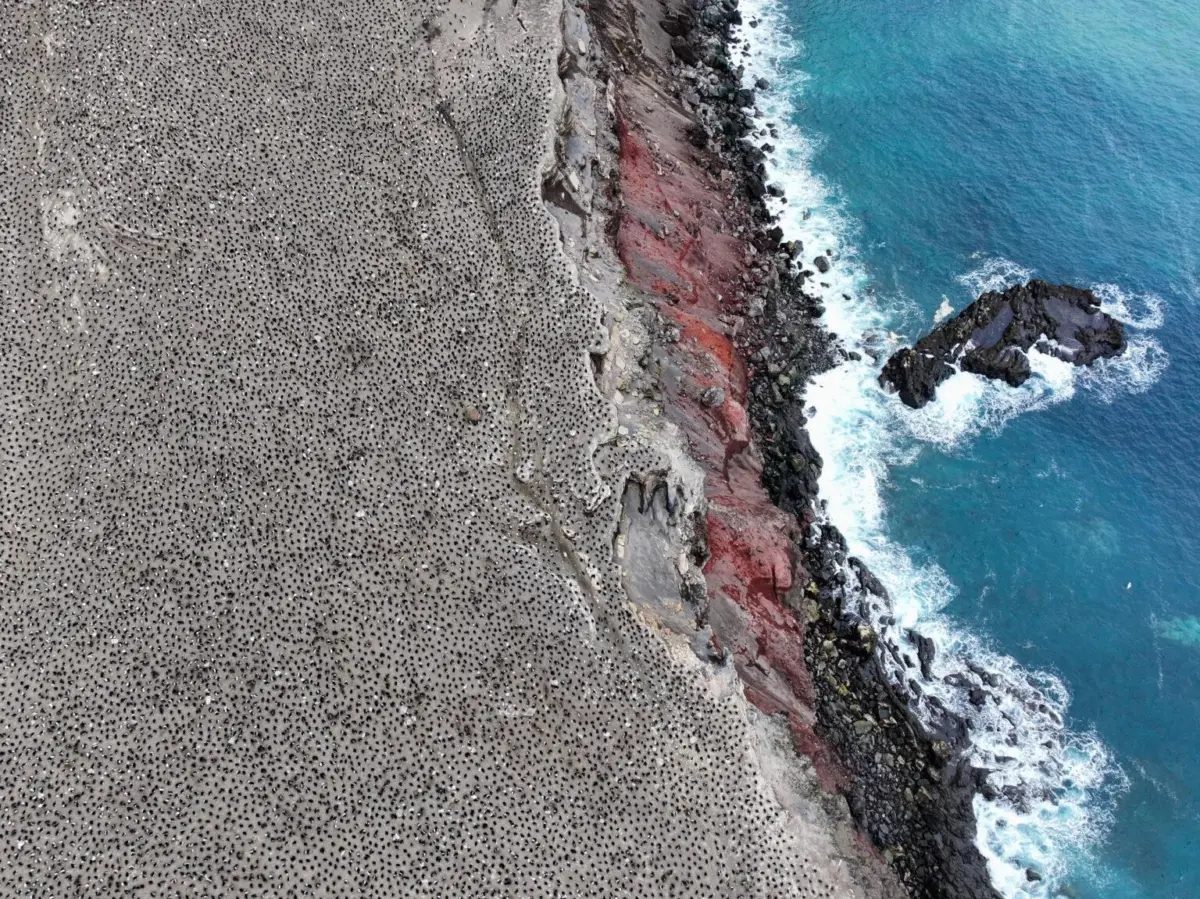
In what marine biologists are calling an environmental alarm bell for the Earth’s most remote wilderness, a comprehensive new study reveals that the world’s largest chinstrap penguin colony has experienced a catastrophic population crash. Plummeting by an astounding two-thirds since 2011, the rapid demise of these seabirds on Zavodovski Island—the northernmost of Antarctica’s South Sandwich Islands—has escalated fears of a wider, systemic ecosystem collapse across the Southern Ocean.
The research, published in the peer-reviewed journal Current Biology, documents the loss of roughly half a million breeding individuals from a single island. Scientists leading the investigation warn that the breathtaking speed of this decline could soon necessitate the reclassification of chinstrap penguins (Pygoscelis antarcticus), named for the distinct black line running beneath their beaks, as an endangered species.
While researchers have definitively ruled out local factors such as volcanic eruptions, inter-species competition, and human interference, the data points uniformly to a singular, overarching culprit: the accelerating climate crisis. As human-driven global heating rapidly alters polar marine environments, food webs are fracturing. Described by experts as a high-stakes game of environmental Jenga, the loss of foundational species like the chinstrap penguin threatens to destabilize an entire continental marine biome.
Read Also
Detailed Chronology of a Catastrophe
To understand the scale of the Zavodovski Island collapse, researchers had to look back at historical baselines and map the trajectory of the decline against unfolding climatic shifts in the Antarctic.
The 2011 Baseline: A Thriving Stronghold
In 2011, Zavodovski Island was uncontested as home to the planet’s largest mega-colony of penguins. Comprehensive population surveys at the time recorded approximately 600,000 chinstrap penguins alongside a robust community of 90,000 macaroni penguins. Dense layers of seabirds blanketed the volcanic slopes, representing a vibrant, pulsing hub of biodiversity in the sub-Antarctic seas.
Early Warning Signs (2016–2020)
Troubling indicators began accumulating over the next decade. In 2016, a major volcanic eruption on Zavodovski Island initially sparked fears of a localized wipeout. Media outlets and scientists briefly hypothesized a "Penguin Pompeii" scenario, wherein ash, lava, and volcanic gases might have smothered hundreds of thousands of birds.
However, subsequent multi-year data analysis debunked this theory. The population drop did not match the sudden, catastrophic wipeout curve expected from a volcanic disaster; rather, it traced a steady, linear decline. Furthermore, field observations revealed that the chinstraps largely avoided the primary ash-and-lava deposition zones—known locally as the "asphyxia plain."
By 2020, alarm bells were sounding elsewhere in the region. Field studies reported by The Guardian highlighted shrinking chinstrap populations on Low Island in the South Shetland Islands. At that time, polar researchers began warning that "something is broken" in the Southern Ocean’s delicate ecological machinery.
The 2025–2026 Revelation
The publication of the new Current Biology study in October 2026 brought the full, grim picture into focus. By comparing historical data with recent high-resolution counts, researchers confirmed a two-thirds population reduction over roughly a decade and a half. Zavodovski Island has effectively forfeited its title as the world’s premier penguin stronghold, with that distinction likely passing to Cape Adare in the Ross Sea. The pace of the crash has shocked even seasoned polar ecologists, demonstrating that high-latitude ecosystems are deteriorating far faster than predictive models anticipated.
Supporting Context & Metrics: The Science of the Collapse
The mechanisms driving the chinstrap penguin’s collapse are deeply rooted in the physical and chemical changes transforming the Southern Ocean.
Unprecedented Thermal Spikes
The Antarctic Peninsula and its surrounding island chains are warming at some of the fastest rates on Earth. Human-driven greenhouse gas emissions have pushed winter temperatures in and around the Peninsula to a staggering 5 degrees Celsius above preindustrial levels.
The atmospheric anomaly reached a chilling milestone on June 6, when Argentina’s Esperanza base on the Trinity Peninsula recorded an astonishing winter high of 15.4°C. This temperature was roughly 20°C above seasonal norms—a margin that polar researchers universally characterized as "absolutely crazy."
The Krill Squeeze and Dietary Specialization
Unlike some of their more adaptable seabird counterparts, chinstrap penguins are ecological specialists. They rely heavily on specific ocean temperature parameters and possess a rigid dietary preference: Antarctic krill (Euphausia superba).

Satellite tracking and foraging data reveal that chinstraps systematically target cooler waters to the northwest of Zavodovski Island to hunt for krill. However, as marine temperatures steadily climb, the krill populations are migrating southward into the colder, more stable waters of the Weddell Sea.
Consequently, adult penguins are forced to undertake longer, more energetically exhausting foraging trips to secure food for their chicks. Many return empty-handed, leading to widespread breeding failure, starvation, and diminished adult survival rates.
The Macaroni Paradox
Interestingly, the island’s macaroni penguin population painted a contrasting picture during the same period, experiencing a 30% increase in numbers. However, scientists caution that this provides little solace. Macaroni penguins possess a broader, more flexible diet and different physiological tolerances than chinstraps.
Prof. Norman Ratcliffe noted that while the macaroni increase is notable, it is mathematically insignificant compared to the massive losses sustained by their chinstrap neighbors. Moreover, if current climatic trends persist, the physical space and marine resources of the island will ultimately become untenable for all penguin species alike.
Official Statements and Expert Analysis
The scientific community has responded to the study with a mixture of grief and urgent warnings regarding the interconnectedness of Antarctic food webs.
-
"It is an enormous population crash, equivalent to half a million breeding individuals being lost from that island," stated Professor Norman Ratcliffe, lead author of the study and a prominent penguin ecologist at the British Antarctic Survey (BAS).
-
Expounding on the wider systemic risks, Ratcliffe used a stark architectural metaphor to describe the fragility of the marine ecosystem:
"Each ecosystem could be regarded as like a giant Jenga set, and every component that you remove increases the risk of ecosystems collapsing completely."
Independent polar scientists not directly involved in the study have echoed these concerns, emphasizing that seabirds act as biological "canaries in the coal mine" for the health of the open ocean. Because penguins integrate changes occurring across vast marine areas—from ice cover dynamics to phytoplankton blooms—their decline signals that the foundational layers of the Antarctic food web are undergoing profound disruption.
Future Outlook: A Race Against Time
The ramifications of the Zavodovski Island study extend far beyond ornithology. They serve as a direct indictment of global climate inaction and underscore the vulnerability of polar regions once thought too remote to be swiftly impacted by industrial civilization.
Conservation Status and Policy Implications
With the species now facing rapid acceleration in its decline, conservation bodies are under mounting pressure to elevate the chinstrap penguin’s IUCN Red List status to endangered. Environmental organizations are calling for:
- Expanded Marine Protected Areas (MPAs): Establishing rigorous, no-take zones around the South Sandwich Islands and the broader Antarctic Peninsula to eliminate industrial krill fishing pressure in critical foraging grounds.
- Aggressive Global Emissions Reductions: Acknowledging that local conservation measures can only act as a temporary palliative; long-term survival demands immediate global adherence to Paris Agreement targets to curb polar warming.
- Enhanced Autonomous Monitoring: Utilizing satellite imagery, drone surveys, and AI-driven population tracking to monitor remote colonies in real-time, bypassing the logistical hurdles of physical field censuses in extreme environments.
The Ultimate Verdict
The quiet emptying of Zavodovski Island’s volcanic slopes serves as a chilling preview of ecological tipping points. As the Antarctic environment warps beyond historical bounds, the iconic black-chinned penguin faces an existential bottleneck. Whether international policymakers can heed the warnings of researchers like Professor Ratcliffe before the Southern Ocean’s "Jenga tower" collapses entirely remains one of the defining environmental questions of the 21st century.





Comments
Facebook App ID not configured. Please add it in the Customizer.