
Executive Overview
In the modern media landscape, discussions of religion are frequently relegated to academic analyses of polarization, culture-war flashpoints, or dismissive portrayals of piety as either quaint or threatening. Elite newsrooms, historically secular compared to the general population, often struggle to engage with the spiritual dimensions of everyday American life authentically. Yet, far from the polished corridors of national broadcasting and the high-minded debates of political theorists, a remarkably different cultural phenomenon thrives daily on the SEC Network and sports radio airwaves.
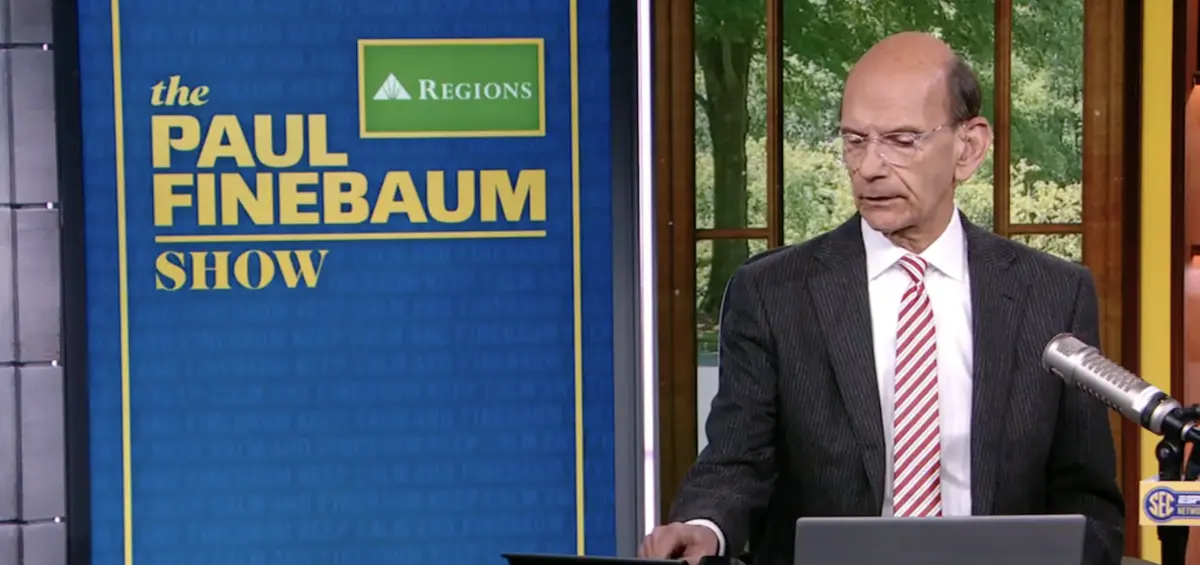
The Paul Finebaum Show, hosted by the man widely known as "the mouth of the South," has quietly evolved into one of the most unique, non-partisan, and ecumenical spaces in modern American media. While ostensibly dedicated to the high-stakes, hyper-competitive world of Southeastern Conference (SEC) college football, the program routinely transcends sports. It functions as a public town square where callers seamlessly weave sports analysis with raw testimonies of personal redemption, addiction recovery, grief, mental health struggles, and deep-seated religious faith.
Paul Finebaum—a secular Jewish host operating in a predominantly Protestant region—has achieved this cultural anomaly not by preaching, but by listening. By ceding the microphone to a colorful cast of regular callers like Legend, Squirrel, and Jim from Tuscaloosa, Finebaum curates a platform where populist sports culture and Judeo-Christian sentiment intersect naturally. This comprehensive examination explores how The Finebaum Show serves as a mirror for American religious life from the margins, offering critical lessons for a mainstream media that frequently avoids matters of faith and a political class obsessed with top-down cultural engineering.
Read Also
Detailed Chronology: From Gridiron Infamy to Ecumenical Radio Sanctuary
The Roots of a Cultural Institution
To understand the unique dynamic of The Paul Finebaum Show, one must first understand the intense ecosystem of SEC college football. For millions across the American South, college football is not merely a seasonal diversion; it is an organizing principle of community, identity, and generational pride. Finebaum built his career by tapping into this visceral passion, creating a call-in format that gave voice to the ordinary fan.
However, the raw intensity of the fan base occasionally spills over into notoriety. The defining moment of this volatility occurred in 2010, when an Alabama fan calling himself "Al from Dadeville" phoned into Finebaum’s program to make a stunning confession. Al announced that he had poisoned the historic, hallowed Toomer’s Corner oak trees at rival Auburn University—a sacred landmark of college football tradition. His explanation captured the unhinged, all-consuming nature of sports fanaticism in the region: "I just had too much ‘Bama in me."
Evolution Toward the Spiritual
While sensational moments like the Toomer’s Corner incident cemented the show’s notoriety, the day-to-day reality of the program evolved into something far more redemptive. Over the years, Finebaum noticed that callers were using the platform to talk about much more than point spreads and coaching hot seats.
The chronology of a typical broadcast now routinely features callers discussing major life transitions, battles with substance abuse, prison sentences, custody disputes, and profound spiritual reckonings. By maintaining a steady, unflinching presence on the line, Finebaum inadvertently fostered an environment where marginalized individuals found a safe harbor to air their burdens and seek communal comfort.
A striking example of this transformation involves a regular caller known as Legend—a man who spent fifteen years in prison for murdering his cousin. Following a high-profile dustup at the SEC’s media days that resulted in him being unceremoniously ejected, Legend called into the show to update listeners on his emotional and spiritual state. Rather than doubling down on grievance, Legend offered a testimony of grace:
"I’ve actually really been being blessed by the Lord. He’s really blessed me. I’ve gotten a personal trainer, and I’ve lost ten pounds. Pride and ego, those are horrible things. I asked God to deal with me."
The Archbishop and the Airwaves
Finebaum’s personal spiritual journey has mirrored this open-ended exploration. Raised Jewish and navigating a landscape heavily saturated by evangelical Protestantism, Finebaum has maintained an attitude of profound respect for various faith traditions. Notably, he and his wife, Linda—who was raised Methodist—have explored the Catholic Church, a journey punctuated by Finebaum’s annual tradition of welcoming high-ranking Catholic figures onto the program.
Among these guests is Joseph Marino, a Catholic archbishop, Vatican diplomat, and native of Birmingham, Alabama. Marino’s appearances on the show have become legendary for their juxtaposition of high-church theology with grassroots SEC fandom. Callers dial in to ask for spiritual counsel on deeply personal matters—such as overcoming hatred toward an estranged father, navigating addiction recovery, or finding a path back to the Church—frequently mingling these existential concerns with earnest prayer requests for an upcoming Alabama football game.
In these moments, Finebaum transitions effortlessly from sports shock-jock to an almost clerical figure. When a caller named Booker from New Jersey phoned in to announce he had fractured his neck, but then jokingly apologized for uttering "Go Buckeyes" on an SEC-centric broadcast, Finebaum deadpanned in priestly fashion: "We’ll grant you that absolution."
Supporting Context & Metrics: Media Secularism vs. Southern Reality
The Secular Media Gap
The success of The Finebaum Show highlights a profound disconnect between the cultural habits of ordinary Americans and the institutional structures of national news and media organizations.
- The 2007 Pew Research Center Study: While comprehensive, recent data tracking the religious demographics of national journalists remains sparse, a landmark Pew study revealed that only 8 percent of journalists at national media outlets attended religious services weekly.
- The General Public Comparison: By contrast, 39 percent of the general American public reported attending weekly religious services during the same period.
This statistical chasm means that America’s elite newsrooms remain significantly more secular than the populace they report on. Consequently, when religion does appear in mainstream news coverage, it is frequently framed through the lens of political conflict, institutional scandal, or cultural backwardness—rarely as an everyday, positive source of communal cohesion and personal healing.
Religious Demographics of the SEC Region
The cultural language of The Finebaum Show is overwhelmingly shaped by the religious demographics of the American South:
- White Evangelical Protestants: Comprise approximately 31 percent of the Southern population.
- Black Protestants: Comprise an additional 9 percent of the region’s demographic makeup.
- Catholic and Jewish Minorities: While evangelical and Protestant traditions set the general tone, Catholic callers (cheering for institutions like Notre Dame) and Jewish perspectives (represented by Finebaum himself) are integrated smoothly into the dialogue without friction.
This specific blend creates what can best be described as a broadly ecumenical, Judeo-Christian framework delivered with a distinct Southern accent—a space where religious vocabulary is treated as a shared, native language rather than a foreign dialect.
Official Statements and Perspectives
Paul Finebaum on Faith and Identity
Finebaum has been notably candid about his own spiritual trajectory, acknowledging that while faith is central to his worldview, institutional belonging has been a complex pursuit. In a 2025 interview with The Athletic, Finebaum reflected on his personal beliefs:
"I believe in God and very strongly in faith, but it has been a challenge to find my way."
Despite navigating a region where religious and political identities can occasionally calcify into rigid tribalism, Finebaum has consistently resisted pressure to conform to narrow molds. When considering a potential run for an open U.S. Senate seat in Alabama, a political consultant warned Finebaum that his Jewish heritage could prove to be an electoral liability. Finebaum strongly rejected the premise, trusting instead in the populist rapport he had built with his multi-faith audience over decades.
Cultural Critics and Observers
Cultural analysts studying the intersection of media, religion, and American politics often point to Finebaum’s platform as a living refutation of top-down ideological engineering. As debates over public Christianity intensify among intellectuals—ranging from discussions of Catholic integralism to Protestant Christian nationalism—observers note that any organic renewal of public faith in America is unlikely to emerge from academic seminaries or political manifestos.
Instead, it looks much closer to the messy, grassroots ecumenism of The Finebaum Show: Protestant-inflected, open to Catholic traditions, welcoming to Jewish perspectives, and fundamentally populist in execution.
Future Outlook: Lessons for Modern Media and Public Discourse
What Mainstream Media Can Learn
The enduring popularity of The Paul Finebaum Show offers a vital roadmap for media organizations seeking to reconnect with a fractured American public:
- Authentic Listening: Media figures must move beyond preconceived narratives and genuinely listen to the lived experiences of everyday citizens. When hosts stop lecturing and start listening, unexpected commonalities emerge.
- De-polarizing Faith: Religion does not inherently have to be a divisive wedge issue. Across the airwaves of the SEC Network, faith functions as a bridge connecting individuals across vast demographic, racial, and ideological divides.
- Embracing Pluralism from the Margins: The most authentic cultural movements often bubble up from the periphery rather than being engineered at the center. Broadcasters who make space for unscripted human vulnerability will consistently outlast those who rely on curated, institutional talking points.
A Lesson in American Populism
For political conservatives and cultural commentators alike, Finebaum’s success underscores a deep-rooted American tradition that dates back to the frontier era. When Tennessee drafted its state constitution, figures like Andrew Jackson—reflecting a deeply populist spirit and an early recognition of religious pluralism—successfully opposed proposals to mandate religious professions for public officeholders.
This populist ethos—captured by the Jacksonian maxim "The world is governed too much"—presents a profound contrast to modern efforts to centralize religious or cultural expression. As photographer Sam Fentress documented in Bible Road Signs on the American Landscape, American public faith has always thrived on decentralized, vernacular expressions—from hand-painted scripture signs dotting rural highways to callers on sports radio mixing desperate prayers for their football teams with appeals for divine grace.
As long as The Paul Finebaum Show remains on the air, it will stand as a testament to the fact that ordinary Americans yearn for spaces where they can bring their whole selves—their passions, their flaws, their sports rivalries, and their deepest spiritual hopes—into the public square. In an increasingly polarized media environment, that lesson is more valuable than ever.



Comments
Facebook App ID not configured. Please add it in the Customizer.