
Executive Overview
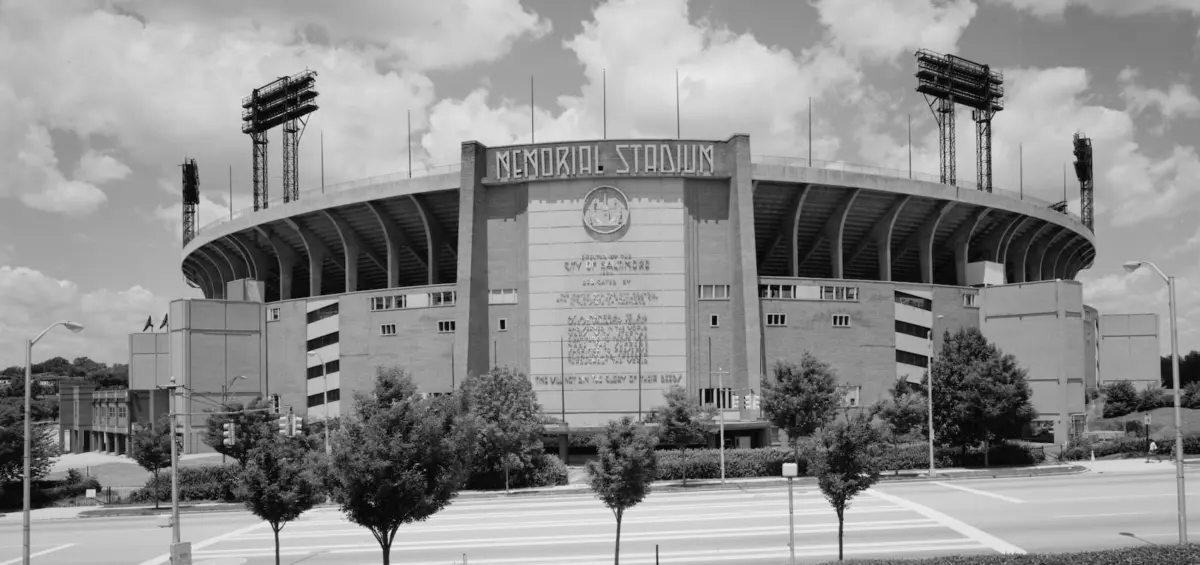
For generations of Baltimoreans, the intersection of 33rd Street and Ellerslie Avenue was not merely a geographic coordinate; it was sacred ground. Known simply as Memorial Stadium, this cathedral of brick, concrete, and soaring Art Deco lettering served as the emotional epicenter of a working-class city, a civic monument that doubled as a neighborhood field of dreams.
When the wrecking ball finally claimed the structure in the turbulent opening year of the 21st century, the demolition was met with a grief that transcended local sports nostalgia. To those who grew up in the shadow of its sweeping facade, the reduction of Memorial Stadium to a field of rubble felt like a desecration of communal memory—an apocalyptic erasure of a shared past.
Yet, as time marches inexorably toward the diamond jubilee of the city’s greatest sporting triumph—the Baltimore Orioles’ stunning sweep of the Los Angeles Dodgers in the 1966 World Series—the ghosts of Memorial Stadium continue to whisper vital lessons to a modern America. Long before the era of multi-billion-dollar sports basilicas with their sybaritic corporate suites, this classic ballyard bore a solemn inscription dedicated to the veterans of the world wars who fought to preserve liberty and equality.
Read Also
Beyond its architectural and military legacy, the stadium played host to a profound social laboratory. In the crucible of the 1966 Fall Classic, a baseball team composed of gritty craftsmen, led by an extraordinary partnership between white superstar Brooks Robinson and Black newcomer Frank Robinson, catalyzed a fragmented city. In an era marked by deep racial fractures and civic unrest, the Orioles offered a masterclass in camaraderie, excellence, and shared purpose. Today, as contemporary American society grapples with its own deepening cultural and political divides, the echoes of 33rd Street offer a timely blueprint for unity, sportsmanship, and collective resolve.
Detailed Chronology: From Sacred Ground to a Field of Rubble
The biography of Memorial Stadium is a tale of civic pride, athletic myth-making, and ultimate erasure. Authorized and constructed to honor the men and women who made the supreme sacrifice in global conflict, the stadium opened its gates with a solemn purpose that elevated it far above a mere venue for athletic entertainment.
[1954] Stadium Erected & Dedicated to World War Veterans
  │
  ├── [1966] Orioles Sweep Dodgers; 1966 World Series Triumph & Civic Unity
  │     │
  ├── [2001] Demolition begins; the "Abomination of Desolation"
  │     │
  └── [Present] Cal Ripken Sr. Foundation "Youth Development Park" Preserves Home Plate
The Genesis of a Monument
Erected by the City of Baltimore in 1954, Memorial Stadium was designed to marry civic duty with athletic passion. Its imposing facade featured stainless-steel Art Deco lettering that proudly proclaimed its dedication to those who "so valiantly fought and served in the world wars with eternal gratitude to those who made the supreme sacrifice to preserve equality and freedom throughout the world." Above all, it carried a promise etched in stone: Time will not dim the glory of their deeds.
Inside those walls, local youths encountered living legends. The turf of Memorial Stadium was patrolled by mythic figures whose names still evoke reverence along the Chesapeake: Triandos and Wilhelm, Aparicio and the legendary manager Earl Weaver, whose tactical genius would later define an era of Orioles baseball.
The Fall of the Ballyard
By the turn of the millennium, however, the economic realities of professional sports rendered the aging concrete bowl obsolete. The opening of Oriole Park at Camden Yards in 1992 had revolutionized ballpark architecture, proving that retro-classic designs could capture the public imagination while offering modern amenities. Memorial Stadium could not compete with the sybaritic comforts of the new era.
When the demolition crews finally arrived in 2001, the process was handled with a clumsy insensitivity that rubbed salt into the wounds of local fans. In a bizarre compromise that satisfied no one, the magnificent brick-and-concrete facade was left standing in isolation for several months after the rest of the stadium had been reduced to dust, before it, too, was unceremoniously torn down.
Rebirth on 33rd Street
The physical site in the Waverly neighborhood did not remain entirely lost to history. Today, thanks to the vision of the Cal Ripken Sr. Foundation, the old footprint houses the "Youth Development Park," a pristine baseball facility designed to foster the next generation of athletes.
Remarkably, the new diamond’s home plate is positioned in the exact geographical spot where home plate rested during the stadium’s glory years. For those who stand in the batter’s box and look out past the pitcher’s mound toward the residential homes on 36th Street beyond the old scoreboard, the past is palpable. The structures may be gone, but the memories endure.
Supporting Context & Metrics: The Miraculous Autumn of 1966
To truly understand the cultural weight of Memorial Stadium, one must return to the shirtsleeve-weather Sunday afternoon of October 9, 1966. The context of that season provides essential metrics for evaluating just how improbable the Orioles’ championship run truly was.
The Backdrop of Game Four
Entering the 1966 World Series, the Baltimore Orioles were cast firmly in the role of plucky underdogs against the lordly Los Angeles Dodgers. While the Dodgers boasted a storied franchise history and perennial powerhouse status, the Orioles were an ascendant franchise hungry for validation.
The momentum of the Series had shifted decisively during the opening games at Dodger Stadium, where Baltimore took the first two contests. By the time the action shifted to Memorial Stadium for Game Three, twenty-one-year-old Wally Bunker had already delivered a three-hit masterpiece, shutting out Los Angeles 1–0.
As fans settled into the lower deck—roughly twenty rows above the first-base dugout, sustained by popcorn and Coca-Cola—the burning questions of the day hung thick in the Maryland air:
- Could Orioles southpaw Dave McNally bounce back from a shaky Game One outing that had required the miraculous, unexpected relief-pitching heroics of Moe Drabowsky?
- Could the Dodgers break their staggering offensive drought, which had already stretched to twenty-four consecutive scoreless innings?
- Could the underdog Birds complete a shocking four-game sweep?
The Climax and the Celebration
The answers arrived with resounding clarity. McNally pitched the game of his life, shutting out the defending champions, while the immortal Frank Robinson sealed the victory with a laser-like line drive into the left-field bleachers off formidable Dodgers intimidator Don Drysdale.
When center fielder Paul Blair hauled in the final fly ball to secure the sweep, Memorial Stadium erupted in a paroxysm of joy. Historical newsreel footage of V-E and V-J Day celebrations in Times Square found their living equivalent in Baltimore that afternoon.
Players like Brooks Robinson, catcher Andy Etchebarren, and slugger Boog Powell raced madly toward the pitcher’s mound to embrace a triumphant McNally. In the stands, an unprecedented scene unfolded: white and black fans, separated by a long and tragic history of municipal segregation, spontaneously embraced one another. For a city long scarred by racial division, the ballpark served as a crucible of integration and shared humanity.
Official Statements & Archival Reflections
The resonance of Memorial Stadium and the 1966 championship extends far beyond nostalgic anecdote; it serves as a case study in how athletic institutions can reflect and shape civic character. Observers, cultural critics, and participants have long noted the unique sociological dynamic that underpinned the Orioles’ success.
The Inscription of Remembrance
The foundational ethos of the stadium was explicitly captured in its original dedication plaque, a text that municipal leaders and historians continue to cite as a testament to civic sacrifice:
ERECTED BY THE CITY OF BALTIMORE 1954
DEDICATED BY THE MAYOR AND THE CITY COUNCIL AND THE PEOPLE OF BALTIMORE CITY IN THE STATE OF MARYLAND AS A MEMORIAL TO ALL WHO SO VALIANTLY FOUGHT AND SERVED IN THE WORLD WARS WITH ETERNAL GRATITUDE TO WHO MADE THE SUPREME SACRIFICE TO PRESERVE EQUALITY AND FREEDOM THROUGHOUT THE WORLD
TIME WILL NOT DIM THE GLORY OF THEIR DEEDS
The Leadership Paradigm
Cultural commentators examining the dynamics of the 1966 roster have frequently highlighted the profound leadership transition embodied by the team’s two biggest stars. Brooks Robinson, an Arkansas native and the 1964 American League Most Valuable Player, willingly and gracefully shared the team’s leadership mantle with Frank Robinson, a proud, uncompromising Black superstar who would capture the 1964 Triple Crown and the 1966 AL MVP award.
Reflecting on this partnership, cultural observers note:
"The camaraderie of the 1966 Orioles was made possible by Brooks Robinson… yielding his leadership role to Frank Robinson. Their partnership, I’ve long been convinced, was a crucial factor in breaking down old prejudices in the old hometown. America could use some of that camaraderie, built on excellence ordered to a common cause, today."
Furthermore, the team’s operational ethos offers a sharp contrast to the self-absorbed individualism often found in modern public life:
"The 1966 Orioles strike me in retrospect as craftsmen, doing something very difficult very well, and taking satisfaction and a certain joie de combat from the often-grinding work. They played hard but they played clean, and they were respected by their competitors for that. America could use more such men today, not least in politics."
Future Outlook: Lessons for 21st-Century America
As contemporary American society navigates an era defined by intense partisan polarization, cultural fragmentation, and institutional distrust, the legacy of Memorial Stadium and the 1966 Orioles provides a clear roadmap for renewal.
┌─────────────────────────────────────────────────────────────│
│            FUTURE OUTLOOK: RENEWAL THROUGH PURPOSE          │
├─────────────────────────────────────────────────────────────┤
│ 1. Subordinating Ego to Common Goals                        │
│    (The Brooks & Frank Robinson Leadership Model)           │
│                                                             │
│ 2. Acknowledging the Dignity of Grinding, Honest Craft       │
│    (Rejecting Performative Politics for Competence)         │
│                                                             │
│ 3. Preserving Civic Memory                                  │
│    (Honoring Our Foundations While Building Anew)           │
└─────────────────────────────────────────────────────────────┘
1. The Power of Subordinated Egos
The harmonious integration of the 1966 Orioles roster proves that deep-seated cultural prejudices can be dismantled when individuals unite around a superior, shared objective. In an era where modern institutions—from corporate boardrooms to legislative halls—are frequently paralyzed by factionalism and identity posturing, the Brooks-and-Frank-Robinson dynamic stands as an enduring rebuke to self-absorption. True leadership requires the magnanimity to share the stage in pursuit of a common victory.
2. The Dignity of Craftsmanship
The 1966 ballclub was characterized not by flashiness or manufactured controversy, but by elite craftsmanship. They viewed their profession as demanding, disciplined work executed with joy (joie de combat) and mutual respect among competitors. Modern political and civic culture, increasingly driven by performative outrage, would do well to re-embrace the quiet dignity of doing difficult things exceptionally well.
3. Preserving Civic Memory
Physical structures may crumble, and architectural landmarks may fall to the wrecking ball of economic "progress," but the values embedded in our historical monuments must remain intact. Whether through the preservation of home plate at the Waverly youth park or the enduring memory of those who fell in defense of liberty, time must not be allowed to dim the glory of past deeds.
As America looks toward the future, the ghost of Memorial Stadium stands as a guardian of our best impulses—reminding us that unity, excellence, and shared sacrifice are not relics of a bygone era, but essential requirements for any society hoping to touch greatness once again.

Comments
Facebook App ID not configured. Please add it in the Customizer.