
Executive Overview
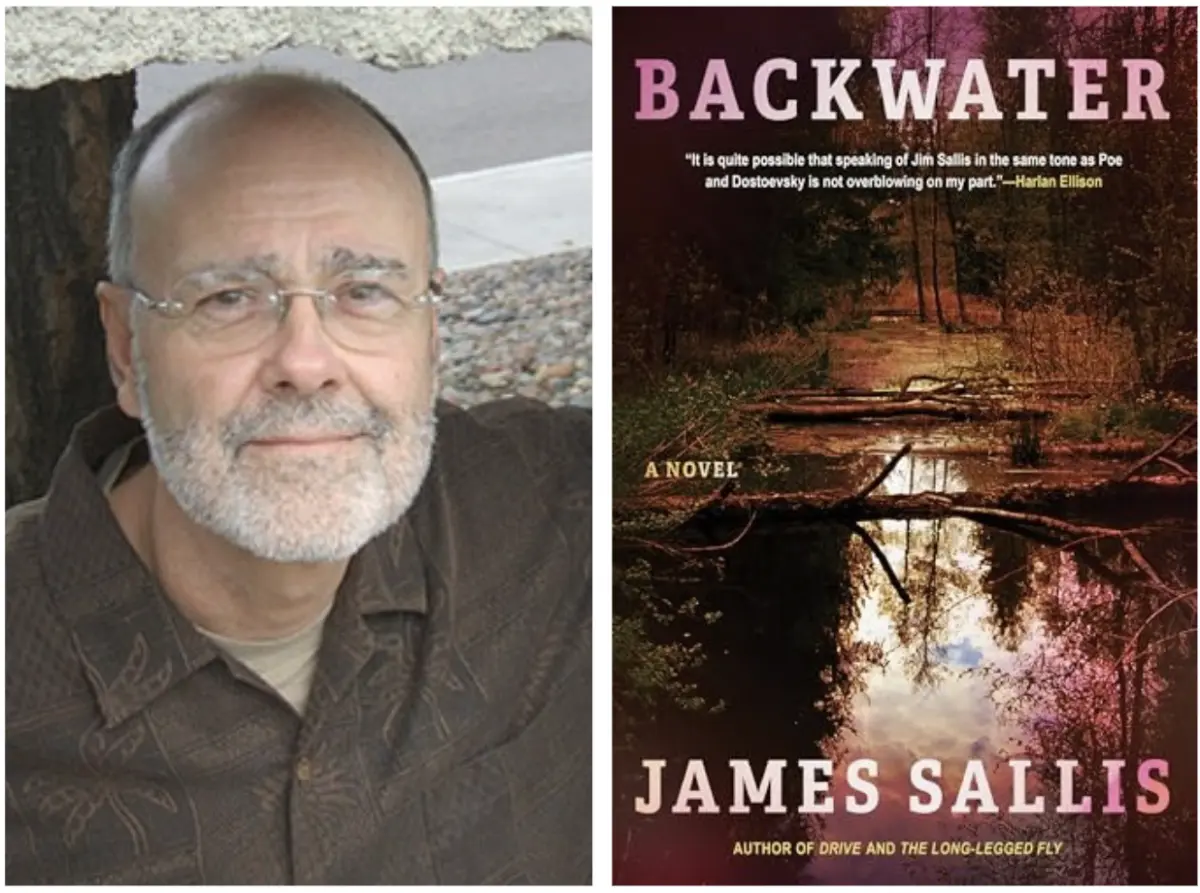
In September, Soho Crime is set to publish Backwater, the final novel from the celebrated poet, critic, and crime writer James Sallis, who passed away earlier this year. Sallis, a towering figure whose work continuously pushed the boundaries of genre fiction, leaves behind an extraordinary literary footprint. Backwater follows a retired law enforcement officer who returns to the fold to investigate the eerie discovery of an abandoned, blood-smeared automobile. Early reviews describe the book as “a tender farewell from a towering talent,” emphasizing that, much like the late author’s broader bibliography, the novel is far more invested in exploring the quiet textures of human existence than chasing breakneck, page-turning action.
Throughout his career, Sallis mastered the art of subverting expectations. From the moody, cinematic minimalism of Drive to the existential, philosophical mysteries of Sarah Jane, his oeuvre consistently married the raw tropes of traditional crime fiction with surreal, contemplative explorations of self-discovery and isolation.
To honor the posthumous publication of Backwater and to celebrate the ongoing evolution of boundary-pushing crime writing, we examine five recent crime novels that similarly color outside the lines. These works defy easy categorization, blending literary depth, psychological acuity, and stylistic daring to expand what the modern crime novel can achieve.
Read Also
Detailed Chronology and Literary Context
To understand the magnitude of Sallis’s contribution—and why contemporary writers continue to bend the rules of the genre—it is helpful to contextualize the historical trajectory of noir and hardboiled fiction.
The Evolution of the Noir Tradition
- Mid-20th Century (The Golden Era): Crime fiction traditionally relied on rigid formulas: a hardboiled detective, a femme fatale, a labyrinthine plot, and a neat resolution where justice, however flawed, was ultimately served. Writers like Dashiell Hammett and Raymond Chandler established the blueprint.
- Late 20th Century (The Deconstruction): Authors began utilizing genre tropes as a Trojan horse for deeper sociological and philosophical commentary. James Sallis emerged during this era as a critical bridge between pulp fiction and literary modernism. His works prioritized internal monologue, temporal disruption, and poetic prose over procedural mechanics.
- The Contemporary Landscape (Post-Sallis): Today’s boundary-pushing crime writers borrow Sallis’s playbook, integrating elements of magical realism, working-class socioeconomic critique, and hyper-stylized psychological horror into their narratives. The five featured novels—spanning gothic Louisiana noir, gritty New England working-class drama, and paranoid political thrillers—represent this vibrant, post-traditional movement.
Supporting Context & Literary Profiles: Five Crime Novels That Defy Convention
1. Clete: A Dave Robicheaux Novel by James Lee Burke
- Publisher: Atlantic Monthly Press
- Format & Price: Hardcover, $28.00 (336p)
- ISBN: 978-0-8021-6307-3
In the gonzo latest offering from Edgar Award-winner James Lee Burke, detective Dave Robicheaux takes a slight step back as his volatile, fiercely loyal private investigator friend, Clete Purcel, is hurled into a bizarre and surreal pursuit involving a suspected bioweapon in late-1990s Louisiana.

The narrative kicks off with a jolt of absurdism: Clete wakes up one Sunday morning to find three strange men systematically disassembling his Cadillac in a frantic search for contraband. Following a brief, brutal confrontation, Clete is knocked unconscious, setting off a dizzying chain of events. One of his assailants is soon unmasked as a member of an occult neo-Nazi organization. The thugs appear to be on a chaotic mission orchestrated by slimy millionaire Lauren Bow and his actor wife, Clara—all of them hunting for a mythical bioweapon codenamed "Leprechaun," which may or may not have been hidden inside Clete’s car.
True to Burke’s sprawling, atmospheric style, Clete does not navigate this madness alone. He receives crucial, if unconventional, assistance from Robicheaux, parish sheriff Helen Soileau, and—in moments of surreal clarity—Joan of Arc, who manifests in prophetic visions to steer him away from mortal danger.
Critics have lauded Burke’s sterling, poetic prose, which elevates the pulp mechanics into something mythic. As Burke describes Louisiana in the novel: “an antediluvian place that could have been formed on the first day of Creation, then forgotten, feral and threatening.” Even amid the heightened, surreal proceedings, the novel anchors itself in existential truth, embodied by Robicheaux’s philosophical assertion: “mysteries exist. The denial of them is an absurdity.” It is a triumphant, eccentric entry in Burke’s legendary canon.
2. A Past without Pictures by Jonathan Ames
- Publisher: Mysterious Press
- Format & Price: Hardcover, $23.95 (176p)
- ISBN: 978-1-61316-805-9
Following his acclaimed Doll trilogy, Jonathan Ames returns with a spare, potent, and emotionally bruising novella that cuts straight to the bone. The narrative opens the morning after newly minted LAPD detective Maria Cole makes the fateful decision to kill a burglary suspect in the line of duty. Before she can process the psychological fallout, she receives a devastating call from an Alabama number: her estranged, ex-con father, Billy Cole, has been shot to death.
Maria travels down to the unassuming beach town of Fair Port to settle her father’s meager estate, only to be met by slimy local police chief Karl, who cheerfully announces that Billy’s killer has already been captured. However, the veneer of closure shatters the very next day when the alleged suspect is discovered dead in his jail cell.
Deeply suspicious of Karl’s sanitized narrative, Maria tacks a rogue murder investigation onto her already overwhelming to-do list. As she sifts through the remnants of her father’s belongings, she reminisces about the few tender moments in a turbulent, isolated childhood marked by anger and neglect. A cryptic entry in Billy’s personal calendar puts her on the trail of an enigmatic figure known only as “Charb.”
Ultimately, Maria’s search leads her straight to Fair Port’s untouchable power brokers, transforming the bare-bones domestic tragedy into a hyperviolent, relentless revenge thriller. Ames infuses the text with a profound, disaffected melancholy that elevates it far above bog-standard crime fiction, making it an essential read for both longtime fans and literary thrill-seekers looking to wander off the beaten path.
3. Freight by Ryan Lowell
- Publisher: Mulholland Books
- Format & Price: Trade Paperback, $18.99 (224p)
- ISBN: 978-0-316-59651-0
Ryan Lowell makes an exceptionally promising debut with Freight, a heartfelt, darkly humorous noir that brilliantly examines the indignities and quiet desperation of contemporary working-class life.
The protagonist, Curtis, works the graveyard shift as a night dispatcher for a New England trucking company. His life is defined by unfulfilled aspirations: he has a pregnant wife, a nine-year-old son whom he rarely gets to see due to his grueling hours, and lingering, unfulfilled dreams of becoming a writer. Compounding his daily frustrations, he is forced to commute on a moped through the freezing New England cold because he cannot afford a reliable car.
When Curtis’s ne’er-do-well uncle, Billy Trask, hatches a half-baked, desperate scheme to steal a commercial trailer loaded with millions of dollars in pharmaceutical drugs, Curtis reluctantly agrees to orchestrate the logistical setup. He devises an intricate plot to swap the stolen cargo with that of another truck, selecting an unwitting patsy named Theo. Theo decides to bring his feisty new girlfriend, Sarah, along on his standard run to Canada, leaving his long-suffering wife behind.

In a brilliant structural choice, Lowell runs a parallel narrative following an exhausted, long-haul trucker on an ill-fated 1,800-mile cross-country trip, serving as a poignant thematic foil to the main heist plot. Populated by richly drawn, three-dimensional characters and driven by sharp social commentary, Freight is a stellar, melancholic journey into the margins of the American dream.
4. The Night Always Comes by Willy Vlautin
- Publisher: Harper
- Format & Price: Hardcover, $26.99 (224p)
- ISBN: 978-0-06-303508-9
Drawing heavy inspiration from the bleakest corners of classic noir, Willy Vlautin (Don’t Skip Out on Me) delivers a stunning, heartbreaking study of one woman’s desperate struggle against socioeconomic fate in an America that has systematically cast her aside.
Set against the backdrop of Portland, Oregon’s hyper-inflated housing boom—which has priced countless working-class families out of the market—the story centers on 30-year-old Lynette. Her landlord offers her a rare, favorable deal to purchase the decrepit house she and her mother have rented for years. Lynette works two exhausting jobs while simultaneously caring for her developmentally disabled brother, Kenny, who lives with them. Through sheer grit and self-denial, she has finally saved enough cash for a down payment; all she needs is her mother to cosign the loan.
At the eleventh hour, however, her mother—weary from a lifetime of relentless struggle and compounding disappointments—backs out of the agreement. Facing the imminent loss of their home, Lynette launches into a frantic, last-ditch effort to secure the financing on her own. Her desperate quest takes her into the darkest recesses of her past—navigating the lingering trauma of mental illness, childhood sexual abuse, and sex work—while pitting her against predatory men who prey on society’s most vulnerable.
Vlautin’s gritty, fast-paced narrative sings with pitch-perfect, muscular prose. Lynette’s desperation is palpable on every page, leading critics to rightly hail the novel as a brilliant, modern synthesis of Raymond Carver’s emotional realism and Jim Thompson’s relentless pulp fatalism.
5. The Diary of Lies by Philip Miller
- Publisher: Soho Crime
- Format & Price: Hardcover, $29.95 (304p)
- ISBN: 978-1-64129-699-1
Philip Miller returns with The Diary of Lies, his outstanding third installment featuring investigative reporter Shona Sandison (following The Hollow Tree). Miller effortlessly weaves together three interconnected, highly sophisticated story lines into a complex web of political espionage and media corruption.
The novel opens as Shona receives a prestigious U.K. Media Award nomination for her explosive investigative exposé on secret government plans to pass the "Great British Freedom Act"—legislation designed to systematically undermine Scottish autonomy. Shortly after the nomination, her anonymous government source reaches out with a chillingly cryptic message: “Find Grendel.”
Concurrently, Shona’s friend Hector Stricken, a mild-mannered media officer for the government’s Capacity and Resilience department, is accidentally looped into a classified virtual discussion regarding a shadowy, clandestine operation code-named “Grendel.” Terrified by what he has inadvertently stumbled upon, Hector realizes he possesses state secrets that could spell his doom.
As both Shona and Hector race to uncover the true scope of Operation Grendel and the existential threats it poses, Miller intersperses the narrative with diary entries penned by an unnamed intelligence agent. These journals offer tantalizing clues, though the agent frequently admits that much of what they record may be deliberate falsehoods, creating an unreliable narrator dynamic of the highest order.
Miller refuses to rush his storytelling, allowing the disparate strands of his sophisticated plot to converge with deliberate, agonizing precision. Enriched by striking, visceral prose—such as a stream running “hard and clear, whitening with grinning teeth over boulders”—and inhabited by deeply human, lovable characters, The Diary of Lies is a masterclass in modern political suspense that will leave fans of Mick Herron utterly enthralled.
Official Statements and Industry Perspectives
The literary community has responded with profound reflection regarding the passing of James Sallis and the enduring resonance of his final work, Backwater.
From Soho Crime Editorial Director Juliet Grames:
"James Sallis was a rare literary titan who moved effortlessly between poetry, philosophy, and crime fiction. With Backwater, he gifts us not just a mystery, but an meditation on time, memory, and grace. It is a fitting final curtain for a writer who taught us that the most dangerous mysteries in life are internal."
Industry analysts note that the critical and commercial success of boundary-pushing crime fiction—exemplified by the five titles highlighted above—signals a permanent shift in reader expectations. The traditional, strictly linear whodunit is increasingly sharing shelf space with deeply atmospheric, character-driven narratives that prioritize social commentary and psychological inquiry over simple plot mechanics.
Future Outlook
As the publishing industry prepares for the September launch of Backwater, the legacy of James Sallis remains a guiding light for a new generation of crime writers. The appetite for genre-defying literature has never been stronger. Authors like James Lee Burke, Jonathan Ames, Ryan Lowell, Willy Vlautin, and Philip Miller demonstrate that the boundaries of noir and hardboiled fiction are elastic, capable of stretching to accommodate poetry, political paranoia, working-class grit, and profound emotional truth.
Ultimately, Sallis’s final novel reminds readers why we return to the crime genre in the first place: not merely to see who committed the crime, but to understand the complex, fractured humanity of those left behind in the wake of tragedy. As the genre continues to evolve and color outside the lines, the foundational lessons of James Sallis will endure, proving that the most profound investigations are those of the human soul.





Comments
Facebook App ID not configured. Please add it in the Customizer.