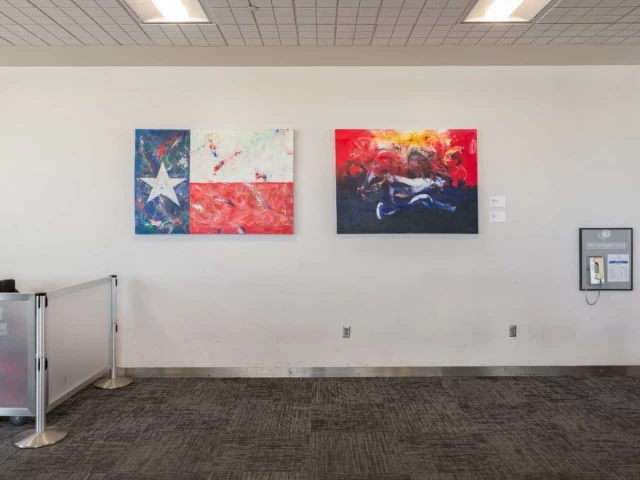
In the high-velocity, transient environment of the George Bush Intercontinental Airport (IAH) in Houston, Texas, millions of international and domestic travelers rush past concourses, glancing up at flight status boards, baggage carousels, and architectural installations. Among these transient markers of modern transit, a striking visual anchor now commands the space: Day and Night, a monumental work of contemporary abstract expressionism by Pakistani-American artist Riaz Rafi.
Selected for a prestigious two-year public art exhibition managed in coordination with initiatives like the Houston Arts Alliance and local arts groups such as Silver Streets Artists, the painting serves as a vibrant ambassador for cross-cultural dialogue. Featuring Rafi’s signature energetic brushwork and rich tonal contrasts, Day and Night explores the seamless duality of light and shadow, motion and stillness—a thematic blueprint tailor-made for travelers crossing time zones, borders, and oceans.
For Rafi, whose artistic evolution spans over four decades across two continents, this public installation is far more than a resume milestone. It is a profound manifestation of cultural diplomacy. In an era where geopolitical narratives are frequently dictated by polarization, Rafi views his presence in a major international transport hub as a vital contribution to Pakistan’s "soft image"—the cultural, artistic, and humanistic footprint that transcends political rhetoric.
Yet, Rafi’s journey to the walls of IAH is not a tale of overnight success. It is a masterclass in artistic resilience, defined by formative years in rural Sindh and metropolitan Karachi, mentorship under modern art pioneers, a brief detour into television and classical dance, a harrowing medical crisis that robbed him of his voice for years, and a deliberate mid-career relocation to the United States. Today, as his canvas speaks to a global audience, Rafi stands as a testament to the enduring power of merit, dedication, and the universal language of visual art.
Detailed Chronology: From the Banks of the Indus to the Heart of Texas
Roots in Sukkur and the Foundations of Visual Inquiry
Riaz Rafi’s artistic genesis traces back to the historic city of Sukkur, nestled along the banks of the Indus River in Pakistan’s Sindh province. Born and raised in an environment rich in cultural textures, historic architecture, and agrarian rhythms, Rafi developed an early fascination with drawing. Long before he understood the mechanics of the international art market or the politics of gallery representation, the young Rafi was cataloging his environment through sketchpads.
This early immersion in the sights and sounds of interior Sindh established a sensory baseline for his future work. It taught him to observe the interplay of harsh sunlight and deep shadow, the migration of birds across the flat horizons, and the subtle gestures of everyday human interaction. These observations would later form the subconscious library from which his abstract strokes are drawn.
Metropolitan Forays: Lahore, Karachi, and the Iconography of Ali Imam
As his ambitions matured, Rafi transitioned from his provincial roots to the epicenters of Pakistani high culture: Lahore and Karachi. He pursued formal training at prestigious institutions, including the National College of Arts (NCA) in Lahore—widely recognized as the cradle of South Asian modernist art—and the Karachi School of Art. These academic environments exposed him to rigorous aesthetic philosophies, historical traditions, and the tensions between figurative realism and emerging modernisms.
However, Rafi’s most transformative professional crucible was the Indus Art Gallery in Karachi, founded in 1970 by the legendary artist, gallerist, and intellectual Ali Imam. Imam was a towering figure in Pakistani art history, credited with establishing the country’s first modern gallery space and democratizing art by bringing it out of elite enclaves and into public consciousness.
Working within Imam’s orbit proved decisive for Rafi. Under the mentorship of a man who helped shape the trajectory of modern Pakistani art, Rafi refined his technical discipline and broadened his intellectual scope.
"Ali Imam was one of Pakistan’s people who made us how we are," Rafi reflects, acknowledging the foundational role of the Indus Art Gallery in his professional development. "In 1970, he opened Pakistan’s first modern gallery, which created awareness of art and brought it to people’s houses. My real growth happened from Indus Art Gallery."
Interdisciplinary Exploration: Movement, Journalism, and Silence
Rafi’s creative appetite was never confined strictly to the boundaries of canvas and oil. During his formative years in Karachi, his artistic network expanded to include cultural figures such as Firdous Haider and classical dancer Nighat Chaudhry. Driven by a desire to understand rhythm, composition, and kinetic continuity, Rafi undertook formal training in Kathak—the intricate North Indian classical dance form characterized by rapid footwork, rhythmic pirouettes, and expressive storytelling.
Though he never pursued dance professionally, the physical training left an indelible mark on his painting style. The gestural sweep of a Kathak dancer’s arm translated directly into the dynamic, sweeping brushstrokes that define his abstract compositions today.
Simultaneously, Rafi pursued a Master’s degree in Journalism. This academic pursuit instilled in him a "generalist approach"—a critical lens that views the world through a synthesis of current events, social observation, and narrative structure. This journalistic framing often informs the structural integrity of his canvases, ensuring that even his most abstract works retain a coherent internal logic and communicative urgency.
Perhaps the most harrowing yet transformative chapter of his life occurred during a television drama shoot in Hyderabad, Pakistan. Amidst a burgeoning career that crossed into acting and television production, Rafi experienced a sudden, catastrophic medical crisis: he completely lost his ability to speak.
A complicated operation and its aftermath plunged the artist into years of enforced silence. The psychological toll was compounded by the indignities of the physical world. During the period when his voice failed him, an incident during a shoot led strangers to mistake him for a beggar. This stark vulnerability—the realization of how low a human being must humble themselves to ask for sustenance—etched itself deeply into his psyche.
Deprived of speech, Rafi channeled his existential shock and observational insights directly into his visual art. The canvas became his voice box. The "beggar instinct"—the raw, unfiltered human desperation and resilience—manifested organically in his stroke work. In a profound historical irony, the artist who spent years in literal silence has now created a visual language so potent that it communicates effortlessly across linguistic and national divides to thousands of travelers every day.
The American Migration and the Houston Art Scene
In 2013, seeking a new horizon and an environment conducive to contemplative studio work, Rafi relocated to the United States. After traveling across the country and exploring museums and galleries in various cultural capitals, he ultimately chose Houston, Texas, as his permanent base.
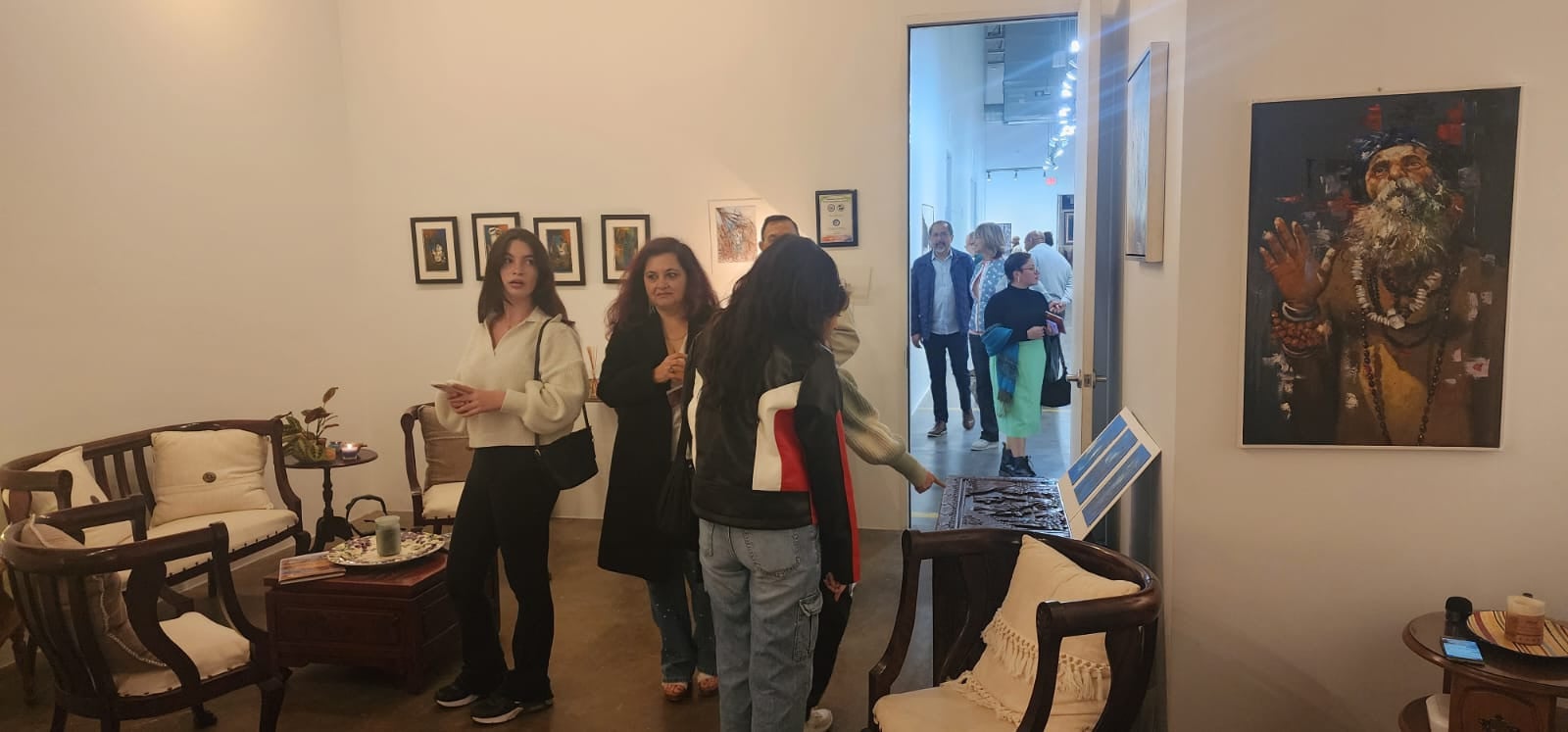
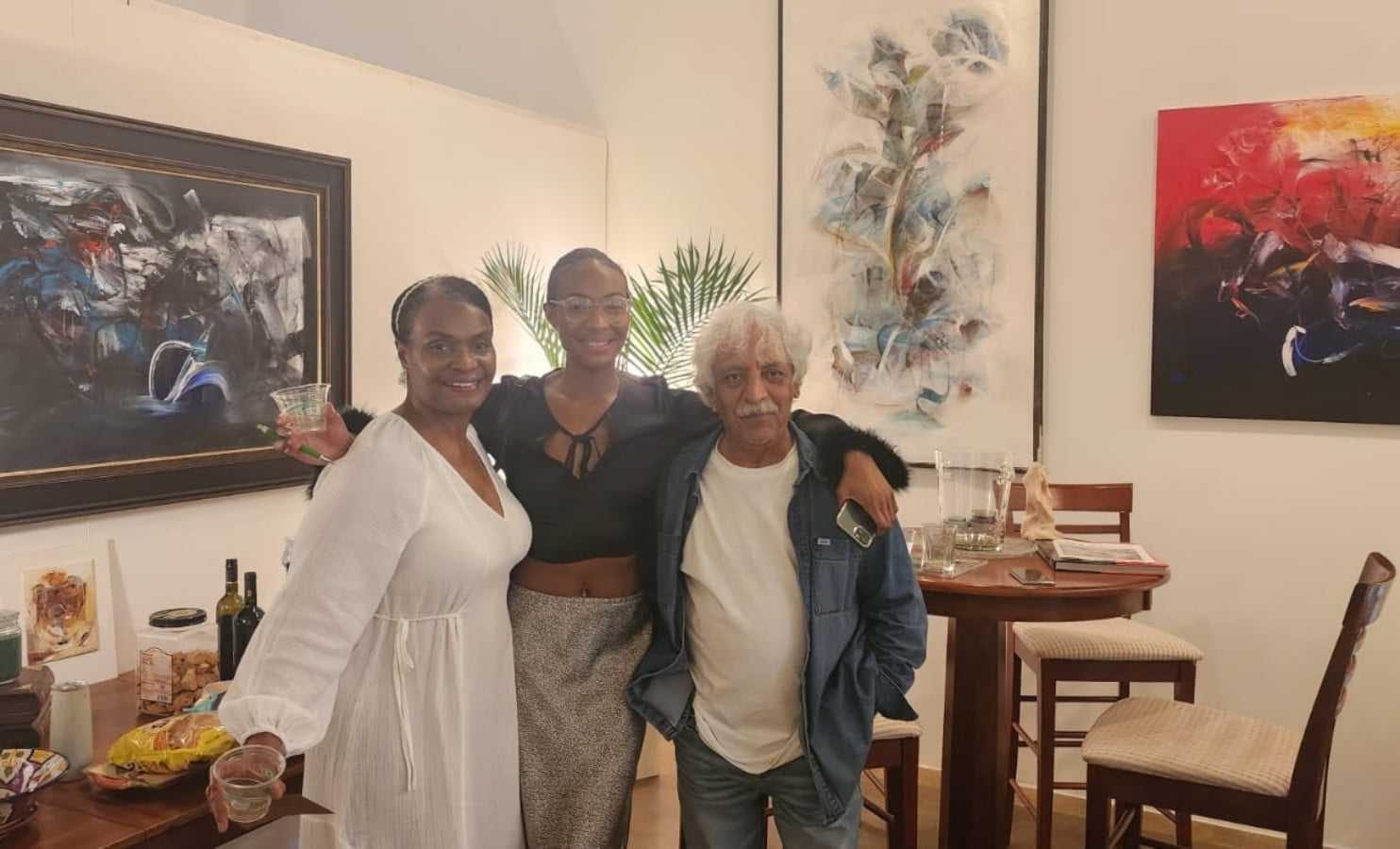
Houston offered a rare combination: a booming, multicultural metropolis with a vibrant, welcoming arts ecosystem, coupled with the spatial and mental calm required for rigorous studio practice. Rafi integrated himself into the city’s thriving creative community, establishing his studio in the heart of Houston’s bustling arts district. Surrounded by roughly 200 fellow artists—where he stands proudly as one of the few South Asian practitioners—Rafi found a collaborative yet independent environment.
This strategic relocation positioned him perfectly to participate in civic art initiatives, leading directly to the landmark selection of Day and Night by the Houston Airport System.
Supporting Context & Metrics: Public Art and Cultural Diplomacy
The integration of Day and Night into the terminal architecture of George Bush Intercontinental Airport (IAH) is part of a deliberate, long-term strategy by the City of Houston to leverage public art as a tool for civic identity and cultural diplomacy.
Metrics of Impact: IAH Public Art Program
Duration of Exhibition: Two years (2024–2026), providing sustained exposure across multiple seasonal travel peaks.
Audience Reach: Millions of domestic and international passengers annually, transforming the airport concourse into a high-traffic democratic gallery space.
Demographic Diversity: Reaching travelers from over 180 countries, neutralizing cultural biases through pure aesthetic engagement.
Local Integration: Part of a curated initiative featuring the Silver Streets Artists collective, highlighting the work of studio practitioners embedded within Houston’s urban core.
Public art programs in major international airports serve a dual function. Functionally, they humanize sterile transit environments, reducing travel-related anxiety and creating memorable spatial waypoints. Culturally, they act as an economic and diplomatic handshake, signaling to incoming foreign visitors the values, diversity, and sophistication of the host city.
By selecting Riaz Rafi’s work—a piece deeply informed by both his Pakistani heritage and his American residency—IAH curators have curated an installation that mirrors Houston’s own identity as a diverse, immigrant-rich global hub.
Official Statements and Artistic Philosophy
The Genesis of Day and Night
Unlike many contemporary artists who obsess over conceptual branding and market-driven titles, Rafi approaches titling with extreme reluctance. He typically prefers to leave his canvases untitled, inviting viewers to project their own psychological landscapes, ask unprompted questions, and derive personal meaning from the abstract forms.
However, the monumental nature of the IAH commission demanded a bridge between his internal artistic universe and the diverse public viewing it. Thus, Day and Night was born—a title deeply rooted in linguistic duality and geopolitical symbolism.
"In Urdu, we have a saying, ‘Kabhi ke raate bari, kabhi ke din bare’—some days are long, some nights are long," Rafi explains, unpacking the cultural resonance of the title. "So here, our American flag also has two colors, blue and red, so I kept that in mind when making the creation. Because I am a Pakistani-American artist, I wanted to paint from that point of view."
The painting embodies what critics and the Silver Streets Artists collective have termed "signature energetic abstract brushwork and rich tonal contrast." It does not attempt to render a literal landscape; rather, it captures the visceral sensation of transition—the psychological and physical state of moving between light and shadow, East and West, past and present.
Cultivating the "Soft Image" of Pakistan
Rafi is acutely aware of his status as a cultural ambassador. In various public forums and podcast appearances, he has frequently discussed the concept of a nation’s "soft image"—the projection of its cultural wealth, artistic innovation, and intellectual vitality to counter one-dimensional media stereotypes.
"The soft image which is produced of an image of a country, they always show how your country is," Rafi asserts. "Your art, culture, music, and dance and all is a reflection of that, so it is a good way to show a soft image of Pakistan."
For Rafi, representing Pakistan on an international stage is not about carrying a political banner; it is about demonstrating the depth, sophistication, and universal applicability of the artistic sensibilities nurtured on Pakistani soil. The fact that Day and Night was selected purely on aesthetic merit—competing against and standing alongside works by numerous American and European artists—validates his belief that powerful art transcends geographic and ethnic pigeonholing.
"Because things happened here on merit, they didn’t see I’m South Asian or Pakistani," he notes with quiet pride. "They saw my work over many white artists too. I am not such a big artist, but for many years I’ve been doing work with dedication, and let’s see where the future takes me now. It will only bring more success."
Future Outlook: The Unfolding Canvas
As Day and Night anchors itself in the concourses of IAH for the next two years, Riaz Rafi remains remarkably grounded. Rejecting the materialist traps of the contemporary art circus—such as status symbols, luxury cars, and speculative price inflation—his focus remains fixed on the easel.
+-----------------------------------------------------------------+
                       Rafi’s Core Tenets
+-----------------------------------------------------------------+
| 1. Merit Over Identity: Let the work speak for itself.           |
| 2. Dedication Over Spectacle: Prioritize studio discipline.      |
| 3. Global Empathy: Bridge cultures through abstract resonance.  |
+-----------------------------------------------------------------+
His trajectory suggests an artist entering a mature, highly confident phase of his career. Having successfully synthesized the classical traditions of his homeland, the somatic discipline of dance, the observational rigor of journalism, and the stark existential lessons of enforced silence, Rafi’s strokes carry an authority born of lived experience.
Looking toward the horizon, Rafi refuses to make grand predictions or map out rigid career trajectories. True to his philosophy, he believes that an artist’s ultimate legacy is forged not through self-promotion, but through the intrinsic gravity of the work itself.
At George Bush Intercontinental Airport, thousands of travelers from every corner of the globe will continue to walk beneath the sweeping colors of Day and Night. Many will know nothing of Sukkur or Karachi, of the legendary Ali Imam or the silent years of physical trauma that shaped the artist’s soul. They will not need to. They will simply look up, feel the pulse of the brushwork, and encounter a mind that has traversed oceans to speak directly to theirs. For Riaz Rafi, that silent, universal communion is the only success that matters.




Comments
Facebook App ID not configured. Please add it in the Customizer.