
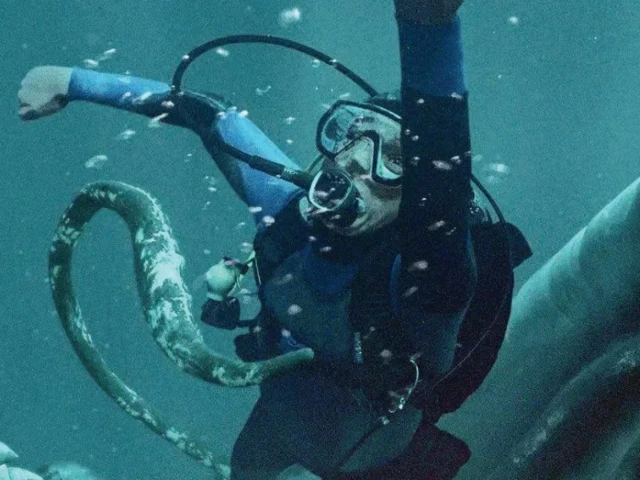
LONDON — In the annals of Hollywood cinema, cinematic encounters between humans and the ocean’s apex predators have historically fostered a culture of terror. Steven Spielberg’s 1975 masterwork Jaws famously triggered a generation-defining fear of the deep, reshaping public perception of sharks into mindless, bloodthirsty antagonists—a legacy conservationists have spent decades attempting to reverse. Now, nearly half a century later, director Brian Duffield and an elite team of filmmakers are intentionally turning that cinematic legacy on its head.
With their upcoming survival thriller Whalefall, based on Daniel Kraus’s acclaimed 2023 bestselling novel, the creative team is plunging audiences not into a narrative of mindless monster attacks, but into an intricate, claustrophobic exploration of survival, familial grief, and profound reverence for the ocean’s gentle giants. At its core, the film features a premise as bizarre as it is terrifying: a teenager, diving off the rugged coast of California to recover the remains of his late father, is inadvertently swallowed alive by a massive sperm whale.
Yet, rather than demonizing the majestic cetacean, those behind Whalefall are positioning the film as an antidote to Jaws. Speaking exclusively at the movie’s high-profile London premiere, Duffield emphasized that the project has been warmly embraced by marine biologists and whale experts. Far from generating panic, the filmmakers hope the harrowing ordeal will inspire a deep-seated awe of the creatures that dominate the frame, reframing the ocean not as a theater of war, but as a vast, fragile ecosystem worthy of our deepest respect.
Read Also
As the film prepares for its global theatrical rollout on October 14, industry analysts and cinephiles alike are watching closely. Blending cutting-edge practical effects with a deeply emotional human core, Whalefall is poised to redefine the limits of the survival-thriller genre.
Executive Overview: A Whale of a Tale Reimagined for the Screen
At its structural and narrative zenith, Whalefall operates on a dual-track velocity. On the surface, it is a pulse-pounding, high-stakes race against time: a lone human being trapped within the visceral, shifting anatomy of a living leviathan, running out of oxygen, fighting crushing pressure, and navigating a nightmarish labyrinth of flesh, blubber, and gastric acid.
Beneath the surface, however, the film anchors itself in the universal, agonizing landscape of grief. The protagonist, Jay—brought to life by rising star Austin Abrams (Resident Evil)—is not merely fighting for biological survival; he is fighting for emotional closure. Diving into the frigid, unforgiving waters off California’s Monastery Beach, Jay is searching for the physical remains of his estranged father, an emotionally distant man whose shadow has loomed large over his son’s life.
When the unimaginable occurs and Jay is swallowed by a sperm whale, his physical imprisonment becomes a metaphor for his psychological entrapment. To escape the whale’s belly, Jay must metaphorically and literally confront the unresolved trauma of his relationship with his father, played in flashbacks and spectral presence by Hollywood heavyweight Josh Brolin.
For Brolin, the project’s magnetic pull lay precisely in this emotional dichotomy. Reflecting on the script and the source material at the London premiere, the actor admitted to being deeply moved by the narrative arc. "I sobbed at the end of the book," Brolin shared with journalists. "Partially because of the father-son relationship, partially because it’s truly a hero story."
By marrying the claustrophobic terror of a deep-sea survival scenario with an intimate character study on father-son dynamics, Duffield and his co-writer, Daniel Kraus, have engineered a cinematic experience that defies easy categorization. It is a terrifying adventure, an environmental love letter, and an emotional elegy all at once.
Detailed Chronology: From Viral Video to the Silver Screen
The genesis of Whalefall is a fascinating study in modern creativity, proving that inspiration can strike from the most unexpected digital corners. The journey from an offhand internet clip to a multimillion-dollar Hollywood production spans years of meticulous literary translation, scientific consultation, and grueling physical execution.
The Spark: A Viral Moment
The conceptual bedrock of Whalefall was laid when author Daniel Kraus stumbled upon a viral video circulating across social media platforms. The clip depicted kayakers who, through a freak alignment of circumstances, appeared to end up momentarily inside a whale’s mouth before escaping unharmed. For a writer celebrated for his inventive, dark, and visceral storytelling, the video ignited an instantaneous creative spark.
"Immediately, I had what I felt at the time was the best idea I’ve ever had," Kraus recalled during press rounds. The central question burned in his mind: Could someone really be swallowed by a whale?
The Scientific Inquiry
Recognizing the absurdity yet theoretical possibility of the premise, Kraus did not simply rely on creative license. He dove headfirst into marine biology, consulting extensively with whale experts and cetacean anatomists. To his surprise, the scientific consensus was unequivocal: under the precise, albeit extraordinarily rare, alignment of circumstances, a human being could theoretically be swallowed by a sperm whale.
This scientific validation laid the groundwork for the 2023 novel, which quickly caught the attention of Hollywood producers and director Brian Duffield. Known for his sharp handling of high-concept genre fare, Duffield recognized the cinematic potential of Kraus’s text and immediately signed on to co-write the screenplay and direct the feature adaptation.
Production Hell: Building the Interior Leviathan
Translating a story set almost entirely inside the stomach of a sperm whale from page to screen presented a monumental logistical challenge. Eschewing the temptation to rely entirely on green screens and computer-generated imagery, Duffield and his production design team opted for an old-school, tactile approach.
The crew constructed massive, highly detailed physical interiors and exteriors representing the whale’s anatomy. CGI was deployed primarily to enhance the surrounding marine environments and digital elements, while the core of the drama played out within practical, physical sets.
The toll on the cast and crew was immense. "Everyone who worked on this movie said it was the hardest thing they’ve ever done," Duffield remarked. For lead actor Austin Abrams, navigating the physical set was not merely an acting challenge, but an athletic and hazardous endurance test. Duffield noted that simply sitting inside the hyper-realistic whale set constituted an "incredibly dangerous stunt" for Abrams, requiring immense physical fortitude, claustrophobic resilience, and unyielding stamina.
Supporting Context & Metrics: The Anatomy of a Modern Survival Thriller
To understand the unique cinematic ecosystem Whalefall inhabits, one must examine the mechanics of how it builds tension, the biological realities of its premise, and its place in the modern cinematic landscape.
Biological Feasibility: Fact Versus Fiction
When asked by inquiring reporters whether Jay’s terrifying fate could genuinely befall an unwary ocean explorer, director Brian Duffield offered a blend of dark humor and cetacean biology.
"A lot of things have to go very badly for you for it to happen," Duffield joked, acknowledging the extreme improbability of the event. However, he grounded his defense in the specific predatory design of the sperm whale (Physeter macrocephalus).
"Sperm whales are designed to do one thing and one thing only, which is eat giant squid," Duffield explained, detailing the anatomy of the animal. "And so if you’re smaller than a giant squid, you can fit down that throat. Who knows what happens next?"
Sperm whales possess massive, specialized jaws lined with teeth primarily in the lower jaw, fitting into sockets in the upper jaw. While they are not equipped to chew their prey—swallowing giant squid whole—their gargantuan esophagi and multi-chambered stomachs are engineered to process massive, soft-bodied cephalopods under immense underwater pressure. Placing a human body into this biological processing plant creates an instant, high-stakes countdown for survival.
Breaking the Jaws Paradigm
For decades, Hollywood’s relationship with marine life has been defined by predatory antagonism. Steven Spielberg’s 1975 masterpiece Jaws created an enduring cultural phobia of sharks, leading to widespread overfishing and public demonization of marine predators—a consequence Spielberg himself and environmentalists have frequently lamented.
Whalefall aims to rewrite this paradigm. By casting a sperm whale not as a malicious villain hunting humans, but as a magnificent, indifferent force of nature—an animal that simply encountered an anomaly in its feeding path—the film deliberately avoids stoking fear. Whale conservation groups and marine biologists who have previewed the project have praised the filmmakers for fostering curiosity rather than terror. The underlying message is clear: the ocean’s creatures are not monsters out to get us; they are wild animals living in an alien world that we enter at our own peril.
Official Statements: Perspectives from the Cast and Crew
The human element of Whalefall is anchored by its powerhouse cast and visionary creative minds. At the London premiere, key members of the production shared insights into the emotional core that elevates the film from a creature-feature gimmick to a profound human drama.
Josh Brolin on Fatherhood, Grief, and Mortality
Academy Award-nominee Josh Brolin, who portrays Jay’s late father, spoke candidly about the emotional resonance of the script. Known for playing rugged, stoic characters across blockbusters like Dune, Avengers: Infinity War, and No Country for Old Men, Brolin found himself uniquely vulnerable when engaging with the father-son dynamic at the heart of Whalefall.
"I hope people want to go home and hug their families and realise that we have a short time here and might as well utilise it the best we can," Brolin stated during the press junket.
The actor emphasized that the script’s exploration of unresolved grief and the complexities of parent-child relationships transcended the typical boundaries of the genre. For Brolin, the story is ultimately about reconciliation—facing one’s internal demons before it is too late.
Brian Duffield on Crafting Awe Over Fear
Director Brian Duffield reiterated his commitment to changing how cinematic monsters operate. By ensuring that the whale is portrayed with biological accuracy and majestic scale, Duffield hopes viewers leave the theater with a renewed sense of wonder rather than dread.
"It’s the opposite of Jaws," Duffield noted. "Whale experts have welcomed the project and hoped it would encourage audiences to learn more about the animals."
Daniel Kraus on the Birth of a Modern Classic
Co-writer and original novelist Daniel Kraus reflected on the surreal journey of seeing his viral-video-inspired thought experiment materialize into a major Hollywood motion picture. What began as a speculative thought experiment—Could someone survive being swallowed by a whale?—has transformed into a defining cultural text for survival fiction.
Future Outlook: The Road to the Global Premiere
As the countdown to October 14 ticks away, industry expectations for Whalefall are steadily rising. Positioned in the sweet spot between high-concept genre entertainment and prestige emotional drama, the film arrives during the peak of the autumn prestige and thriller movie season.
Box Office and Critical Trajectory
Early industry tracking suggests strong interest from both horror/thriller aficionados and fans of prestige literary adaptations. The combination of Austin Abrams’ rising star power, Josh Brolin’s undeniable box-office gravity, and Brian Duffield’s directorial pedigree gives Whalefall a formidable competitive edge in a crowded marketplace.
Furthermore, the film’s unique ecological messaging positions it well for positive word-of-mouth campaigns among environmentally conscious moviegoers and marine conservation advocates. By championing awe over terror, Whalefall taps into a modern appetite for stories that respect the natural world rather than exploit outdated tropes of monster-movie villainy.
The Legacy of a Unique Survival Tale
When the credits roll on Whalefall, audiences will not simply have witnessed a harrowing physical escape from the belly of a beast; they will have taken an introspective journey through the murky waters of human grief, familial reconciliation, and existential survival.
As theaters globally prepare to open their doors on October 14, one thing is certain: the cinematic landscape of survival thrillers will never be quite the same. In the dark of the theater, much like Jay in the dark of the whale, audiences are about to discover that the deepest transformations often happen when we are forced to confront what lies within.





Comments
Facebook App ID not configured. Please add it in the Customizer.