
Executive Overview
The rapid democratization of generative artificial intelligence has gifted humanity unprecedented creative capabilities, yet it has simultaneously unlocked a Pandora’s box of digital exploitation. In an alarming incident that has reignited global anxieties regarding the safety of women in the digital age, prominent Indian actress Janhvi Kapoor has fallen victim to a malicious deepfake operation. The incident involved the non-consensual digital manipulation of footage from her hit 2024 Telugu action-drama Devara: Part 1—specifically altering her appearance in the chart-topping song Chuttamalle to depict her in a sexually explicit manner entirely absent from the original cinematic production.
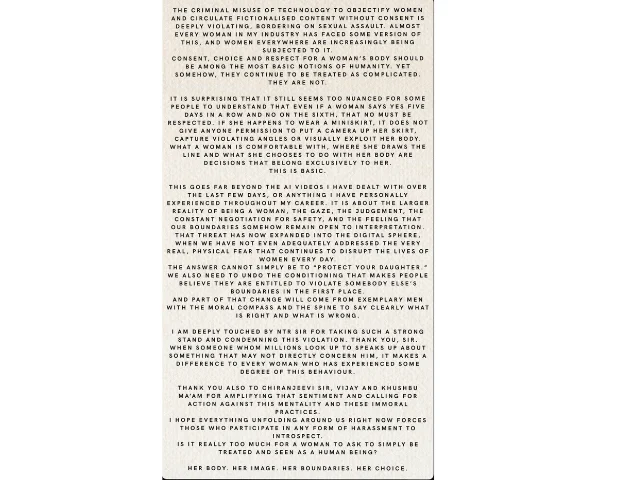
The fallout has sent shockwaves through the South Asian entertainment landscape, exposing the glaring vulnerabilities in current legal frameworks and platform moderation systems. Breaking her silence via a powerful and deeply personal statement on Instagram, Kapoor did not merely decry the unauthorized use of her likeness; she elevated the discourse to confront a pervasive systemic issue. She characterized the digital fabrication as an act "deeply violating, bordering on sexual assault," drawing a direct line between physical autonomy and digital integrity.
Kapoor’s courageous stand has opened a vital dialogue on how misogyny has seamlessly migrated from physical spaces into the algorithmic wild west of the internet. As artificial intelligence tools become cheaper, faster, and increasingly sophisticated, the barrier to creating convincing, hyper-realistic forged content has vanished. This investigative feature explores the mechanics of the Devara deepfake controversy, analyzes the broader cultural and societal implications of AI-driven harassment, chronicles the industry-wide pushback led by figures like co-star Jr NTR, and evaluates the urgent regulatory crossroads facing governments and tech conglomerates worldwide.
Read Also
Detailed Chronology of the Devara Deepfake Incident
The unfolding of the controversy illustrates the terrifying speed at which fabricated media can infiltrate digital ecosystems and inflict irreversible reputational and psychological damage.
The Genesis: Cinematic Success and Viral Exploitation
In late 2024, Devara: Part 1, starring actor Jr NTR alongside Janhvi Kapoor in her highly anticipated Telugu cinema debut, dominated the box office. The romantic track Chuttamalle became an overnight cultural phenomenon, garnering tens of millions of views across YouTube and streaming platforms. Kapoor’s performance was widely praised, cementing her footing in the regional film industry.
However, the immense visibility of the track made it a prime target for bad actors. Utilizing advanced, open-source deepfake software—technologies originally designed for visual effects and entertainment—unidentified perpetrators isolated footage of Kapoor from the music video. They mapped synthetic imagery over her body, transforming an innocent, graceful cinematic sequence into a sexually explicit, fabricated video designed for shock value and online virality.
The Spread and Algorithmic Amplification
Within days, the manipulated clip broke containment from fringe image-board forums and encrypted messaging channels, spilling onto mainstream social media ecosystems, including X (formerly Twitter), Instagram, and Reddit.
- Algorithmic Complicity: Recommendations engines and engagement-driven algorithms, which prioritize sensationalism and high-arousal content, inadvertently accelerated the distribution of the illicit video.
- The Scale of Exposure: Millions of internet users were exposed to the forged material before content moderation teams could flag and excise the primary uploads. Mirror accounts and secondary re-uploads continuously slipped past automated filters by altering metadata, watermarks, and video resolutions.
The Breaking Point and Public Exposure
As the illicit video continued to circulate, fans and industry insiders alerted Kapoor’s management team. Recognizing the gravity of the violation—and the urgent need to reclaim the narrative before misinformation became entrenched—Kapoor decided to bypass traditional public relations statements. She took directly to her verified Instagram account to issue an unvarnished, emotionally resonant condemnation of the act, transforming her personal trauma into an empowering platform for collective resistance.
Supporting Context & Metrics: The Global Deepfake Epidemic and the Gendered Reality of AI Abuse
To fully comprehend the gravity of Janhvi Kapoor’s ordeal, one must examine the broader statistical landscape of AI-facilitated harassment. The Devara incident is not an isolated aberration; it represents a booming, multi-million-dollar shadow industry characterized by the weaponization of technology against women.
The Grim Statistics of Deepfake Misuse
According to industry reports and cybersecurity watchdogs tracking synthetic media:
- The Gender Disparity: An overwhelming majority—studies estimate between 90% to 96%—of all online deepfake videos are non-consensual pornography (NCP). Within this category, female public figures, politicians, journalists, and everyday women are the primary targets.
- Exponential Growth: Research firms tracking generative AI abuse note that the volume of deepfake pornographic content online has doubled nearly every year since 2019, fueled by the proliferation of deepfake generation apps and Telegram bots that require zero coding or technical expertise.
- The Celebrity vs. Private Citizen Divide: While high-profile actors like Janhvi Kapoor possess the institutional leverage, legal resources, and public platforms to fight back, millions of non-famous women—including students, professionals, and teenagers—are routinely targeted with deepfake harassment on school campuses and workplaces, often with devastating psychological consequences and virtually no institutional recourse.
The Psychology of Digital Violation
Cyber-psychologists and legal scholars emphasize that deepfake abuse inflicts a unique psychological trauma. Victims describe a profound sense of "un-selfing"—the terrifying realization that their bodies no longer belong to them, even in the abstract digital ether.
When an individual’s likeness is stolen and weaponized to depict non-consensual sexual acts, the boundary between physical reality and digital simulation collapses. As Kapoor poignantly articulated in her statement, this technology provides bad actors with a frictionless avenue to bypass consent entirely, reducing human beings to pixels that can be manipulated at will to satisfy voyeuristic desires.
Official Statements and Industry Solidarity
The controversy catalyzed an unprecedented wave of solidarity within the Indian film industry, signaling a notable shift from past eras where victims of online harassment were often advised to maintain a dignified silence.

Janhvi Kapoor’s Manifesto on Consent and Humanity
In her landmark social media address, Kapoor dismantled the archaic tropes that blame victims for their visibility or career choices. Her words serve as a definitive manifesto for bodily autonomy in the twenty-first century:
"The criminal misuse of technology to objectify women and circulating fictionalised content without consent is deeply violating, bordering on sexual assault. Almost every woman in my industry has faced some version of this. And women everywhere are increasingly being subjected to it."
Kapoor emphasized that consent must never be treated as a flexible concept subject to judicial or social interpretation. A woman’s sovereignty over her image remains absolute, irrespective of her profession, clothing choices, or public exposure:
"It is about the larger reality of being a woman. The gaze, the judgement, the constant negotiation for safety and the feelings that our boundaries somehow remain open to interpretation. That threat has now expanded into the digital sphere."
Jr NTR and Industry-Wide Backlash
Kapoor publicly acknowledged and thanked her Devara co-star, prominent Telugu superstar Jr NTR, for his swift and unequivocal condemnation of the manipulated footage. Jr NTR did not merely offer verbal support; he announced aggressive legal measures to track down, prosecute, and penalize the creators and initial circulators of the deepfake video.
Other prominent voices across Bollywood and regional Indian cinema rallied behind Kapoor. Actresses, directors, and producers issued joint statements demanding stringent accountability from social media conglomerates. They argued that platforms hosting user-generated content must face heavy regulatory fines if they fail to instantly purge synthetic abuse upon notification.
Future Outlook: The Battle for Digital Safety and Legislative Reform
The Janhvi Kapoor deepfake controversy serves as a stark warning flare for the future of civil society. As artificial intelligence continues its relentless march toward hyper-realism—where voice cloning, face-swapping, and generative video can be executed on consumer-grade hardware in mere seconds—the existing social and legal safeguards are proving dangerously inadequate.
1. Legislative and Regulatory Overhauls
Governments worldwide are beginning to realize that traditional obscenity and copyright laws are ill-equipped to handle the nuances of AI-generated non-consensual imagery.
- India’s Legal Landscape: Legal experts are calling for explicit, targeted amendments to information technology laws and penal codes that classify the creation and distribution of non-consensual deepfake pornography as a heinous, non-bailable offense with mandatory prison sentences.
- Global Precedents: Nations like South Korea, the United States, and members of the European Union are racing to pass stringent legislation—such as the EU Artificial Intelligence Act—that mandates watermarking for synthetic media, criminalizes malicious deepfakes, and imposes strict liability on platforms that fail to police their ecosystems.
2. Technological Countermeasures and Watermarking
The tech industry bears an ethical and financial responsibility to build defensive shields against the tools it unleashes. Moving forward, the integration of cryptographic content credentials, blockchain verification for media authenticity, and robust AI-detection algorithms will be critical. Platforms must deploy proactive content moderation systems that detect synthetic alterations at the point of upload, rather than reacting only after content has gone viral.
3. Cultural Transformation and the Elimination of the Entitled Gaze
As Kapoor emphasized in the closing remarks of her statement, institutional fixes and technological patches will ultimately fail unless society undergoes a fundamental cultural evolution:
"I hope everything unfolding around us right now forces those who participate in any form of harassment to introspect. Is it really too much for a woman to ask to simply be treated and seen as a human being? Her body, her image, her boundaries, her choice."
The fight against AI abuse is not merely a technical glitch to be patched; it is a moral battleground determining whether women can exist freely in both the physical world and the digital frontier. Janhvi Kapoor’s refusal to remain silent has drawn a firm line in the sand, transforming an act of malicious cyber-violence into a rallying cry for universal digital dignity, respect, and human rights.



Comments
Facebook App ID not configured. Please add it in the Customizer.