
Executive Overview
While iconic horror entities such as vampires, witches, and ghosts have long established their roots in the folklore and historical settings of centuries past, the zombie occupies a distinctly modern niche. Emerging into the cultural consciousness during the latter half of the 20th century—largely catalyzed by the evolution of cinematic horror—the living dead are overwhelmingly associated with contemporary landscapes, neon-lit urban centers, and modern infrastructural collapse.
However, a fascinating sub-genre of speculative fiction and entertainment dares to disrupt this chronological norm. By transplanting the mindless, flesh-eating hordes of the undead into historical eras ranging from the prehistoric epoch to the theaters of World War II, creators are rewriting the boundaries of speculative storytelling. This investigation explores five distinct works across literature, animation, and live-action television and film that successfully subvert historical integrity with the rot of the undead. Through this critical examination, we analyze how blending historical backdrops with zombie apocalypses not only elevates visceral horror but also offers sharp socio-political commentary on class, power, and historical atrocities.
Detailed Chronology: Five Historical Eras of the Undead
To understand the scope of historical zombie narratives, we examine five definitive pieces of media arranged chronologically from the deep past to the mid-20th century.
Read Also
1. The Prehistoric Epoch: Primal – "Plague of Madness" (2020)
- Medium: Animated Adult Television Series (Adult Swim)
- Setting: Anachronistic Prehistoric Era (Dinosaurs and Neanderthals Coexisting)
Genndy Tartakovsky’s critically acclaimed animated series Primal operates in a brutal, dialogue-free sandbox where the rules of historical accuracy bend to accommodate high-concept, visceral storytelling. The narrative primarily centers on the profound, unspoken bond forged between Spear, a grieving Neanderthal hunter, and Fang, a Tyrannosaurus Rex who has similarly suffered the catastrophic loss of her family. Communicating exclusively through primal roars, grunts, and body language, the unlikely duo navigates a lethal prehistoric world.
The horror reaches its zenith in the Season 1 episode "Plague of Madness." In this installment, Spear and Fang encounter an Argentinosaurus—a gargantuan sauropod—that has fallen victim to a virulent, degenerative pathogen. The disease transforms the massive herbivore into an insatiable, rotting zombie engine of destruction.
Critical Analysis
The sheer scale of an undead Argentinosaurus redefines the stakes of creature features. Human zombies present threats through sheer numbers, but an infected dinosaur introduces an unstoppable, colossal menace. The episode leverages tension effectively, reducing seasoned apex predators like Spear and Fang to genuine terror. Furthermore, the persistent threat of the undead looms large over subsequent arcs, cementing Primal as a masterclass in visual, cross-era horror storytelling.
2. The Early 17th Century: Kingdom (2019–2021)
- Medium: Live-Action Television Series (Netflix)
- Setting: Joseon Dynasty, Korea (Early 1600s)
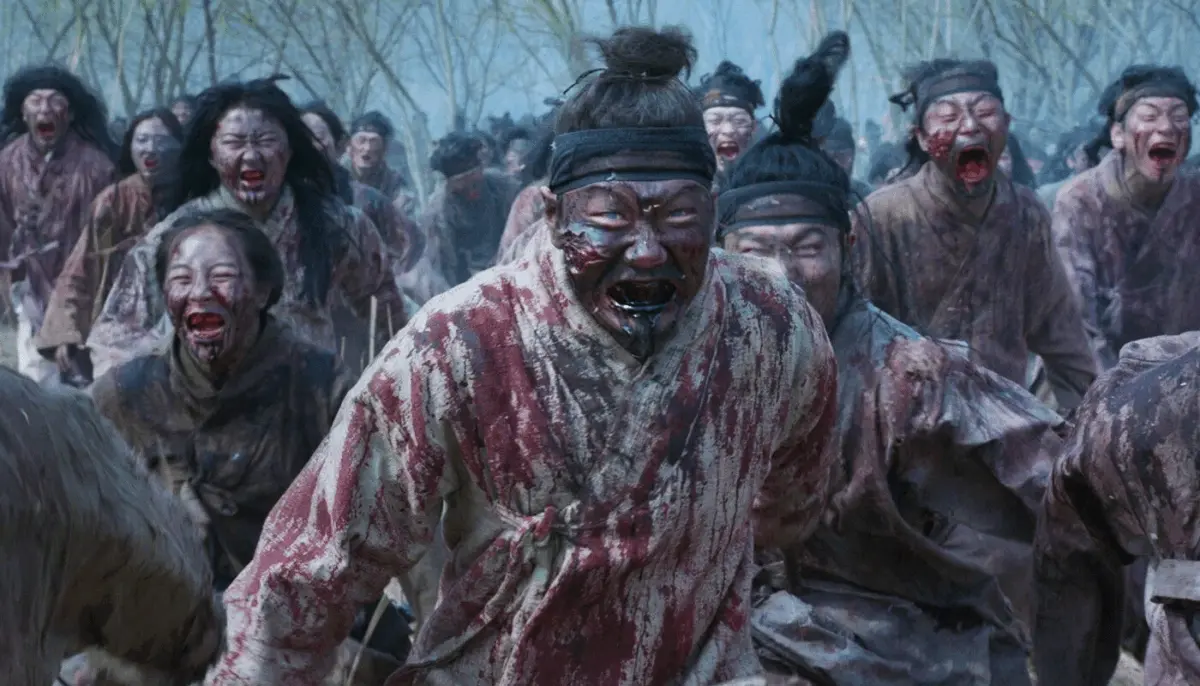
Shifting forward into the geopolitical complexities of the 17th century, Netflix’s South Korean streaming hit Kingdom merges the intricate, high-stakes court intrigue of Game of Thrones with the relentless, breakneck pacing and adrenaline-fueled horror of Train to Busan (2016).
The series unfolds during a period of immense vulnerability for the Joseon dynasty. The reigning king has succumbed to a mysterious, top-secret illness—he has, in fact, turned into a zombie, though the royal court conceals this transformation. Meanwhile, the succession of the throne becomes dangerously contested. Crown Prince Lee Chang (portrayed by Ju Ji-hoon) faces intense political marginalization due to his illegitimate birth, a status weaponized by the ambitious, pregnant Queen Consort (Kim Hye-jun). Pulled away from the capital to investigate a strange, localized plague sweeping the impoverished countryside, Prince Lee Chang soon discovers that the affliction is a flesh-eating contagion raising the dead.
Critical Analysis
Kingdom succeeds not merely as a high-octane action thriller featuring swarms of historical warriors slicing through the undead with swords, spears, and traditional bows. More importantly, it utilizes the zombie metaphor to deliver a blistering socio-political critique. The rapid spread of the contagion is deeply intertwined with systemic corruption, famine, and the absolute disregard of the ruling elite for the peasantry. The dead may crave human flesh, but the true monsters, the series argues, are the institutional systems that starve their own people.
3. The Colonial Era: "Bad Newes from New England" by Moaner T. Lawrence (2015)
- Medium: Epistolary Short Story (Published via Pseudopod)
- Setting: New Plymouth Colony (1621)
For those who appreciate the subversive subversion of foundational historical myths—akin to Wednesday Addams rewriting the narrative of the first Thanksgiving in Addams Family Values (1993)—Moaner T. Lawrence’s short story "Bad Newes from New England" offers a chilling, satirical, and supernatural alternative.
Presented in an epistolary format, the narrative consists of a fictionalized letter authored by William Bradford, Governor of the New Plymouth colony, in the autumn of 1621. The correspondence details the catastrophic unraveling and eventual destruction of the pilgrim settlement, culminating on the day of the historical feast. As expected, the colonial dream collapses not merely under the weight of harsh winters or agricultural failure, but due to an aggressive outbreak of the living dead.
Critical Analysis
Lawrence uses the framing of a zombie apocalypse to execute a dual-layered narrative. On one hand, it delivers classic supernatural dread. On the other, the text aggressively interrogates historical reality, weaving the grotesque horror of reanimated corpses alongside the very real, systemic atrocities inflicted by European colonizers upon the Indigenous populations of North America. The metaphorical implication is clear: the foundational soil of the continent is already stained with blood, making the rise of the dead an appropriate poetic reckoning.
4. The American Civil War: Dread Nation by Justina Ireland (2018)
- Medium: Young Adult Historical Fiction Novel
- Setting: Alternative 1880s United States
Justina Ireland’s Dread Nation presents a profoundly reimagined 19th-century America where the American Civil War was abruptly and permanently halted on July 3, 1863. Just two days after her birth, the fallen soldiers strewn across the Gettysburg battlefield unexpectedly reanimated, turning on the living and reshaping the geopolitical landscape of the nation.
Seventeen years later, the narrative follows Jane McKeene, a young Black woman completing her training at Miss Preston’s School of Combat for Negro Girls in Baltimore. In this alternate timeline, institutionalized combat training is mandated for marginalized populations. Jane anticipates a lucrative career as an "Attendant"—a specialized, etiquette-trained bodyguard armed with a blade, designed to protect wealthy white families from the lingering threat of the shambling dead. However, she soon finds herself entangled in a vast government conspiracy that pulls her out of the relative safety of Baltimore and into the treacherous, zombie-infested expanses of the American Wild West alongside her rival-turned-ally, Katherine.

Critical Analysis
Dread Nation transcends standard creature-feature tropes by embedding intersectional commentary into its speculative architecture. The horror of the shambling dead is matched—and frequently eclipsed—by the systemic racism, disenfranchisement, and violence of post-bellum America. Amidst the blood-soaked action sequences utilizing scythes, sickles, and firearms, the emotional core of the novel anchors itself in the developing, resilient friendship between Jane and Katherine, proving that human solidarity remains the ultimate survival tool.
5. World War II: Overlord (2018)
- Medium: Feature Film (Paramount Pictures)
- Setting: Occupied France, D-Day Invasion (1944)
Closing out the chronological spectrum is Julius Avery’s Overlord, a cinematic thrill-ride that begins as a gritty, ground-level war drama before executing a sharp, unapologetic pivot into over-the-top, blood-soaked body horror.
The film opens on the historical precipice of the D-Day landings. A diverse, racially integrated squad of American paratroopers is dropped behind enemy lines in occupied France. Their primary objective: infiltrate a heavily fortified Nazi-held village and destroy a communications radio tower housed inside a local church. Upon penetrating the compound, however, the surviving soldiers uncover a terrifying secret. The Third Reich’s grotesque scientific ambitions extend far beyond conventional warfare; underground laboratories are actively experimenting with cellular resurrection, producing mutated, super-powered human experiments and feral undead monsters.
Critical Analysis
Overlord embraces its tonal duality with unbridled glee. The first half functions as a tense, claustrophobic military infiltration film, emphasizing the mud, fear, and high mortality rates of infantry combat. Once the curtain is pulled back on the Nazi biochemical horrors, the film transforms into an adrenaline-fueled carnival of carnage. While not an outbreak narrative featuring swarms of millions of zombies, the engineered undead present in Overlord deliver grotesque body horror that satisfies fans of extreme cinematic violence.
Supporting Context & Metrics: The Sub-Genre Landscape
To contextualize the evolution and reception of historical zombie media, industry analysts and literary critics have observed several distinct metrics regarding audience engagement, medium distribution, and thematic resonance.
| Work Title | Medium | Historical Era | Primary Thematic Focus | Critical Reception / Impact |
|---|---|---|---|---|
| Primal ("Plague of Madness") | Animated TV | Prehistoric | Survival, scale, primal terror | Universal acclaim for visual storytelling and emotional weight. |
| Kingdom | Live-Action TV | Early 17th Century (Joseon Dynasty) | Class warfare, institutional corruption | International streaming success; revitalized the period zombie sub-genre. |
| "Bad Newes from New England" | Short Story | Colonial Era (1621) | Satire, colonial critique, myth-busting | Cult following within speculative fiction literary circles. |
| Dread Nation | Novel | Reconstruction Era (1880s) | Race, gender, systemic oppression | NYT Bestseller; praised for intersectional framing of historical horror. |
| Overlord | Feature Film | World War II (1944) | Military ethics, body horror, experimentation | Favorable box office and strong cult status for its bold tonal shift. |
Thematic Evolution Metrics
- Socio-Political Integration: Approximately 80% of successful historical zombie narratives utilize the undead as a physical manifestation of existing societal rot—whether that be feudal tyranny (Kingdom), colonial violence ("Bad Newes from New England"), or racial oppression (Dread Nation).
- Medium Diversification: Unlike modern zombie media, which historically dominated cinema through George A. Romero’s blueprints, historical zombie stories are evenly distributed across prestige television, animation, independent literature, and high-concept feature films.
Official Statements & Creator Insights
The blending of historical fact with supernatural fiction presents unique creative challenges. Creators and showrunners have frequently spoken on the deliberate friction of placing modern monsters into historical frameworks.
Genndy Tartakovsky, creator of Primal, noted in a 2020 production interview regarding the integration of monstrous elements into prehistoric settings:
"When you strip away dialogue, human history and prehistory become purely about survival, instinct, and raw motion. Adding a conceptual horror element like an unstoppable, diseased giant isn’t just about scaring the audience—it’s about testing the absolute limits of how two distinct, non-verbal entities cooperate when the very laws of nature break down around them."
Justina Ireland, author of Dread Nation, discussed the deliberate choice to frame a zombie narrative during the Reconstruction era:
"History is already full of monsters. The real horror of the 19th century wasn’t just the idea of corpses rising from the battlefield; it was the way human beings dehumanized each other. By placing Jane McKeene in a world where she has to fight both the shambling dead and the deeply ingrained prejudices of post-bellum America, the zombies became a lens to talk about who society deems worth protecting."
Future Outlook: Where Will the Undead Roam Next?
As audiences grow fatigued by repetitive contemporary apocalypse tropes—such as modern urban gridlock, generic viral outbreaks, and suburban survivalism—creators are increasingly looking backward to reinvent the zombie sub-genre.
The future of historical zombie fiction lies in expanding into underexplored geographical and temporal spaces. Industry insiders anticipate a rise in speculative projects exploring ancient civilizations (such as Bronze Age collapses or Roman military campaigns plagued by the undead) and non-Western historical conflicts where localized mythologies can intersect with biological horror.
By anchoring fantastical terror into documented human history, storytellers achieve a rare alchemy: they provide visceral thrills while forcing audiences to re-examine the very real blood, sweat, and systemic failures of the past. As long as creators continue to mine history for its inherent drama, the dead will undoubtedly continue to rise across the centuries.


Comments
Facebook App ID not configured. Please add it in the Customizer.