
Executive Overview
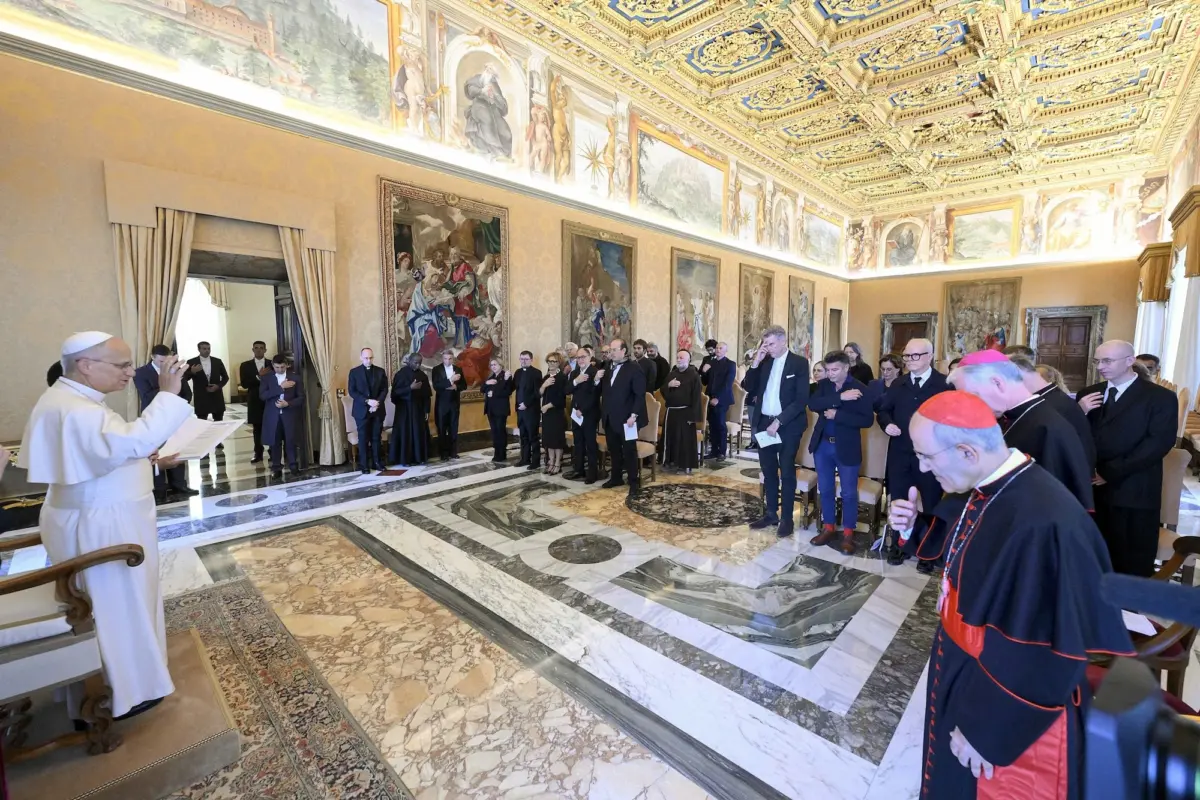
In an era defined by the dizzying acceleration of artificial intelligence—where technological capability outpaces ethical frameworks and existential dread lingers among policy makers—the Vatican has emerged as an unexpected ideological bulwark for the preservation of human consciousness. Speaking within the gilded halls of the Apostolic Palace on a Friday morning, Pope Leo XIV issued a resounding appeal to the international community of artists, creators, and curators: the Catholic Church needs them now, more than ever, to safeguard the sacred boundaries of human expression.
The pontiff’s address, delivered to an assembly gathered for the inauguration of the exhibition “The Art of Possibility: Weaving Together” (curated by the Vatican’s Dicastery for Culture and Education), cuts to the core of the contemporary anxiety surrounding generative AI. Coming on the heels of high-stakes political maneuvers in Washington, D.C., where U.S. President Donald Trump convened architects of frontier AI models to sign voluntary self-regulation pacts, and arriving amid apocalyptic warnings from tech prognosticators predicting human obsolescence within a decade, Pope Leo’s message offers a starkly philosophical counter-narrative.
At the heart of the Pope’s address is a profound defense of the ontological distinction between human creation and machine generation. Algorithms, the pontiff argued, operate through cold statistical calculation, recycling human heritage without grasping its soul. In contrast, authentic art remains the ultimate vessel of the human "spark." By framing the preservation of art not merely as a cultural endeavor, but as a spiritual and existential imperative, Pope Leo XIV has positioned the Vatican at the vanguard of a global movement to resist the homogenization of human experience. This comprehensive report examines the chronology of the address, the philosophical underpinnings drawn from his recent encyclical, the geopolitical backdrop of recent AI regulation, and the long-term implications of this historic convergence between faith and aesthetic resistance.
Read Also
Detailed Chronology: A Week of High-Stakes Reckoning with Artificial Intelligence
To fully grasp the gravity of Pope Leo XIV’s Friday address, one must view it within the framework of a volatile, fast-moving global week defined by desperate attempts to rein in artificial intelligence.
Tuesday: The White House Frontier AI Summit
The prelude to the Vatican’s cultural intervention occurred thousands of miles away in Washington, D.C. U.S. President Donald Trump convened a closed-door summit at the White House, bringing together the chief executive officers and chief architects behind the world’s most powerful frontier AI models. Among the attendees was tech billionaire Elon Musk, whose own massive investments in artificial intelligence have placed him at the center of the global technological arms race.
The objective of the Tuesday summit was ostensibly to establish guardrails. Under pressure from lawmakers, national security experts, and civil society groups demanding binding federal oversight, the tech leaders signed an agreement committing to voluntary self-regulation. Critics and policy analysts immediately questioned the efficacy of asking Silicon Valley titans to police their own exponential growth. The summit underscored a terrifying reality for many observers: governments are scrambling to catch up to an industry moving at lightspeed, often relying on the good faith of the very corporations profiting from unchecked expansion.
Thursday: The Cacophony of Silicon Valley
As policymakers in Washington celebrated their voluntary agreements, the wider scientific community remained deeply fractured. Throughout the week, leading AI researchers and existential risk experts continued to voice catastrophic predictions. A vocal faction of computer scientists warned that without severe, legally binding interventions, autonomous general intelligence systems could render humankind functionally obsolete—or worse—within a single decade. The market, meanwhile, rewarded every incremental breakthrough in algorithmic capability, driving multi-billion-dollar valuations while displacing traditional knowledge workers, designers, and writers.
Friday Morning: The Apostolic Palace Address
Against this backdrop of corporate self-regulation, existential dread, and algorithmic saturation, the Vatican stepped into the void. Pope Leo XIV addressed a curated audience of international artists, intellectuals, and museum directors inside the Apostolic Palace.
The venue itself—steeped in centuries of artistic patronage, from Michelangelo to Raphael—served as a living testament to the spiritual dimensions of human creation. The pontiff did not merely offer general words of encouragement; he delivered a precise, philosophically rigorous critique of generative AI. He contrasted the relentless, instantaneous responses of modern search engines with the deep, inquiring nature of true art.
Later that same morning, the Vatican press office amplified the message globally, while the Pope utilized his official X (formerly Twitter) account—managed by the Holy See and bearing ironic adjacency to platforms owned by summit attendee Elon Musk—to broadcast the core tenet of his speech to millions of digital followers:
"In this era of artificial intelligence, it is becoming urgent to distinguish human art from what machines produce. There is an ontological difference, even before an aesthetic one, between art and what a machine can generate through statistical calculation based on millions of…"
Supporting Context & Metrics: The Philosophical Foundations of Magnifica Humanitas
Pope Leo XIV’s Friday address was not an isolated philosophical musing; it was the latest iteration of a carefully constructed doctrinal framework established earlier in the year. The pontiff directly anchored his arguments in his landmark May encyclical letter, titled “Magnifica Humanitas… On Safeguarding the Human Person in the Time of Artificial Intelligence.”
The "Ontological Difference"
The cornerstone of the Pope’s critique—and his most significant contribution to the modern discourse on technology—is his insistence on an "ontological difference" between human creation and machine output.
In contemporary technological debates, proponents of generative AI often point to stunning visual art, evocative prose, and complex musical compositions generated by algorithms as proof of machine "creativity." Pope Leo dismantles this equivalence at its root:
- Algorithmic Derivation: What a machine generates is fundamentally derivative. It is the product of statistical calculation, pattern recognition, and predictive modeling trained upon billions of images, texts, and sounds previously created, suffered, and imagined by human beings. Algorithms synthesize; they do not experience.
- The Human Spark: Authentic culture and art, according to the pontiff, preserve the unquantifiable spark of human consciousness. Art emerges from mortality, suffering, joy, faith, and physical embodiment—dimensions entirely alien to silicon chips and neural networks.
The Anti-Search Engine: Art as Inquiry
In his Friday remarks, Leo expanded upon this by contrasting algorithmic information retrieval with artistic creation. We live, he observed, in an age of search engines capable of delivering thousands of instantaneous answers. Yet these systems suffer from a fatal flaw:
"No matter how powerful they may be, they merely return what already exists and tend to give us what we already want."
Algorithms are designed to cater to user preferences, reinforce existing biases, and maximize engagement through algorithmic feedback loops. Art, conversely, operates on an entirely different vector. It is a "different kind of search engine," one that "does not proceed by indexing but by inquiry."
Artistic inquiry, the Pope noted, refuses to be satisfied with the mere accumulation of facts or the frictionless delivery of data. It digs deeper, seeking the invisible threads that unite human experiences. When art resists homogenization—when it forces viewers to pause before that which cannot be consumed or monetized—it functions as an indispensable form of cultural and spiritual regeneration.
Official Statements and Historical Echoes
The relationship between the Catholic Church and the artistic community has historically been symbiotic, marked by centuries of magnificent patronage offset by occasional friction over dogma and freedom of expression. In the modern era, however, this relationship has increasingly focused on defending human dignity against the dehumanizing forces of industrialization, mass media, and now, digital automation.
Echoes of Vatican II: Paul VI (1964)
During his address, Pope Leo XIV explicitly invoked one of his illustrious predecessors, Pope Paul VI, referencing a historic meeting between the Church and artists in 1964. Addressing creators at the close of the Second Vatican Council, Paul VI made a direct, emotional plea: "We need you."
Reiterating those exact words over six decades later, Pope Leo updated the context for the twenty-first century. While Paul VI sought to heal a perceived rift between the Church and modern artistic avant-gardes, Leo views artists as indispensable allies in a spiritual war for the preservation of the human soul against technological reductionism.
"The ministry of the Church," Leo stated on Friday, "is to make the world of the spirit inspiring. And in this task, which translates the invisible world into accessible, intelligible forms, you are masters."
The Vatican Dicastery for Culture and Education
The exhibition “The Art of Possibility: Weaving Together,” which served as the occasion for the address, was organized under the auspices of the Vatican’s Dicastery for Culture and Education. The department has increasingly focused its programmatic initiatives on the ethical implications of the digital revolution. By bringing contemporary curators and artists into direct dialogue with theological doctrine, the Vatican is actively attempting to establish a counter-culture—a sanctuary where human imperfections, emotions, and physical materiality are celebrated precisely because they cannot be replicated by code.
Future Outlook: The Intersection of Faith, Art, and Artificial Intelligence
As humanity navigates the uncharted waters of the mid-2020s, the convergence of religious philosophy and technological critique represents a fascinating and potent cultural shift. While governments negotiate voluntary self-regulation with tech oligarchs and venture capitalists pour trillions into replacing human labor with automated systems, the moral leadership provided by figures like Pope Leo XIV fills a critical vacuum.
Key Implications for the Future:
- The Rise of "Authenticity Certification": Just as organic farming emerged as a consumer rebellion against industrial food production, we are likely to see a massive cultural pivot toward certified human-made art. The "ontological difference" highlighted by the Pope will likely become a primary market and spiritual differentiator, with consumers actively seeking out the documented struggles of human creators over frictionless machine generation.
- The Church as a Cultural Sanctuary: By positioning itself as a welcoming home for artists resisting homogenization, the Vatican is reinventing its role as a patron of counter-cultural resistance. Institutions of faith and culture may increasingly become safe havens for deep, unhurried, non-monetized human expression.
- Ethical Policy and Human Rights: The philosophical distinction between statistical calculation and authentic consciousness provides a much-needed vocabulary for legal and ethical policymakers. As courts grapple with copyright infringement, intellectual property theft by AI models, and the erosion of creative labor, theological and philosophical arguments for human uniqueness will increasingly inform secular legislation.
Pope Leo XIV concluded his Friday address with a benediction of profound solidarity:
"Dear artists, dear curators, know that the Church looks upon you with esteem, gratitude and hope; that she needs you, and that she wishes to walk alongside you, so that together we may safeguard the grandeur of humanity entrusted to us."
In an age hurtling blindly toward machine-driven homogenization, the Pope’s message serves as both a warning and a beacon: the future of humanity depends not on how efficiently our machines can mimic us, but on how courageously we preserve the unquantifiable, beautiful mess of our own humanity.


Comments
Facebook App ID not configured. Please add it in the Customizer.