
In the craft of creative writing, few dictums are repeated more frequently—or misunderstood more profoundly—than the golden rule: "Show, don’t tell."
For generations of aspiring novelists, screenwriters, and memoirists, this phrase has served as both a beacon and a stumbling block. When applied to character development, the directive fundamentally asks creators to communicate a subject’s internal landscape—their volatile emotions, hidden motivations, and distinct personality traits—through external manifestations. Rather than telling a reader that a protagonist is terrified, heartbroken, or jubilant, the writer must orchestrate body language, micro-expressions, and physical actions so that the audience feels palpably present in the room. They must experience the scene firsthand, bypassing the author’s editorial narration altogether.
Yet, mastering this technique remains one of the steepest climbs in literature. Many writers default to internal monologue or heavy-handed exposition because capturing the subtle choreography of human emotion on the page is notoriously difficult. However, an unexpected masterclass in this discipline exists right outside our doors, running through our pastures, sleeping at the foot of our beds, and peering down from our backyard trees: the animal kingdom.
Read Also
Executive Overview: The Nonverbal Blueprint
Writing about animals offers a masterclass in the mechanics of "showing, not telling" because nonhuman subjects lack the luxury of verbal syntax. Animals do not articulate jealousy with cutting remarks, process grief through intellectualized soliloquies, or declare affection with direct declarations. Instead, their entire emotional architecture is broadcasted through pure physical syntax—respiratory cadence, muscle tension, gaze direction, and behavioral shifts.
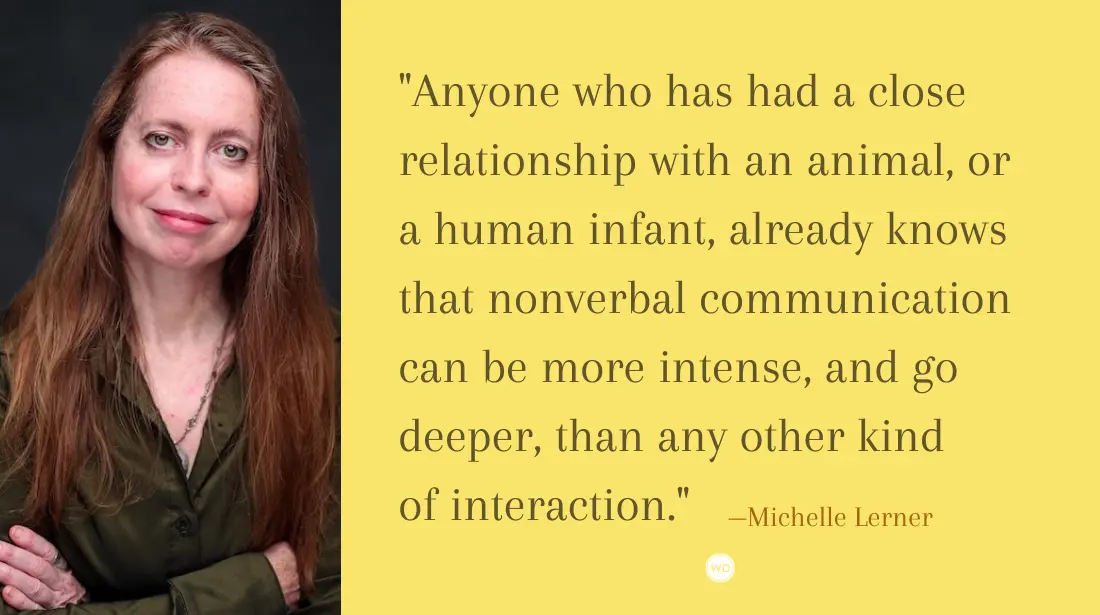
According to Michelle Lerner, author of the memoir A Series of Opinionated Animals, observing and writing about animals forces a writer to strip away linguistic crutches and focus entirely on sensory truth. By studying how animals communicate without words, authors can unlock a deeper, more visceral approach to writing human characters.
This article explores the core thesis of Lerner’s work: that the secret to writing believable, three-dimensional characters—regardless of their species—lies in treating them, at least temporarily, as nonverbal entities whose internal states must be deciphered exclusively through physical evidence. Through structured analysis, practical applications, and lessons drawn from real-world animal behavior, we examine how adopting a zoological lens can revolutionize narrative prose.
Detailed Chronology: Translating Instinct to the Page
To understand how animal behavior translates into compelling literature, one must examine how writers transition from abstract emotional labeling to concrete physical staging. Historically, character development in Western literature relied heavily on omniscient narration—telling the audience precisely what a character felt. The evolution toward sensory-driven prose required writers to look closer at the physical realities of existence.
Phase 1: Recognizing the Language of Instinct
In the natural world, survival depends on accurate emotional and physiological reading. A predator does not announce its intention to strike; it drops its center of gravity, fixes its gaze, and silences its breathing. Prey animals do not debate their anxiety in town halls; they stiffen, flare their nostrils, and lock their limbs.
Humans instinctively understand this physical vocabulary. When a deer freezes dead center in a pair of oncoming headlights, the image is so universally resonant that "deer in the headlights" has been permanently codified into human lexicon as a metaphor for paralysis by fear and confusion.
Phase 2: Applying Behavioral Mechanics to Memoir
When Lerner set out to write A Series of Opinionated Animals, she faced the distinct challenge of bringing a menagerie of real-life creatures to life on the page. Her subjects included Monster, a neurological squirrel with a penchant for goofy antics; Lamby, an aggressive sheep dubbed "the woolly bully"; Stephanie, a fiercely protective and aggressive chicken; Shire, an equine soulmate; alongside a rotating cast of domestic canines and felines.
Rather than relying on abstract claims about their temperaments, Lerner utilized precise behavioral mapping:
- Lamby’s Impatience: Instead of telling readers the sheep grew angry when mealtime was delayed, Lerner depicted the brute force of Lamby physically bashing in the window of the kitchen door whenever dinner was off schedule by mere minutes.
- Stephanie’s Ferocity: Rather than asserting that the chicken was vicious, Lerner allowed readers to witness Stephanie screaming like an avian ninja while relentlessly pursuing the local UPS delivery woman across the farm.
- The Bond with Shire: The profound, wordless connection between human and horse was conveyed not through sentimental reflection, but through the sensory intimacy of lying side-by-side in a stable stall, breathing in unison while resting an arm across the animal’s upper back.
Phase 3: The Micro-Interactions of Multi-Species Dynamics
Behavioral tension is often best observed in interactions between animals. Consider a specific vignette from Lerner’s work detailing an encounter between her dog, Chip, and a stoic Siamese cat named Sushi:
Chip barked. Sushi stared. Chip gulped. Sushi stared harder. Chip backed up. Sushi moved toward her. Chip looked around for her posse, but Nubi and Fern shrugged and backed off. Sushi looked at me again and asked if I was taking notes.
Even with a touch of humorous authorial interpretation, the psychological arc of the scene is entirely self-evident. The reader does not need a psychological profile to understand Chip’s journey from misplaced bravado to sudden subjugation. It is communicated entirely through spatial dynamics, gaze duration, and the transition from an aggressive bark to an involuntary swallow.
Supporting Context & Metrics: The Science of Nonverbal Communication
Why does nonverbal description resonate so deeply with readers? Science and psychology suggest that human beings are fundamentally hardwired to read physical cues long before we process linguistic data.
- Evolutionary Primacy: Nonverbal communication pre-dates human language by millions of years. The amygdala and other primitive structures of the human brain process body language, posture, and vocal tone with rapid-fire efficiency, often bypassing the neocortex where intellectualized language is parsed.
- The Power of Observation in Infancy: Much like our relationship with domestic animals, human beings form their earliest and most profound bonds with nonverbal infants. Long before a child speaks their first word, parents and caregivers decipher hunger, exhaustion, terror, and joy through sighs, shivers, shifts in eye contact, and vocal pitches.
- Literary Immersion: According to creative writing metrics tracked by editorial platforms, scenes heavy on sensory-motor details trigger "embodied simulation" in readers. Brain scans show that when a reader processes a physical description (e.g., “she gripped the doorframe until her knuckles turned white”), the motor regions of the reader’s brain light up as if they were performing the action themselves. Telling a reader “she was anxious” activates no such neurological simulation.
Official Guidelines for Authors: The "Nonverbal Exercise"
For writers seeking to elevate their prose, Lerner offers a practical, counter-intuitive methodology that can be applied to any draft, whether featuring humans, aliens, or beasts.
1. The Nonverbal Scene Test
For at least one moment in every narrative scene, pretend that your characters are entirely nonverbal. Challenge yourself to communicate their exact psychological or physiological state using exclusively body language and physical action.
- If a human character is terrified, do they freeze, hyperventilate, swallow audibly, or jump at microscopic sounds? What is the register and volume of their breath?
- If they are depressed, do they push food around their plate rather than eating? Do they remain horizontal long past dawn? Do they actively avoid meeting the gaze of others?
- If they are physically uncomfortable, how does their body react? Does sweat soak through their fabric and darken their collar? Do they rub their hands together, hug their torso defensively, or struggle to flex stiffening fingers?
2. Borrow from the Animal Kingdom
If you find yourself stuck—struggling to invent physical clues for a nuanced human emotion—ask yourself: What physical signs would an animal exhibit if it were experiencing a similar state?
- Envy might manifest as pacing, stiffened posture, and a fixed, unblinking stare.
- Guilt might look like a lowered head, shifting weight from paw to foot, and an active avoidance of physical space.
- Anticipation might reveal itself in rhythmic twitching, erratic breathing, or sudden, unfocused bursts of motion.
Future Outlook: The Evolution of Character Craft
As literature continues to evolve in an increasingly digital and fast-paced world, readers crave authenticity and emotional depth more than ever. The temptation to over-explain—to act as an intrusive tour guide pointing out every emotional landmark—remains a persistent trap for modern writers.
However, embracing the lessons of the animal kingdom offers a reliable antidote to this literary fatigue. By recognizing that nonverbal communication is often more intense, layered, and resonant than spoken dialogue, writers can break free from expositional habits.
Ultimately, the paradox holds true: to write more vivid, relatable, and deeply human characters, we must sometimes step outside of human language entirely. Whether crafting a fantasy epic, a contemporary drama, or a personal memoir, the rule remains universal. If you can forge a profound connection in real life without speaking a single word, you can achieve the exact same depth on the page—no matter your character’s species.




Comments
Facebook App ID not configured. Please add it in the Customizer.