
Executive Overview
For author Sophie Lefens, the genesis of a narrative does not begin in the sterile isolation of a quiet room, but rather in the ambient, unpredictable theater of everyday public life. Writing amidst the gentle ebb and flow of coffee shops, libraries, and parks, Lefens developed a unique sensitivity to human dynamics—an innate radar for shifts in mood, unspoken tensions, and invisible currents of energy that ripple through a shared space. Little did she know that this acute hyper-awareness of the psychological atmosphere around her would become the foundational bedrock of her debut novel, Her Kind.
When Her Kind was acquired for publication, Lefens transitioned from solitary creator to collaborative partner, working alongside editor Peter Kispert. What followed was a profound education in the mechanics of long-form fiction. Moving from her poetic roots—where she had rarely authored works exceeding five pages—to the sprawling architectural demands of a psychological and atmospheric novel presented a steep learning curve. Crucially, Lefens discovered that mastering narrative pacing was not simply a matter of grand structural overhauls or shifting massive blocks of plot. Instead, it was an exercise in micro-attunement: learning to conduct the invisible energy pulsing across the page with the precision of a symphonic maestro.
This feature explores Lefens’ creative journey, examining how her unique observational habits informed the creation of Her Kind, a slow-burn psychological exploration of motherhood, mortality, and impending rupture. Through an in-depth look at her revision process, we uncover how minor adjustments to micro-expressions, sensory details, and atmospheric tension can transform a manuscript from a rough draft into a living, breathing work of literary art.
Read Also
Detailed Chronology: From Public Observation to Publication
Phase 1: The Incubation of Observation (Pre-Manuscript)
Long before securing a book deal, Lefens established her writing ritual in public arenas. Driven partly by domestic reality—sharing a home with a small child—and partly by a longstanding preference for ambient motion, she routinely positioned herself at communal tables and café bars.
Working in these shared spaces for hours at a time instilled in her a specialized form of emotional intelligence. As strangers settled beside her—shedding coats, bringing distinct aromas, and carrying diverse emotional weight—Lefens learned to read the room on a molecular level. She developed the ability to sense whether her neighbor was experiencing irritation, dreaminess, or profound loneliness before ever casting a glance at their face. This heightened perception of atmospheric shifts served as an early training ground for character psychology, proving that a person’s internal weather can fundamentally alter the space they occupy.
Phase 2: Crossing the Threshold into Long-Form Fiction
With a background deeply rooted in poetry, Lefens possessed an intrinsic understanding of cadence, sound, and the musicality of a single line. However, this poetic foundation presented a distinct challenge when she set out to write Her Kind. Prior to the novel, her longest literary output capped out at roughly five pages.
The leap into a full-length manuscript meant scaling up her technical toolkit. While she understood how to make a single stanza resonate, sustaining tension, character development, and atmospheric dread over the course of a novel required an entirely different methodology. When her manuscript was finally sold and she began collaborating with editor Peter Kispert, the inevitable friction of the editorial process began. Kispert flagged the novel’s pacing as a primary area for development—a critique that initially threw the debut author for a loop.
Phase 3: Redefining Structural Revision
When told the novel required pacing adjustments, Lefens’ first instinct was architectural. She assumed she would need to violently dismantle her plot, excise chapters, reposition large narrative blocks, and invent entirely new dramatic scenes to bridge structural gaps.
However, under Kispert’s guidance, a profound shift in perspective occurred. Lefens realized that the pacing issues within Her Kind were not structural defects born of broken plots, but rather atmospheric lapses born of a temporary disconnection from the text. The solution lay not in adding more narrative noise, but in sharpening her focus on the material already resting on the page.
Supporting Context & Metrics: The Anatomy of Her Kind
To understand the editorial challenges Lefens faced, one must examine the atmospheric blueprint of Her Kind itself. The novel is intentionally designed as a "slow burn"—a psychological and atmospheric narrative that relies heavily on a dual-tension framework.
Thematic Architecture of the Novel
- The Protagonist’s Dilemma: The story centers on Ada, a woman plagued by persistent, unsettling visions of being violently dragged away from the Earth.
- The Inciting Crisis: Paralyzed by fear over what will become of her young son if she vanishes, Ada invites her three closest friends to visit her secluded home.
- The Setting: Set deep in the Michigan woods, Ada lives alongside her beloved aunt, Leigh, in a home described as a site of eccentric, overgrown beauty.
- The Emotional Core: Aunt Leigh’s home is a sanctuary—a place where people feel intensely alive, anchored, and at home in the world. Lefens deliberately cultivated this sense of vibrant refuge so that the reader would fall in love with the setting.
The Physics of Literary Tension
The central triumph—and the primary technical hurdle—of Her Kind rests in holding two contradictory emotional realities in delicate suspension:
- Enlivenment: The reader and the characters must feel deeply nourished, safe, and enlivened by the lush, beautiful world of Leigh’s woodland home.
- Inevitability: Running parallel to this warmth is a lurking, omnipresent dread. Just as Ada feels it, the reader must sense that a catastrophic rupture is approaching—that death, in its myriad forms, remains an absolute certainty.
Maintaining this razor-thin equilibrium required rigorous, microscopic revisions. A mismanaged scene could either dilute the dread or smother the beauty, tipping the novel into melodrama or clinical detachment.
Official Statements & Creative Methodology
During her work on Her Kind, Lefens adopted a hands-on, sensory-driven approach to revision that transformed her relationship with her own text. Below are the core methodological pillars she utilized during her collaboration with Peter Kispert:
1. The Conductor Metaphor
Reflecting on her editorial sessions with Kispert, Lefens often compares the novelist to a symphonic conductor. A writer must possess an acute ear for musical phrasing, understanding how tension builds, swells, and resolves over time. Just as an orchestra relies on tempo and dynamic variation to move an audience, a novelist must regulate the emotional velocity of a scene to keep the reader fully immersed.
2. Immersive Scene Reconstruction
To correct pacing errors and eliminate dead zones, Lefens subjected her manuscript to a rigorous, line-by-line autopsy. Her revision process involved several concrete steps:
- Slow, Linear Reading: Starting from page one, she read the manuscript at a glacial pace, actively hunting for moments where she had lost touch with the scene’s internal energy.
- Tracking Micro-Interactions: She identified missing micro-expressions, subtle gestures, and unspoken physical cues between characters that needed to be rendered visible on the page.
- Calibrating Information Flow: She meticulously adjusted places where she had either concealed too much information—leaving the reader confused—or revealed too much too soon, thereby flattening the dramatic charge of the moment.
- Total Physical Immersion: For every scene she revised, Lefens forced herself to re-enter the physical space mentally. She mapped out spatial logistics: Where was everyone sitting? What did the room smell like? What sounds drifted in? What was happening outside the window?
- Omnipresent Character Consciousness: She ensured she knew how every character in a scene was experiencing the moment, regardless of whether they were the immediate narrative focus. Every single detail was forced to pull its own weight.
3. The Psychology of the Future Reader
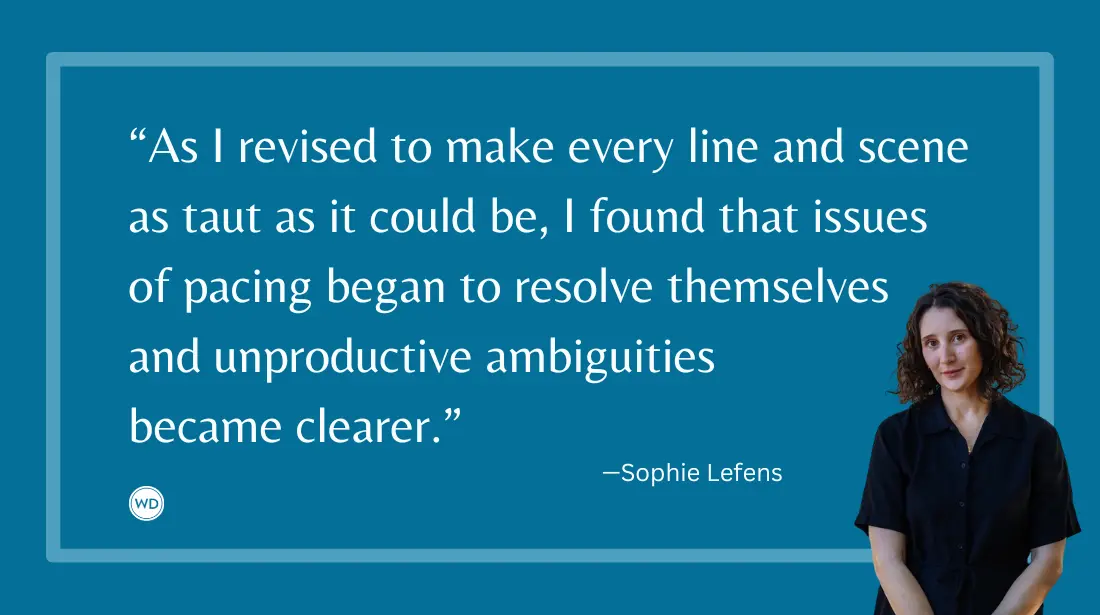
For Lefens, this level of intense immersion evolved from a mechanical chore into a source of pure creative joy. By tightening every line and sealing every atmospheric leak, she found that broader structural ambiguities naturally dissolved. Furthermore, this rigorous attention fostered a deeper sense of empathy toward her audience. Because she revised with the reader’s experiential journey constantly in mind, the final product emerged as a more intimate, generous offering.
Future Outlook: The Evolution of a Literary Voice
The publication of Her Kind marks a significant milestone not only for Sophie Lefens, but for contemporary psychological fiction that prioritizes atmospheric resonance over breakneck plot mechanics. By proving that a debut author can successfully bridge the gap between poetic sensibility and novelistic architecture, Lefens has established a compelling template for craft.
Key Takeaways for Emerging Writers
- Pacing is Micro, Not Macro: As Lefens discovered, pacing problems are frequently symptoms of emotional detachment from the immediate scene rather than structural failures of plot. Solving them requires local attention to sensory details, character interiority, and spatial awareness.
- The Value of Collaborative Editing: A skilled editor like Peter Kispert does not alter an author’s voice; rather, they act as an acoustic tuner, helping the writer identify false notes and amplify the resonant frequencies already buried within the prose.
- Empathy in Craft: Writing with a profound awareness of the reader’s psychological journey transforms revision from an exhausting chore into an act of profound hospitality.
As Lefens looks toward future literary projects, the lessons learned in the Michigan woods—and in the bustling public coffee shops where her journey began—will undoubtedly continue to shape her work. In an era dominated by hyper-fast media consumption, Her Kind and its author stand as a testament to the power of the slow burn, reminding us that true literary tension is not built by rushing toward the end, but by learning to inhabit every single moment along the way.





Comments
Facebook App ID not configured. Please add it in the Customizer.