
Executive Overview
The 83rd World Science Fiction Convention (LAcon V) has officially released its detailed voting tallies and nominating statistics for the 2026 Hugo Awards, Lodestar Award for Best Young Adult Book, and Astounding Award for Best New Writer. The data reveals a significant surge in voter engagement across the speculative fiction community, marked by a substantial increase in both nominating and final preference ballots compared to the previous year’s gathering in Seattle.
A total of 2,492 valid final ballots were submitted (including just two paper ballots), representing a 27% increase over the 1,962 ballots cast at Seattle Worldcon 2025. Nominating participation similarly expanded, with 1,488 nominating ballots received (six paper), up from 1,338 in 2025.
====================================================================
               LACON V (2026) VOTER TURNOUT METRICS
====================================================================
Metric                      Seattle (2025)   LAcon V (2026)   Growth
--------------------------------------------------------------------
Valid Final Ballots             1,962            2,492       +27.0%
  — Electronic Ballots          1,960            2,490       +27.0%
  — Paper Ballots                   2                2         0.0%
--------------------------------------------------------------------
Nominating Ballots              1,338            1,488       +11.2%
  — Electronic Ballots          1,332            1,482       +11.3%
  — Paper Ballots                   6                6         0.0%
====================================================================
The election outcomes featured a mix of dominant sweep victories by established authors alongside stark, come-from-behind upsets driven by the mechanics of Instant Runoff Voting (IRV). Major literary honors saw high-profile wins for Alix E. Harrow, Amal El-Mohtar, John Scalzi, and Thomas Ha. Concurrently, categories like the Lodestar Award demonstrated the powerful influence of down-ballot preference distribution, as C.B. Lee’s Coffeeshop in an Alternate Universe surmounted a massive initial nomination lead held by Suzanne Collins’s blockbuster Sunrise on the Reaping.
Read Also
Administratively, the 2026 cycle underscored the strict enforcement of World Science Fiction Society (WSFS) eligibility criteria. Multiple high-profile entries across the Best Series, Best Dramatic Presentation, and Astounding Award categories were disqualified or reclassified due to word-count thresholds, cross-category rules, or prior eligibility windows.
Detailed Category Deep-Dives
Fiction Categories
=================================================================================
                            HUGO AWARDS: FICTION SUMMARY
=================================================================================
Category       Winner                       Entry Title             Margin / Note
---------------------------------------------------------------------------------
Best Novel     Alix E. Harrow               The Everlasting         Led all 6 rounds
Best Novella   Amal El-Mohtar               The River Has Roots     Led all 6 rounds
Best Novelette H.H. Pak                     "Never Eaten Veg."      Led all 6 rounds
Best Short St. Thomas Ha                    "In My Country"         Led all 6 rounds
Best Series    John Scalzi                  Old Man's War           Led all 6 rounds
=================================================================================
Best Novel
Alix E. Harrow secured her second Hugo Award (out of seven career nominations) with The Everlasting, entering the final ballot with the highest number of first-place votes and maintaining an uninterrupted lead across all six elimination rounds.
Emily Tesh’s The Incandescent, which entered the process with the highest overall nomination tally, mirrored Harrow’s path by securing second place cleanly. Third place featured a dynamic multi-round battle: Antonia Hodgson’s The Raven Scholar held an early lead through the first two rounds of transfer counting, but was ultimately overtaken in the fourth round by Robert Jackson Bennett’s A Drop of Corruption. Hodgson’s work subsequently locked in fourth place without challenge. Nnedi Okorafor’s Death of the Author captured fifth place in a single round, followed by Shroud in sixth.
According to official EPH margin statistics, the closest runner-up to miss the six-book final ballot was R.F. Kuang’s Katabasis, which fell short by just three nominating ballots.

BEST NOVEL FINAL STANDINGS
1. The Everlasting by Alix E. Harrow (WINNER)
2. The Incandescent by Emily Tesh
3. A Drop of Corruption by Robert Jackson Bennett
4. The Raven Scholar by Antonia Hodgson
5. Death of the Author by Nnedi Okorafor
6. Shroud
-- Closest Runner-Up: Katabasis by R.F. Kuang (Short by 3 nominations)
Best Novella
Amal El-Mohtar demonstrated absolute voter consensus with The River Has Roots. Entering with the highest nomination total and the most first-place preferences, El-Mohtar led all six rounds to claim her third Hugo Award on her third nomination—maintaining a 100% win rate in nominated categories.
The remaining placements were decided without significant volatility:
- 2nd Place: Automatic Noodle by Annalee Newitz
- 3rd Place: Cinder House by Freya Marske
- 4th Place: The Summer House by Naomi Novik
- 5th Place: What Stalks the Deep by T. Kingfisher
- 6th Place: Murder by Memory by Olivia Waite
Nghi Vo’s A Mouthful of Dust was the top unnominated contender, requiring 11 additional nominations to breach the finalist threshold.
Best Novelette
H.H. Pak claimed their career-first Hugo nomination and win with "Never Eaten Vegetables", leading wire-to-wire through six rounds.
The contest for second place saw substantial vote transfers: Scott Lynch’s "Kaiju Agonistes" led early, but Catherynne M. Valente’s "When He Calls Your Name" accumulated significant momentum following the elimination of Sarah Pinsker’s "The Millay Illusion", clinching second place in the fifth round. Lynch comfortably retained third place.
In a rare statistical event, fourth place resulted in an exact tie between Martha Wells’s "Rapport: Friendship, Solidarity, Communion, Empathy" (which had led nominations) and Cameron Reed’s "The Girl My Mother Is Leaving Me For". Pinsker’s entry finished sixth. John Scalzi’s "3 Days, 9 Months, 27 Years" was the closest runner-up, missing the ballot by a fraction of a point (one nomination valued at over 0.5 EPH points).
Best Short Story
Thomas Ha claimed his first Hugo Award on his second nomination with "In My Country", maintaining an uninterrupted lead across six voting rounds.

The second-place contest featured shifting leads: Isabel J. Kim’s "Wire Mother" commanded the first two rounds before Samantha Mills’s "10 Visions of the Future; or, Self-Care for the End of Days" surged in rounds three and four. However, down-ballot transfers in the fifth round pushed Kim back into second place. Tia Tashiro’s "Missing Helen" took third place, Mills placed fourth, nomination-leader J.R. Dawson ("Six People to Revise You") landed in fifth, and Effie Seiberg ("Laser Eyes Ain’t Everything") completed the ballot in sixth. Angela Liu’s "Barbershops of the Floating City" missed final nomination by a single ballot.
Best Series
John Scalzi’s long-running Old Man’s War series captured the category in six rounds, earning Scalzi his fourth Hugo Award across 14 career nominations.
The battle for second place shifted significantly after Elizabeth Bear’s White Space was eliminated; its vote transfers propelled Katherine Addison’s The Chronicles of Osreth (the nomination leader) past Seanan McGuire’s October Daye series in the fifth round. McGuire took third place, Bear’s White Space narrowly edged Max Gladstone’s The Craft Wars for fourth, and Heather Fawcett’s Emily Wilde finished sixth.
Visual Media, Graphic Works, and Interactive Media
=================================================================================
                 GRAPHIC, DRAMATIC & INTERACTIVE CATEGORIES
=================================================================================
Category       Winner                       Entry Title             Elim. Round
---------------------------------------------------------------------------------
Graphic Story  Fred Fordham & U.K. Le Guin  A Wizard of Earthsea    6 Rounds
Dramatic (Long)N/A                          Sinners                 6 Rounds
Dramatic (Sht) N/A                          Murderbot: "All Sys."   5 Rounds
Interactive    N/A                          Clair Obscur: Exp. 33   6 Rounds
=================================================================================
Best Graphic Story
Fred Fordham’s graphic novel adaptation of Ursula K. Le Guin’s A Wizard of Earthsea dominated all six rounds to secure the award. This marked Fordham’s first Hugo nomination and win, and Le Guin’s 9th win out of 27 career nominations.
Nnedi Okorafor and Tana Ford’s The Space Cat claimed second place after a contested race against Kelly Thompson and Hayden Sherman’s Absolute Wonder Woman Vol. 1: The Last Amazon, benefiting from vote transfers when Leigh Bardugo and John Picacio’s nomination-leading The Invisible Parade was dropped. Absolute Wonder Woman took third, The Invisible Parade placed fourth, K.B. Spangler and Ale Presser’s webcomic A Girl and Her Fed took sixth, behind The Power Fantasy Vol. 1: The Superpowers in fifth. Paul Cornell and Rachael Smith’s Who Killed Nessie? missed nomination by two votes.
Best Dramatic Presentation – Long Form
Ryan Coogler’s vampire thriller Sinners swept the long-form category, entering with the highest nominating count and highest initial preference tally before securing an unchallenged victory through six rounds.
BEST DRAMATIC PRESENTATION – LONG FORM STANDINGS
1. Sinners (WINNER)
2. Andor (Season 2)
3. KPop Demon Hunters
4. Frankenstein
5. Superman
6. Mickey 17- 2nd Place: Andor (Season 2)
- 3rd Place: KPop Demon Hunters (secured in just three rounds)
- 4th Place: Frankenstein (overtook Superman in the final round)
- 5th Place: Superman
- 6th Place: Mickey 17
Best Dramatic Presentation – Short Form
The debut episode of Murderbot ("All Systems Red") established absolute dominance, expanding an initial lead to take the Hugo in five rounds. The second episode, "The Perimeter", secured second place in four rounds.

- 3rd Place: Pluribus: "We Is Us"
- 4th Place: Severance: "Cold Harbor"
- 5th Place: Doctor Who: "The Story & the Engine"
- 6th Place: The Wheel of Time: "The Road to the Spear"
Best Game or Interactive Work
Sandfall Interactive’s Clair Obscur: Expedition 33 secured an undisputed win across six rounds, propelled by top nomination counts and initial vote preferences.
Hades II staged a late-stage surge against Blue Prince, overcoming a deficit in the fourth round with a 20-vote margin to lock down second place. Blue Prince settled for third, followed by Hollow Knight: Silksong (4th), Dispatch (5th), and Citizen Sleeper 2: Starward Vector (6th). Split Fiction missed the finalist ballot by 11 nominations.
Professional, Editorial, and Fan Categories
=================================================================================
                   EDITORIAL & PROFESSIONAL ARTIST SUMMARY
=================================================================================
Category             Winner                 Total Wins / Noms     Career Notes
---------------------------------------------------------------------------------
Ed. Short Form       Neil Clarke            8 Wins / 18 Noms      5th win in cat.
Ed. Long Form        Diana M. Pho           3 Wins / 5 Noms       Led all 6 rounds
Pro Artist           John Picacio           4 Wins / 19 Noms      16th pro-art nom
=================================================================================
Best Editor (Short & Long Form)
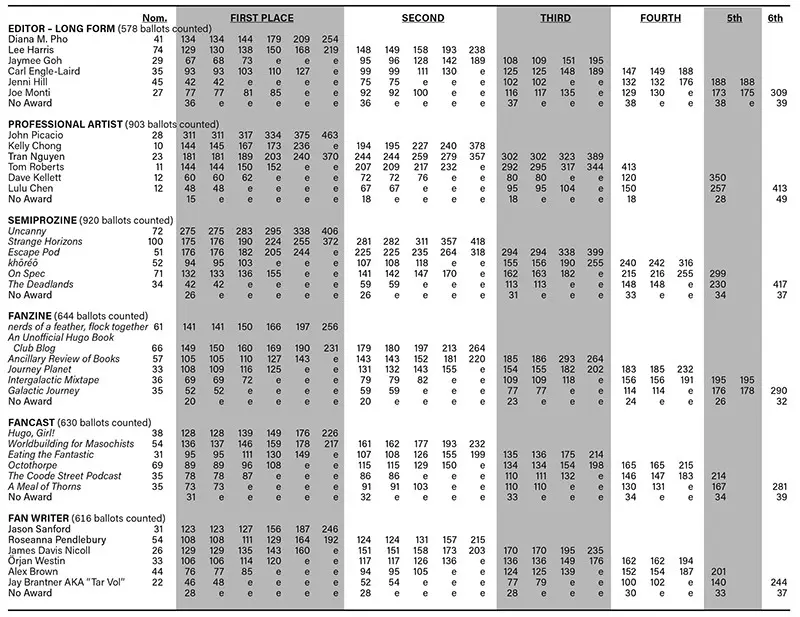
- Short Form: Neil Clarke won his 8th overall Hugo Award (5th in this category across 14 category nominations), leading continuously through six rounds. Sheila Williams took second. A third-place tie emerged between Jennifer Brozek and Michael Damien Thomas, with Brozek erasing a two-point deficit in the fourth round.
- Long Form: Diana M. Pho captured her third Hugo Award on her fifth nomination, building on an early lead to win in six rounds. Top-nominated editor Lee Harris took second. Carl Engle-Laird and Jaymee Goh battled for third, with Goh pulling ahead in the fourth round.
Best Professional Artist
John Picacio won his 4th Hugo Award (out of 19 career nominations) with a wire-to-wire victory. The race for second featured a three-way shift: Tran Nguyen led early, but Kelly Chong surged in the fifth round to take second, leaving Nguyen in third. Tom Roberts, Dave Kellett, and Lulu Chen rounded out the ballot.
Semiprozine, Fanzine, and Fancast
- Best Semiprozine: Uncanny Magazine claimed its 9th win out of 11 nominations without facing a single lead change. Nomination leader Strange Horizons took second, followed by Escape Pod, Khōréō, On Spec, and The Deadlands.
- Best Fanzine: nerds of a feather flock together earned its 3rd win on its 8th nomination. Early leader An Unofficial Hugo Book Club Blog held the lead through four rounds, but transfers from the eliminated Journey Planet pushed nerds of a feather into first place in the sixth round.
- Best Fancast: Hugo, Girl! executed a final-round comeback, overcoming long-time leader Worldbuilding for Masochists in the sixth round to win by a narrow nine-point margin.
BEST FANCAST VOTING TRAJECTORY (ROUND 6 SURGE)
  Rounds 1-5: Worldbuilding for Masochists leads
  Round 6:    Hugo, Girl! surges via transfer votes -> WINS (+9 pts)
Fan Writer, Fan Artist, and Best Poem
- Best Fan Writer: Jason Sanford won his first Hugo Award on his seventh nomination, surging past early leader James Davis Nicoll in the fourth round. Roseanna Pendlebury placed second, pushing Nicoll to third.
- Best Fan Artist: Yuumei won on her first-ever nomination, leading cleanly through five rounds ahead of Geneva Bowers and Sara Felix.
- Best Poem: Elis Montgomery’s "Hex Supply Customer Support Log" took first place in six rounds, followed by Theodora Goss’s "How to Become a Sea Witch".
Non-Hugo Honors: Lodestar & Astounding Awards
Lodestar Award for Best Young Adult Book
The Lodestar Award provided the most dramatic illustration of preferential ranked-choice voting dynamics. Suzanne Collins’s Sunrise on the Reaping entered the final voting phase with the highest nomination tally and a substantial lead in initial first-place preferences.
However, C.B. Lee’s Coffeeshop in an Alternate Universe—which entered with the fewest nominations and ranked fourth in initial first-place votes—steadily accumulated transferred preference votes as lower-ranked titles were eliminated (particularly Trang Thanh Tran’s They Bloom at Night). In the final round, Lee’s work overtook Collins to capture the award.
=================================================================================
             LODESTAR AWARD: PREFERENCE TRANSFER DYNAMICS (IRV)
=================================================================================
Nominee                         Nom Status    Initial Rank    Final Outcome
---------------------------------------------------------------------------------
Coffeeshop in an Alt. Universe  Lowest Noms   4th Place       WINNER (Rnd 5)
Sunrise on the Reaping          Highest Noms  1st Place       4th Place
Among Ghosts                    Mid Tier      Mid Tier        2nd Place
They Bloom at Night             Mid Tier      Mid Tier        3rd Place
=================================================================================
Collins’s book subsequently entered the run-off for second place with an initial lead, but was overtaken in the fifth round by Rachel Hartman’s Among Ghosts. Collins was similarly overtaken for third place by Tran’s They Bloom at Night, ultimately ending in fourth place—just two votes ahead of Margaret Owen’s Holy Terrors.
Astounding Award for Best New Writer
Antonia Hodgson secured the Astounding Award following her dominant performance in Best Novel nominations for The Raven Scholar. Hodgson led through all rounds to win ahead of H.H. Pak (2nd), Jared Pechaček (3rd), Sophie Burnham (4th), Kamilah Cole (5th), and Molly O’Neill (6th).

Supporting Context & Governance Metrics
The Voting Mechanics Explained
Understanding the Hugo Award statistical releases requires analyzing the two distinct electoral systems employed by WSFS:
                      WSFS ELECTORAL ARCHITECTURE

    NOMINATING PHASE                        FINAL VOTING PHASE
  [E Pluribus Hugo (EPH)]                [Instant Runoff Voting (IRV)]
  -----------------------                -----------------------------
  • Single point per voter               • Ranked preference ballots
  • Point divided among nominees         • Lowest entry eliminated per round
  • Anti-bloc voting math                • Transfers second preferences
  • Lowest points/votes dropped          • Requires >50% majority to win
1. Nominating Phase: E Pluribus Hugo (EPH)
Implemented in 2017 to neutralize organized slate voting (bloc voting), EPH assigns a total value of one point to each voter’s nominating ballot. That single point is divided equally among all works nominated by the voter in a given category.
During counting, total points are tallied, and the two lowest-scoring items are compared. The item with fewer absolute nominating votes is eliminated. This process repeats iteratively until six finalists remain. Because of EPH’s complex mathematical interactions, determining how close a runner-up was to making the final ballot relies on official margin-of-elimination calculations published directly by the Hugo Administration team.
2. Final Voting Phase: Instant Runoff Voting (IRV) / Australian System
Final winners are selected via ranked-choice preference counting:
- Round 1: First-preference votes (including "No Award") are counted.
- Elimination: If no nominee achieves an absolute majority (>50%), the nominee with the fewest votes is dropped.
- Transfer: Ballots assigned to the eliminated candidate are re-allocated to each voter’s next preferred active candidate.
- Subsequent Places: Once first place is determined, the winning candidate is removed from all ballots, and the process is re-run from scratch using the original preference sheets to determine second place. This sequence repeats for all six ranks.
Official Statements, Ineligibility Rulings, and Administrative Nuances
The LAcon V Hugo Administration team faced several complex eligibility determinations across multiple categories, highlighting strict compliance with WSFS constitutional bylaws:
1. Best Series Word-Count Disqualifications
Two prominent book series received sufficient nominations to reach the final ballot but were determined ineligible under WSFS rules governing word counts:
- Mary Robinette Kowal’s Lady Astronaut Series: Disqualified because it failed to achieve the mandatory threshold of at least 240,000 new words published since its last finalist appearance in 2019.
- Nghi Vo’s The Singing Hills Cycle: Disqualified because the series as a whole had not yet reached the minimum total word count threshold of 240,000 words.
Due to the removal of these two series, calculating the exact runner-up was statistically ambiguous: T. Kingfisher’s Sworn Soldier fell two nominations short (pending word-count verification), while Adrian Tchaikovsky’s Dogs of War was nine nominations away.

=================================================================================
               BEST SERIES ELIGIBILITY DISQUALIFICATIONS
=================================================================================
Series Title            Author               Reason for Disqualification
---------------------------------------------------------------------------------
Lady Astronaut          Mary R. Kowal        <240k new words since 2019 ballot
The Singing Hills Cycle Nghi Vo              <240k total cumulative series words
=================================================================================
2. Dramatic Presentation Cross-Category Limits
WSFS rules dictate that a television series or franchise cannot appear in both Long Form and Short Form if individual episodes qualify separately, nor can more than two episodes of the same show appear on a single Short Form ballot:
- Andor (Season 2): Received enough nominations to qualify in both Long Form and Short Form (for individual episodes). Because more voters nominated the full season in Long Form than nominated specific episodes in Short Form, the individual episodes were removed from the Short Form ballot.
- Murderbot: Similarly achieved cross-category nomination thresholds. The overarching show was dropped from Long Form in favor of its individual episodes in Short Form. To comply with the two-episode maximum per franchise, the producers requested that the episode "Free Commerce" be withdrawn, allowing "All Systems Red" and "The Perimeter" to compete.
3. Astounding Award Eligibility Clarifications
Questions arose regarding the eligibility of Antonia Hodgson, author of The Raven Scholar, due to her prior publication history. The Hugo Administration confirmed that while Hodgson had previously published several novels, none contained speculative elements. Under WSFS rules, an author’s eligibility clock begins only upon the publication of their first work of science fiction or fantasy, making The Raven Scholar her official qualifying debut work.
Conversely, authors Barbara Truelove and Silvia Park were ruled ineligible for the 2026 Astounding Award because both had published genre works prior to the 2024 eligibility window.
4. Pseudonym Consistency Standards
Administrative adjustments were required regarding Fan Writer finalist Jay Brantner, who publishes under the pseudonym "Tar Vol." The vast majority of nominating ballots listed variations such as "TarVolon" or "Tar Vol," with only five ballots citing his legal name. To balance voter recognition with the author’s preference to use his legal identity, administrators standardized his ballot listing as Jay Brantner (AKA "Tar Vol").
Future Outlook & Governance Reforms
The results of LAcon V set several operational precedents and structural adjustments for future Worldcon conventions:
Permanent Establishment of Best Poem
The Best Poem category operated as a Special Hugo Award at both Seattle Worldcon 2025 and LAcon V 2026. A constitutional amendment to establish Best Poem as a permanent, standing Hugo Award category passed its first legislative vote in 2025 and achieved final ratification at the LAcon V WSFS Business Meeting. The category will officially enter the permanent Hugo canon starting at Worldcon 2027, subject to a mandatory re-ratification review in 2029.
=================================================================================
                  WSFS LEGISLATIVE & CATEGORY CHANGES
=================================================================================
Category / Rule        Status              Effective Date   Notes
---------------------------------------------------------------------------------
Best Poem              Ratified Permanent  2027 Worldcon    Requires review 2029
Best Pro Artist        Category Renamed    2027 Worldcon    Renamed to "Best Artist
                                                            in Pro Illustration"
=================================================================================
Category Renaming
Beginning in 2027, the Best Professional Artist category will undergo a formal title change. To clearer denote the scope of the honor within modern media landscapes, it will be officially renamed Best Artist in Professional Illustration.

Participation Trends
With voter turnout expanding by 27% year-over-year and digital submission platforms accounting for over 99.9% of all cast ballots, future Worldcon committees face growing expectations for real-time statistical transparency, rigorous digital validation, and expanded international voting access as the convention prepares for its upcoming cycles.

Comments
Facebook App ID not configured. Please add it in the Customizer.