
Executive Overview
For decades, the standard art-historical narrative surrounding the apex of Abstract Expressionism has operated as a hagiography centered on a singular, tormented male figure. Jackson Pollock, the hard-drinking, cigarette-smoking pioneer of action painting, was long consecrated as the quintessential American genius—elevated to the $100 million auction bracket, immortalized by a Pulitzer Prize-winning 934-page biography, and romanticized in Hollywood cinema. Meanwhile, his wife and fellow painter, Lee Krasner, was relegated to the periphery: viewed as a long-suffering helpmate, a protective studio manager, and a footnote to her husband’s mythic trajectory.
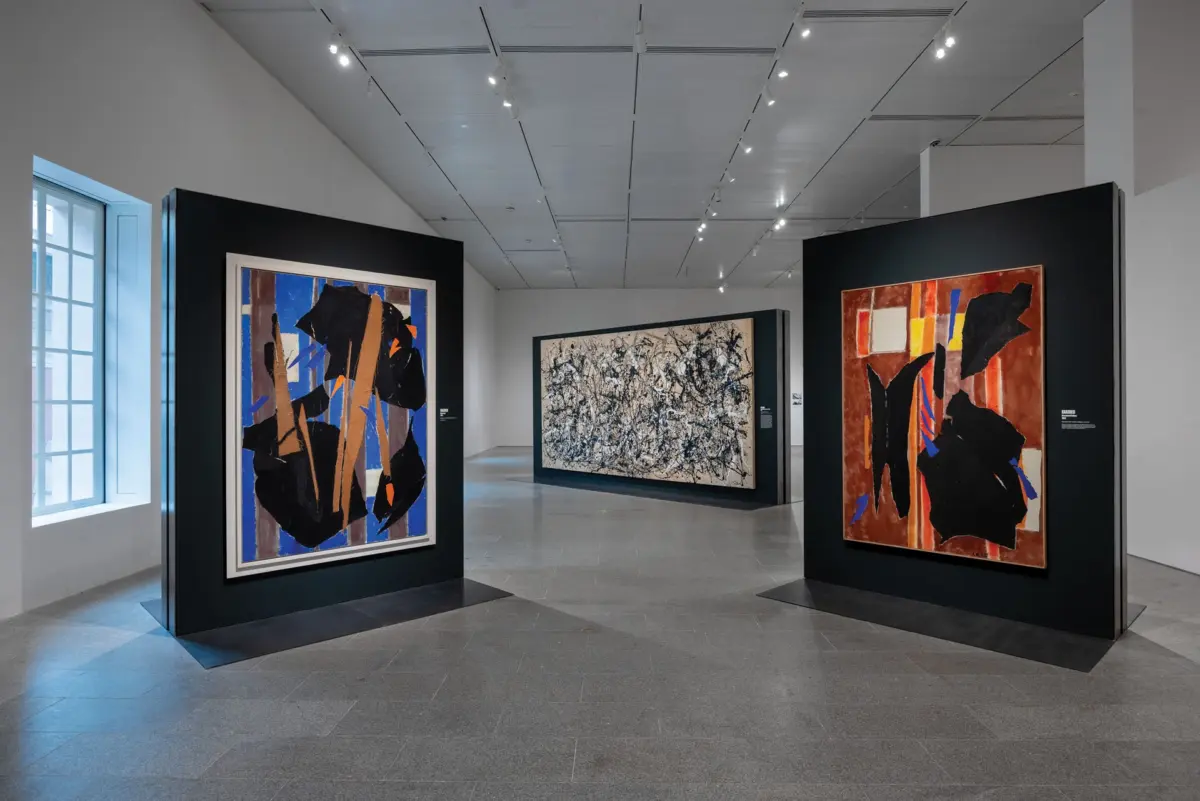
Now, a monumental and long-overdue revision is underway. "Krasner and Pollock: Past Continuous," a once-in-a-lifetime exhibition at the Metropolitan Museum of Art, gathers more than 120 works to radically dismantle the tired tropes of the twentieth-century master and his muse. Rather than treating Krasner as a satellite revolving around Pollock’s gravitational pull, the exhibition presents them as a complex, volatile, and deeply interconnected artistic partnership of absolute equals.
By dedicating equal—and at times, superior—curatorial weight to Krasner’s fierce artistic evolution, the exhibition reshapes our understanding of Abstract Expressionism. It highlights a narrative not of passive support, but of mutual influence, parallel struggles, and Krasner’s triumphant emergence from the ashes of personal tragedy. By re-examining their shared history from the remote shores of Long Island to the height of New York’s mid-century avant-garde, "Past Continuous" successfully dismantles the glass ceiling that constrained Krasner for her entire life, asserting her rightful place in the pantheon of American art.
Read Also
Detailed Chronology: From First Encounters to Tragic Loss
The narrative arc of Krasner and Pollock’s relationship is one of the most compelling dramas in modern art history, characterized by mutual artistic reverence, domestic volatility, and profound psychological endurance.
The Spark: 1942–1945
Long before they became household names, Krasner and Pollock orbited the same nascent New York modern art scene. Their paths officially crossed in 1942 when both were selected for the landmark exhibition "American and French Painting," curated by the Russian émigré artist and theoretician John Graham at the McMillin Theater at Columbia University. The show placed them in staggering company, hanging their works alongside titans such as Stuart Davis, Willem de Kooning, Pablo Picasso, and Henri Matisse.
Intrigued by Pollock’s contribution to the show—and knowing nothing of the man himself—Krasner sought him out. The encounter sparked a romance and a partnership that would permanently alter the course of American art.
The Long Island Years: 1945–1956
In 1945, seeking refuge from the frantic pace and temptations of New York City (and Pollock’s escalating alcoholism near his favorite watering hole, the Cedar Bar), the couple moved into an unheated, two-story shingled house and barn in Springs, East Hampton. This modest homestead, shared with their dog Gyp and a tamed crow named Caw Caw, became the crucible for American abstraction.
It was here, working horizontally with unprimed canvas tacked to the floor, that Pollock revolutionized painting. Eschewing traditional easels and brushes, he began pouring, dripping, and flinging enamel and house paint across the surface, never physically touching the canvas. This technique was catalyzed in part by the work of Janet Sobel, a self-taught Ukrainian-born artist whose groundbreaking 1945 painting Milky Way Pollock viewed at Peggy Guggenheim’s Art of This Century gallery in 1946. Pollock’s subsequent 1947 masterpiece, Galaxy, marked the dawn of his signature drip technique.

Just two years later, a sensationalized LIFE magazine article asked the rhetorical question: "Jackson Pollock: Is he the greatest living painter in the United States?" The spread featured four iconic photographs portraying Pollock as a brooding, hyper-masculine rebel. Krasner was entirely omitted from the text, cementing the myth of the solitary male genius.
The Crisis and the Catalyst: 1955–1956
By the mid-1950s, Pollock’s career had hit an artistic impasse, and his personal life was spiraling out of control. While Pollock battled destructive alcoholism and despair, Krasner experienced a period of profound artistic rebirth.
The tragedy culminated on August 11, 1956, when Pollock, driving drunk with his girlfriend Ruth Kligman and passenger Edith Metzger, crashed his car into a tree in Springs. Pollock and Metzger were killed instantly, while Kligman was severely injured. At the time of the fatal crash, Krasner was in Europe, desperately trying to distance herself from her husband’s chronic infidelity and heavy drinking. She returned home immediately to grapple with the devastation—and to step into the most powerful, uninhibited phase of her artistic career.
Supporting Context & Metrics: Dismantling the Hierarchies
To fully grasp the cultural weight of "Past Continuous," one must examine the persistent gender disparities and market valuations that have historically favored Pollock over Krasner.
The Economics of Genius
The disparity in critical and market valuation between the two artists has been stark for decades. While Pollock’s works command astronomical sums—culminating in a historic auction where a major painting pushed him firmly into the exclusive $100 million club—Krasner’s work has historically been undervalued, despite steady institutional corrections in recent years.
Biographical and cinematic representations have further skewed public perception. Steven Naifeh and Gregory White’s 934-page biography, Jackson Pollock: An American Saga (which won the 1991 Pulitzer Prize), inspired the 2000 Hollywood film Pollock. While Marcia Gay Harden won an Academy Award for Best Supporting Actress for her fierce portrayal of Krasner, the film’s framing inevitably reinforced her role as the secondary character in Pollock’s grand tragedy.
Breaking the Glass Ceiling: Clement Greenberg and Barbara Rose
Art criticism of the mid-century played a direct role in sidelining Krasner. When Krasner debuted her groundbreaking collage work at the Stable Gallery in 1955, prominent critic Clement Greenberg hailed her as "a major addition to the American art scene of the era." Yet, while Greenberg lauded Pollock for breaking past Cubism (represented by Picasso) to invent the first truly American painting style, he stopped short of granting Krasner the same revolutionary status, even though she had brilliantly pushed collage into entirely new American territory.
Efforts to correct this imbalance began during Krasner’s lifetime. In 1981, curator Barbara Rose organized the exhibition "Krasner/Pollock: A Working Relationship" to challenge the narrative of Krasner as a long-suffering helpmate. Rose argued that their marriage was a reciprocal working partnership. However, even Rose’s pioneering effort struggled to dislodge Pollock from the center of the art-historical spotlight. "Past Continuous" finally succeeds where past exhibitions fell short by refusing to let Pollock dominate the curatorial narrative.

Artistic Triumphs: Krasner’s Phoenix-Like Emergence
The Met exhibition brilliantly traces Krasner’s evolution through her mastery of collage and monumental scale, showcasing her ability to metabolize destruction and transform it into artistic triumph.
The Art of Reclamation
Rather than being broken by Pollock’s decline and death, Krasner transformed her grief and frustration into raw material. In her seminal 1955 collage Bald Eagle, Krasner utilized scraps of dark brown linen and unprimed canvas that both she and Pollock had discarded. The central white shape—resembling a bird’s profile—features a dripped black line executed by Pollock. By incorporating her husband’s rejected fragments into her own independent vision, Krasner enacted a literal and metaphorical rebirth.
This reclamation defined her late-career masterworks. In Blue Level and Desert Moon (both 1955), Krasner constructed sturdy, vertical compositions using solid blocks of blues and reds. These raw elements push beyond the upper and lower edges of the canvas, functioning as aspirational self-portraits of resilience.
Monumental Ambition
Following Pollock’s death, Krasner’s scale and ambition expanded exponentially. Her 17-foot-long 1957 masterpiece, The Seasons, completed a year after the crash, confronts the theme of rebirth through bold, organic, and biomorphic forms that evoke fertility and renewal.
She continued to pivot unpredictably across the decades. Works like Kufic (1965)—a spare, contemplative painting referencing ancient Arabic calligraphy—highlighted her lifelong fascination with linear marks and writing. Later monumental works, such as Rising Green (1971) and her final major collage Future Indicative (1977), which incorporated charcoal figure drawings from her student days under Hans Hofmann, demonstrated a restless intellect that refused to rest on past achievements.
Future Outlook: A New Paradigm for Abstract Expressionism
"Krasner and Pollock: Past Continuous" is much more than a blockbuster museum exhibition; it is a structural realignment of art history. By presenting their oeuvres in tandem—from their early 1930s self-portraits to their mature masterpieces—the Met has established a new gold standard for how museums can address historical gender imbalances within artistic partnerships.
The exhibition proves that Krasner’s artistic trajectory was never derivative of Pollock’s. If anything, her capacity for reinvention, her intellectual rigor, and her fearless experimentation with collage provided a crucial counterweight to Pollock’s more rigid stylistic formulas.
As institutions continue to re-evaluate the canon of Abstract Expressionism, "Past Continuous" ensures that Lee Krasner is no longer viewed through the hazy lens of marital tragedy or domestic support. Instead, she stands revealed as she always was: a titan of modern abstraction whose contributions to American art are as brilliant, complex, and enduring as any in the history of the movement.



Comments
Facebook App ID not configured. Please add it in the Customizer.