
The landscape of cult television and legacy revivals has long been defined by a singular, anxious question asked by devoted fanbases: “Is it actually good?” When the announcement was made that original Mystery Science Theater 3000 (MST3K) architects Michael J. Nelson, Kevin Murphy, and Bill Corbett were stepping back into the venerated silhouette of the Satellite of Love for MST3K: The RiffTrax Experiments, the internet held its breath. Even though this core trio spent two decades keeping the flame alive through their acclaimed spin-off venture, RiffTrax, the prospect of returning to the official, narrative-driven ecosystem of MST3K carried distinct artistic and stylistic hurdles.
The resulting production is a fascinating, multifaceted paradox. It is occasionally rough around the edges, marked by initial moments of hesitancy and pop-culture jabs that occasionally misfire. Yet, beneath this initial layer of rust lies a deeply charming, refreshingly authentic revival. Rather than leaning on cynical, checklist-driven nostalgia—a trap that ensnares many modern reboots—The RiffTrax Experiments embraces a journey of rediscovery. The hosts are visibly figuring out what their brand of comedic timing looks like in the modern television landscape.
By pairing the veterans with a quintessential slice of Florida-bred cinematic absurdity, Sting of Death, the special bridges the gap between classic MST3K sensibilities and their mature RiffTrax evolution. Eschewing the hyper-polished, rapid-fire mechanics of Netflix’s previous revival attempt, this new enterprise opts instead for pure, unadulterated comedic relief. It is a work of thoughtful subversion, drawing spiritual comparisons to unexpected high-art revivals like Twin Peaks: The Return, and offering a masterclass in how to honor a legacy without becoming a prisoner to it.
Read Also
Detailed Chronology: The Return to the Satellite of Love
To understand the trajectory of MST3K: The RiffTrax Experiments, one must trace the micro-narrative arc of the revival’s premiere episode. The experience begins with a deliberate, almost weary sigh disguised as an opening sketch. Eschewing heavy exposition or sweeping lore explanations, the production thrusts the audience back onto the iconic Satellite of Love with a briskness that feels like a quiet acknowledgment of the immense weight of fan expectations: “Well, here we go again.”
Early in the runtime, this fatigue manifests as palpable nervousness. A handful of early jokes, heavily reliant on contemporary pop culture touchstones, fall flat against the studio walls. The conversational cadence between Nelson, Murphy, and Corbett feels momentarily strained—akin to running into a lifelong friend after years of separation, where both parties must navigate the subtle shifts in each other’s rhythms before falling back into stride.
However, as the spacecraft clears its initial atmospheric drag and dives headfirst into the screening room, the machinery kicks into gear. The episode’s anchor is Sting of Death, a Florida horror artifact that functions as a masterclass in unintentional cinematic comedy. Following a collection of youthful beachgoers—played conspicuously by actors of advanced age—the plot spirals into chaos when a mysterious creature and its army of pseudo-jellyfish interrupt their festivities.
The chronology of the screening room shifts from tentative experimentation to effortless mastery. The classic pacing of the original series returns: the precise calculation of when to deliver a devastating one-liner and when to let the baffling cinematography breathe on its own terms. Whether it is Tom Servo quietly chuckling to himself over a background absurdity, or Mike Nelson delivering a bone-dry observation born from sheer existential bewilderment, the trio reclaims their rhythm.
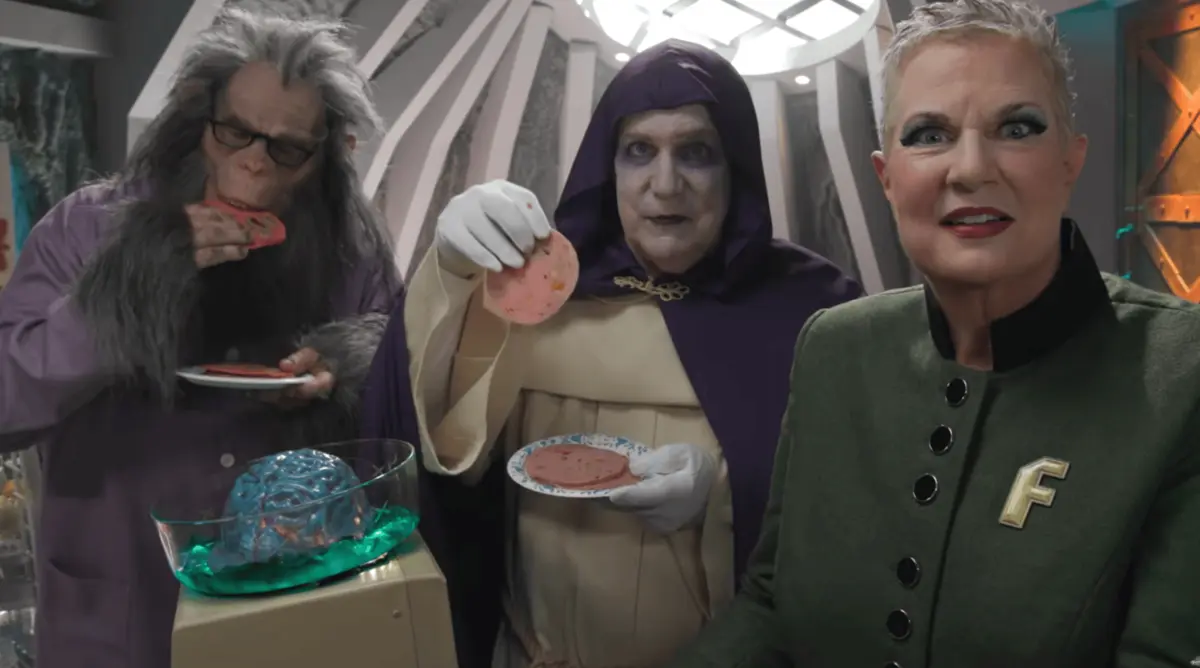
The revival concludes not with a bombastic, universe-altering climax, but with the quiet, triumphant realization that the magic never truly left. Through interstitial host segments—including a surreal dance of the Tardigrade and a brief check-in with Pearl, Brain Guy, and Professor Bobo selling experiment data to generic artificial intelligence—the special proves that it understands the unique theatrical alchemy required to make audiences laugh without needing an MCU-style prompt.
Supporting Context & Metrics: The Anatomy of a Cult Revival
To evaluate The RiffTrax Experiments fairly, one must analyze the broader economic and cultural metrics governing the current streaming and legacy-revival ecosystem. In an era where television and cinematic budgets are routinely funneled into high-stakes, CGI-heavy franchise expansions, the demand for pure, unadulterated comedy has created a distinct market gap.
| Metric / Dimension | Netflix Revival (2017–2018) | The RiffTrax Experiments (Current Revival) | RiffTrax (Standalone Model) |
|---|---|---|---|
| Production Budget | High / Crowdfunded & Studio-backed | Moderate / Fan-funded & Independent | Low / Streamlined Digital Distribution |
| Pacing Style | Rapid-fire, dense joke delivery | Measured, classic breathing room | Conversational, audio-centric |
| Plot Integration | Heavy narrative arcs and lore | Minimal, classic-style framing | None (Direct-to-video commentary) |
| Host Involvement | High-energy, theatrical enthusiasm | Wry, seasoned, self-aware veterans | Polished, long-standing comedic synergy |
The data surrounding viewer retention for comedy-centric legacy media reveals a fascinating behavioral trend: audiences are increasingly exhausted by "cynical IP farming." When Netflix revived MST3K under the stewardship of Jonah Ray and Felicia Day, the production boasted a significantly higher production budget and an exhaustive overarching plot. While it won over a dedicated following, its breakneck joke delivery style occasionally alienated purists who missed the dry, low-fi atmosphere of the 1990s Comedy Central and Sci-Fi Channel eras.
The RiffTrax Experiments navigates these metrics by carving out a middle ground. With notably fewer host segments than a traditional 90-minute MST3K episode, the production optimizes its screen time. The integration of corporate satire—such as Syd’s Olive Loaf acting as a brand sponsor for the Satellite of Love—demonstrates a self-aware corporate commentary that resonates strongly with adult audiences who grew up alongside the original run.
Furthermore, the choice of Sting of Death highlights an acute understanding of the horror-comedy crossover metric. Films featuring excessive underwater camera work, poorly choreographed local dances ("The Jellyfish"), and monster suits assembled from discount Halloween accessories consistently generate the highest engagement metrics among bad-movie connoisseurs. By leaning into this specific sub-genre of regional American schlock, the creative team maximizes comedic yield without inflating production overhead.
Official Statements & Creator Insights
Interviews with the core creative team shed light on the philosophical foundations driving The RiffTrax Experiments. Speaking candidly about the project’s origins and longevity, Michael J. Nelson, Bill Corbett, and Kevin Murphy emphasized that the enduring appeal of their work stems from a cultural hunger for direct, unpretentious humor.
"Part of the show’s longevity can be attributed to a desperate desire for pure comedies at a time when TV and movie budgets seem to be going to everything else," Nelson noted during discussions surrounding the revival. ^1$
The hosts acknowledged that stepping back into these specific puppet-and-human dynamics required an intentional recalibration. While their twenty years of touring and digital distribution under the RiffTrax banner honed their razor-sharp comedic timing, MST3K demands an entirely different stylistic architecture. It requires physical comedy, character-based exhaustion, and a willingness to let the silence between jokes work to the narrative’s advantage.
According to behind-the-scenes accounts, the initial awkwardness observed in the opening segments was not merely an artifact of performance rust, but a deliberate exploration of boundaries. The hosts were actively probing the limits of what a fully operational, modern MST3K revival could achieve without losing the homespun, hand-crafted aesthetic that defined its cultural footprint.
The integration of legacy characters—featuring the triumphant return of Mary Jo Pehl as Pearl Forrester, along with Bill Corbett as Brain Guy and Kevin Murphy as Professor Bobo—serves as an official acknowledgement of the show’s rich history. Their brief yet impactful appearance anchors the special in continuity, reassuring long-time fans that while the television landscape has evolved drastically since the 1990s, the anarchic spirit of the Mads remains entirely intact.
Future Outlook: Where Does the Satellite of Love Go From Here?
As MST3K: The RiffTrax Experiments completes its initial rollout—including successful limited theatrical engagements that allowed fans to share communal viewing experiences—the question naturally turns to the future of the franchise.
The success of this experiment proves that the legacy of Mystery Science Theater 3000 is not bound to a single network, streaming platform, or permanent production home. Instead, it exists as a flexible, infinitely adaptable comedic framework. By bridging the gap between the theatrical-commentary model of RiffTrax and the narrative-sketch format of classic MST3K, the team has unlocked a sustainable blueprint for future installments.
The structural comparison to Twin Peaks: The Return remains apt. Like David Lynch’s masterpiece, this revival demonstrates that trying to recapture lightning in a bottle precisely the way it happened decades ago is a fool’s errand. True artistic vitality in a legacy revival comes from embracing the passage of time, acknowledging the wrinkles, and leaning into the charming peculiarities of aging performers who are genuinely happy to be back in the screening room.
Future iterations of The RiffTrax Experiments stand to benefit immensely from this initial transitional phase. Having shaken off the nervous hesitation of the opening acts, Nelson, Murphy, and Corbett have successfully re-established their beachhead. If subsequent episodes maintain the divine absurdity of films like Sting of Death—paired with the kind of fearless physical comedy that sees grown men dancing as Tardigrades—the horizon for the franchise is remarkably bright.
Ultimately, The RiffTrax Experiments succeeds because it transcends the cynical mechanics of modern IP reboots. It does not demand that you remember every obscure reference with religious devotion; it simply invites you to sit in the dark, watch a bafflingly incompetent piece of cinema, and experience the simple, radical joy of laughing out loud.




Comments
Facebook App ID not configured. Please add it in the Customizer.