
For decades, the standard American perception of agricultural production has been shaped by idyllic imagery: family-owned farms, animals roaming freely on lush pastures, and traditional husbandry practices that prioritize animal welfare and environmental stewardship. But beneath this wholesome veneer lies a complex, highly corporatized financial engine that quietly funnels mandatory contributions from sustainable, independent farmers directly into the coffers of industrial agriculture’s most aggressive lobbying entities.
Take Russ Kremer, a longtime hog farmer who manages a 150-acre operation in the Missouri Ozarks. His 2,000 pigs roam freely across open fields, nourished without antibiotics and entirely free of confinement cages. Kremer is, by every practical measure, the antithesis of the industrial hog farming complex. Yet, every time Kremer sends his pigs to slaughter, federal law mandates that he—along with virtually every other hog farmer in the United States—surrender a portion of his sales. Known as a "checkoff" program, this assessment demands 35 cents for every $100 of revenue, effectively serving as an agricultural tax paid initially by producers and ultimately borne by consumers at the checkout counter.
The National Pork Board, the federal entity funded by these checkoff dollars, was originally established by Congress to promote pork consumption generically through campaigns such as the iconic "Pork. The Other White Meat" slogan. By law, these funds are strictly limited to marketing and non-political research; they are explicitly prohibited from being utilized for legislative lobbying. The underlying rationale is simple: because all farmers are forced to contribute, the collected capital must remain policy-neutral, benefiting the entire industry rather than tipping the scales in favor of specific production models.
Read Also
However, an exclusive financial analysis of public records gathered by the Accountability Board—a nonprofit advocating for higher-welfare animal farming—reveals a startling reality. Over the past two decades, the National Pork Board has quietly transferred roughly $66 million of farmer-generated checkoff funds to the National Pork Producers Council (NPPC), the nation’s preeminent and most aggressive industrial livestock lobbying group. Nearly half of these financial transactions have never before been reported by the news media.

This multi-million-dollar pipeline has effectively created a reverse Robin Hood effect in American agriculture. Independent producers who utilize sustainable, humane methods are legally compelled to finance a lobbying apparatus that routinely advocates for policies—such as the mandatory defense of restrictive gestation crates and the suppression of independent contract protections—that directly undermine their livelihoods. For farmers like Kremer, the arrangement is nothing short of a betrayal: a system that extracts capital from ethical operators to bankroll the expansion of the factory-farm model.
Detailed Chronology: How Big Pork Built Its Federal Piggy Bank
To understand how a mandatory marketing fund morphed into a de facto corporate subsidy, one must trace the historical entanglement between agricultural promotion boards and lobbying organizations.
The 1980s: The Genesis of the Mandatory Checkoff
The concept of a federally sanctioned, farmer-funded promotion board was not unprecedented. By the mid-1980s, similar programs existed for eggs and dairy, producing memorable marketing campaigns like the "Incredible Edible Egg" and "Got Milk?" However, these initiatives drew immediate skepticism from lawmakers concerned about compelled speech and forced association. During the legislative debates preceding the creation of the National Pork Board in 1985, Senator Chuck Grassley (R-IA) issued a prescient warning: "We should protect against making these producers de facto members of any association that they may not wish to be involved with."
Despite these misgivings, the NPPC—which had operated a voluntary checkoff program since the 1960s—successfully lobbied Congress to establish a mandatory program. The NPPC even drafted the foundational regulations for the National Pork Board. Transitioning from a voluntary model to a mandatory assessment dramatically inflated revenues, transforming a modest $40,000 annual collection in the 1960s into a multi-million-dollar federal war chest.

The 1990s: Operational Overlap and Internal Alarm
Though formally structured as independent entities, the National Pork Board and the NPPC operated as virtually indistinguishable organizations during their first 15 years. Handling nearly $500 million in checkoff funds while employing a tiny internal staff of just two people, the Pork Board contracted out its accounting, operations, and program execution directly to the NPPC. Both organizations shared corporate headquarters in Iowa, leading internal investigators and legal observers to note that it was nearly impossible to discern where the Pork Board ended and the lobbying group began.
This flagrant disregard for statutory boundaries sparked an investigation by the Clinton administration’s USDA Inspector General. In a scathing internal report, the watchdog insisted that the two bodies maintain an "arms-length business relationship."
The tension boiled over in 2000. Fed up with programs that disproportionately benefited massive factory farms and corporate meatpackers while squeezing independent producers, hog farmers organized a historic referendum and voted to terminate the National Pork Board entirely.
The 2001 Settlement and the Birth of Creative Financing
The farmers’ victory was short-lived. The NPPC filed a lawsuit against the USDA over technical procedural matters. The ensuing legal battle culminated in a 2001 settlement that preserved the mandatory checkoff fund while ordering the NPPC to relinquish direct management of it. The settlement mandated that future transactions between the two groups must be executed at "fair market value."

Rather than severing financial ties, the two organizations adapted, establishing a complex series of high-dollar trademark transfers and real estate agreements designed to keep cash flowing into the lobbying group’s accounts.
- The Slogan Licensing (2004): Following internal communications revealing that the NPPC required an additional $881,000 annually, the National Pork Board began paying more than $800,000 a year to license the "Pork. The Other White Meat" slogan—a dramatic markup from the previous $1 annual licensing fee.
- The $60 Million Trademark Buyout (2006): In a deal that stunned agricultural policy experts, the Pork Board used farmer checkoff funds to outright purchase the trademark package from the NPPC for $60 million, structured as $3 million annual payments over 20 years. This single stream accounted for up to 25 percent of the NPPC’s annual operating revenue.
- The 2018 Judicial Intervention and Termination Fee: After the Pork Board stopped utilizing the slogan in 2011 yet continued making multi-million-dollar annual payments, a federal judge intervened in 2018, ruling the arrangement "arbitrary and capricious." A year later, the Pork Board paid the NPPC an unreported $3 million termination fee to officially close out the remainder of the deal.
- The 2020 Trademark Repurchase: In an astonishing twist of intellectual property maneuvering, ownership of the trademark package reverted fully to the NPPC after the termination of the 20-year agreement. In 2020, the NPPC sold the exact same trademark package back to the National Pork Board, extracting an additional $17.2 million in checkoff funds.
Supporting Context & Metrics
The sheer scale of these financial maneuvers highlights how institutional guardrails have repeatedly failed to protect independent producers and consumers.
- $66 Million: The total amount of farmer checkoff funds paid by the National Pork Board to the National Pork Producers Council since 2004, as revealed by the Accountability Board’s analysis.
- 18.5 Percent: The approximate share of the NPPC’s total operational revenue derived directly from mandatory farmer checkoff contributions since the early 2000s.
- $59.5 Million: The cumulative amount extracted by the NPPC through repeated trademark licensing and purchase agreements for the "Pork. The Other White Meat" campaign.
- $13+ Million: The projected total cost of a 30-year real estate lease entered into by the Pork Board to rent office space owned directly by its lobbying landlord, the NPPC.
- $6.58 Million: The amount spent by the Pork Board on capital improvements for the NPPC-owned real estate property, a detail omitted from prior media coverage.
- 74 Percent: The magnitude of a sudden rent hike implemented by the NPPC on its Pork Board tenant in 2022—the exact year the lobbying group aggressively escalated litigation against state-level animal welfare legislation.
Legal and economic experts have universally condemned these arrangements. Dr. Parke Wilde, a food policy professor at Tufts University and former USDA agricultural economist, noted that because the value of the slogan had been built entirely using prior checkoff funds, farmers were effectively "double paying" for intellectual property that should have belonged to the public sector from its inception. David Muraskin, an agricultural law professor at George Washington University and attorney with FarmSTAND, stated bluntly that the advertising funds are routinely deployed as a financial cover to transfer wealth directly to an industrial lobbying entity in clear violation of federal statutes.
Official Statements & Institutional Stonewalling
Despite mounting scrutiny from independent journalists, agricultural legal clinics, and congressional watchdogs, institutional accountability remains virtually nonexistent.

When approached for comment, representatives for the National Pork Producers Council declined to answer detailed inquiries regarding their financial entanglements. Instead, a corporate spokesperson issued a brief statement maintaining that all business transactions and lease agreements between the two entities had been fully vetted, reviewed, and approved by the United States Department of Agriculture (USDA).
Similarly, the National Pork Board declined multiple interview requests and failed to respond to written, detailed inquiries regarding its real estate leases, capital improvement expenditures, and trademark buyouts. The USDA—the federal oversight body statutorily charged with ensuring that checkoff funds are administered impartially and in strict compliance with federal law—also declined interview requests and did not respond to written questions.
This institutional silence underscores a profound regulatory failure. Critics argue that the USDA has effectively abdicated its oversight responsibilities, shielding the narrow legislative agenda of industrial meatpackers at the expense of independent producers and American consumers. Legislative efforts to address these systemic abuses—most notably the Opportunities for Fairness in Farming (OFF) Act, repeatedly introduced by Senators Mike Lee (R-UT) and Cory Booker (D-NJ)—have consistently stalled in Congress. The proposed legislation seeks to bar checkoff programs from contracting with lobbying organizations and prohibit anti-competitive preferential treatment, yet powerful agricultural lobbies have successfully blocked the bills from receiving a full floor vote.
Future Outlook: The Battle Over Gestation Crates and Industry Survival
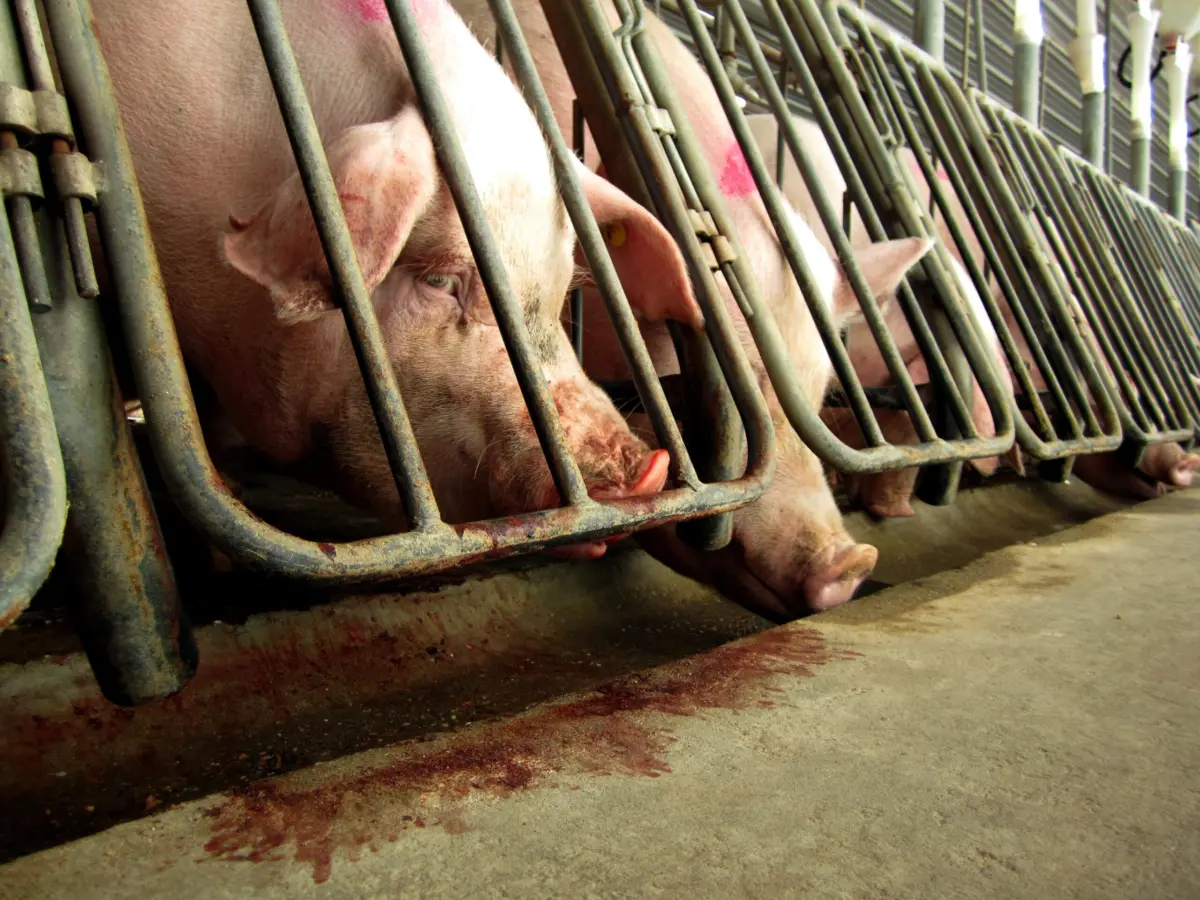
The friction between industrial meat production and sustainable farming is most visibly manifested in the high-stakes legislative and judicial battles over animal confinement practices. At the center of this conflict are gestation crates—metal enclosures so restrictive that breeding sows cannot turn around or take more than a single step for nearly their entire lives.

While animal welfare organizations and veterinary associations have widely condemned gestation crates as inhumane, and voters in states like California and Massachusetts have overwhelmingly approved ballot measures banning the sale of pork derived from caged animals, the industrial pork complex has fought back aggressively. The NPPC spearheaded expensive federal lawsuits—ultimately losing before the US Supreme Court—to overturn state-level animal welfare laws. Furthermore, the lobbying group heavily championed the "Save Our Bacon Act," an industry-backed legislative rider embedded in the House version of the Farm Bill designed to preempt and nullify state regulations. While Senate resistance has kept the measure out of competing legislative packages, negotiations continue, ensuring that the bitter ideological and financial conflict remains active.
For independent, pasture-based farmers like Russ Kremer, these regulatory battles represent an existential threat. Crate-free producers who have invested in higher-welfare standards find their own mandatory checkoff dollars being weaponized by the NPPC to overturn market advantages and dismantle animal welfare protections.
As long as federal oversight remains dormant and legislative reform languishes, the structural architecture of American pork production will continue to prioritize hyper-industrial consolidation. For consumers purchasing bacon or pork chops at the supermarket—and for independent farmers surrendering a cut of every sale—the system functions as an involuntary subsidy for factory farming: a perpetual motion machine that converts mandatory agricultural taxes into corporate lobbying power.




Comments
Facebook App ID not configured. Please add it in the Customizer.