
Executive Overview
In the literary world, commercial success is often treated as a linear trajectory: a debut makes a splash, the author builds momentum, and a stable, lifelong career follows. However, the realities of the publishing industry are rarely so forgiving. For bestselling author Amy Ewing, the onset of the COVID-19 pandemic brought a sudden, devastating halt to her upward career path. Plagued by rejection slips, crashing sales, and a total collapse of her professional self-worth, Ewing faced a profound existential crisis that bled into every facet of her personal life.
This in-depth feature explores Ewing’s journey from the brink of creative despair to personal and professional rebirth, anchored entirely by an unexpected pivot to the romance genre. By examining the psychological mechanics of writing happily-ever-afters (HEAs), this article investigates how crafting contemporary romance served as an unconventional form of cognitive behavioral therapy for Ewing. It helped her dismantle toxic romantic patterns, secure a major book deal, and ultimately find lasting love at age 44. Through Ewing’s story, we examine a broader cultural phenomenon: how the contemporary romance genre—long dismissed by literary elitism—functions as a powerful engine of emotional resilience, self-actualization, and radical healing for both its creators and its millions of readers.
Detailed Chronology: From Dark Fantasy to the Depths of Despair
The Early Success and the Pandemic Crash
Before the global upheaval of 2020, Amy Ewing was known for building dark, sprawling speculative worlds filled with magic and high-stakes fantasy. Having experienced early commercial success right out of the gate, her identity had become inextricably linked to her output as an author. Her self-esteem was tethered to her latest royalty statement, glowing reviews, and the validation of book contracts.
Read Also
When the pandemic struck, the publishing landscape shifted unpredictably. For Ewing, the pipeline dried up entirely. Books that once would have found eager homes were met with silence or rejection.
"I had wound my sense of self-worth so tightly around being an author and that loss was a blow that left me reeling," Ewing reflects. "I felt completely untethered. I felt like I had no value."
The psychological toll was immediate and crushing. Writing—an activity that had once served as her greatest sanctuary and source of joy—turned into a daily crucible. Facing a blank screen felt like facing a physical manifestation of her perceived failures. Every rejection letter stacked up in her inbox felt like definitive proof that she was no longer "good" at the craft she loved.
The Paralysis of the Dating Scene
Simultaneously, Ewing’s personal life mirrored her professional stagnation. Having hit pause on dating during the early waves of COVID-19, she was forced to confront long-standing behavioral patterns that she had previously ignored. Reflecting on her romantic history, Ewing recognized a lifelong tendency to chase the illusion of safety that she believed a relationship would provide.
Driven by an internalized mandate to be "picked," she had spent years contorting herself to match the desires of whichever partner she was with, completely bypassing her own internal compass.
"I never considered whether the man I was with was compatible with my wants and needs," she admits. "I’d twist myself into a pretzel to pretend that whatever he wanted, I wanted, too."
By 2021, the convergence of professional rejection and romantic disillusionment left Ewing feeling like she had lost her core identity. The future appeared bleak, colorless, and completely devoid of hope. In her darkest moments, a pervasive internal narrative took hold: If she could no longer sell books, who was she? And who, burdened with the label of a failed author, would ever want to love her?
Supporting Context & Metrics: The Healing Power of the Romance Genre
The Shift to Contemporary Romance
Salvation arrived in an unexpected form: the contemporary romance genre. Up to this point, Ewing’s bibliography had been strictly rooted in speculative fiction and high-concept fantasy. But under the weight of her personal distress, she found herself drawn to the mechanics of contemporary love stories.
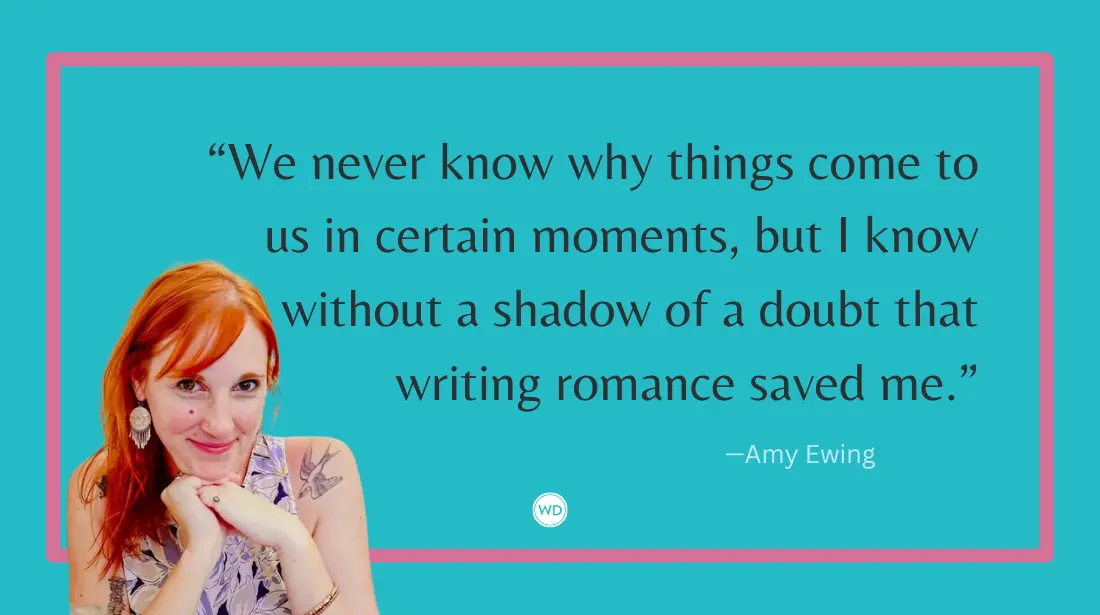
What began as an exploratory pivot quickly transformed into a lifeline. "Writing romance saved me," Ewing states unequivocally. "It brought color back to my life. It made writing joyful again. It made me believe in love again."
Unlike the sprawling, dystopian, and often fatalistic worlds of dark fantasy, the romance genre operates under a steadfast, unbreakable social contract: the Happy Ever After (HEA) or Happy For Now (HFN). In romance, love conquers all. No matter how insurmountable the obstacles, the hero and heroine will ultimately find their way back to each other.
For Ewing, this structural guarantee provided a profound psychological container.
"I found so much comfort in the safety of that promise," she explains. "I was able to explore a vast spectrum of emotions, putting my own angst to good use. It helped. A lot. By writing a happily ever after, I tentatively started to picture one for myself in the real world."
The Psychology of Dual-Perspective Writing
A pivotal element of Ewing’s creative and personal rehabilitation involved the mechanics of her craft. When writing contemporary romance, she made a deliberate choice to dual-wield perspectives, writing from both the hero’s and the heroine’s points of view.
This structural choice required Ewing to deeply interrogate male psychology, emotional availability, and mutual respect from the inside out. In doing so, she built fictional men who possessed integrity, emotional intelligence, and genuine care for their partners.
The psychological transfer effect was profound. As she engineered healthy, communicative, and respectful relationships on the page, she found it increasingly impossible to tolerate the real-world red flags she had previously glossed over. The characters she created established a new baseline for what she expected—and would accept—in her own life.
Official Statements & Industry Perspectives: The Resilience of the Romance Writer
Ewing’s experience is far from an isolated incident. Across the literary landscape, authors and psychologists alike have long noted the therapeutic synergy between creative expression and emotional processing.
Industry analysts point out that the romance genre has historically served as a cultural barometer for hope during times of societal crisis. During economic downturns, global conflicts, and health crises, romance sales consistently surge. Readers turn to the genre for emotional regulation, while authors frequently use the predictable narrative architecture of romance to metabolize personal trauma.
In an official statement regarding her creative pivot and subsequent healing, Ewing emphasizes the importance of separating human identity from professional output:
"Writing romance not only breathed new life into my career, but it allowed me to be open to love itself. Finding love at 44 is quite exhilarating. I know myself better. I’ve been through the crucible and survived. And I think romance gave me that resilience. It taught me patience. It was a light in my darkest time. And most importantly, it reminded me that I am more than just one thing. That my sense of self does not stem from what I do, but from who I am."
This philosophy strikes at the heart of modern discussions surrounding burnout in the creative industries. For decades, writers have been fed the capitalistic myth that their worth is directly pegged to their output speed, bestseller list rankings, and advance sizes. Ewing’s public reckoning dismantled that myth for herself, proving that true artistic longevity requires a foundation built on self-compassion rather than external validation.
Future Outlook: A New Chapter in Life and Literature
Today, Amy Ewing’s life looks radically different from the bleak landscape she navigated during the height of the pandemic. Having committed to breaking her old relational patterns and focusing intensely on her authentic needs, she met an extraordinary partner. The couple is set to be married this year, marking a joyous real-life manifestation of the narrative resolutions she once only dared to draft on the page.
Professionally, the risk paid off exponentially. Shortly after meeting her fiancé, Ewing sold her first contemporary romance novel, The Plus One List. The book translates her hard-won wisdom, emotional vulnerability, and sharp wit into a fresh narrative that resonates deeply with readers navigating their own modern relationship dilemmas.
What’s Next for Amy Ewing?
Looking toward the horizon, Ewing’s literary future is brighter than ever. Free from the shackles of perfectionism and the toxic pressure to tie her humanity to her book sales, she approaches her craft with renewed playfulness and depth. Her journey serves as a powerful reminder to creatives across all disciplines: endings—whether in publishing or in personal relationships—are frequently just precursors to a much better beginning.
For readers and aspiring writers alike, Ewing’s story stands as a testament to the transformative power of storytelling. The romance genre is often derided by cynics as formulaic or escapist, but as Ewing’s life demonstrates, sometimes we need to escape into a story to find our way back to ourselves.
Amy Ewing’s contemporary romance novel, The Plus One List, is available now wherever books are sold.

Comments
Facebook App ID not configured. Please add it in the Customizer.