
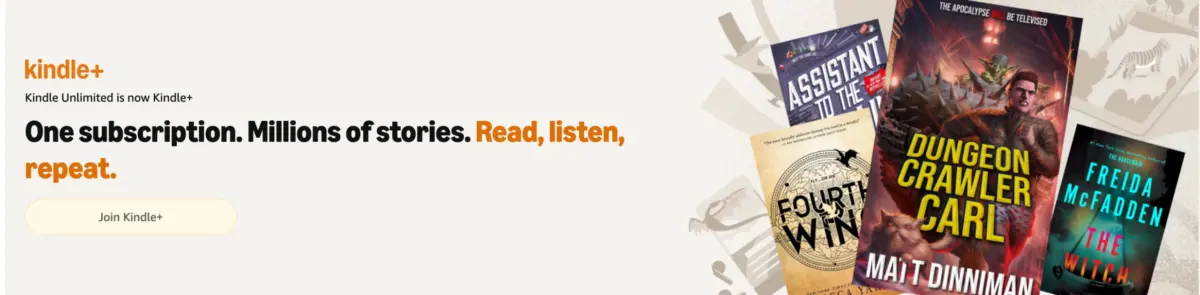
SEATTLE — In a move that signals a mature evolution in the digital reading marketplace, Amazon has officially retired the "Kindle Unlimited" moniker, rebranding its flagship subscription reading service to Kindle+.
The strategic shift, rolled out across desktop and mobile storefronts globally, is more than a simple cosmetic update. It represents Amazon’s formal acknowledgment that its digital library has long transcended standard e-books. By aligning the service with the ubiquitous "+" naming convention used across modern streaming ecosystems—from Disney+ to Apple TV+—Amazon is signaling a unified multimedia push that places robust audiobook integration at the absolute center of its digital reading strategy.
For the company’s millions of subscribers, the core mechanics of the service remain reassuringly familiar, yet the underlying value proposition has quietly expanded. As the battle for consumer digital subscription budgets intensifies, Kindle+ positions itself as an all-in-one literary ecosystem designed to capture users whether they are sitting with an e-ink device, driving to work, or cooking dinner.
Read Also
Executive Overview: The Dawn of Kindle+
For over a decade, Amazon’s Kindle Unlimited has operated as the undisputed heavyweight champion of digital book subscriptions. Launched in 2014, the service carved out a distinct niche for voracious readers, indie authors, and self-published creators by offering flat-rate, unlimited access to a massive library of titles. However, as consumer habits evolved, the word "Unlimited" began to feel increasingly narrow. Subscribers were no longer just reading digital text on dedicated Paperwhites; they were shifting fluidly between text formats, graphic novels, magazines, and, most importantly, audiobooks.
The rebrand to Kindle+ addresses this conceptual bottleneck. The new branding emphasizes inclusivity and multi-format consumption under a single umbrella. With the updated branding comes a deeply integrated audio experience, allowing users to seamlessly transition between reading an e-book and listening to its audiobook counterpart at no additional cost.
Industry analysts view this as a necessary modernization. In an era where consumers experience subscription fatigue, bundling complementary media formats under a single, streamlined banner is vital for retention. Kindle+ is not merely a new coat of paint for an old service; it is a structural realignment designed to future-proof Amazon’s digital reading empire against competing platforms and audio-first platforms.
Detailed Chronology: From Kindle Unlimited to Kindle+
The transition from Kindle Unlimited to Kindle+ marks a significant milestone in Amazon’s software and marketing history. To understand the gravity of this shift, it is helpful to look at how the service has evolved over the past decade:
- July 2014: Amazon launches Kindle Unlimited in the United States, offering access to over 600,000 e-books and audiobooks for $9.99 per month. The service is initially met with both excitement from indie authors and skepticism from major traditional publishers hesitant about flat-rate subscription models.
- 2015–2020: The catalog expands exponentially, crossing millions of titles. Amazon introduces international rollouts across the UK, Germany, France, Italy, Spain, Japan, and other key global markets. The inclusion of rotating selections of magazines and comic books begins to dilute the pure "e-book" definition of the platform.
- 2021–2023: As the audiobook market explodes in popularity, Amazon experiments with bundled access, occasionally pairing Whispersync-enabled audio titles with Kindle Unlimited borrowings. However, the experience remains fragmented, often requiring separate navigation between Kindle apps and Audible.
- Late 2023–2024: Price adjustments take effect in the US, moving the baseline cost to $11.99 per month, reflecting broader inflationary pressures and increased payouts to participating authors and publishers.
- October 2026: Amazon executes a quiet yet comprehensive platform-wide rebrand. Landing pages, promotional banners, user interface elements, and marketing materials are systematically updated. "Kindle Unlimited" is officially deprecated, replaced entirely by Kindle+, accompanied by the promotional tagline: "One subscription. Millions of stories. Read, listen, repeat."
Supporting Context & Metrics: The Anatomy of the New Service
While the branding has undergone a radical overhaul, the underlying mechanics of the subscription will feel instantly familiar to veteran users. The architecture of Kindle+ preserves the consumer-friendly features that made its predecessor a staple of digital libraries, while significantly upgrading the multimedia payout.
Core Features and Limitations
- Borrowing Limits: Subscribers can continue to borrow up to 20 titles at a time in their digital library.
- No Due Dates: True to the original service, items checked out via Kindle+ carry no expiration dates or late fees, remaining accessible as long as the active subscription is maintained and the title stays within the Kindle+ catalog.
- Pricing: In the United States, the service maintains its current price point of $11.99 USD per month (local currency adjustments apply globally). Crucially, the subscription remains completely standalone and is not bundled directly into the standard Amazon Prime membership, preserving its status as a specialized add-on for dedicated readers.
- Cross-Device Ecosystem: Accessibility remains a cornerstone of the platform. Users can read or listen across any supported hardware via the free Kindle App (iOS and Android), dedicated Kindle e-readers (such as the Paperwhite and Scribe), Fire tablets, and Alexa-enabled smart devices.
The Audiobook Integration Breakthrough
The defining upgrade of the Kindle+ era is the deep, frictionless inclusion of audiobooks. Historically, Audible (also owned by Amazon) operated as a distinct ecosystem requiring credit-based purchases or separate subscription tiers. Under Kindle+, millions of US subscribers gain access to companion audio editions without incurring extra fees.
This bridge allows users to take advantage of Amazon’s Whispersync technology—automatically syncing reading progress with listening progress so a user can read an e-book on their Kindle device during a lunch break and pick up the exact same narrative on audio through their smartphone during their evening commute.
Official Statements and Visual Overhauls
The rollout of Kindle+ has been accompanied by a massive visual and textual transformation across Amazon’s digital real estate. Visitors navigating to Amazon’s digital reading hubs are now greeted by striking promotional banners featuring dynamic collages of best-selling book covers, magazines, and audio wave graphics.

The prominent call-to-action buttons have been updated from "Join Kindle Unlimited" to "Join Kindle+," accompanied by the punchy manifesto:
"One subscription. Millions of stories. Read, listen, repeat."
Though Amazon has historically kept official press announcements regarding minor-to-moderate platform tweaks concise, internal communications and partner briefings emphasize that the "+" nomenclature is designed to reduce cognitive friction for consumers. By categorizing the service alongside modern subscription tiers, Amazon aims to capture casual readers who might have previously dismissed Kindle Unlimited as an archaic service strictly for dedicated text purists using monochrome e-ink screens.
Industry insiders note that the rebrand also helps clear up market confusion. For years, consumers frequently conflated Kindle Unlimited with Amazon Prime Reading (a smaller, rotating selection of books included free with Prime) and Audible. By branding the unlimited catalog as Kindle+, Amazon draws a clean, distinct line between basic Prime perks and its heavy-duty, all-you-can-consume literary library.
Future Outlook: What Kindle+ Signals for the Publishing Industry
The launch of Kindle+ is not merely a consumer-facing marketing play; it is a seismic event for authors, publishers, and competing audiobook platforms.
Impact on Authors and the KDP Select Program
For independent authors participating in Kindle Direct Publishing (KDP) Select—the program through which authors enroll their books into the subscription pool in exchange for a share of the Global Fund—the rebrand could prove highly lucrative. By lowering the barrier between reading and listening, Amazon is likely to drive higher engagement metrics across the board. If audio consumption surges under the new Kindle+ banner, participating authors may see increased visibility and compensation derived from audiobook page-read and listen-duration equivalents.
The Competitive Landscape
The digital subscription space is fiercely contested. Platforms like Scribd (now Everand) have long positioned themselves as multi-format hubs offering e-books, audiobooks, podcasts, and sheet music under a single subscription. By pivoting to Kindle+, Amazon is directly countering Everand’s multi-format pitch with the unmatched hardware integration of Kindle devices and Fire tablets.
Furthermore, traditional audiobook giants and independent subscription services now face a formidable competitor that seamlessly bridges text and audio formats natively within a single app environment.
Looking Ahead
As Kindle+ rolls out globally through late 2026, market watchers will closely monitor subscriber retention rates, publisher negotiations, and how Amazon scales its audiobook licensing agreements to support the massive influx of simultaneous listeners.
For the everyday reader, however, the verdict is simple: the library just got louder, the branding got sharper, and the journey from the first page to the final spoken word has never been more interconnected.





Comments
Facebook App ID not configured. Please add it in the Customizer.