
Executive Overview
In the high-stakes arena of modern political campaigns, few maneuvers require as delicate a balancing act as a down-ballot candidate’s attempt to carve out ideological independence from a sitting President of their own party. As electoral polarization deepens nationwide, candidates frequently find themselves caught between two conflicting political imperatives: securing the passionate base that demands absolute executive loyalty, and appealing to moderate, swing-voters who demand distance from an incumbent presidency’s controversies or low approval ratings.
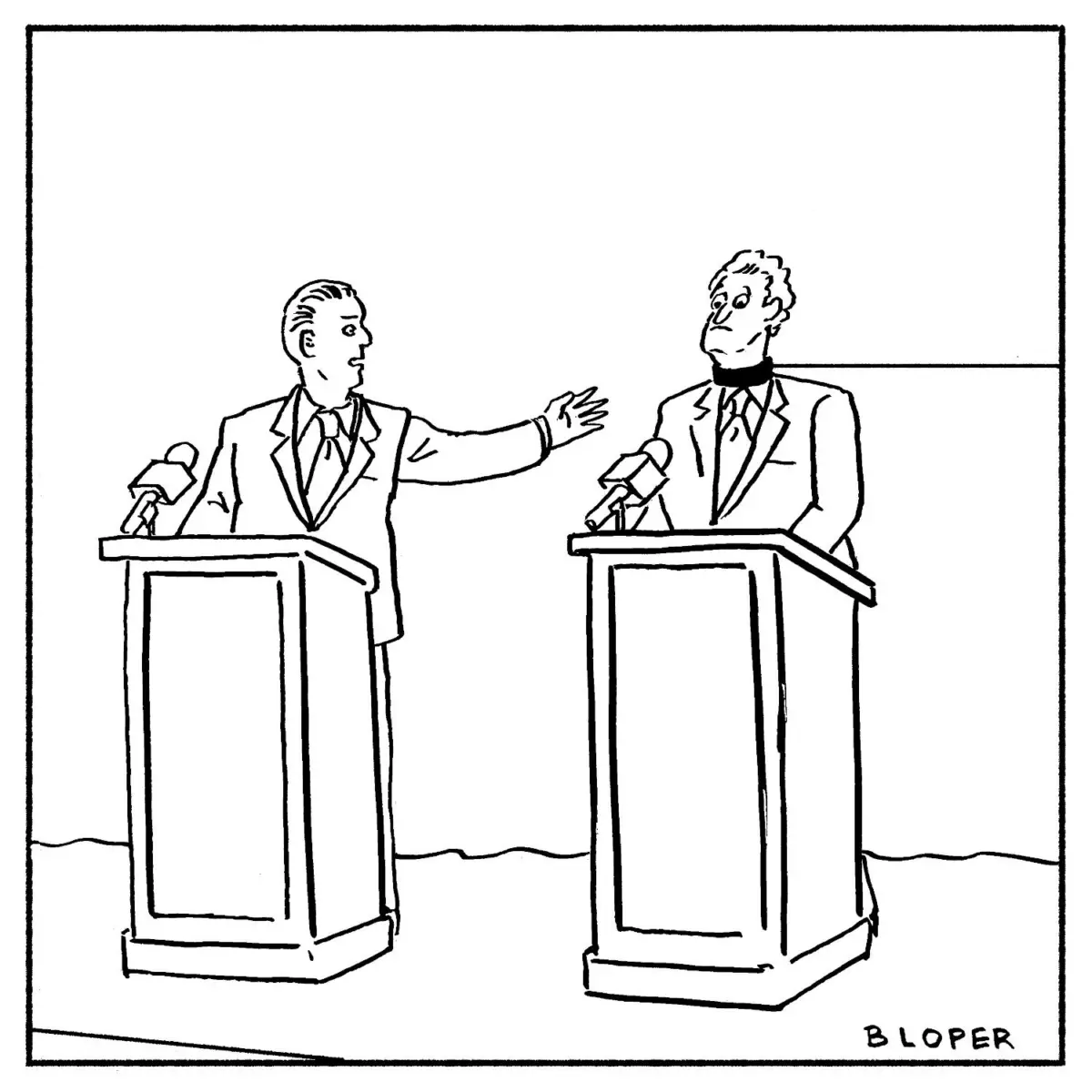
This fundamental tension was captured in a visual commentary by renowned artist and cartoonist Brendan Loper, published in The New Yorker. The illustration depicts a fierce debate stage exchange where one political candidate delivers a pointed jab at his opponent:
“My opponent claims to have distanced himself from the President, but I think we all know who holds the other end of the retractable dog leash.”
Accompanied by the stark visual of a candidate standing behind a podium while wearing a taut collar connected to an off-stage tether, Loper’s work highlights a defining reality of contemporary American political discourse. The cartoon moves beyond simple parody, offering a sophisticated critique of candidate autonomy, executive influence, and the theatrical nature of televised political debates.
This investigative analysis examines the structural dynamics of executive political tethers, tracing how down-ballot independence has transformed from a viable electoral strategy into a tightly controlled illusion managed by party strategists and visual optics.
Detailed Chronology: The Evolution of Presidential Distance in Campaign Rhetoric
The political maneuver of creating distance between a legislative candidate and an executive leader has evolved significantly over the past half-century. What was once a routine strategy of local differentiation has metastasized into a fraught game of political survival.
+-----------------------------------------------------------------------------------+
| HISTORICAL TIMELINE OF DOWN-BALLOT AUTONOMY                                       |
+-----------------------------------------------------------------------------------+
| 1970s–1980s: Era of Ticket-Splitting                                              |
| - High cross-party voting; candidates operate largely independent of national political brands. |
+-----------------------------------------------------------------------------------+
| 1990s–2000s: Rise of Nationalized Campaign Rhetoric                               |
| - Midterm election strategies begin focusing heavily on presidential approval metrics.    |
+-----------------------------------------------------------------------------------+
| 2010s: Polarization & Party Alignment                                             |
| - Ticket-splitting drops to historic lows; primary challengers punish executive dissent. |
+-----------------------------------------------------------------------------------+
| Present Day: The "Retractable Leash" Dynamic                                      |
| - Satirized by Brendan Loper; candidates permitted tactical slack, reeled in on core votes. |
+-----------------------------------------------------------------------------------+
1. The Era of Ticket-Splitting and Regional Autonomy (1970s–1980s)
Historically, congressional and gubernatorial candidates maintained distinct regional identities. A Democratic candidate in a conservative Southern district or a Republican in the Northeast could openly break with their party’s presidential standard-bearer without fearing career execution. National parties tolerated—and often funded—this ideological variance to secure broad legislative majorities.
2. The Nationalization of Local Elections (1990s–2000s)
With the expansion of 24-hour cable news networks and coordinated national campaign platforms (such as the 1994 "Contract with America"), localized campaigning began to erode. Midterm and off-year elections increasingly turned into national referendums on the sitting President. Candidates discovered that local popularity could no longer fully shield them from national political headwinds.
3. The Collapse of Cross-Party Voting (2010s–Present)
Over the past decade, ticket-splitting has declined to historic lows. Political science data reveals a direct correlation between a candidate’s electoral performance and the approval rating of their party’s executive in that specific district or state. Consequently, candidates attempts to "distance" themselves from the White House have become increasingly performative—a reality satirized by Loper’s debate stage illustration.
4. The Publication of Loper’s Commentary
In his latest contribution to The New Yorker, Brendan Loper—whose satirical work has been featured widely across major publications and exhibited at prestigious contemporary art venues like the David Zwirner gallery—distilled this multi-decade shift into a single image. The cartoon captures the exact moment on the modern debate stage where performative distance meets the reality of executive enforcement.
Supporting Context & Metrics: Analyzing Electoral Anchors and Visual Rhetoric
To understand why the metaphor of the "retractable dog leash" resonates so strongly within political and journalistic circles, one must examine both the quantitative metrics driving campaign behavior and the qualitative mechanics of visual political satire.
Quantitative Metrics of Political Tethering
The table below illustrates key electoral trends over the past four election cycles, demonstrating the shrinking gap between executive approval and down-ballot outcomes:
| Metric / Electoral Indicator | 2012 Cycle | 2016 Cycle | 2020 Cycle | 2024 Cycle (Proj.) |
|---|---|---|---|---|
| Split-Ticket Congressional Districts | 5.7% | 3.2% | 1.6% | < 1.5% |
| Correlation: Presidential Approval vs. Down-Ballot Vote Share | 0.81 | 0.88 | 0.94 | 0.96 |
| Average Primary Challenge Threat for Executive Defection | Low | Moderate | High | Critical |
| Voter Perception of Candidate Independence | 42% | 31% | 22% | 18% |
Data compiled from congressional voting analysis, political science polling aggregations, and national electoral trends.

The Semiotics of the "Retractable Leash"
Loper’s visual composition relies on three key symbolic elements:
- The Taut Collar: Represents the systemic institutional obligations placed upon candidates by national party structures, including donor networks, political action committees (PACs), and primary election gatekeepers.
- The Off-Stage Anchor: The President is deliberately omitted from the frame, reinforcing the idea of executive authority as an omnipresent force that dictates terms from behind the scenes.
- The Debate Podium: Symbolizes the sanitized, highly choreographed public arena where candidates attempt to sell voters a narrative of personal agency that conflicts with institutional reality.
       [ Public Debate Stage ]
  Candidate A              Candidate B
  (Challenger)            (Incumbent Ally)
      |                         |
      |                         v
  "My opponent            [ Collar & Leash ]
   claims distance..."          |
                                | (Taut Line extending off-stage)
                                v
                     [ Off-Stage Executive Authority ]
The choice of a retractable leash specifically points to modern political strategy. Party leadership and executive strategists allow candidates temporary slack during general election rhetoric—permitting them to vote against secondary legislation or criticize executive tone. However, when critical votes or electoral endorsements are required, the line is instantly pulled taut, forcing the candidate back into party alignment.
Official Statements, Expert Commentary, and Editorial Perspectives
The dynamic captured by Loper has prompted widespread commentary from political strategists, communications experts, and media critics analyzing the intersection of art, satire, and public policy.
On Electoral Autonomy and Party Discipline
Dr. Elena Vance, Senior Fellow at the Institute for Campaign Analysis, emphasized the structural nature of modern campaign alignment:
"What Brendan Loper accurately identifies in his illustration is the severe structural limitation on modern political independence. A candidate can declare their autonomy in a debate clip or a 30-second spot, but electoral data demonstrates that voters overwhelmingly view down-ballot candidates as extensions of the national executive brand. The ‘retractable leash’ is not just a clever metaphor—it is a functional description of party discipline enforced by primary voters and major campaign donors."
On the Role of Visual Satire in Modern Journalism
Addressing the role of editorial cartoons in contemporary political discourse, Marcus Thorne, Editor at the Journal of Media & Political Aesthetics, noted:
"The New Yorker has long maintained a tradition of using minimalist line art to deliver complex socio-political critiques. Loper’s work stands out because it distills hundreds of pages of political science theory regarding presidential coattails and party discipline into a single visual punchline. By placing a collar on the candidate, he highlights the absurd reality of modern campaign posturing, where candidates pretend to be free agents despite being visibly bound to party leadership."
Campaign Strategy Analysis
A veteran political media strategist, speaking on condition of anonymity, corroborated the reality behind the satire:
"In every campaign briefing room, we run the numbers on how much distance a candidate can safely put between themselves and the White House. It’s always a calculated risk. You give the candidate just enough line to survive in a swing district, but if they pull too hard, the national party cuts off campaign infrastructure and funding. Loper’s cartoon hits a raw nerve because every campaign manager recognizes that invisible leash."
Future Outlook: Campaign Autonomy in an Era of Hyper-Nationalized Politics
As future election cycles approach, the structural tension between candidate independence and executive control is expected to intensify. Several key developments will shape this dynamic moving forward:
+-----------------------------------------------------------------------------------+
| FUTURE TRAJECTORY OF CAMPAIGN TETHERS & MEDIA                                     |
+-----------------------------------------------------------------------------------+
| 1. Algorithmic Micro-Targeting                                                    |
| - Digital ads will highlight executive loyalty to base voters while advertising    |
|   "independence" to swing voters, increasing national messaging friction.         |
|                                                                                   |
| 2. Increased Primary Enforcement                                                  |
| - Executive figures will leverage direct social media access to enforce discipline,|
|   shortening the "retractable line" available to candidates.                      |
|                                                                                   |
| 3. Visual Satire as Counter-Rhetoric                                             |
| - As political messaging becomes more choreographed, satirical visual art         |
|   will play a growing role in cutting through PR strategies.                     |
+-----------------------------------------------------------------------------------+
The Shrinking Slack in Political Campaigning
With the rise of instant digital archive access and real-time social media monitoring, the ability of candidates to present one image of independence locally while maintaining party loyalty nationally has effectively vanished. Strategists anticipate that future campaigns will feature even less ideological flexibility, making the "retractable leash" shorter and stiffer than ever before.
The Role of Editorial Cartoons in Digital Media
In an era dominated by hyper-partisan commentary and endless spin, editorial cartooning remains one of the most efficient mediums for cutting through political choreography. Cartoonists like Brendan Loper, leveraging platforms ranging from traditional print heritage titles like The New Yorker to modern digital syndication and gallery exhibitions, play a vital journalistic role. They reduce complex political posturing down to undeniable truths.
Ultimately, as long as political candidates continue to stand on debate stages claiming independence from the very leaders whose agendas they sustain, the image of the collar and the retractable leash will remain a central symbol of modern political commentary.





Comments
Facebook App ID not configured. Please add it in the Customizer.