
By the Tech & Media Desk
Published: October 22, 2026
Executive Overview
In a strategic pivot that signals a mature phase in digital publishing and cross-media consumption, Amazon has officially retired its iconic Kindle Unlimited moniker. Moving forward, the multi-billion-dollar reading subscription service will be known globally as Kindle+.
The rebrand is far more than a superficial marketing refresh; it represents an institutional acknowledgement of how modern audiences consume literature, journalism, and audio entertainment. Over the past decade, Amazon’s catalog has evolved far beyond traditional reflowable e-books. Today, the service encompasses millions of titles spanning professional audiobooks, sequential graphic novels, comic books, digital magazines, and interactive publications.
Read Also
By adopting the industry-standard "+R" nomenclature—a styling popularized by video streaming giants and music platforms alike—Amazon is aligning its premier reading ecosystem with the modern subscription economy. Despite the aesthetic and structural updates, core consumer-friendly mechanics remain intact: subscribers can still check out up to 20 titles simultaneously with no looming due dates or late penalties, all for the stable baseline price of $11.99 USD per month in the United States.
This comprehensive report breaks down the timeline of the transition, the technical inclusions driving the shift, the broader market implications, and what the future holds for the millions of avid readers utilizing Amazon’s hardware and software ecosystems.
Detailed Chronology: The Evolution to Kindle+
To understand the weight of the Kindle+ rebrand, one must examine the trajectory of Amazon’s digital subscription ambitions over the past decade and a half.
2014–2020: The Formative Years of "Unlimited"
When Amazon launched Kindle Unlimited in July 2014, the digital landscape looked fundamentally different. Smartphones were smaller, dedicated e-readers were monochrome luxuries, and audiobooks were largely purchased as standalone luxury items via Audible rather than bundled into all-you-can-read packages.
- The Initial Offering: Kindle Unlimited launched with roughly 600,000 e-books and a smattering of audio companions.
- The Value Proposition: For $9.99 a month, readers gained open access to a vast, curated library, transforming how self-published authors and independent presses reached global audiences.
As the years progressed, the library swelled into the millions. However, the term "Unlimited" increasingly felt restrictive—or conversely, misleading—to consumers who expected comprehensive multimedia integration rather than a text-heavy repository.
2021–2025: The Multimedia Expansion
Gradually, Amazon began introducing non-traditional reading formats into the ecosystem. Digital comic books from major publishers, sequential manga, and interactive magazines began populating the backend infrastructure.
More importantly, Amazon began experimenting with "Read and Listen" bundles, pairing Whispersync-enabled e-books directly with professional narration. As consumer habits shifted overwhelmingly toward auditory media—spurred by the explosive growth of podcasts and audiobooks—the infrastructure of Kindle Unlimited strained against its legacy name.
October 2026: The Kindle+ Transition
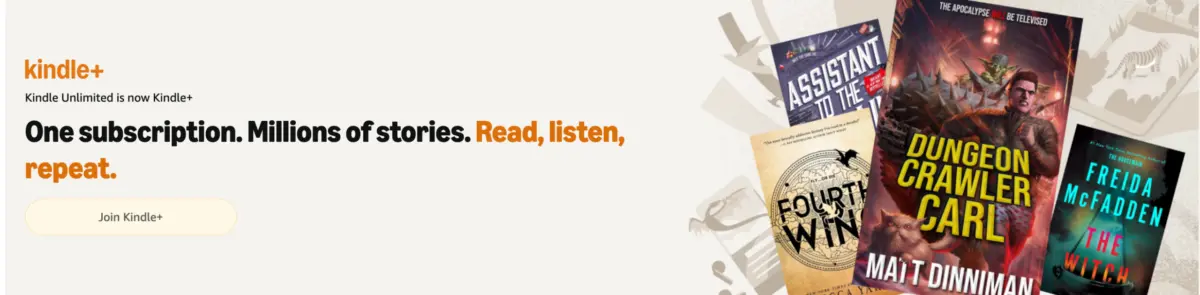
In late October 2026, the quiet transition went live across Amazon’s global digital storefronts. Users visiting landing pages were greeted with a refreshed aesthetic: sleek promotional banners reading "One subscription. Millions of stories. Read, listen, repeat." alongside a distinct "Join Kindle+" call-to-action button.
All legacy references to "Kindle Unlimited" across primary help desks, marketing assets, and checkout funnels were scrubbed and updated overnight to reflect the Kindle+ branding.

Supporting Context & Metrics: What’s New Under the Plus Banner?
While the name change is the most visible update, the architectural upgrade underneath the hood is what truly differentiates Kindle+ from its predecessor.
The Deep Integration of Audiobooks
The marquee feature of the Kindle+ transition is the seamless, deep inclusion of audiobooks at no additional surcharge. Historically, while some Kindle Unlimited titles featured "Read and Listen" integration, accessing the audiobook counterpart often required navigating separate Audible menus or paying distinct add-on fees.
Under Kindle+ architecture:
- Simultaneous Syncing: Subscribers in the United States and participating regions can transition instantly from reading an e-book on a Kindle Paperwhite to listening to the professional narration on an Alexa-enabled tablet or the mobile Kindle App.
- Zero Upcharge: Millions of titles now feature integrated audio components built directly into the base $11.99/month subscription fee. This represents a massive cost savings for hybrid consumers who previously juggled separate subscriptions for text and audio libraries.
Core Mechanics Maintained
Amazon wisely chose not to tamper with the core logistical pillars that made Kindle Unlimited popular in the first place:
- The 20-Book Cap: Users can maintain up to 20 active digital loans at any given moment.
- No Expiration Dates: Books do not automatically disappear after 14 or 21 days as they do in public library apps like Libby; they remain checked out until the user manually returns them to free up a slot.
- Cross-Device Ecosystem: The service remains fully compatible with the entire family of Kindle e-readers, Fire tablets, iOS and Android devices running the Kindle App, and web browsers.
Pricing and Availability
As of launch, the monthly subscription fee remains pegged at $11.99 USD in the United States. Pricing adjustments vary internationally based on regional taxes, currency fluctuations, and localized publishing rights. Crucially, Kindle+ remains an independent ecosystem tier, operating entirely separate from the broader Amazon Prime membership bundle—a distinction that keeps subscription costs modular for dedicated readers who do not utilize Prime shipping or video services.
Industry Analysis & Market Implications
Amazon’s shift to Kindle+ is not happening in a vacuum. The media landscape has grown saturated with the "+" suffix—a naming convention normalized by Disney+, Apple TV+, Paramount+, and countless others.
The Psychology of the "+" Suffix
In consumer psychology, the "+" sign communicates an expansion of scope. It tells the subscriber: "You aren’t just getting what you paid for yesterday; you are getting tomorrow’s media formats bundled into today’s price."
By shedding "Unlimited"—a word that occasionally drew regulatory scrutiny or consumer skepticism regarding true catalog availability—Amazon has positioned Kindle+ as a premium, dynamic media hub.
Impact on Authors and Publishers
For authors participating in the Kindle Direct Publishing (KDP) Select program, the rebrand underscores the importance of multimedia accessibility. As more readers transition fluidly between text and audio formats, authors who optimize their works for Whispersync voice integration stand to capture a significantly higher share of engagement metrics.
Furthermore, the inclusion of magazines and comics under the unified Kindle+ banner provides niche publishers with a powerful discovery engine, exposing serialized content to millions of active book readers who might not otherwise visit standalone digital newsstands.
Future Outlook: Where is Kindle+ Headed?
As we look toward the remainder of the decade, the launch of Kindle+ sets the stage for several anticipated developments in digital reading technology:
- AI-Enhanced Narration and Localization: With advancements in synthetic voice technology, industry analysts anticipate Amazon leveraging AI-driven narration to rapidly expand the audiobook catalog for indie titles that lack the budget for traditional studio voice acting.
- Interactive and Multimedia Storytelling: Expect future updates to incorporate richer multimedia elements, such as embedded ambient soundtracks, dynamic illustrations, and interactive branching narratives designed specifically for next-generation color e-readers and tablets.
- Aggressive Global Rollouts: While the initial deployment targets major Western markets, Amazon is expected to aggressively localize the Kindle+ branding across international territories—particularly in Europe and Asia, where digital subscription models are experiencing explosive growth.
Conclusion
The evolution from Kindle Unlimited to Kindle+ marks a defining milestone in the history of digital reading. By recognizing that modern readers are no longer siloed into single-medium formats, Amazon has future-proofed its reading ecosystem. For the end consumer, the message is clear: the friction between reading and listening has officially dissolved, offering a unified, cross-media storytelling experience for less than twelve dollars a month.





Comments
Facebook App ID not configured. Please add it in the Customizer.