
By Michael Kozlowski
Published by Good e-Reader
Executive Overview
In a significant shift for its digital reading ecosystem, Amazon has officially announced the rebranding of its flagship subscription service, Kindle Unlimited, to Kindle+. This marks the very first time the tech giant has altered the naming convention of its popular e-book and reading subscription service since its inception. While the rebrand is intended to signal an expanded scope of content—most notably the integration of audiobooks—the rollout has been plagued by operational chaos.
Global Amazon storefronts have been hit by a wave of software bugs, broken purchase pathways, and conflicting promotional language. Compounding these technical hurdles is a controversial strategic move: the mass integration of AI-generated narration through Amazon’s proprietary “Virtual Voice” technology. While independent authors and platform executives are championing the cost-free automation as a leap forward in content scalability, veteran audiobook consumers and industry purists are sounding the alarm. The sudden influx of synthetic voices into the core catalog threatens to dilute the value proposition of the newly minted Kindle+ service, forcing users to gamble on the quality of their listening experiences or risk drowning in uncurated machine-generated audio.
Read Also
Detailed Chronology: The Rough Rollout of Kindle+
The transition from Kindle Unlimited to Kindle+ was meant to be a seamless modernization of Amazon’s digital ecosystem. Instead, the sudden shift has created a bureaucratic and technical headache for consumers across the globe.
Day One Glitches and Storefront Inconsistencies
Almost immediately after the Kindle+ moniker went live on Amazon’s regional web portals, eagle-eyed shoppers began documenting widespread database and UI errors. The integration has proven particularly disjointed across hardware purchasing pages:
- The Kindle Colorsoft Signature Edition Disconnect: Even upcoming and unreleased flagship hardware, such as the highly anticipated Kindle Colorsoft Signature Edition, contained legacy references to "Kindle Unlimited" in promotional banners and pre-order checklists days after the official announcement.
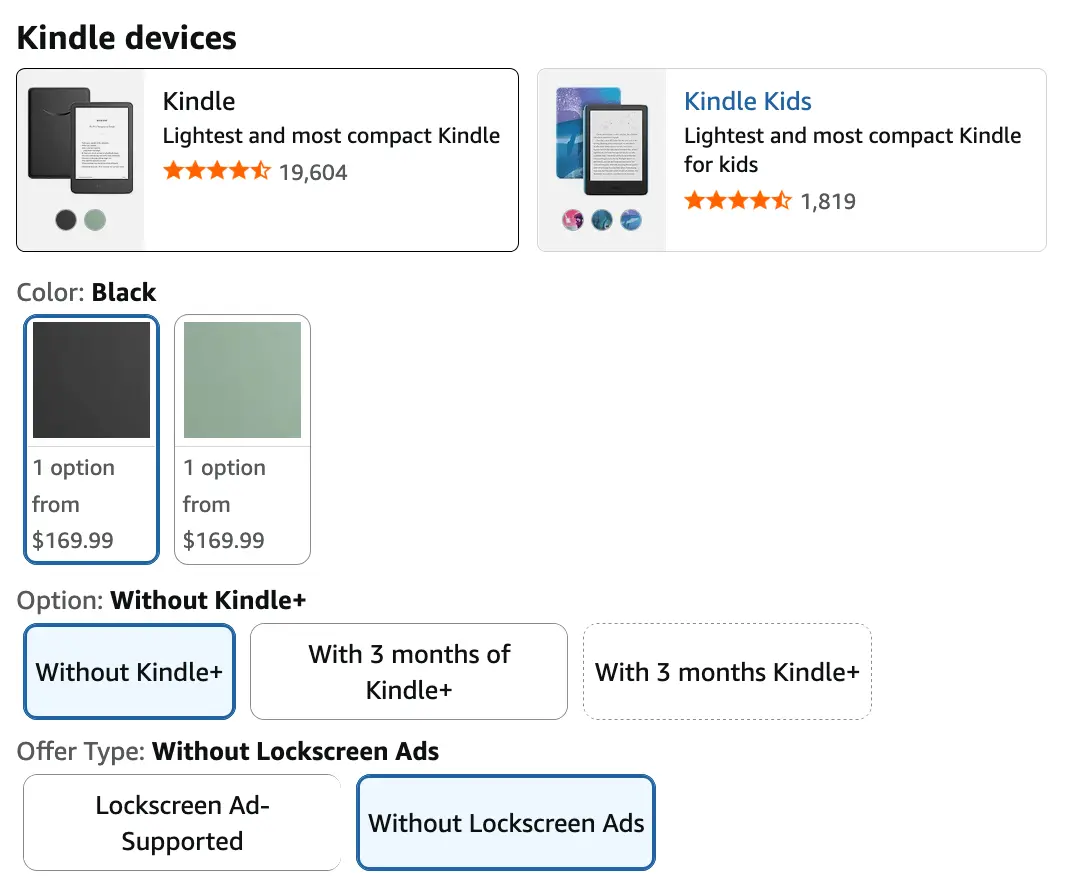
- Confusing Hardware Bundles: When attempting to purchase legacy 11th-generation Kindle units in traditional black or the popular Matcha colorway, the checkout UI presents contradictory options. Shoppers are met with a toggle reading "Without Kindle+" alongside multiple text boxes of varying dimensions that state "With Kindle+," creating friction and confusion at the point of sale.
- Missing Options on New Hardware: More bafflingly, certain newly introduced hardware iterations—such as the revised Kindle model featuring an aluminum back plate—omit the subscription bundle option entirely, leaving buyers unable to natively enroll in Kindle+ at checkout.
These errors are not isolated to the United States. International e-reader communities in Canada, the United Kingdom, and parts of Europe have reported identical UX failures, proving that the digital plumbing behind the rebrand was rushed to deployment without adequate quality assurance testing.
The Core Catalyst: AI "Virtual Voice" and the Audiobook Expansion
Beneath the surface of the branding makeover lies the primary driver behind the Kindle+ evolution: a massive, automated expansion of the platform’s audiobook catalog. To compete more aggressively with established audiobook ecosystems like Audible and Spotify, Amazon is systematically bridging the gap between its e-book repositories and audio formats.
However, rather than commissioning traditional studio recordings, Amazon is leveraging its Virtual Voice technology to rapidly scale the inventory.
How Kindle Direct Publishing (KDP) Powers the AI Surge
Under the newly minted Kindle+ framework, the mechanics of independent publishing are undergoing a seismic shift:
- Zero Cost to Authors: Independent authors utilizing Kindle Direct Publishing (KDP) are given free access to Amazon’s Virtual Voice text-to-speech tools.
- Automated Conversion: Writers can convert their written manuscripts into synthetic, AI-narrated audiobooks with the click of a button, bypassing the traditional bottlenecks of casting, professional studio recording, and hiring sound engineers.
- Automatic Catalog Integration: If an author’s e-book is enrolled in KDP Select, the newly generated AI audiobook is automatically funneled directly into the broader Kindle+ subscription library at no extra charge.
Phased Regional Rollout
Amazon has confirmed that this integrated audiobook feature—complete with its reliance on AI Virtual Voices—is currently deploying in phases. United States subscribers and KDP authors are the first to experience the system, with corporate roadmaps indicating an international expansion to markets including the UK and Canada in the subsequent quarters.

Supporting Context & Metrics: The Crisis of Content Quality
The pivot toward synthetic audio highlights a broader, industry-wide struggle: the balance between content volume and editorial curation. For years, Kindle Unlimited relied on a vast sea of self-published indie literature, where readers routinely navigated variable quality in exchange for limitless reading volume. By extending this philosophy to audiobooks, Amazon is entering a much less forgiving medium.
The Anatomy of Professional Production vs. Synthetic Audio
To understand consumer resistance to Kindle+, one must examine the rigorous standards of traditional audiobook production:
- The Human Element: Professional narrators undergo years of voice training, character work, and pacing mastery. They interpret subtext, emotional cadence, and narrative tension.
- Studio Engineering: Commercial audiobooks are recorded in acoustically treated environments, monitored by professional sound engineers, and subjected to rigorous post-production editing to eliminate artifacts, breathing anomalies, and digital distortion.
- The AI Gap: While Amazon’s Virtual Voice has improved significantly from early text-to-speech engines, it frequently struggles with complex dialogue attribution, localized dialects, emotional resonance, and pacing inflection.
When users subscribe to a flat-rate service for audio entertainment, they expect a baseline standard of performance. Injecting thousands of unvetted, algorithmic audiobooks directly into the main search and recommendation feeds fundamentally alters the user experience.
Official Statements and Industry Reception
While Amazon executives frame the Kindle+ transformation as a win-for-all ecosystem enhancement that rewards indie creators with broader reach, consumer advocacy groups and literary critics are raising critical questions about transparency.
Industry analysts point out that Amazon is uniquely positioned to populate its own platforms at virtually zero marginal cost by substituting human labor with proprietary AI models. However, this strategy risks alienating the core demographic of heavy readers and listeners who view audiobooks as an art form rather than a mere data-conversion exercise.
Future Outlook: Adapt or Segregate?
As the dust settles on the initial launch of Kindle+, consumers and industry observers are left weighing the long-term viability of the platform’s new direction.
As an editor-in-chief who has spent over a decade analyzing the evolution of e-readers and audiobooks, my assessment of the current landscape points toward an inevitable reckoning for Amazon. I listen exclusively to Audible productions anchored by proven, professional narrators who sit in sound studios alongside experienced engineers. Subscribing to Kindle+ in its current state—where content discovery is increasingly a gamble against machine-generated approximations—feels premature at best.
Ultimately, Amazon faces a binary choice to preserve subscriber retention:
- Mass Subscriptions Cancellations: Frustrated by the dilution of quality, discerning users may abandon Kindle+ en masse, viewing the service as an uncurated dumping ground for low-effort media.
- Catalog Segregation: Amazon will be forced to introduce granular filtering or completely segregate AI-generated Virtual Voice audiobooks into a distinct, clearly labeled category—much like industry discussions surrounding indie e-book organization.
Until Amazon implements strict quality controls and transparent labeling that empowers users to filter out synthetic narration with a single click, Kindle+ will remain a turbulent experiment in automated publishing.





Comments
Facebook App ID not configured. Please add it in the Customizer.