
Executive Overview
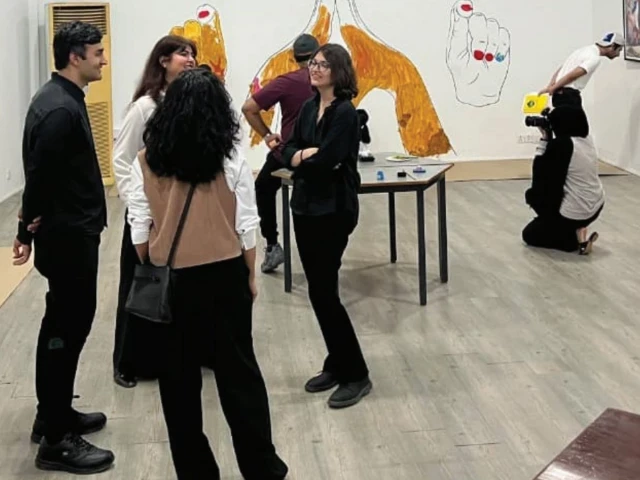
Art has long served as a transcendent medium, cutting through the dense thickets of cultural, linguistic, and geopolitical barriers to forge profound human connections. In a striking testament to this philosophy, renowned French muralist and street artist Chifumi has launched his latest retrospective exhibition in Pakistan’s bustling metropolis of Karachi. Titled Chifumi – Vous Laissez La Main (Let’s You Take the Lead), the exhibition opened on Thursday, November 12, at the esteemed Alliance Française de Karachi.
Rather than adhering to the traditional, passive gallery model—where spectators are separated from the work by a polite expanse of polished floor and cautionary ropes—Chifumi’s exhibition introduces a radical, highly engaging interactive concept. The French artist has deliberately left his sprawling wall-drawings unfinished, transforming the gallery walls into a shared communal canvas. Visitors are actively encouraged to step up, pick up paintbrushes, and infuse their own imaginations, preferred color palettes, and cultural nuances into the artwork.
This ambitious project is more than a simple display of aesthetic prowess; it is a profound sociological experiment in co-creation. By inviting the people of Karachi to co-author the murals, Chifumi bridges the gap between creator and consumer, turning a solitary artistic vision into a polyphonic collective dialogue. This article explores the mechanics of the Karachi exhibition, examines Chifumi’s illustrious global footprint, traces the rich lineage of French artistic tradition that informs his practice, and analyzes the profound cultural exchange transpiring between France and Pakistan through the
Read Also
medium of public art.
Detailed Chronology and the Karachi Exhibition
The Genesis of a Participatory Concept
The journey of Chifumi – Vous Laissez La Main to Karachi is the culmination of years of global experimentation in public and street art. The concept crystallized from Chifumi’s core belief that art should not be sequestered in elite, inaccessible institutions, but should instead breathe, evolve, and belong to the community.
When the exhibition doors swung open on November 12 at the Alliance Française de Karachi, attendees were met with an unexpected visual landscape. Instead of finished, framed masterpieces, the gallery walls featured meticulously drawn outlines, intricate geometric patterns, and signature hand-sign communications conceptualized by the artist. The instructions were deceptively simple yet creatively liberating: take the lead.
"We have only drawn the outlines and left the murals for people to complete," Chifumi explained in an exclusive interview with The Express Tribune. "We want everyone to participate, choose their favourite colours and add whatever they like."
This participatory methodology instantly dismantled the intimidating aura often associated with contemporary art galleries. Within hours of the opening, the stark black-and-white outlines began to burst with vibrant hues, reflecting the eclectic inner lives, emotions, and cultural aesthetics of Karachi’s diverse populace.
Returning to Pakistan: A Deepening Bond
This year’s exhibition is not Chifumi’s maiden voyage into Pakistan’s thriving artistic ecosystem. During his previous visit to the country last year, the French muralist left an indelible mark on the cityscape by executing a large-scale mural painting at the Arts Council of Pakistan in Karachi. That initial engagement allowed him to sample the creative energy of the city, fostering an appreciation that drew him back for a more immersive project.
Reflecting on his return, Chifumi expressed deep admiration for the country. "Travelling to different countries and experiencing diverse cultures has been a major source of inspiration for my work," he noted. He singled out Pakistani culture for its distinct allure, highlighting traditional attire, rich culinary traditions, and, above all, the legendary hospitality of the Pakistani people. By returning with a project that demands direct collaboration, Chifumi has transitioned from a visiting foreign artist to an active participant in Karachi’s contemporary cultural narrative.
Supporting Context and Metrics: Chifumi’s Global Footprint and Artistic Evolution
The Making of a Global Muralist
To fully appreciate the significance of Chifumi’s Karachi retrospective, one must examine the trajectory of his career. Born in France, Chifumi completed his formal training at a prestigious art school, mastering the foundational techniques of visual and plastic arts. However, his artistic awakening truly accelerated following a pivotal relocation to Cambodia after graduation.
This move sparked a lifelong, profound fascination with ancient Asian heritage, mythology, and public spatial dynamics. Chifumi’s signature style evolved into a mesmerizing synthesis of classical European training and Asian motifs, characterized by majestic, intricate large-scale murals. His visual vocabulary heavily incorporates mythological narratives, traditional ethnic patterns, and intricate hand-sign communications—a silent language that transcends verbal boundaries.
Activism and the Cambodia Urban Art Festival
Beyond his studio and mural work, Chifumi has cultivated a stellar reputation as an engaged artist driven by a desire to impact societal and environmental issues. His passion for democratizing art in public spaces led him to become a driving force behind the Cambodia Urban Art Festival.
Since 2015, Chifumi has organized this pioneering annual event, which stands as Cambodia’s premier celebration of street creativity. Through the festival, he has tirelessly mentored and pushed young, local Cambodian artists to reclaim their public spaces and express their cultural identities through modern mediums.
A Global Atlas of Creativity
Chifumi’s artistic footprint is truly global. Over the course of his dynamic career, he has conceived, executed, and completed impactful murals in far-flung, culturally diverse corners of the earth. His works adorn walls in:
- Cambodia (serving as a hub for his Southeast Asian cultural dialogues)
- The United States (California)
- India
- France (his European roots)
- Denmark and Croatia (reflecting European contemporary urban art movements)
- Thailand and Nepal (deepening his engagement with Asian heritage)
- Italy (reconnecting with classical Mediterranean artistic influences)
Historical Context: The Evolution of French Artistry
To understand Chifumi’s place in the global art ecosystem, it is essential to trace the rich, centuries-old tapestry of French art from which his foundational training emerges. France has historically stood as one of the world’s most influential incubators of aesthetic innovation.
Ancient Roots and Medieval Flourishing
Modern France holds the distinction of being a primary center for European art dating back to the Upper Paleolithic era, leaving behind breathtaking cave paintings, megalithic monuments, and exceptional Celtic artifacts from the Iron Age. The Gallo-Roman period subsequently introduced a distinctive provincial sculpture style, while the Franco-German border region became an industrial engine for mass-producing finely decorated Ancient Roman pottery exported across the continent.
As Christianity swept Europe, Merovingian art laid the groundwork for distinctly French styles. This momentum exploded during the medieval period with the magnificent rise of Romanesque and Gothic architecture. Notably, Gothic architecture originated in the Île-de-France and Picardy regions of northern France before rapidly expanding across the entirety of Europe, defining the verticality and spiritual aspiration of medieval Christendom.
Renaissance, Rococo, and Neoclassicism
The 16th-century Italian Renaissance initially redirected the flow of stylistic developments toward the south. However, France quickly reclaimed its status as the continent’s preeminent artistic engine during the late phase of Louis XIV’s reign, spearheading the ornate Rococo and balanced Neoclassicism movements.
The turbulence of the French Revolution and the Napoleonic Wars fundamentally restructured the arts. Emperor Napoleon leveraged visual culture for political myth-making, closely coordinating with master painters such as Jacques-Louis David, Antoine-Jean Gros, and Anne-Louis Girodet de Roussy-Trioson. Concurrently, architects Pierre Fontaine and Charles Percier pioneered the opulent Empire style for imperial residences, drawing heavily on Roman and Egyptian antiquity.
In painting, Jean-Auguste-Dominique Ingres reigned as the titan of Neoclassicism until the 1850s, prioritizing precise drawing over color. A vibrant counter-movement, Romanticism, soon emerged in defiance of rigid classifications. Championed by Eugène Delacroix—the fierce opponent of Ingres—and foreshadowed by Théodore Géricault’s monumental The Raft of the Medusa (1819), Romanticism embraced the tragic anti-hero, untamed landscapes, Orientalism, and historical nostalgia.
The Modern Epicenter: Impressionism to the École de Paris
Throughout the 19th and well into the mid-20th century, France—and Paris in particular—was universally acknowledged as the undisputed epicenter of the global art world. It was within this hyper-creative ecosystem that groundbreaking movements were born:
- Impressionism and Post-Impressionism: Capturing fleeting light and atmospheric variations, pioneered by visionaries who broke away from academic conventions (inspired in part by the realist sensibilities of Camille Corot and the Barbizon school).
- Cubism and Fauvism: Radically deconstructing perspective and exploding with color.
- The École de Paris (School of Paris): Congregations of brilliant foreign artists migrating to the French capital to participate in its unparalleled creative ferment.
The logical descendants of these movements included the Symbolism of Gustave Moreau (who mentored legendary modernists like Henri Matisse and Georges Rouault) and the dreamlike visions of Odilon Redon. It is this formidable lineage of artistic rebellion, technical mastery, and cultural cross-pollination that informs contemporary French creators like Chifumi as they take their practices to the streets and galleries of the developing world.
Official Statements and Cultural Dialogue
The inauguration of Chifumi – Vous Laissez La Main at the Alliance Française de Karachi drew significant attention from cultural diplomats, local artists, and art enthusiasts alike. The exhibition serves as a physical manifestation of cultural diplomacy, strengthening ties between France and Pakistan through shared creative expression.
Speaking on the transformative power of his work, Chifumi emphasized that language is never a prerequisite for true communication. "Art is a powerful medium of communication that allows people to express themselves and connect beyond language barriers," he reiterated during his interview with The Express Tribune.
By relinquishing total artistic control over his canvases, Chifumi is making a profound political and philosophical statement about inclusivity. He noted that the primary goal of leaving the murals unfinished is to dismantle the hierarchical wall that traditionally separates the "genius creator" from the "ignorant observer."
"We want everyone to participate, choose their favourite colours and add whatever they like," Chifumi stated, explaining that the gallery is transformed into a microcosm of society where diverse backgrounds, ideologies, and personal histories merge into a single, cohesive visual statement.
Local cultural commentators and organizers at the Alliance Française have lauded the exhibition as a breath of fresh air. In a city as dynamic, complex, and culturally rich as Karachi, providing public and semi-public spaces for unstructured, joyful co-creation offers therapeutic and community-building benefits. Visitors of all ages—from seasoned local painters to curious onlookers picking up a brush for the very first time—have embraced the opportunity to co-author a piece of international contemporary art.
Future Outlook
As Chifumi – Vous Laissez La Main continues its run at the Alliance Française de Karachi, its ripples are expected to extend far beyond the gallery’s physical walls. The exhibition offers a compelling blueprint for the future of interactive art in South Asia, proving that local audiences are eager to move beyond passive spectatorship into active cultural production.
Looking ahead, Chifumi’s ongoing engagement with Pakistan highlights a growing trend of transnational artistic residencies and collaborations. As global urban centers grapple with issues of identity, public space, and community fragmentation, participatory street and mural art offers a viable antidote. By inviting citizens to physically write their stories onto the walls of an exhibition space, projects like Chifumi’s foster a deep sense of ownership, empathy, and shared humanity.
For Karachi’s vibrant arts community, the exhibition marks another milestone in the city’s evolution as a regional hub for contemporary creativity. As the final brushstrokes are laid upon the gallery walls by an army of anonymous co-creators, the resulting murals will stand as a permanent monument to a fleeting moment in time—a vibrant mosaic proving that when borders dissolve, art remains the ultimate universal language.


Comments
Facebook App ID not configured. Please add it in the Customizer.