
Executive Overview
The literary landscape has experienced a profound shift over the past decade, driven by an insatiable readership appetite for subgenres that blend intellectual rigor with gothic dread, dangerous obsessions, and atmospheric settings. At the forefront of this movement is dark academia, a literary aesthetic and subgenre that has successfully captured the imagination of millions worldwide. Known for its tweed jackets, ivy-draped libraries, centuries-old universities, and underlying currents of moral ambiguity, dark academia offers a remarkably fertile playground for storytellers.
Few understand this malleable subgenre quite like author De Elizabeth, whose upcoming novel, She Haunts Me Still (published by Penguin Random House), transports readers to the fictional Shore College in Rhode Island. Following a trio of university theatre students bound together by a chilling vampiric curse, Elizabeth’s latest work exemplifies the complex world-building and psychological depth that defines the genre today.
In this comprehensive literary analysis and masterclass, Elizabeth pulls back the curtain on her creative process. Offering a masterclass for emerging and established writers alike, she outlines six foundational strategies for crafting a compelling, immersive, and resonant dark academia novel. From treating atmospheric settings as living characters to leveraging deep historical research, these insights provide a definitive roadmap for mastering the shadows of modern fiction.
Read Also
Detailed Chronology: The Evolution and Crafting of She Haunts Me Still
To fully appreciate the mechanics of writing dark academia, one must examine the developmental timeline of a novel built within its parameters. De Elizabeth’s journey from conceptualizing She Haunts Me Still to the book’s upcoming publication offers a fascinating case study in modern genre fiction creation.
Phase One: Conceptualization and Mythos (The Spark)
The genesis of She Haunts Me Still began with a desire to explore the theatrical arts through a lens of psychological tension and supernatural entrapment. Elizabeth conceptualized a trio of university theatre students whose lives collide not only through the dramatic stakes of the stage—specifically, a campus production of Shakespeare’s Romeo and Juliet—but through a terrifying, inescapable vampiric curse.
Unlike traditional vampire tropes, Elizabeth anchored her narrative in historical reality by tapping into the lesser-known New England vampire panic. This historical inflection point provided the narrative with structural weight, bridging the gap between academic study and visceral horror.
Phase Two: Sensory World-Building and Research
With the premise established, the timeline shifted toward intensive environmental design and archival investigation. Elizabeth focused heavily on building Shore College, a fictional Rhode Island institution designed to feel tactile, damp, and overwhelmingly historic.
Concurrently, the research phase required historical fieldwork. Elizabeth visited a Rhode Island cemetery housing the actual grave of an individual exhumed during the height of the New England vampire hysteria. This physical immersion into the macabre history of her setting allowed her to infuse the manuscript with authentic period details, grounding the supernatural elements in historical plausibility.
Phase Three: Drafting, Moodboards, and Environmental Design
The drafting phase of She Haunts Me Still was characterized by radical atmospheric immersion. Elizabeth utilized a dual-monitor setup—keeping her manuscript open on one screen and a meticulously curated Pinterest moodboard on the other. Accompanied by the scent of burning autumnal candles and the haunting, instrumental tones of soundtracks like The Queen’s Gambit and The Haunting of Bly Manor, the writing process became an exercise in method-writing.
Phase Four: Polishing and Thematic Elevation
As the manuscript moved into revision, the focus shifted from surface-level aesthetics to deeper thematic resonance. Elizabeth wove complex explorations of generational female rage, personal autonomy, and identity into the narrative core, ensuring that the novel transcended mere visual style to deliver a lasting emotional impact.
Supporting Context & Metrics: The Anatomy of Dark Academia
To understand why De Elizabeth’s advice holds such weight in the contemporary publishing ecosystem, it is vital to examine the metrics and cultural context driving the dark academia phenomenon.
The Malleability of the Subgenre
As Elizabeth notes, one of the defining features of dark academia is its remarkable malleability. Aside from a foundational focus on academia—ranging from secondary boarding schools and elite universities to arcane societies—there are virtually no hard-and-fast rules. This structural freedom allows authors to subvert expectations, blending the subgenre seamlessly with fantasy, horror, historical fiction, and psychological thrillers.
Essential Reading: The Modern Dark Academia Canon
For writers seeking to understand the parameters and possibilities of the micro-genre, extensive and diverse reading is mandatory. De Elizabeth curates an essential reading list that highlights the breadth of contemporary dark academia:
- Bunny by Mona Awad: A surreal, biting satire exploring artistic elitism and dark psychological obsession.
- Immortal Dark by Tigest Girma: A visceral dive into dark academia infused with gothic terror and high stakes.
- An Arcane Inheritance by Kamilah Cole: A masterclass in blending historical academia with intricate magic systems.
- The Whispering Dark by Kelly Andrew: A haunting exploration of isolation, sensory perception, and academic pressure.
- If We Were Villains by M.L. Rio: A Shakespearean tragedy examining the blurred lines between acting and reality among conservatory students.
- Immortal Consequences by I.V. Marie: A sharp, atmospheric exploration of mortality and dark ambition.
- Katabasis by R.F. Kuang: A brilliant intersection of academic rigor and mythological descent.
- Ninth House by Leigh Bardugo: A modern classic establishing secret societies and occult practices at Yale University.
- The Atlas Six by Olivie Blake: A character-driven phenomenon focusing on ambitious initiates vying for ultimate knowledge.
- A Lesson in Vengeance by Victoria Lee: A gothic thriller steeped in witchcraft, mental instability, and boarding school lore.
- Legendborn by Tracy Deonn: A thrilling fusion of Arthurian legend, contemporary YA fantasy, and southern gothic academia.
Official Insights & Masterclass Tips from De Elizabeth
For writers preparing to step into the ivy-covered halls of their own fictional institutions, De Elizabeth distills her publishing journey into six foundational rules of engagement.
1. Imagine the Setting Like a Character
A hallmark of successful dark academia is an immersive, highly tactile setting that breathes alongside the characters. When designing Shore College, Elizabeth prioritized a sensory approach.
"I wanted readers to be able to smell the crisp autumn air, see the dense fog hanging over the campus gardens, and smell the dust that clings to the prop loft in the theatre," Elizabeth explains.
By treating the university not merely as a backdrop, but as a living entity with its own history and temperament, writers can create an environment that feels lived-in and fundamentally real.
2. Read Diversely Throughout the Subgenre
Writing successfully within a micro-genre requires total immersion in its existing literature. Reading widely sharpens narrative craft, sparks innovative plot mechanics, and provides vital awareness of competitive titles ("comp titles") essential for the book-pitching process. By studying how different authors approach similar tropes, writers can find their own unique narrative angle.
3. Immerse Yourself in the Moodiness of It All
Atmosphere is everything in dark academia. Elizabeth advocates for environmental conditioning during the writing process. By curating dedicated spaces featuring thematic visual aids (such as Pinterest moodboards), sensory triggers (autumnal candles), and targeted auditory landscapes (instrumental scores like The Queen’s Gambit and The Haunting of Bly Manor), authors can maintain psychological alignment with their fictional worlds throughout the grueling drafting and editing phases.
4. Think Beyond the Aesthetics to the Core Message
While the visual appeal—dark wool sweaters, vintage leather-bound books, flickering candlelight—is a primary driver of the subgenre’s popularity, enduring stories require substantial thematic weight. Dark academia serves as an exceptional vehicle for exploring complex socio-political and psychological motifs. In She Haunts Me Still, Elizabeth utilizes the academic framework to dissect generational female rage, personal autonomy, and the construction of identity.
5. Relish in the Excuse to Geek Out
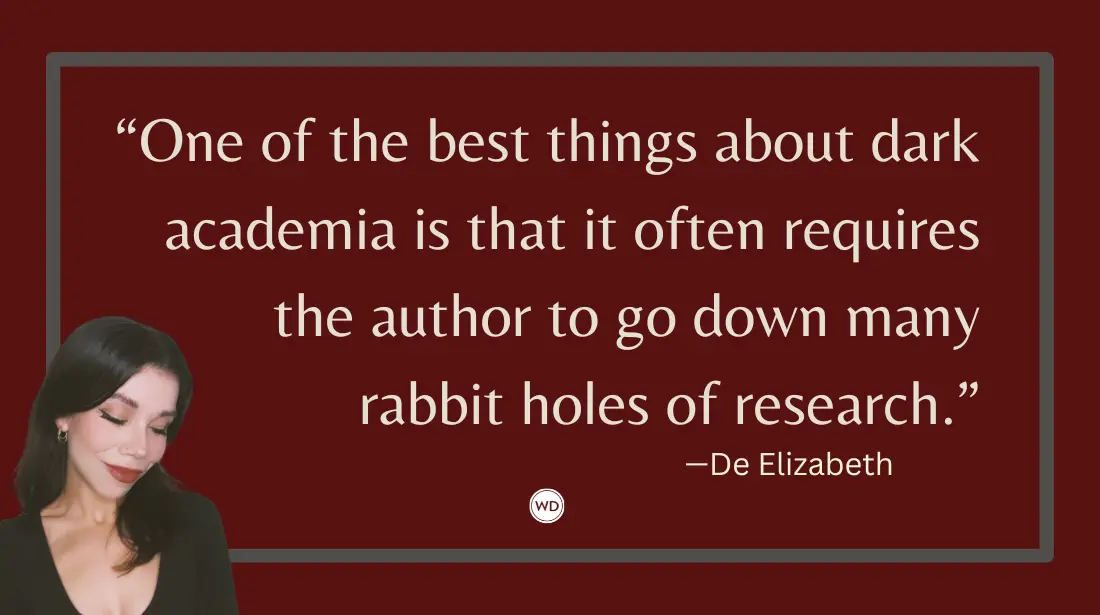
One of the greatest joys of writing dark academia is the deep, rabbit-hole research it demands. Whether an author is exploring complex physics, historical folklore, or classical Greek mythology, the genre offers a license to indulge one’s inner academic.
"Learning about this topic was incredibly fascinating," Elizabeth notes regarding her research into the New England vampire panic and Shakespearean performance. Embracing this intellectual curiosity infuses manuscripts with authentic, rich detail.
6. Have Fun!
Despite the ominous, macabre, and often tragic events that populate dark academia novels, the creative process should ultimately be an enjoyable endeavor. Elizabeth’s parting advice to aspiring authors is simple: embrace the dark playfulness of the storytelling, cherish the time spent inhabiting these complex worlds, and above all, have a blast bringing them to life.
Future Outlook
As the publishing industry continues to evolve, the appetite for sophisticated, atmospheric, and intellectually stimulating fiction shows no sign of slowing down. Authors like De Elizabeth are pushing the boundaries of traditional dark academia by injecting historical deep-dives, marginalized perspectives, and intersectional themes into gothic frameworks.
With the release of She Haunts Me Still, readers and aspiring writers alike are reminded of the power of meticulous world-building, deep thematic resonance, and unapologetic intellectual curiosity. As more creators adopt these foundational masterclass strategies, the future of dark academia looks richer, darker, and more brilliantly diverse than ever before.
For readers eager to dive into the shadows of Shore College, De Elizabeth’s She Haunts Me Still is available for pre-order and purchase through major literary retailers, offering an unforgettable journey into theatrical curses and historical hauntings.




Comments
Facebook App ID not configured. Please add it in the Customizer.