
Executive Overview
As Prime Video’s The Rings of Power hurtles toward its third-season climax, the latest double-episode drop—comprising Episodes 5 and 6—delivers a masterclass in escalating narrative tension, political manipulation, and psychological warfare. Across the vast, fractured expanses of Arda, the chess pieces are violently locking into place. The forces of darkness, personified by an increasingly desperate Sauron and the tyrannical Thrain, are probing aggressively for the long-lost secrets of ring-craft. Meanwhile, the beleaguered alliances of Elves, Men, and Dwarves find themselves forced to rely on stubborn resilience, diplomatic maneuvering, and tactical deception just to survive.
From the sulfurous, blood-soaked dungeons of Mordor to the glittering, politically volatile halls of Númenor and the deep-mountain echoes of Khazad-dûm, these episodes prioritize high-stakes character dynamics over simplistic spectacle. While narrative beats occasionally flirt with predictability, the execution relies heavily on psychological claustrophobia, shifting loyalties, and morally gray alliances. With the season finale looming, the table is set for a cataclysmic collision of divine metal, corrupted magma, and ancient bloodlines that will permanently reshape the Second Age of Middle-earth.
Detailed Chronology: Episodes 5 and 6 Unpacked
The Crucible of Mordor and the Greenwood
Episode 5, titled "The Lady of Lorien," opens with brutal immediacy. Marnûkh awakens upon a torture rack, subjected to systematic torment by Sauron. Initially defiant, Marnûkh spits out allegiance to Adar and resists yielding the whereabouts of Galadriel’s evacuation route. However, Sauron’s psychological warfare shifts to domestic terrorism: the Dark Lord threatens the lives of Marnûkh’s children.
Read Also

Broken by the threat, the Orc confesses that an Eagle transported them toward the Greenwood, where Arondir maintains familial ties. The tragic cruelty of Sauron is immediately underscored when he reveals that he has already slaughtered Marnûkh’s children—a chilling reminder of the disposable nature of servant races within the shadow of Morgoth.
Deep within the Greenwood, Galadriel and Celeborn cross paths, leading to a hauntingly layered reunion. Celeborn recounts his harrowing survival: tossed into a pool moments before his entire legion was incinerated by the legendary dragonfire of Ancalagon, he became a forgotten prisoner in Thangorodrim until the fortress fell. Galadriel confesses a devastating psychological truth—she had glimpsed him among the liberated prisoners of Thangorodrim long ago, but dismissed the vision as a grief-induced hallucination.
Yet, safety is fleeting. When Galadriel falls unconscious after a startling vision where Celeborn’s face momentarily morphs into Sauron’s, Celeborn bravely surrenders himself to pursuing Orcs to shield her. Sauron arrives to claim the Elf, delivering a chilling psychological parting shot: Galadriel will indeed come looking for Celeborn, but her journey will ultimately lead her straight into Sauron’s waiting arms.

By Episode 6, titled "From Valinor," Sauron’s interrogation of Celeborn shifts from physical pain to philosophical and psychological subjugation. Bound within a terrifying torture device utilizing massive blocks carved from the literal lava of Mount Doom, Celeborn is subjected to Sauron’s twisted worldview. The Dark Lord expounds upon his core philosophy: the ultimate bliss is the complete and voluntary subjugation of another being’s free will. To break the Elf, Sauron utilizes a cunning glamour, masquerading as Galadriel to trick Celeborn into revealing the sacred smithing secrets—specifically, the utilization of precious metals salvaged from Valinor itself.
Unbeknownst to the captive Celeborn, the "Galadriel" offering comfort in the dark is merely an illusion manufactured by the master deceiver. Concurrently, Sauron struggles with an echo of the past: a mental figment of Celebrimbor mocking him over Fëanor’s unbreakable hammer, realizing too late that only the extreme, elemental heat of Mount Doom possesses the thermodynamic capability to melt the sacred Valinorean metal.
Númenor’s Political Chessboard and Elrond’s Burden
The geopolitical landscape of Númenor serves as a masterclass in diplomacy and coercion. Flashbacks provide historical context: Elros visits his brother Elrond, announcing his historic choice of mortality and kingship over the Edain, setting the foundation for Númenor. In the present, Elrond and Gil-galad arrive by sea, navigating a frosty reception engineered by Pharazôn.

Pharazôn plays a ruthless waiting game before delivering an ultimatum: he will only commit Númenor’s formidable armada to Middle-earth if the Elves intervene to pacify the domestic unrest fomented by the Faithful.
Elrond finds himself caught in an agonizing crossfire of competing loyalties. He must balance his reverence for his late brother Elros’s vision, the almost religious devotion shown to him by the Faithful, Gil-galad’s hardline geopolitical demands, and his interactions with Isildur and a newly empowered Miriel. In Episode 6, Gil-galad uses his Ring of Power to heal Míriel and restore her physical sight, setting the stage for a tense parlay. Recognizing the catastrophic loss of life a civil war would bring, Míriel agrees to meet Pharazôn in private.
The Númenorean tyrant delivers a proposal designed to permanently neutralize his political opposition: he demands that Míriel marry him to unify the fractured island nation. While deeply distasteful, the union represents a grimly pragmatic strategy to safeguard her people from systematic eradication.

Khazad-dûm and the Depths of Betrayal
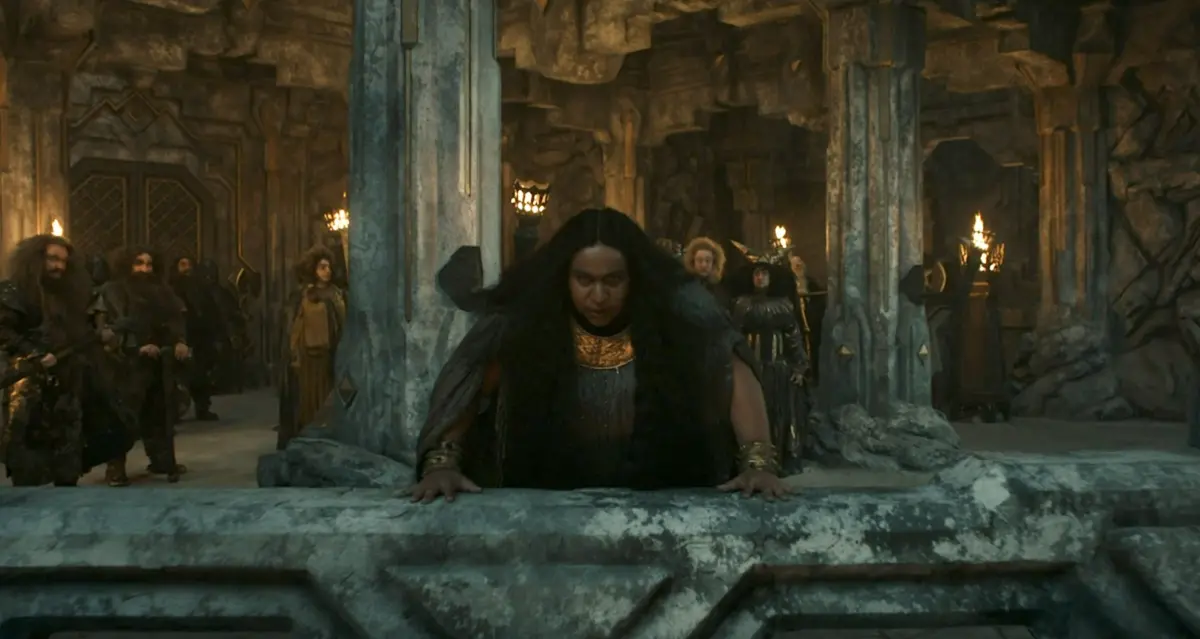
Beneath the mountains, Khazad-dûm seethes with domestic tension and dark coercion. King Thrain, desperate to locate the hidden Rings of Power, finds his traditional stone-singing methods failing. Blaming the mountain’s silence, Thrain turns to psychological extortion, placing the children under heavy guard to force the master stone-singer, Disa, into compliance.
In a brilliant subversion of expectations, Disa executes a daring counter-plot. Feigning compliance, she leads a delegation—including Lady Freyja—deep into the mines under the pretext of uncovering the rings’ hiding place. Instead, she springs a trap, subduing her escorts to liberate her imprisoned husband, Durin, who has been languishing in a cell. Although Lady Freyja secretly feigns unconsciousness to overhear their clandestine conversation—discovering that the rings are hidden safely within their own home—Disa’s bold resistance cements her status as a formidable matriarch of the deep realm, turning Thrain’s authoritarian commands back against him.
The Fate of the Wizards in Rhûn
Far to the East, Gandalf’s quest takes a grim turn. Seeking to build an alliance against the gathering shadow, Gandalf confronts Pallando, urging him to join the fight against Sauron. Pallando rejects the notion of resistance, arguing fatalistically that absolute submission is the only rational path. In the ensuing magical duel, Gandalf is decisively defeated. He regains consciousness bound tightly to the back of a towering Oliphant, forced into silent witness as the vast, terrifying army of Rhûn marches relentlessly toward war.

Supporting Context & Metrics: The Mechanics of Arda
To fully appreciate the narrative weight of Episodes 5 and 6, one must examine the deep-lore mechanics and thematic parallels driving the season’s overarching structure:
- The Valinorean Metallurgy Paradox: The revelation that the true secret ingredient of elven ring-craft relies upon uncorrupted metal sourced directly from Valinor reframes the physics of Arda. Sauron’s obstacle—overcoming the unbreakable nature of Fëanor’s hammer—is solved by utilizing the elemental fury of Mount Doom.
- The Physics of Mount Doom Magma: As Sauron explains to Celeborn during his torture, the magma of Mount Doom carries an unnatural density because it was historically utilized by Morgoth as an execution site, where the souls of criminals were cast alive into the molten earth, locking their residual evil into the very stone. This establishes a direct theological parallel between Tolkien’s Catholic-inspired mythos of the Fall, damnation, and corruption.
- Geographical and Historical Milestones:
- Thangorodrim: The massive triple-peaked mountains raised by Morgoth before the gates of Angband. Historically destroyed at the end of the First Age when the dragon Ancalagon was slain by Eärendil (Elrond’s father) and crashed into the peaks.
- Ancalagon the Black: Mentioned in Episode 5 as the titanic dragon whose fiery breath obliterated Celeborn’s entire legion, and upon whose back Sauron rode during the wars of the First Age.
Official Statements & Production Insights
While Prime Video’s promotional campaign for Season 3 has kept cast interviews tightly focused on character arcs, showrunners J.D. Payne and Patrick McKay have repeatedly emphasized their commitment to grounding high-fantasy spectacle in intimate emotional stakes.
In recent production briefings, the creative team noted that Season 3 was specifically designed to test the ideological boundaries of its principal characters. "Sauron does not conquer Arda through brute force alone; he conquers by convincing the resilient that resistance is intellectually bankrupt," production notes indicate. This philosophy is visibly manifested in the psychological torture sequences between Vickers’ Sauron and the captive Celeborn, where emotional manipulation and physical confinement merge into a singular, disturbing display of dominance.

Future Outlook: The Road to the Season Finale
As The Rings of Power approaches its third-season finale, several major narrative threads demand immediate resolution:
- The Forging of the One Ring: With Sauron now possessing both Fëanor’s hammer, the Valinorean metal, and the secret knowledge extracted from Celeborn under false pretenses, the final ingredient—his own essence—stands as the definitive next step in the creation of the Master Ring.
- The Númenorean Union: Will Míriel’s forced marriage to Pharazôn succeed in stabilizing the island kingdom, or will it accelerate Númenor’s catastrophic descent toward arrogance and eventual destruction?
- The Eastern Campaign: Gandalf’s current predicament bound to the Rhûn war machine leaves the Istari fractured and vulnerable as the armies of darkness converge on multiple fronts.
- The Resistance in Middle-earth: With Galadriel falling directly into a psychological trap and core allies scattered or captured, the remaining free peoples face unprecedented existential peril.
The stage is definitively set. Whether the collective wills of Elves, Dwarves, and Men can withstand the psychological and military onslaught of the reborn Shadow will be tested when the season finale airs next week.




Comments
Facebook App ID not configured. Please add it in the Customizer.