
Executive Overview
On Friday, Pakistan marked its 80th Independence Day, an annual milestone historically defined by an explosion of national pride, flag-filled tributes, and nostalgic expressions of patriotism. Across the country and within the diaspora, millions commemorated the momentous sacrifices of the founding fathers and the historic events of 1947. Yet, as the traditional green-and-white displays painted streets and digital platforms alike, a profound paradigm shift rippled through the public consciousness, heavily reflected in the discourse of the nation’s most prominent cultural and athletic icons.
While a significant segment of Pakistan’s A-list actors, musicians, and cricket stars adhered to traditional expressions of unity and festive jubilation, an equally vocal faction utilized their considerable digital footprints to interrogate the true meaning of freedom. Against the backdrop of volatile political tensions, governance challenges, economic instability, and a deeply alarming surge in heinous crimes against women and children, this year’s Independence Day conversation was far from uniform.
Instead of treating the August 14 celebrations as an uncritical exercise in self-congratulation, many celebrities channeled public frustration into hard-hitting questions: What does national sovereignty signify when ordinary citizens—particularly the most vulnerable—continue to struggle for basic physical safety, systemic justice, and fundamental human rights? This comprehensive report examines how Pakistan’s cultural and sporting elite observed the nation’s 80th anniversary, balancing deep-seated national devotion with urgent, often uncomfortable demands for structural accountability and societal reform.
Read Also
Detailed Chronology and Cultural Expressions
The prelude to August 14 set a tone of heightened anticipation, with digital spaces rapidly saturating with patriotic imagery as the clock struck midnight. The chronology of public engagement on social media revealed a fascinating dichotomy between traditional pageantry and critical introspection.
The Stroke of Midnight: Festivities and Visual Tributes
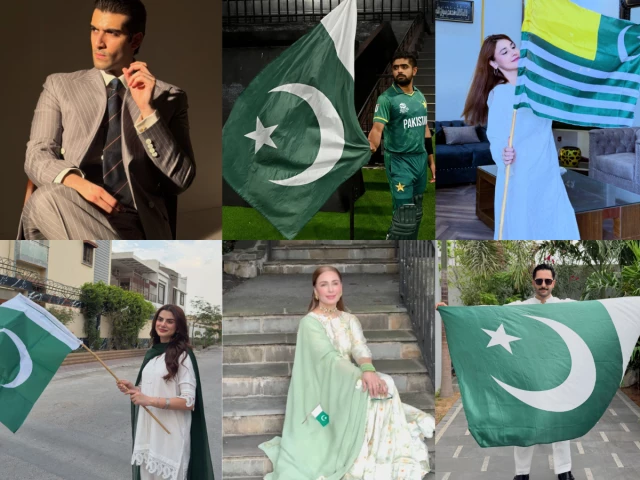
As fireworks illuminated major skylines from Karachi to Islamabad, celebrities initiated the day’s events by posting curated visual tributes. Actor Aiman Khan shared a vibrant video of herself dressed in a custom green-and-white athletic jersey, singing classic national anthems with her followers while simply captioning it, "Happy Birthday Pakistan." Similarly, actor Zubab Rana adopted a classic aesthetic, posing in a crisp white shalwar kameez offset by a deep emerald green dupatta while clutching the national flag. Her accompanying message urged compatriots to "keep the spirit of freedom alive in our hearts and minds," echoing a sentiment shared by millions of citizens participating in neighborhood rallies and family gatherings.
Concurrently, veteran actor Reema Khan posted a serene portrait dressed in a white floral ensemble, issuing a formal statement calling for divine intervention, national resilience, and a collective commitment to remembering the martyrs who paid the ultimate price for independence.
Historical Homages and Aesthetic Symbolism
Among the most discussed tributes of the morning was that of actor Shuja Asad. In a carefully orchestrated homage, Asad appeared in a bespoke suit-and-tie ensemble mirroring the quintessential sartorial style of Pakistan’s founder, Quaid-e-Azam Muhammad Ali Jinnah. Posing in architectural spaces reminiscent of mid-20th-century governance, Asad accompanied his visuals with a deeply philosophical caption.
"Pakistan, despite everything, you remain my home, my land and a part of who I am," Asad wrote. "We may be frustrated by the times we’re living through, but our love for this country is bigger than any government or difficult chapter. I still believe in our people and in Pakistan we can build together." Weaving in a reflective quote from national poet Allama Iqbal, Asad expressed his desire for the collective courage and leadership required to actualize the nation’s founding vision.
In a similar vein of historical reverence, veteran television star Faisal Quraishi shared archival portraits of both Jinnah and Iqbal. Quraishi’s message emphasized the timeless utility of their philosophies, encouraging the public to allow the foundational ethos of unity and discipline to guide contemporary socio-political recovery.
The Natural Splendor of the Homeland
Shifting away from urban socio-political anxieties, actor and director Yasir Hussain used his platform to celebrate the geographical grandeur of the Pakistani landscape. Curating a rich visual archive featuring snow-capped northern mountains, local fauna, unblemished rural communities, and sprawling desert sunsets, Hussain grounded his patriotism in the physical beauty of the land. "May the moon keep sparkling. May this flag be our highest," he wrote, invoking imagery that reminded his audience of the diverse ecosystems encapsulated within national borders.
Supporting Context & Metrics: Navigating Identity Amid Disillusionment
While visual spectacles and artistic tributes dominated early feeds, the narrative quickly evolved into a rigorous debate regarding identity, civic duty, and systemic disillusionment. The socioeconomic realities of contemporary Pakistan—marked by inflation, polarization, and a fractured social contract—provided a heavy backdrop to the day’s discussions.
The Burden of the "Foreign Passport" vs. Domestic Resilience
The friction between living abroad and remaining tethered to the homeland was a recurring theme. Actor Asad Siddiqui, celebrating the holiday alongside his wife, actor Zara Noor Abbas, addressed the complex relationship citizens maintain with their national identity. Following a family evening spent observing fireworks, Siddiqui penned a candid reflection on the permanence of home:
"Whether we are free or not, this is a different debate. But we are on our land. We are in our country. No one can escape us from here because of the ‘foreign’ passport. Our house. Nobody can snatch my identity from me."
This sentiment was mirrored by star actor Danish Taimoor, who published a nuanced, long-form essay detailing the psychological cycle of complaint, frustration, and eventual reconciliation characteristic of the modern Pakistani experience.
"We complain about Pakistan. We argue about what needs to change. We get frustrated, disappointed, and sometimes even lose hope. But at the end of the day… this is home," Taimoor shared. Challenging his followers to move past passive cynicism, he added, "Less hate. More respect. Less division. More unity. Less ‘what has Pakistan given me?’ and more ‘what can I give back?’ We have a long way to go, but I’ll never stop believing in this country and its people. We are Pakistan. And Pakistan is us."
The Athletic Voice: Sports and National Pride
As standard-bearers of national prestige, Pakistan’s premier athletes also weighed in, anchoring their messages in the unifying power of sports.
Former national cricket captain Babar Azam released a striking photograph of himself draped in the national standard at an international stadium. "Today’s day is dedicated to the flag whose star adorns our chest, then our identity is complete. Long live Pakistan!" he stated.
Meanwhile, legendary all-rounder Shahid Afridi chose the international stage of the United Nations Headquarters in New York City to broadcast his allegiance. Sharing a solemn portrait from the UN plaza, Afridi wrote: "My blood, my soul, and every heartbeat belongs to this sacred soil. Nothing gives me greater pride than standing under our green flag. Pakistan is my identity, my strength, and my whole life."
Official Statements and Critical Dissent: Redefining Freedom
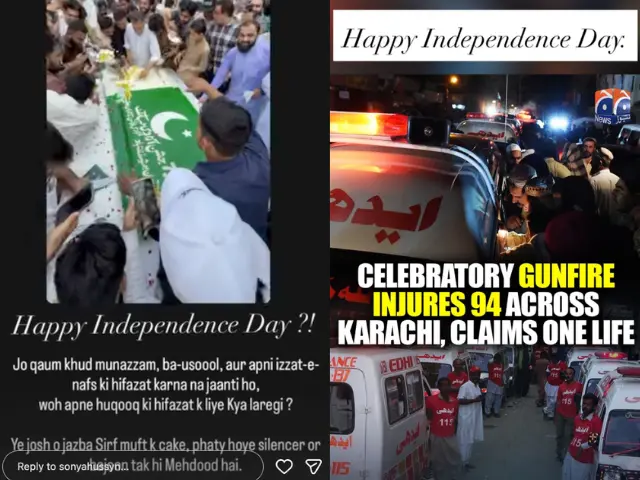
The defining characteristic of Pakistan’s 80th Independence Day discourse, however, was the stark emergence of anti-celebratory dissent. A prominent faction of the artistic community openly questioned whether traditional festivities were morally justifiable in the face of compounding human rights crises, governance failures, and rampant gender-based violence.
Hina Khawaja’s Condemnation of Hollow Festivities
The most visceral critique came from veteran actor Hina Khawaja, who openly challenged the appropriateness of public celebrations given the deteriorating state of child safety and public security across the country.
"How can we celebrate 14th August?" Khawaja questioned in a widely circulated video statement. Recalling her childhood memories of waking up to military parades, visiting the Quaid’s mausoleum, and learning about the sacrifices of the freedom movement, she contrasted those formative experiences with contemporary realities.
"However, today I see videos of people dancing and celebrating that freedom. If you leave your house, it is not the same. It is not the same freedom if small kids are being raped and parents are taking their children to the graves where no justice is being served."
Khawaja’s commentary struck a nerve with millions of citizens who feel that institutional failure and the lack of swift, transparent justice have hollowed out the promises of the 1947 independence movement. Her remarks shifted the national conversation from abstract geopolitical sovereignty to the micro-level safety of the individual citizen.
Iqra Aziz and Sonya Hussayn: Statistics, Grief, and Moral Reckoning
In parallel, leading actors Iqra Aziz and Sonya Hussayn leveraged their massive digital platforms to redirect public attention toward grim socio-legal realities. Aziz posted stark empirical data highlighting the alarming frequency of violent crimes, homicides, and assaults recorded in the immediate aftermath of preceding celebratory periods. By juxtaposing the festive noise of urban centers with cold, unvarnished crime statistics, Aziz forced her audience to confront the disconnect between state-sanctioned pageantry and societal decay.
Sonya Hussayn echoed these misgivings, posing a rhetorical question to her followers: Can superficial revelry substitute for structural reform? Hussayn’s digital engagement underscored a growing exhaustion with symbolic patriotism that fails to translate into safer streets, economic relief, or legal protections for the marginalized.
Future Outlook: Navigating the Next Decade of Nationhood
As the confetti clears and the green-and-white banners are packed away for another year, the discourse surrounding Pakistan’s 80th Independence Day leaves a lasting imprint on the nation’s socio-cultural trajectory. The events of August 14 demonstrate that the Pakistani public—amplified by influential cultural and athletic figures—is no longer satisfied with tokenistic nationalism.
The Evolution of Civic Discourse
The juxtaposition of traditional flag-waving with fierce structural critique signals a maturing civil society. For decades, state narratives on Independence Day relied heavily on monolithic tropes of uncritical celebration. The 2025 milestones, however, proved that patriotism in modern Pakistan has evolved into a complex, multi-layered emotion. It is an emotion capable of holding two contradictory truths simultaneously: an unconditional love for the geographical and cultural entity of Pakistan, coupled with deep, unyielding frustration directed at its administrative shortcomings.
The Imperative for Systemic Reform
Ultimately, the messages delivered by artists like Hina Khawaja, Iqra Aziz, and Sonya Hussayn serve as a warning to the establishment. True freedom—as emphasized across multiple platforms—remains fundamentally incomplete as long as women, children, and marginalized communities remain insecure within their own neighborhoods.
As Pakistan looks ahead toward its next decade of statehood, the challenge for both its leadership and its citizens lies in bridging the gap between the idealized dreams of Allama Iqbal and Muhammad Ali Jinnah and the gritty, ground-level realities of day-to-day governance. Until the promise of justice matches the grandeur of the national flag, Independence Day in Pakistan will likely remain a dual narrative: a solemn remembrance of past sacrifices, paired with an urgent, unyielding demand for a safer, more equitable future.

Comments
Facebook App ID not configured. Please add it in the Customizer.