
Executive Overview
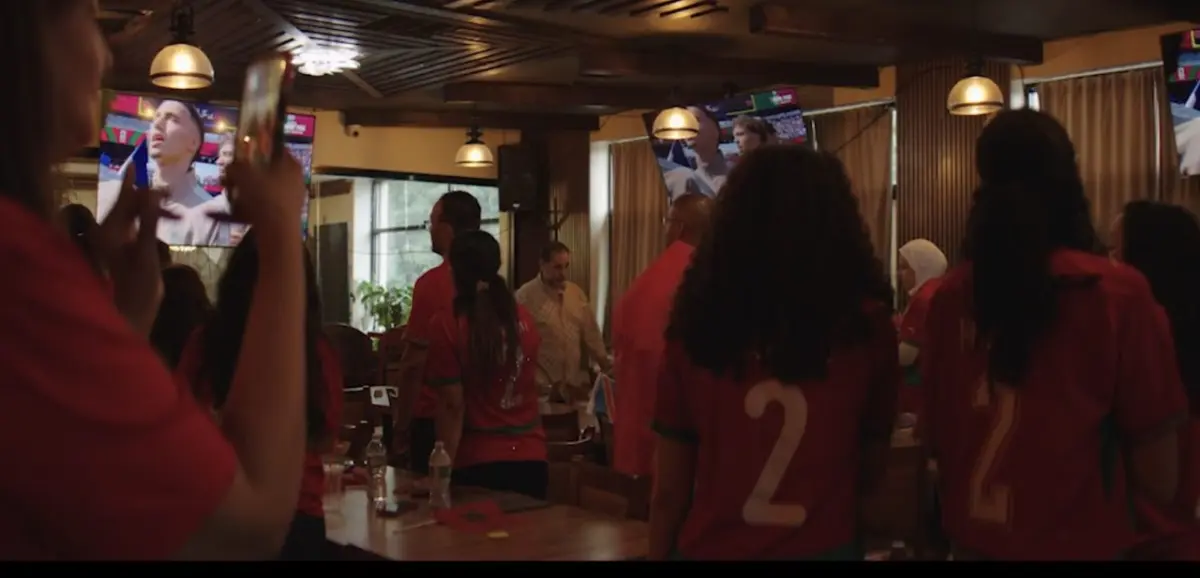
When Ismael Saibari’s winning penalty struck the back of the net on June 29 in Monterrey, Mexico, the kinetic energy of the moment instantly transcended borders. Inside Zikrayat, a Middle Eastern restaurant and lounge in Astoria, Queens, the room erupted into a visceral wave of cheers, celebratory dances, and the high-pitched, piercing trill of the zaghrouta. Outside, fireworks painted the night sky over New York City, mirroring the celebrations happening simultaneously across major urban centers worldwide.
This dramatic victory—clinching a tense match against the Netherlands—was not merely a sporting triumph; it was a powerful manifestation of a transnational identity. For the Moroccan diaspora, the national football team, affectionately known as the Atlas Lions, serves as much more than athletic representatives. They are cultural ambassadors, political metaphors, and living embodiments of a complex dual existence.
Yet, this golden era of Moroccan football exists in stark juxtaposition with domestic realities. As the national team scales unprecedented heights on the global stage—transitioning from traditional underdogs to regional heavyweights—their ascent unfolds against a backdrop of severe domestic socioeconomic challenges, political repression, and intense debates over identity, scouting infrastructure, and state priorities. This report examines the intricate relationship between modern Moroccan football, the global diaspora, and the socioeconomic pressures defining contemporary Moroccan society.
Read Also
Detailed Chronology: From Steinway Street to the World Stage
The Pulse of Astoria: A Microcosm of Diaspora Life
Weeks prior to the decisive clash in Monterrey, Steinway Street in Astoria—fondly known as "Little Morocco"—transformed into a vibrant sea of red and green. Hours before Morocco’s opening tournament match against Brazil, the neighborhood pulsed with anticipation. M60 buses deposited waves of fans clad in the iconic red jerseys of the national team, with the name of star player Achraf Hakimi omnipresent across the avenue.
Local commerce shifted entirely to accommodate the fervor. Merchants stationed folding tables on the sidewalks, selling flags, scarves, and traditional garments while shouting "Dima Maghrib!" ("Always Morocco!") to passing traffic. Inside cafes like Noisette, patrons sipped mint tea and indulged in pastries while anxiously tracking television screens. Conversations flowed naturally in Darija (Moroccan Arabic), punctuated by discussions of stadium atmospheres, logistics, and comparisons to the electric crowds of the 2022 World Cup in Qatar.
For many fans, Astoria serves as a vital surrogate homeland. Individuals drove in from neighboring states like New Jersey and Pennsylvania—some choosing local cafes over expensive stadium tickets at MetLife Stadium—to share the communal experience of the match surrounded by familiar faces and shared cultural memory.
The Monterrey Thriller and the Weight of Memory
The June 29 match against the Netherlands tested the nerves of every supporter. For the majority of the game, the North African side trailed, pushing fans to the brink of despair. However, a miraculous equalizer in the 90th minute forced extra time, setting the stage for a heart-stopping penalty shootout.
As the players gathered in a circle on the pitch to recite a religious prayer, time seemed to halt inside Zikrayat. When Saibari’s penalty sealed the victory, collective anxiety dissolved into pure euphoria.
For fans like Fouzia Michel, who traveled from River Edge, New Jersey, the celebration carried deep emotional resonance. Watching the fireworks light up the Queens sky, Michel confided that the explosions stirred memories of her late father, Jimmy Elidrissi, an immigrant from Temara, near Rabat, who spent over five decades working as a bellhop at the Waldorf Astoria. For Michel, whose engagement with her ancestral homeland had historically been limited to family stories and occasional visits, the national anthem and the football squad offered a potent conduit to her heritage.
Supporting Context & Metrics: Economics, Migration, and the Diaspora
The Remittance Economy and the National Squad
The phenomenon of the Atlas Lions cannot be understood through sports alone; it is inextricably linked to the socio-economic realities of migration. As prominent Moroccan journalist and public intellectual Aboubakr Jamaï observes, the national team functions as a direct metaphor for Moroccan society and its economy.
"The team is a metaphor for the Moroccan economy and Moroccan society," Jamaï notes. "We rely heavily on our emigrants. Remittances play an enormous role in the country’s economy. Football tells a similar story."
Statistical data underscores this dependency. Since 2024, Moroccans living abroad have funneled nearly $13 billion in remittances back to the homeland, accounting for approximately 8 percent of the country’s GDP. These funds sustain domestic households by covering essential expenditures such as rent, food, and healthcare, often rivaling the nation’s largest domestic industrial sectors.
The Diaspora Pipeline: Scouting and Infrastructure
This financial reliance finds its mirror image on the football pitch. The transformation of the Atlas Lions into a global powerhouse is largely the result of a deliberate, highly sophisticated scouting and development network established across Europe.
- The Diaspora Core: At the 2018 World Cup, 17 out of 23 players on the Moroccan squad were born outside the country. By recent tournaments, that figure rose to 19 out of 26, featuring elite talents born in Spain (such as Achraf Hakimi) and the Netherlands (such as Sofyan Amrabat and Noussair Mazraoui).
- Institutional Architecture: Key figures like Nasser Larguet—former head of Salé’s Mohammed VI Football Academy and subsequent technical director of the Royal Moroccan Football Federation—pioneered the overseas scouting networks designed to identify and recruit diaspora talent.
- The Managerial Call: This dynamic was famously encapsulated by head coach Walid Regragui ahead of the 2022 World Cup, when he reminded his players: "You chose Morocco, why? For your parents! … You need to fight to the death [for them]."
Official Statements & Sociopolitical Tensions
Despite the unifying euphoria generated by the national team, Morocco’s sporting success has unfolded against a backdrop of deep domestic friction and political complexity.
Gen Z Activism and State Priorities
The meteoric rise of Moroccan football has required millions of dollars in state investment aimed at upgrading sporting infrastructure and foreign talent acquisition. However, these expenditures have frequently drawn sharp criticism from domestic populations grappling with economic marginalization.
- Youth Protests: In late 2023 and early 2024, widespread protests led by Gen Z activists shook the country, demanding that the state prioritize fundamental public services—specifically healthcare, education, and youth employment—over high-profile prestige projects and perceived "sportswashing."
- Political Gestures: In what critics characterized as a public relations maneuver rather than genuine conciliation, the state released a small group of imprisoned activists on the eve of the national team’s opening match against Brazil, following the completion of their targeted sentences.
- The 2030 World Cup Horizon: Despite domestic discontent, the state’s strategic trajectory remains unaltered, culminating in Morocco’s official status as a co-host for the 2030 FIFA World Cup alongside Spain and Portugal.
From Underdogs to Regional Heavyweights
The public image of the Atlas Lions has undergone a notable evolution. In Qatar (2022), Morocco captivated the global imagination as the ultimate underdog, proudly representing the Global South and waving the Palestinian flag after historic victories.
By the time Morocco hosted the Africa Cup of Nations (AFCON) tournament, however, the team’s persona had shifted. Marked by high-stakes controversies—including disputed penalties, brief opponent walkouts, and protracted legal battles—Morocco’s dominance increasingly mirrored that of a traditional regional superpower, inspiring as much geopolitical suspicion as athletic admiration.
Future Outlook: Ambition, Identity, and the 2030 Horizon
As the dust settles on recent tournament exits—such as the 2-0 defeat to France in the quarterfinals—the expectations surrounding Moroccan football have fundamentally shifted. Merely participating or reaching the early knockout stages is no longer viewed as an acceptable ceiling by supporters. A passionate populace now demands both technical excellence and relentless competitive spirit.
This evolving mindset raises profound questions for the future of Moroccan identity:
- The Reconciliation of Domestic and Diaspora Identities: While initial returns of foreign-born players in 2018 sparked skepticism from mainland citizens regarding cultural authenticity, sustained athletic success has largely bridged the psychological divide between resident Moroccans and the global diaspora.
- Economic and Social Sustainability: As Morocco prepares for its historic role as a 2030 World Cup co-host, the state faces the ongoing challenge of balancing multi-billion-dollar athletic investments with the urgent socioeconomic demands of its domestic youth population.
- Transnational Belonging: For millions of members of the diaspora scattered from Astoria to Amsterdam, the Atlas Lions will remain vital anchors of cultural continuity, transforming moments of athletic competition into powerful assertions of shared heritage, melancholia, and collective pride.
Ultimately, as street celebrations on Steinway Street demonstrate, the Moroccan national team—transnational, contradictory, and deeply passionate—serves as an authentic reflection of the people who champion them: a global community bound across oceans by an unwavering devotion to the red and green.



Comments
Facebook App ID not configured. Please add it in the Customizer.