In the volatile landscape of mid-1990s alternative rock, few moments carried the raw emotional weight of Hole’s performance at the Reading Festival in August 1994. Coming merely months after the tragic loss of Nirvana frontman Kurt Cobain and Hole’s founding bassist Kristen Pfaff, the band’s return to the public stage was watched by an industry holding its breath. Stepping into this intense media crucible was Melissa Auf der Maur, a young Canadian musician and art student from Montreal who was abruptly drafted to take over bass duties.
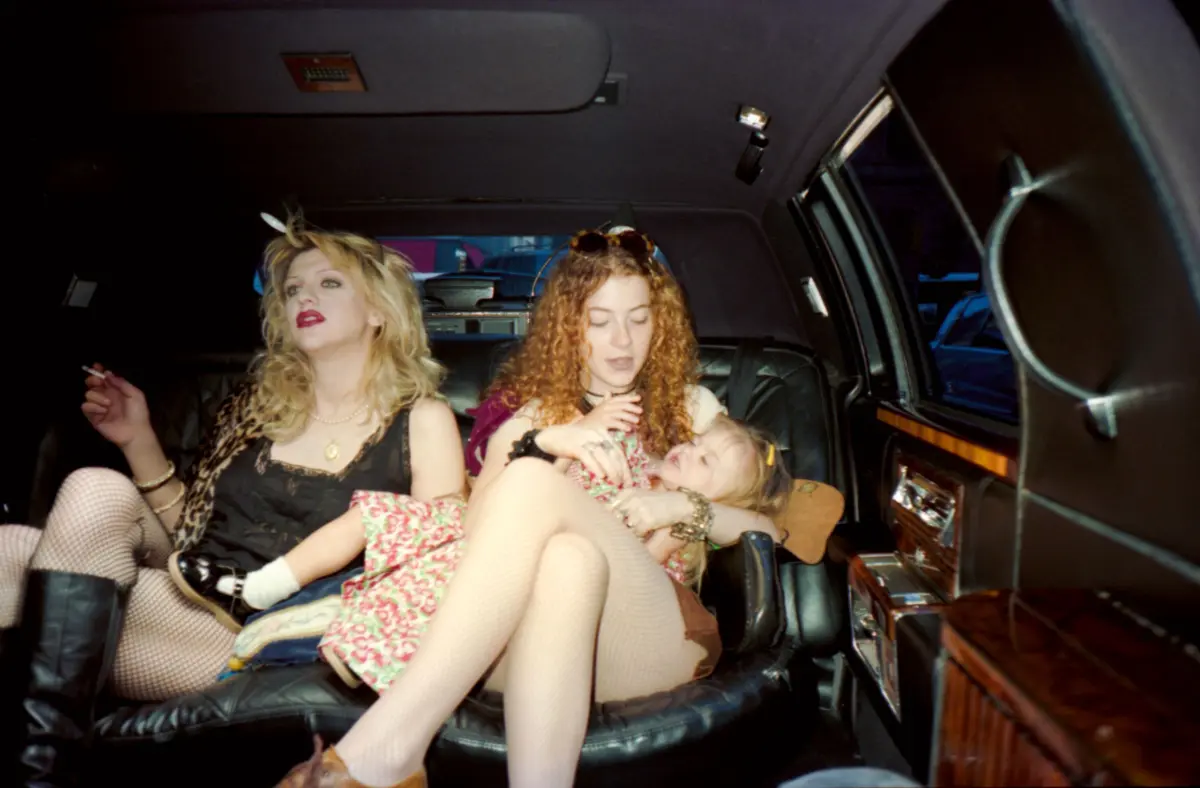
Over the subsequent six years, Auf der Maur occupied a singular vantage point in modern music history: simultaneously an insider driving the rhythm section of two of the era’s biggest rock acts—Hole and The Smashing Pumpkins—and an outsider meticulously documenting the phenomenon around her. Armed with a durable 35mm Nikon point-and-shoot camera, she amassed an extraordinary archive of over 10,000 photographs.
Decades after stepping off the arena stages, Auf der Maur is opening this vast personal repository to the public. Her forthcoming book, My ’90s Rock Photographs (published by AGO/DelMonico), alongside a major companion exhibition at the Art Gallery of Ontario, presents roughly two hundred curated images. The collection offers an intimate, historically unprecedented record of alternative rock’s commercial zenith, capturing candid backstage moments, intense fan culture, and the collision of underground art with corporate stardom.
Summer 1994: Tragedy, Resilience, and a Baptism by Fire
The spring and summer of 1994 marked one of the most tragic and turbulent stretches in rock music history:
April 8, 1994: Kurt Cobain was found dead in Seattle, just four days before Hole released their seminal, critically acclaimed second album, Live Through This.
June 16, 1994: Hole’s bassist Kristen Pfaff died from a fatal heroin overdose in Minneapolis, throwing the band’s future into complete uncertainty.
July 1994: Recommended to Courtney Love by The Smashing Pumpkins’ Billy Corgan—who had seen Auf der Maur perform in Montreal with her band Tinker—Auf der Maur was drafted into Hole. Despite initial hesitations about entering the intensely media-scrutinized ecosystem around Love, she accepted the assignment.
August 1994: Auf der Maur made her live debut with Hole at the Reading Festival in England before tens of thousands of fans, officially stepping into the international spotlight.
1995–1998: The Celebrity Skin Era and the Alternative Mainstream
1995: Hole embarked on an extensive worldwide tour supporting Live Through This. Backstage and on the road, Auf der Maur carried her Nikon camera constantly, shooting bandmates, fans, celebrity guests (including Drew Barrymore and Kurt Cobain’s mother, Wendy O’Connor), and Kurt Cobain and Courtney Love’s daughter, Frances Bean Cobain.
1998: The band released their third studio album, Celebrity Skin, featuring Auf der Maur’s basslines and vocal harmonies. The album pushed Hole into mainstream pop-rock stardom, generating massive radio hits and world tours.
1999–2000: Transition to The Smashing Pumpkins and the Sunset of an Era
Late 1999: After five years, Auf der Maur departed Hole. Shortly thereafter, she was recruited by Billy Corgan to replace D’arcy Wretzky as the touring bassist for The Smashing Pumpkins.
Summer 2000: During The Smashing Pumpkins’ farewell tour across Europe, Auf der Maur developed sophisticated remote-triggering setups on stage, mounting cameras to her bass amplifiers with foot pedals to capture high-angle live shots and self-portraits amidst stadium lights.
Post-2000: From Rock Icon to Cultural Archivist
2000s–Present: Following her tenure with major rock acts, Auf der Maur launched a solo music career and transitioned into arts administration, co-founding Basilica Hudson, a non-profit multidisciplinary arts center in Hudson, New York.
Present: Decades after storing thousands of film negatives, Auf der Maur partnered with DelMonico Books and the Art Gallery of Ontario to digitize, edit, and publish her visual history of 1990s rock culture.
Supporting Context & Metrics
Quantitative Scale of the Archive
Auf der Maur’s visual project stands as one of the most comprehensive primary visual source collections of 1990s music culture created by a performing musician.
Metric
Detail / Value
Total Images Shot
10,000+ analog negatives
Curated Book Selection
~200 photographs
Primary Camera Gear
Nikon 35mm point-and-shoot
Key Bands Documented
Hole, The Smashing Pumpkins, Foo Fighters
Key Figures Featured
Courtney Love, Billy Corgan, Dave Grohl, Taylor Hawkins, Marilyn Manson, Drew Barrymore
Exhibition Venue
Art Gallery of Ontario (AGO)
Publication Partner
AGO / DelMonico Books
    [10,000+ Raw Negatives Preserved]
                   │
                   ▼
  [Decades of Archival & Digitization]
                   │
                   ▼
  [~200 High-Impact Works Curated]
                   │
     ┌─────────────┴─────────────┐
     ▼                           ▼
[Hardcover Book]       [Museum Exhibition]
(AGO / DelMonico)   (Art Gallery of Ontario)
The Socio-Cultural Shift: From Underground Subculture to Corporate Co-optation
When Auf der Maur joined Hole in 1994, alternative rock was undergoing a profound structural evolution. What had existed for over a decade as an underground, highly localized network of independent record stores, college radio stations, and indie labels was suddenly acquired by major corporate entities.
In the wake of Nirvana’s multi-platinum success, major record labels rushed to sign underground acts. For musicians hailing from tight-knit local scenes—such as Montreal’s art-rock community—transitioning to a major-label arena act was often viewed with mixed emotions. Auf der Maur noted that to some of her peers in Montreal, joining Hole was viewed as "the equivalent of me joining Céline Dion." Her photographs capture this precise historical inflection point: the collision between raw indie authenticity and the glossy, high-stakes machinery of MTV-era stardom.
The Pre-Digital Audience and Unfiltered Intimacy
A striking element of Auf der Maur’s visual documentation is the sheer absence of digital technology among concertgoers and musicians. Unlike contemporary performances—where crowds view stages through elevated smartphone screens—the crowds captured in Auf der Maur’s 1990s images are entirely present, making direct eye contact with the performer and the camera.
1990s ANALOG CONCERT EXPERIENCE
[Direct Eye Contact] ──> [Raw Emotional Engagement] ──> [Shared Physical Space]
                                                              │
                                                        No Smartphones /
                                                        No Instant Media
This era allowed for a specific kind of unfiltered backstage vulnerability. Musician-led photography produced candid glimpses impossible for press photographers to capture: child-rearing on tour buses (such as Frances Bean Cobain sleeping in a bunk), intimate downtime between stadium sets, and unscripted backstage encounters among major icons of the decade.
Official Statements
Melissa Auf der Maur on Her Dual Role and Protective Lens
Reflecting on her double life as a band member and visual documentarian, Auf der Maur emphasizes how the camera functioned as an emotional buffer amid the volatile environment surrounding Hole:
"As a new member of Hole, who didn’t play on the ‘Live Through This’ album, I feel half in and half out of the band, a wandering visitor who’s not quite sure how long she might stay."
"I had two tools: my camera and my bass. I remember being on Canal Street and asking for the most durable point-and-shoot Nikon. I knew I was on assignment."
"That camera—and that outsider’s lens that I came in with—was my protector. Everyone on tour knew me as the person with the camera."
Addressing the shift from the 1990s analog world to today’s hyper-connected digital landscape, Auf der Maur included a handwritten manifesto at the conclusion of her book:
"Can we promise each other to keep the analogue dreams of music, art + people alive? To resist the digital tentacles that are sucking our time + magic together?"
Describing her remote-triggered stage self-portraits during The Smashing Pumpkins’ 2000 tour, she recalled communicating directly across time to her future self:
"I would look at the camera and send a message to myself in the future. I was saying, ‘Here I am, I fucking love my bass, I’m playing in my favorite band—but this will be over soon.’"
Historical Stage Dialogue: Reading Festival (August 1994)
The live dynamics between Courtney Love and Auf der Maur were established during Auf der Maur’s very first performance at the Reading Festival:
Courtney Love:"Oh, yeah, I’m so goddam brave. That’s Melissa, fuckin’, last name is French. What is it?"
Melissa Auf der Maur:"Auf der Maur. ‘On the wall,’ in German."
Courtney Love:"Auf der Maur. ‘Off the wall,’ in German."
Future Outlook
The publication of My ’90s Rock Photographs and its accompanying exhibition at the Art Gallery of Ontario represent a crucial milestone in music history preservation. As the 1990s transition from living memory into formal historical canon, Auf der Maur’s archive serves as a vital counter-narrative to commercialized rock mythologies.
                       [HISTORICAL TRAJECTORY]
                                  │
    ┌─────────────────────────────┴─────────────────────────────┐
    ▼                                                           ▼
[Preservation of Women's Voices]             [Analog Arts Renaissance]
Highlighting female creators in               Promoting analog mediums via
male-dominated 1990s rock environments        initiatives like Basilica Hudson
Key Implications for the Cultural Sector
Re-centering Female Perspectives in Rock History: Much of the journalistic narrative surrounding 1990s grunge and alternative rock was defined by male writers, photographers, and executives. Auf der Maur’s collection places the female gaze—both onstage and behind the lens—at the very center of the narrative, shedding new light on figures like Courtney Love, Patty Schemel, and female fans.
The Defense of Analog Mediums: Beyond its historical value, Auf der Maur’s work serves as a defense of 35mm film photography and tactile, physical arts. Through her ongoing stewardship of Basilica Hudson, Auf der Maur continues to advocate for independent, non-digital creative spaces that preserve artistic intimacy.
Primary Archival Value: Scholars, music historians, and curators will draw upon Auf der Maur’s 10,000-image repository to study fan subcultures, fashion, stage design, and tour logistics from the final pre-internet decade of the music industry.
As these images move from private storage boxes into museum galleries, they offer modern audiences something increasingly rare: an authentic, unfiltered look into a transformative era of modern culture, preserved by someone who lived at its exact center.








Comments
Facebook App ID not configured. Please add it in the Customizer.