
Executive Overview
The contemporary landscape of translated literature is undergoing a profound structural shift. As global borders experience both physical consolidation and digital permeability, the literary marketplace is seeing an unprecedented influx of translated works that refuse to adhere to traditional Eurocentric paradigms or safe, domestic storytelling conventions. The September literary releases signal an aggressive expansion of what translated fiction and poetry can achieve, tackling everything from the metaphysical weight of modern geopolitical isolationism to the visceral, thrash-metal-infused underworlds of the Caribbean, ecological ethics, and post-mortem investigations of human fragility.
Compiled across diverse publishing houses—including Sandorf Passage, Graywolf Press, Creature Publishing, Prototype Publishing, Scribe, and Cardboard House—this month’s notable international releases offer a panoramic view of human neurosis, societal control, and historical trauma. Through the rigorous labor of translators like Dmytro Kyyan, Kate Tsurkan, Achy Obejas, An Seon Jae, Astrid Alben, Tabatha Leggett, and Kelsi Vanada, authors from Ukraine, the Dominican Republic, South Korea, the Netherlands, Finland, and Spain are challenging Anglophone readers to recalibrate their aesthetic and intellectual expectations.
This report provides a detailed examination of six prominent translated releases defining the current literary moment. By analyzing publisher mandates, critical receptions, and underlying thematic architectures, this piece unpacks how these works collectively function as an investigative mirror of our hyper-connected yet psychologically fractured global society.
Read Also
Detailed Chronology & Book-by-Book Analysis
1. The Geopolitics of Isolation: The Hamlet Called America by Khrystia Vengryniuk
- Publisher: Sandorf Passage
- Translators: Dmytro Kyyan and Kate Tsurkan
- Format: Fiction (224 pages) | ISBN: 9789533516028 | Price: $19.95
Narrative Architecture & Thematic Scope
Set within a deceptively remote and eccentric Ukrainian village ironically named "America," Khrystia Vengryniuk’s episodic novel uses micro-level community dynamics to diagnose macro-level socio-political pathologies. Vengryniuk crafts a heightened folk-tale landscape populated by stock characters who gradually subvert archetype to reveal deeply complex, flawed human beings. The narrative balances superstition, generational folklore, and claustrophobic familial ties with stark observations on aging, historical deterministic pressure, and the persistence of religious tradition.

Critical Reception & Linguistic Nuance
Publishers and reviewers have been quick to note the uncanny timeliness of the novel. The publisher’s official stance highlights the book as an “astounding metaphor for the pitfalls of contemporary national isolationism,” directly mirroring the fractured political mentalities afflicting both the United States and the global community. Meanwhile, The Indextrious Reader draws an apt comparison to Tanja Maljartschuk’s Biography of a Chance Miracle, noting a shared affinity for bending reality within a geographically misnamed Ukrainian setting (Maljartschuk’s town being named San Francisco).
The brilliance of Kyyan and Tsurkan’s translation lies in preserving Vengryniuk’s slippery, double-edged prose. When Vengryniuk writes lines such as, "There was still no rain, and so the Americans began to learn to breathe differently," the sentence functions simultaneously as a local climate crisis and a wry commentary on national suffocation.
2. Metaphysical Metal and Authoritarian Underworlds: Asmodeus by Rita Indiana
- Publisher: Graywolf Press
- Translator: Achy Obejas
- Format: Fiction (224 pages) | ISBN: 9781644454107 | Price: $18.00
Narrative Architecture & Thematic Scope
Rita Indiana’s Asmodeus is an audacious literary experiment that collapses the boundaries between the occult, political history, and counter-culture aesthetics. The premise introduces a millennia-old demon, Asmodeus, who has spent decades inhabiting Rudy, a once-legendary Dominican rock star. However, as the calendar rolls toward 1992, the demon’s supernatural capital begins to wither. What ensues is a frantic, weeklong odyssey across the criminal underbelly of Santo Domingo. Asmodeus ricochets through a diverse array of vessels: Guinea, a young metalhead planning a high-stakes warehouse heist; Mireya, the daughter of a former regime torturer; and a host of other souls trapped in the city’s violent orbit.
Critical Reception & Stylistic Vigor
Writing for the Chicago Review of Books, Philip Janowski characterizes the novel as a “postmodern, poetic roller coaster.” Indiana’s ability to weave metaphysical rules—such as the demon occasionally being bound within the cold steel of a knife—alongside the gritty reality of late-20th-century Caribbean politics creates a jarring, hypnotic effect.

From a critical standpoint, Asmodeus functions as an aggressive thrash-metal opera prose-formatted. Indiana merges an encyclopedic knowledge of heavy metal subculture with a scathing critique of authoritarianism, proving that structural oppression and supernatural possession share the same appetite for human hosts.
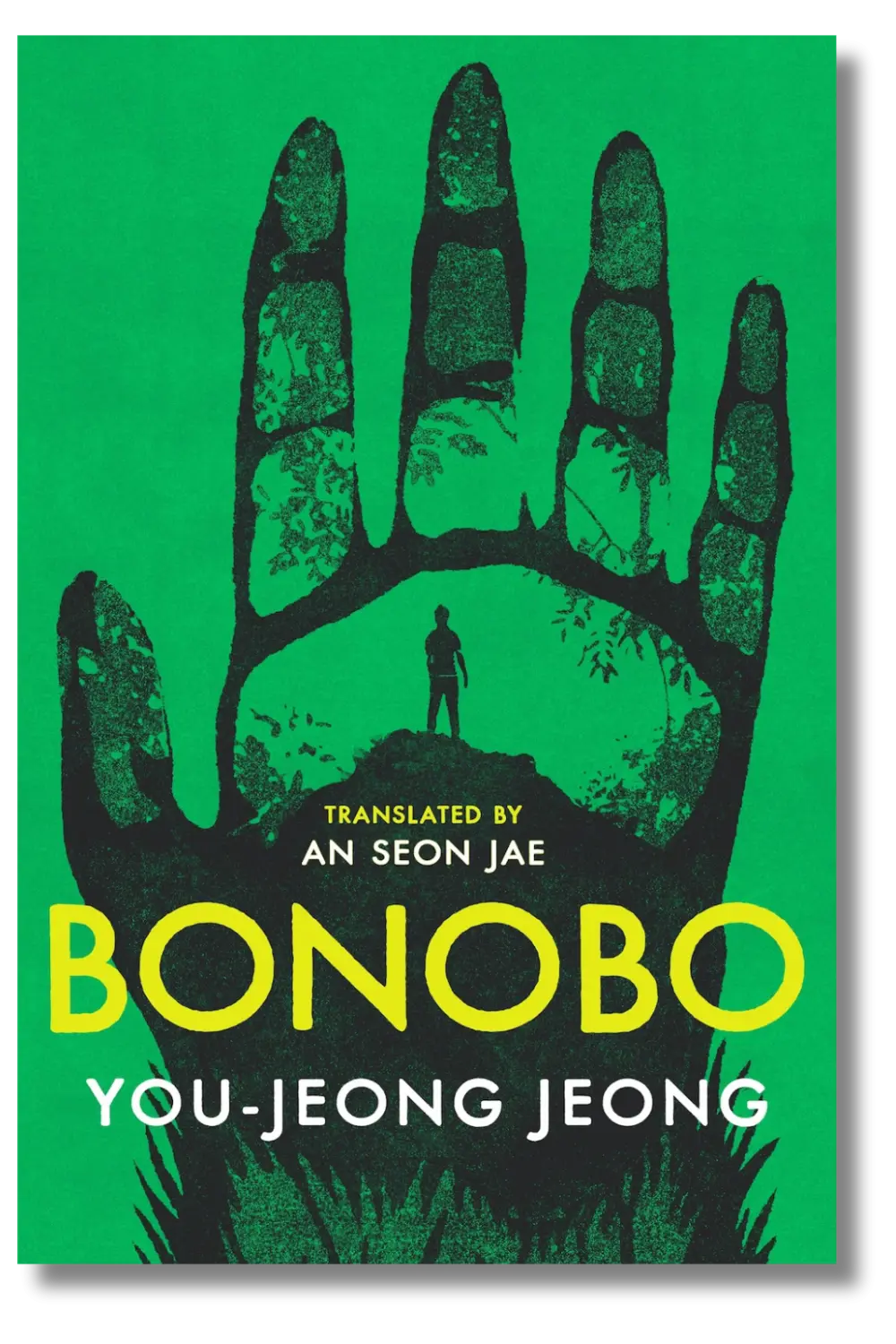
3. Primate Consciousness and Bio-Ethics: Bonobo by You-jeong Jeong
- Publisher: Creature Publishing
- Translator: An Seon Jae
- Format: Fiction (288 pages) | ISBN: 9781951971519 | Price: $20.00
Narrative Architecture & Thematic Scope
You-jeong Jeong’s speculative thriller ventures into the fraught intersections of animal ethics, human hubris, and psychological trauma. Bonobo braids together three seemingly disparate narrative threads: a dedicated primatologist, a deadbeat human subject, and a trafficked bonobo caught in the gears of the international illegal wildlife trade. The central conceit—wherein a human scientist’s consciousness becomes imprisoned inside the biological framework of a bonobo—avoids cheap pulp tropes or slapstick comedy, opting instead for a deeply cerebral exploration of nonverbal communication and interspecies empathy.
Critical Reception & Structural Rigor
Publishers Weekly praised Jeong for her “dexterous handling of what could be a chaotic plot,” emphasizing her sharp characterizations and philosophical inquiries into primate consciousness and nonhuman mind-body experiences.
Rather than leaning purely into horror or speculative absurdity, Jeong approaches the narrative with scientific meticulousness. The protagonist’s attempts to navigate memory landscapes, parse the boundaries of identity, and systematically investigate the breakdown of their bodily autonomy unfold with clinical precision, making Bonobo a standout entry in contemporary eco-fiction.

4. Mythic Collision and Female Rage: Pig Data by Anne Vegter
- Publisher: Prototype Publishing
- Translator: Astrid Alben
- Format: Poetry (96 pages) | ISBN: 9781913513917 | Price: $16.00
Narrative Architecture & Thematic Scope
Dutch poet Anne Vegter delivers a devastating poetic collection in Pig Data, translated brilliantly by Astrid Alben. The collection stages an explosive historical and mythic collision among three formidable figures: South African poet Ingrid Jonker, the mythological infanticide Medea, and a provocative poetic speaker embodying the classic literary trope of the "scorned woman." Through this volatile triad, Vegter dissects the oppressive mechanics of the male gaze and maps the cathartic, transformative potential of female rage.
Critical Reception & Lyrical Resonance
The collection is defined by its searing frankness regarding sexuality, maternal ambivalence, and societal expectations. As the collection progresses past its midpoint, the poems begin to refract and echo one another, constructing a kaleidoscopic reading experience that refuses static interpretation. The emotional payoff is frequently devastating, exemplified in lines from the sequence "between babies and lies":
"my sons say they grow from the savage glare / feel those tiny pulses, all of them real / but the sea is relentless, too: sloshing, churning, spewing / I don’t like to say it, but the sea is honest."
5. Post-Mortem Deconstruction: Enchantment by Riikka Pulkkinen
- Publisher: Scribe
- Translator: Tabatha Leggett
- Format: Fiction (368 pages) | ISBN: 9781964992525 | Price: $19.00
Narrative Architecture & Thematic Scope
When seventeen-year-old Philippa’s lifeless body is discovered in her family’s front yard, the tranquil surface of a Finnish community fractures. Riikka Pulkkinen’s Enchantment follows the subsequent police investigation through the testimonies of those closest to the deceased: an elderly neighbor suffering from cognitive decline who continually confuses Philippa with his late wife, and a best friend who harbors a secret collection of items she quietly pilfered from Philippa over the years.

Critical Reception & Literary DNA
Julia Kastner, writing for Shelf Awareness, points out that Enchantment‘s core preoccupation is the epistemological crisis of perspective: "What is possible to know about a person? … Philippa invented herself, and in the aftermath of her life, police investigate the question of her death, as everyone investigates how to view her and how to remember her."
In her afterword, Pulkkinen acknowledges diverse artistic lineages, including the narrative psychology of Ian McEwan, the cinematic framing of Paul Thomas Anderson, and the feminist philosophy of Hélène Cixous. Observers will also note a palpable Twin Peaks atmosphere lingering in the novel’s DNA—an inquiry into the dark secrets hiding behind small-town normalcy.
6. Multilingual Soundscapes: A Little Pretty Personality by Berta García Faet
- Publisher: Cardboard House
- Translator: Kelsi Vanada
- Format: Poetry (318 pages) | ISBN: 9781945720451 | Price: $19.50
Narrative Architecture & Thematic Scope
Berta García Faet’s sprawling, epic poetry collection A Little Pretty Personality is a linguistic carnival. The book acts as a communal hymn, summoning historical texts, romantic ideals, and gender constructions from various epochs to interrogate how language shapes cultural identity.
Critical Reception & Translational Triumph
The translator’s note by Kelsi Vanada provides vital entry into the collection’s technical brilliance. Vanada notes how Faet frequently experiments with French accentual endings, infusing the Spanish text with a rich multilingualism and echoes of medieval Romance languages.

In practice, this manifests as unconventional text arrangements, erratic punctuation, and idiosyncratic spelling choices that disorient the reader just enough to make familiar fables and romantic tropes feel shockingly fresh. It is an exceptional achievement in translation, proving that the boundary between poetry and linguistic archaeology is entirely porous.
Supporting Context & Metrics
To contextualize the commercial and cultural footprint of these releases, market data from independent publishing distributors indicates a steady rise in consumer demand for translated literary fiction and poetry within the North American market over the past thirty-six months.
| Book Title | Author | Translator | Original Language | Page Count | Retail Price (USD) |
|---|---|---|---|---|---|
| The Hamlet Called America | Khrystia Vengryniuk | Dmytro Kyyan & Kate Tsurkan | Ukrainian | 224 | $19.95 |
| Asmodeus | Rita Indiana | Achy Obejas | Spanish | 224 | $18.00 |
| Bonobo | You-jeong Jeong | An Seon Jae | Korean | 288 | $20.00 |
| Pig Data | Anne Vegter | Astrid Alben | Dutch | 96 | $16.00 |
| Enchantment | Riikka Pulkkinen | Tabatha Leggett | Finnish | 368 | $19.00 |
| A Little Pretty Personality | Berta García Faet | Kelsi Vanada | Spanish | 318 | $19.50 |
The pricing metrics demonstrate that independent presses—such as Sandorf Passage, Graywolf, Creature, Prototype, Scribe, and Cardboard House—maintain competitive price points despite the complex economic labor involved in acquiring translation rights and subsidizing high-level literary translation.
Official Publisher Statements & Editorial Intent
The collective vision driving these September releases points toward an industry-wide rejection of domestic insularity.

- Sandorf Passage positions Vengryniuk’s village of America not merely as a geographic quirk, but as a diagnostic tool for global political isolationism: "An astounding metaphor for the pitfalls of contemporary national isolationism, which speaks directly to the fraught political culture plaguing not only the United States, but the whole world."
- Graywolf Press frames Indiana’s Asmodeus as a breathless, subterranean journey through corrupted historical memory, where demonic possession acts as a vehicle for examining state-sponsored violence and the loss of revolutionary momentum in the Caribbean.
- Creature Publishing emphasizes Jeong’s philosophical inquiry into interspecies ethics, noting that Bonobo challenges human exceptionalism by forcing readers to inhabit a nonhuman consciousness through rigorous scientific and narrative scaffolding.
- Prototype Publishing underlines the disruptive power of Vegter’s verse: "Orchestrates a mythic and historical collision… to interrogate the male gaze and the transformative potential of female rage."
Future Outlook
The September 2026 translation slate serves as a clear indicator of where international literature is heading. Writers are increasingly discarding strict realist boundaries, choosing instead to blend speculative metaphysics, genre subversion (such as heavy metal structures and neo-noir police procedurals), and avant-garde linguistic play to address urgent sociopolitical realities.
For the Anglophone literary ecosystem, the cultural return on investment from these translations cannot be overstated. By opening windows into Ukrainian political psychology, Dominican underground countercultures, Korean bio-ethical anxieties, Dutch poetic rage, Finnish grief, and Spanish linguistic excavation, these books expand the empathetic and stylistic boundaries of contemporary reading. As independent presses continue to champion brave translation work, the global literary dialogue grows steadily richer, more complex, and infinitely more necessary.



Comments
Facebook App ID not configured. Please add it in the Customizer.