
Executive Overview
In the dynamic and ever-evolving landscape of Pakistani television, theatre, and film, few artists have charted a course defined by such deliberate versatility, intellectual depth, and uncompromising artistic integrity as Zahid Ahmed. Recently, the celebrated actor reached a monumental milestone in his professional life, marking the conferment of the prestigious Pride of Performance award—one of Pakistan’s highest civil honors—with an intimate yet star-studded gathering of family, friends, and industry peers.
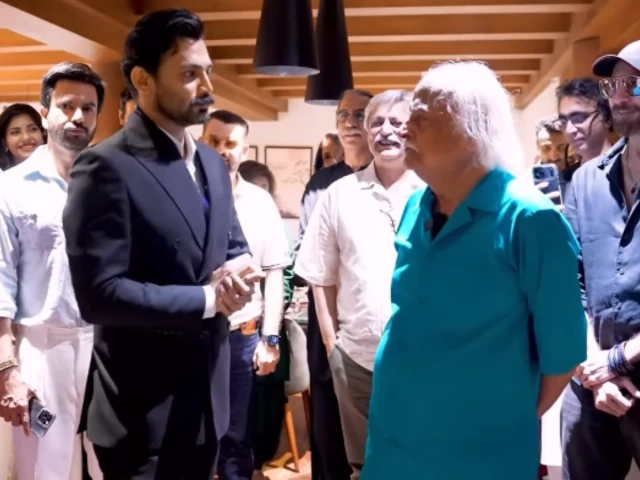
The celebratory dinner, documented extensively across social media platforms, was far more than a routine industry gala. It served as a profound retrospective of a career built on unconventional choices, psychological depth, and a willingness to challenge the conventional boundaries of Pakistani drama. Amidst the glitz and the congratulatory wishes of fellow luminaries, Ahmed chose to anchor the celebration in humility and gratitude. He directed the collective spotlight away from his own immediate triumphs and toward the foundational pillars of his career, most notably veteran writer, satirist, and intellectual icon Anwar Maqsood.
Ahmed’s journey from the gritty, unyielding world of underground and contemporary theatre to the pinnacle of television stardom offers a compelling case study in perseverance and artistic evolution. This comprehensive report explores the significance of the civil award, the web of mentors and peers who have shaped Ahmed’s trajectory, the broader socio-cultural context of Pakistan’s national awards system, and what this critical milestone signifies for the future of the nation’s performing arts sector.
Read Also
Detailed Chronology: From the Stage to the State’s Highest Honors
The Genesis of a Passion: The Anwar Maqsood Connection
To understand Zahid Ahmed’s recent accolade is to understand the lineage of Pakistani satire and dramatic writing. Long before he graced television screens as one of the country’s most dependable leading men, Ahmed was a young creative mind searching for a North Star in a fragmented media landscape. Like countless actors of his generation, he found that directional force in the timeless genius of Anwar Maqsood.
In emotional remarks shared during his celebratory gathering, Ahmed confessed that his entry into the performing arts was fundamentally catalyzed by Maqsood’s body of work. "I can be amongst many of those who can say I started acting because of Anwar Maqsood sahib. That is where my career started," Ahmed reflected in a video message that quickly resonated across digital platforms.
The actor’s admiration for the veteran writer went beyond distant professional appreciation; it manifested as a deeply personal aspiration. Ahmed revealed that as his name was announced for the Pride of Performance, his primary wish was for the award to be presented to him by Maqsood, standing shoulder-to-shoulder with the President of Pakistan. Though administrative protocols dictate the formal presentation of civil awards at dedicated state functions, Ahmed’s public tribute ensured that his mentor remained central to the narrative of his success.
The Rise Through Theatre and Television
Ahmed’s career trajectory is characterized by a deliberate departure from traditional paths. Unlike many contemporaries who step directly into commercial television serials, Ahmed honed his craft on the live stage. Fellow actor Ali Rehman, who shared the stage with Ahmed during their formative theatre days, recalled the raw, unadulterated brilliance of those early performances. "I had the privilege of actually coming up with Zahid when we did theatre," Rehman noted. "That’s when I saw his work and it was so serene. I’ve just been a fan ever since."
Theatre provided Ahmed with the discipline required to transition into television with a unique command over voice modulation, physical presence, and psychological character subtext. When he eventually made the leap to the small screen, he systematically dismantled the archetype of the conventional, one-dimensional romantic hero. From portraying complex psychological disorders in dramas like kaisi Teri Khudgarzi and Sang-e-Mah to tackling socially resonant narratives with unflinching honesty, Ahmed built a reputation as an actor who elevates every script he touches.
The conferment of the Pride of Performance award thus serves as a state-sanctioned validation of this rigorous, risk-laden journey. It signals a shift in institutional recognition—from rewarding sheer commercial popularity to acknowledging substantive contributions to the cultural fabric of the nation.
Supporting Context & Metrics: The Landscape of National Honors and Industry Reception
The 2024–2025 Civil Awards Cycle
The announcement of Zahid Ahmed’s Pride of Performance falls within the broader framework of Pakistan’s annual national awards cycle, traditionally unveiled ahead of Pakistan Day celebrations. This rigorous selection process evaluates candidates across science, arts, public service, sports, and literature.
For the cycle featuring Ahmed, the Government of Pakistan announced a comprehensive list comprising over 372 recipients, reflecting a broad spectrum of national achievement. Within this expansive roster:
- 54 awards were strictly dedicated to recognizing excellence, innovation, and long-term service in the field of arts (spanning television, film, theatre, music, and the visual arts).
- 29 awards were allocated to literature, honoring poets, novelists, and critics who have preserved and enriched regional and national languages.
Ahmed’s inclusion places him in elite company alongside other stalwarts of the Pakistani entertainment industry whose names were announced in the honors list, including seasoned television actors Mahmood Aslam, Sania Saeed, and Maria Wasti. Together, this cohort represents decades of institutional memory, resilience through changing political and media landscapes, and an unwavering commitment to storytelling.
Industry Solidarity: Peers Celebrate a Deserved Milestone
The celebratory dinner hosted by Ahmed was a rare gathering of Pakistan’s creative elite, highlighting the deep mutual respect that exists within the fraternity despite the competitive nature of the entertainment industry.
Megastar Humayun Saeed, veteran television actor Ejaz Aslam, versatile performers Aamina Sheikh, Sonya Hussyn, Hajra Yamin, Ahmed Ali Butt, Sunita Marshall, and Hassan Ahmed were all in attendance. Each offered personal reflections on Ahmed’s professional ethics and exceptional talent.
Mehwish Hayat, one of Pakistan’s most prominent film and television stars, offered a glowing endorsement of the actor’s achievement: "Such a great honour and so well deserved because he’s such a phenomenal actor. I love his work and I’m glad that it’s been recognised by the state."
This overwhelming outpouring of peer support underscores a vital metric of Ahmed’s success: longevity built on professionalism. In an industry frequently buffeted by fleeting trends and viral fame, Ahmed has cultivated a reputation for intellectual rigor, punctuality, and an insistence on script depth—qualities that have earned him the enduring admiration of both colleagues and critics.
Official Statements and Personal Reflections
The emotional core of the celebrations centered on Ahmed’s own reflections regarding his career, his struggles, and his profound sense of gratitude. In statements released via his official social media channels and elaborated upon during his gathering, the actor articulated the philosophical weight of the Pride of Performance honor.
"Receiving the Pride of Performance is an honour I carry with immense gratitude — for every character, every lesson, and every person who has been part of this journey."
— Zahid Ahmed, Actor and Pride of Performance Recipient
Ahmed’s commentary went beyond standard celebrity humility; it was an analytical breakdown of how creative identities are forged collectively rather than individually. By explicitly acknowledging the directors, writers, co-actors, and technical crews who brought complex narratives to life, Ahmed positioned his award as a collective victory for contemporary Pakistani drama.
Furthermore, his dedication to Anwar Maqsood served as a masterclass in intergenerational respect within the arts. In an industry where younger artists frequently chase modern aesthetics at the expense of historical awareness, Ahmed’s vocal reverence for Maqsood bridges the gap between the golden age of Pakistan Television (PTV) and the modern, digitized era of private entertainment networks.
Future Outlook: The Evolution of Pakistani Drama and Ahmed’s Next Chapter
As Zahid Ahmed steps into this new chapter of his career bearing the state’s highest civilian recognition, the broader Pakistani entertainment industry stands at a critical crossroads. The convergence of digital streaming platforms, international co-productions, and shifting domestic viewer habits demands a new caliber of storytelling—one that Ahmed is uniquely positioned to lead.
Elevating Narrative Standards
The recognition of actors who prioritize substance over superficiality—such as Ahmed, Sania Saeed, and Maria Wasti—sends a powerful signal to network executives and producers. It validates the appetite for complex, character-driven narratives that tackle mental health, social injustice, and historical nuance. Moving forward, audiences can anticipate Ahmed taking on roles that continue to push psychological boundaries, potentially expanding his footprint into international film and streaming projects.
Mentorship and the Next Generation
With legendary figures like Anwar Maqsood serving as his personal benchmark, Ahmed now assumes the mantle of mentorship for emerging actors. Having transitioned from underground theatre to mainstream acclaim, his insights into character immersion and artistic discipline will be invaluable to the next wave of talent entering the Pakistani media sphere.
Conclusion
Zahid Ahmed’s celebration of his Pride of Performance award is ultimately a testament to the transformative power of dedication, humility, and artistic lineage. By honoring Anwar Maqsood, celebrating with his peers, and reflecting on the rigorous path that brought him to this juncture, Ahmed has redefined what it means to be a modern cultural ambassador. As he continues to grace screens and stages, this milestone is not merely a reflection of past achievements, but a promising harbinger of the profound artistic contributions yet to come.

Comments
Facebook App ID not configured. Please add it in the Customizer.