
Executive Overview
The landscape of modern audio entertainment is undergoing a seismic shift. For decades, the audiobook experience has remained fundamentally a passive medium—one where listeners lean back, press play, and let a single narrator paint the scene over dozens of chapters. While highly successful, this traditional format has left a vast frontier of digital engagement completely unexplored.
Enter Audible. In a move that signals the next major evolution in digital publishing, the audiobook titan has announced a suite of groundbreaking, AI-driven features designed to transform passive listening into an active, multi-sensory experience. Over the coming months, Audible will roll out three flagship innovations: Character Guide, Interactive Stories, and Visual Explorer.
Tied to high-profile multi-cast productions and Audible Originals—ranging from timeless classics like Dracula and George Orwell’s 1984 to futuristic sci-fi epics like Exoplanet, produced by Andy Weir and written by Benjamin Percy—these new features aim to capture the attention of younger, digitally native audiences. By combining generative artificial intelligence, conversational design, and synchronized visual mapping, Audible is redefining the boundaries of narrative media. Currently launching in a limited beta phase for users in the United States and the United Kingdom, this technological leap offers a fascinating glimpse into the future of storytelling.
Read Also
Detailed Chronology of the Announcement and Feature Rollout
The rollout of Audible’s new interactive ecosystem did not happen in a vacuum; it represents the culmination of years of experimentation with synthetic media, multi-cast audio production, and advanced UX design.
The Lead-Up to the Beta Launch
Rumors and industry whispers regarding Audible’s exploration of generative AI tools have circulated for some time, particularly as competitors began experimenting with synthetic narration. However, rather than replacing human narrators—a controversial path that the company has largely avoided for core narration—Audible has chosen to deploy AI as a supportive, interactive layer atop premium audio productions.
The Roadmap and Initial Phase
- Late September to Early October: Audible quietly conceptualizes and finalizes the beta testing parameters for its U.S. and U.K. subscriber bases.
- Mid-October: The company formally announces the three core features: Character Guide, Interactive Stories, and Visual Explorer.
- Current Beta Status: The tools begin appearing natively within the Audible mobile application for select titles, allowing the product team to harvest real-time user feedback, monitor server loads for generative AI requests, and tweak the user interface.
- November 5 and Beyond: A staggered release schedule begins for upcoming titles, most notably the integration of the Exoplanet interactive story experience, marking a critical milestone in author-collaborative AI design.
Deep Dive: Breaking Down the Three Core Innovations
Audible’s new offerings are not mere gimmicks; each feature directly targets a specific friction point or unmet desire in the modern audiobook consumption cycle.
+-------------------------------------------------------------------+
|                        AUDIBLE'S AI SUITE                         |
+------------------+-----------------------+------------------------+
| CHARACTER GUIDE  |  INTERACTIVE STORIES  |    VISUAL EXPLORER     |
| • Tracks speakers| • Real-time dialogue  | • Maps & contextual art|
| • Actor bios &   | • Generative AI stakes| • Enhances non-fiction |
|   headshots      | • Role-playing missions|  & European tours     |
+------------------+-----------------------+------------------------+
1. Character Guide: Solving the Multi-Cast Confusion
Every avid audiobook listener knows the dizzying feeling of diving into a sprawling epic with a massive cast of characters, only to lose track of who is allied with whom—or even who is currently speaking during a heated dialogue scene.
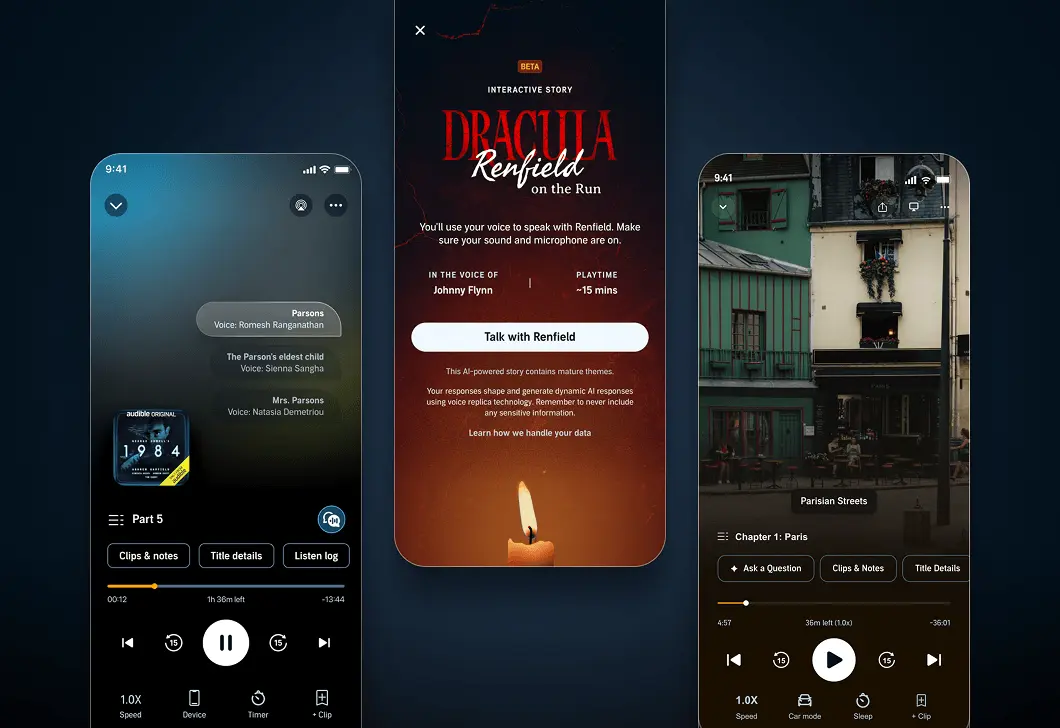
- How It Works: As the listener enjoys a supported Audible Original, the Character Guide dynamically tracks and displays the active speaker in real time directly within the app interface.
- Beyond the Voice: Recognizing the immense talent behind modern multi-cast productions, Audible has integrated narrator headshots and comprehensive biographies right into the player page. This bridges the gap between voice actors and their audiences, giving proper recognition to the artists bringing these audio universes to life.
2. Interactive Stories: Stepping Inside the Narrative
Perhaps the most ambitious feature in Audible’s new arsenal is Interactive Stories, which turns listeners from mere observers into active participants within the plot.

- The Dracula Integration: Launched alongside a reimagined version of Bram Stoker’s classic, this feature utilizes advanced generative AI, conversational design, and immersive sound production.
- The Mechanics: Listeners are assigned a specific role and a narrative mission. The characters themselves initiate conversations with the user, raising the dramatic stakes. Users respond in their own words, and the AI-driven characters react on the spot, creating a branching, personalized narrative experience.
- Future Expansion: The excitement continues on November 5 with the release of the next Interactive Story tied to Exoplanet, crafted in collaboration with renowned sci-fi author Benjamin Percy. This demonstrates that Audible is working hand-in-hand with human creators to ensure that interactive elements honor the original artistic vision.
3. Visual Explorer: Bridging the Audio-Visual Gap
While audio remains an inherently "eyes-free" medium, modern consumers—particularly younger demographics—frequently crave complementary visual context to anchor complex narratives, especially in non-fiction, travel, and historical audiobooks.
- Contextual Imagery: The Visual Explorer feature delivers relevant images, historical maps, and contextual artwork directly to the listener’s screen in sync with the audio track.
- The Grand Tour: This feature makes its debut in The Cultural Tutor’s Grand Tour: The Story of Europe in Six Cities. As the narrator guides listeners through historical European landmarks, the Visual Explorer populates the screen with rich imagery, deep-dive information on historical figures, and geographic data, transforming an audio lesson into a multimedia masterclass.
Supporting Context, Industry Trends, and Market Metrics
Audible’s pivot toward interactive and AI-enhanced audiobooks is reflective of broader macroeconomic and cultural shifts in the digital media ecosystem.
- The Rise of Gen-Z and Millennial Audio Habits: Younger demographics consume media with a multi-screen, highly interactive mindset. Traditional, static audiobooks occasionally struggle to capture the undivided attention of digital natives accustomed to gamified experiences, branching narratives, and instant visual feedback.
- The Generative AI Gold Rush: The publishing and audiobook industry has spent the last three years grappling with the rise of generative AI. While text-to-speech tools have sparked fierce debates regarding copyright, job displacement, and quality, Audible’s strategy highlights a different path: using AI not to replace human talent, but to augment human-created stories (like those by Benjamin Percy or multi-cast voice actors) with interactive wrappers.
- Data-Driven Development: By launching these features as a limited beta in the U.S. and U.K., Audible is employing a classic tech-sector playbook. By monitoring engagement metrics, session lengths, and user drop-off rates during interactive segments, the company can fine-tune its conversational AI models before scaling globally.
Official Statements and Industry Perspective
The integration of artificial intelligence into creative arts is always a sensitive subject, requiring careful navigation from corporate leadership. Audible has been proactive in framing these changes as a natural extension of authorial intent rather than a technological takeover.
Andy Tsao, Chief Product and Analytics Officer at Audible, emphasized this philosophy during the initial rollout announcement:
"AI is allowing us to create new interactive experiences that today’s listeners, especially younger audiences, are craving. We are opening up entry points into stories that are still part of the authors’ vision, but that make our customers’ experiences more personal and unique."
Industry analysts have noted that Tsao’s emphasis on "authorial vision" is a crucial PR and philosophical stance. By collaborating directly with established writers like Benjamin Percy and producing versions of classics under tight creative constraints, Audible is attempting to reassure the literary community that generative tools will serve as a bridge to new readers, rather than a wedge dividing creators from their audiences.
Future Outlook: What’s Next for Audible and Interactive Audio?
As the beta testing phase progresses in the U.S. and U.K., the audiobook industry will be watching closely to see how consumers respond to these features. Several key questions remain for the future of the platform:
- Broadening the Catalog: While high-profile titles like Dracula, 1984, and Exoplanet make for phenomenal launch vehicles, the long-term viability of these features will depend on how easily Audible can scale Character Guides and Visual Explorers across its massive, million-plus title catalog. Will automated pipelines eventually handle simpler books, or will these tools remain exclusive to high-budget Audible Originals?
- Monetization and Tiered Access: Will interactive features eventually require a premium subscription tier, or will they be bundled into standard membership credits? As processing real-time generative AI queries incurs higher server costs than standard audio streaming, monetization models will inevitably evolve.
- The Author Community Response: As authors experience tools like Interactive Stories firsthand, the literary world will form a clearer consensus on whether AI-assisted branching narratives represent a exciting new literary frontier or a distraction from pure prose.
Conclusion
Audible’s latest initiative marks a watershed moment for the audiobook industry. By marrying traditional voice acting and masterclass sound design with cutting-edge conversational AI and visual sync tools, the company is boldly stepping beyond the boundaries of the traditional spoken-word format. Whether listeners want to keep track of a complex sci-fi character roster, converse in real-time with Bram Stoker’s creations, or visually explore European landmarks alongside a cultural guide, Audible is ensuring that the future of storytelling is not just heard—it is experienced.



Comments
Facebook App ID not configured. Please add it in the Customizer.