
By Eliza McGraw | History Correspondent
Special Smithsonian Magazine Report
Executive Overview
Nearly 250 years ago, as the British Empire sought to crush the nascent American rebellion with unmatched naval might, a quiet innovation brewed in the collegiate halls of Yale University. David Bushnell, a forward-thinking student with an obsessive fascination for underwater explosives, conceptualized an asymmetric marvel: the Turtle. Shaped like an acorn and constructed from stout oak and iron hoops, the vessel was designed to perform the unthinkable—sneak undetected beneath the surface of New York Harbor, attach a timed explosive device to the copper-sheathed hull of the Royal Navy’s flagship, and vanish into the murk.
On the night of September 6–7, 1776, that radical vision met the unforgiving reality of warfare. Piloted by Continental Army soldier Ezra Lee, the Turtle targeted the HMS Eagle. The mission ultimately faltered, failing to sink the British flagship. Yet, looking back from the vantage point of the nation’s 250th anniversary, historians argue that the mission’s failure obscures its true significance.
Read Also
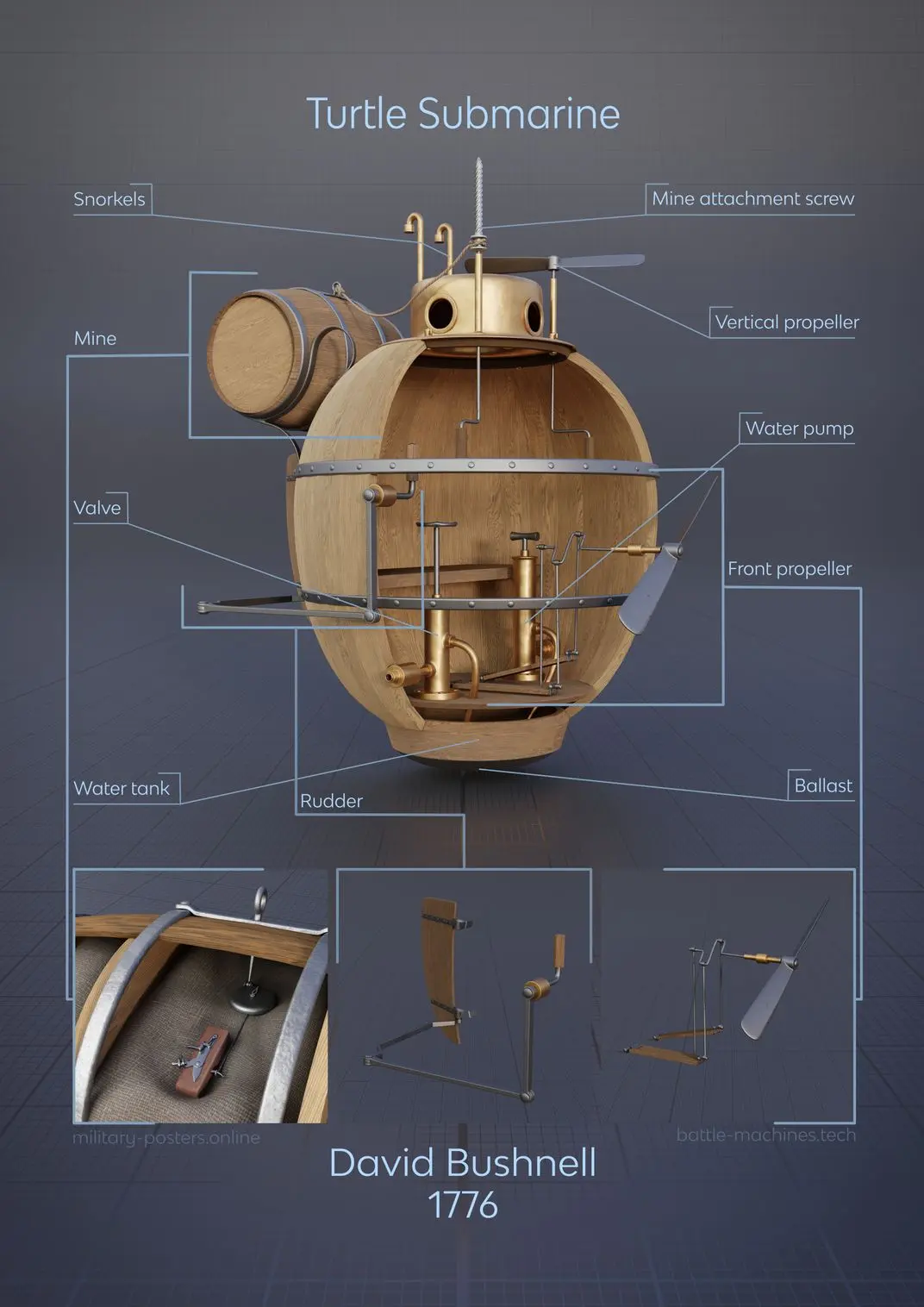
/https://tf-cmsv2-smithsonianmag-media.s3.amazonaws.com/filer_public/a5/30/a530c850-32a9-4cf0-a6da-b74e6cfc15f8/turtle-diagram.png)
The Turtle was not merely a mechanical curiosity or a failed prototype; it was the intellectual progenitor of modern undersea warfare, asymmetric insurgency, and special operations. Long before the advent of nuclear-powered submarines or elite frogman units, David Bushnell’s hand-cranked, pedal-powered submersible laid down the foundational blueprint for how weaker nations could challenge maritime hegemons.
Detailed Chronology: From Yale Pubs to the Waters of New York
The genesis of the Turtle can be traced back to the intellectual ferment of Yale University in the early 1770s. As tensions between the American colonies and Great Britain escalated toward inevitable armed conflict, students and faculty alike recognized an insurmountable obstacle: the Royal Navy.
[1771: Yale Pub Debates] ➔ [1775: Hull Completed] ➔ [Sept 1776: New York Attack] ➔ [Oct 1776: Vessel Lost]The Academic Incubator (1771–1775)
As early as 1771, groups of Yale students gathered at local New Haven establishments to debate how a future American republic could possibly counter the greatest naval force on earth. Mark Jacobson, a historian at the International Spy Museum, notes that these thinkers understood a fundamental truth: "You couldn’t take them on head-on."
/https://tf-cmsv2-smithsonianmag-media.s3.amazonaws.com/filer_public/a5/30/a530c850-32a9-4cf0-a6da-b74e6cfc15f8/turtle-diagram.png)
David Bushnell took these strategic discussions to heart. While studying at Yale, he began experimenting with gunpowder, quickly realizing that an explosive charge detonated against the submerged hull of a wooden warship would inflict exponentially more structural damage than one placed on its deck.
To bring his vision to life, Bushnell assembled a collaborative network. Historians Roy R. Manstan and Frederic J. Frese, authors of Turtle: David Bushnell’s Revolutionary Vessel, describe a painstaking, four-year development process involving local clockmakers, mentors, and his brother, Ezra Bushnell. Most notably, local clockmaker Isaac Doolittle contributed critical expertise, crafting the intricate timing mechanisms for the explosive charges alongside the submarine’s internal valves and pumps.
By the time the American Revolution officially erupted with the Battles of Lexington and Concord in the spring of 1775, the wooden hull of the Turtle was virtually complete. Bushnell later explained to Thomas Jefferson that the name derived from its striking external silhouette, which "bore some resemblance to two upper tortoise shells of equal size, joined together."
/https://tf-cmsv2-smithsonianmag-media.s3.amazonaws.com/filer_public/9c/8f/9c8fb1a9-28d3-439f-b557-6a841a3079a6/gettyimages-90745770.jpg)
The Midnight Assault: September 6–7, 1776
Originally slated for deployment against British forces in Boston Harbor, the Turtle had to be relocated when the British fleet shifted its operations to New York City. Transported southward via a small sloop, the submersible faced its first major hurdle when its designated pilot, Ezra Bushnell (the inventor’s brother), fell gravely ill.
To take his place, Continental Army volunteer Ezra Lee stepped forward. Around midnight on September 6, 1776, Lee squeezed into the cramped, single-occupant interior of the Turtle. Armed with an internal water-ballast system, a hand-cranked vertical propeller, and a foot-operated horizontal screw, Lee submerged into the icy, black waters of the harbor.
Using bioluminescent foxfire fungus coated on the glass faces of his compass and barometer (a method rendered unreliable in winter when the fungus lost its luminescence), Lee navigated toward the HMS Eagle. Yet, as he maneuvered beneath the colossal warship, he encountered a fatal obstacle: the Eagle’s iron-reinforced hull lining deflected the mounting screw.
/https://tf-cmsv2-smithsonianmag-media.s3.amazonaws.com/filer_public/9a/43/9a43c29d-9c99-4b16-b4cf-82b0a881ba23/bushnell_turtle.jpeg)
Unable to secure the explosive charge, Lee was forced to abort the mission. He released the powder magazine, which drifted away into the harbor before detonating harmlessly. While the explosion failed to damage the Eagle, it sent shockwaves through the British fleet, forcing commanders to relocate their anchorages out of an abundance of caution.
The Aftermath and Disappearance
In the weeks following Lee’s attempt, two subsequent missions—one by Lee and another by pilot Phineas Pratt—similarly failed to inflict damage. The ultimate fate of the Turtle remains shrouded in mystery. In October 1776, British forces sank the supply sloop carrying the submersible. While Bushnell maintained that he successfully salvaged the craft, subsequent accounts, including reports from Pratt’s son in 1800, suggest the vessel was eventually broken down into its component parts.
Supporting Context & Metrics: Engineering an Improbable Machine
To fully appreciate the ambition of the Turtle, one must examine the extreme operational parameters required of its single pilot. Operating the submarine was an extraordinary physical and psychological endurance test.

Technical Specifications and Life Support
- Dimensions: Approximately 7.5 feet long, 6 feet high, and 3 feet wide.
- Propulsion: A hand-cranked vertical propeller for depth control and a foot-operated treadle driving a horizontal screw propeller.
- Ballast System: A central bilge chamber controlled by foot-operated valves that allowed water to flood in for descent and be pumped out via bilge pumps for ascent.
- Air Supply: Limited strictly to the air trapped within the sealed wooden hull upon closing the hatch—giving the pilot roughly 30 minutes of breathable oxygen under resting conditions, and considerably less during strenuous physical labor.
As Evan Wilson, a historian at the U.S. Naval War College’s Hattendorf Historical Center, observes, operating the vessel demanded immense physical exertion. Pedaling, pumping bilges, steering, and attempting to screw an explosive charge into an enemy ship simultaneously required elite physical fitness and unshakeable psychological fortitude. General George Washington himself underscored this reality, writing to Thomas Jefferson in 1785: "It is no easy matter to get a person hardy enough to encounter the variety of dangers to which he must be exposed."
Official Statements and Expert Analysis
Naval and military historians looking back across two and a half centuries view the Turtle through a lens of strategic evolution rather than tactical failure.
-
Evan Wilson (U.S. Naval War College):
/https://tf-cmsv2-smithsonianmag-media.s3.amazonaws.com/filer_public/13/ae/13aeb9ca-66f8-4cee-b219-d7434591202f/ezralee.jpg)
"First, all of Turtle’s attacks failed, and second, the launching of Turtle did not herald the age of the submarine—that was still more than a hundred years away. A wooden-hulled submersible carrying one person was never likely to be the foundation for a new era of naval warfare… Military and naval historians think about the Turtle as an asymmetric weapon. It was very difficult—probably impossible—for the American rebels to challenge the British Navy symmetrically, by building their own navy."
-
Mark Jacobson (International Spy Museum):
"The possibility of swimmers and divers being armed with underwater timed explosive devices will eventually evolve into the frogmen of World War II and the Navy SEALs… The Turtle’s oar-like propellers, meanwhile, were the first of their kind to be used in a maritime vessel for propulsion, paving the way for the screw propellers popularized in the 19th century."
/https://tf-cmsv2-smithsonianmag-media.s3.amazonaws.com/filer_public/3f/9c/3f9cd020-e870-4574-a75a-2a038655bc71/1920px-fultondesign7.jpg)
Future Outlook and Legacy
As the United States commemorates its 250th anniversary, the legacy of David Bushnell’s invention resonates far beyond naval museums. The Turtle established a direct technological and tactical lineage that extends straight to the modern era.
By demonstrating that a low-cost, single-operator vessel could strike terror into the heart of a global naval empire, Bushnell birthed the doctrine of asymmetric maritime warfare. The concept of deploying hidden, timed explosives against entrenched power found new iterations in Robert Fulton’s Nautilus in 1800, the Confederate submersible H.L. Hunley during the American Civil War, World War II naval combat swimmers, and ultimately today’s elite naval special warfare units.
Two centuries after his death in 1826, David Bushnell’s creation stands vindicated by history. Though it never sank a ship, the Turtle proved that human ingenuity, pushed to its absolute limits by the crucible of revolution, could redefine the very boundaries of warfare. In the words of George Washington, written nearly 250 years ago: "I then thought, and still think, that it was an effort of genius."


Comments
Facebook App ID not configured. Please add it in the Customizer.