
Executive Overview
For well over a century, the popular and academic understanding of Upper Paleolithic cave art has been dominated by a flat, two-dimensional lens. From coffee-table books to documentary films, ancient rock art in subterranean chambers—such as Spain’s El Castillo and France’s Chauvet—is typically presented as if it were a static gallery exhibition, illuminated evenly and viewed with clinical detachment.
However, a radical shift is underway in the archaeological community. Groundbreaking field research, coupled with immersive technologies like virtual reality, reveals that ancient artists did not merely paint pictures on rock walls; they engaged in a deeply multisensory, dynamic performance. By working intimately with the contours, fissures, and textures of the subterranean topography, and by viewing these creations exclusively through the flickering, amber light of primitive torches, Ice Age humans created an experience that modern scholars are beginning to compare to early cinema or immersive installation art.
Simultaneously, this evolving view of cave art intersects with broader cognitive theories regarding the dawn of abstract thought. Renowned archaeologists like Steven Mithen argue that these enduring markings served as "cognitive anchors"—externalized repositories of ideas that enabled early Homo sapiens to make a profound evolutionary leap. Far from being isolated strokes of primitive decoration, these ancient sanctuaries represent the birthplace of symbolic reasoning, collective memory, and the modern human mind.
Read Also
/https://tf-cmsv2-smithsonianmag-media.s3.amazonaws.com/filer_public/8e/83/8e837bc6-e2b3-4bb6-bb1c-4f1287b45a6f/castillo-39-rincon_de_los_signos.jpg)
Detailed Chronology: From Discovery to Digital Reconstruction
To understand how our perception of cave art has evolved, one must trace the timeline of discovery and the corresponding shifts in archaeological theory.
- 1879: The monumental discovery of the polychrome bison on the ceiling of the Altamira cave in northern Spain shatters Victorian assumptions about early humans. For the first time, Western science is forced to grapple with the reality that Ice Age hunter-gatherers possessed sophisticated artistic capabilities.
- Late 19th to Mid-20th Century: Early interpretive frameworks struggle to decode the purpose of subterranean art. Theories cycle rapidly through fashion: scholars suggest the animal illustrations represent clan totems, fertility symbols, or the ecstatic visions of shamans traversing altered states of consciousness.
- The 1950s: El Castillo and other major European caves are modernized for mass tourism, outfitted with concrete staircases and electric lighting. While this opens heritage sites to the public, it inadvertently strips visitors—and many researchers—of the authentic, shadowy sensory environment in which the art was originally experienced.
- The Turn of the 21st Century: A new generation of archaeologists, including Diego Garate and Eduardo Palacio Pérez, begins to pivot away from isolating drawings as standalone motifs. Instead, they focus heavily on the physical relationship between the artist, the art, and the subterranean environment.
- The 2010s: British archaeologist Paul Pettitt and his colleagues publish pivotal spatial analyses of hand stencils in El Castillo. They demonstrate that handprints were not slapped randomly across walls; rather, they were carefully positioned near fissures and gripping curves, suggesting they served to steady explorers moving through the dark zone. Researchers also successfully extract ancient human DNA directly from decorated cave walls, bridging the gap between biological and cultural anthropology.
- 2020–Present: Digital archaeology transforms the field. Researchers like Izzy Wisher utilize virtual reality and computational modeling to simulate the exact physics of primitive torchlight within caves such as Las Monedas. This technological leap allows scientists to prove how flickering flames animated static paintings, breathing motion into stone and resolving decades-old debates regarding intentionality.
Supporting Context & Metrics: Unlocking the Paleolithic Mind
The magnitude of Upper Paleolithic rock art can be quantified through both its physical distribution and its profound cognitive implications.
The Scope of El Castillo
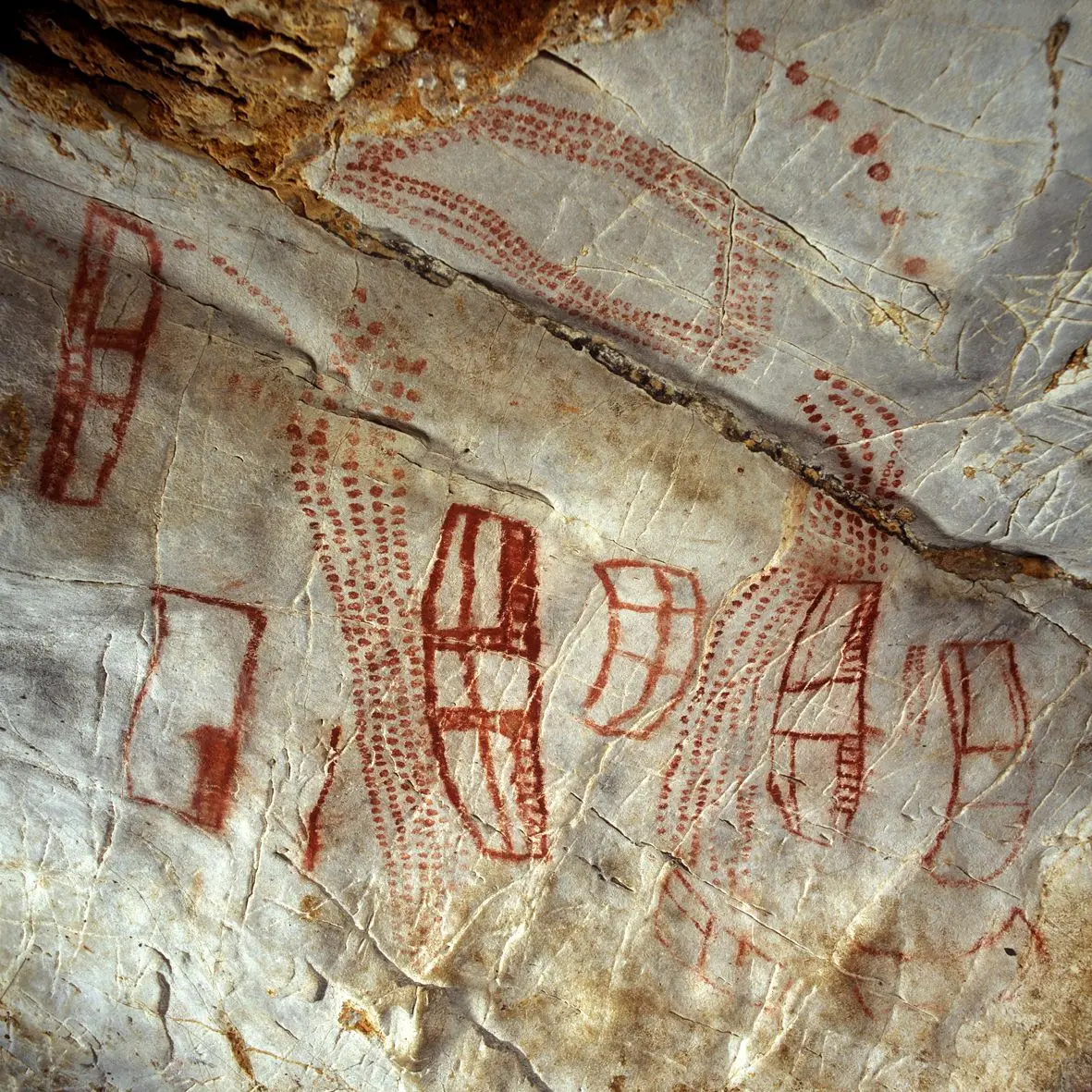
Located in the Cantabria region of northern Spain, El Castillo serves as a masterclass in prehistoric chronology. Archaeological evidence indicates that human artists visited its chambers repeatedly between 13,000 and 41,000 years ago. Today, nearly 3,000 individual marks remain legible, spanning every major thematic era of European rock art.
/https://tf-cmsv2-smithsonianmag-media.s3.amazonaws.com/filer_public/8e/83/8e837bc6-e2b3-4bb6-bb1c-4f1287b45a6f/castillo-39-rincon_de_los_signos.jpg)
The "Cognitive Anchor" Hypothesis
According to Professor Steven Mithen of the University of Reading, author of foundational works such as The Prehistory of the Mind and The Singing Neanderthals, the transition to figurative art marked a turning point in human evolution.
"Today, much of my mind is contained within my mobile phone, the modern equivalent to a painted animal or carved figurine for an Ice Age hunter-gatherer," Mithen notes.
While earlier hominins—including Neanderthals—possessed complex survival skills, they largely failed to externalize their cognitive processes onto material objects. When Homo sapiens began mapping mental concepts onto cave walls, they established a system of shared symbols. This externalization laid the groundwork for complex cultural transmission, ultimately accelerating human evolution by thousands of years before the invention of formal writing.
/https://tf-cmsv2-smithsonianmag-media.s3.amazonaws.com/filer_public/fd/cb/fdcb1447-fea6-4499-80eb-baa875f8216f/castillo-27-techo_de_las_manos.jpg)
Multisensory Dynamics in the "Dark Zone"
The deep chambers of European caves—devoid of natural light and historically stalked by now-extinct cave bears (Ursus spelaeus)—were environments of profound sensory deprivation. Working under these conditions transformed the act of creation.
- Topography as Canvas: Artists utilized bulges in the limestone to suggest the muscular shoulders of bison, natural cracks to form the dorsal lines of horses, and jagged fissures to represent elk antlers.
- Kinetic Illumination: The restricted beam of a torch (typically casting light only a dozen feet in a flickering circle) caused shadows to dance across the rock face. This optical phenomenon meant that static engravings and paintings appeared to shift, breathe, and move.
- Simulated Hunting Environments: Researchers Derek Hodgson and Paul Pettitt argue that Paleolithic visual systems, naturally primed to detect partially obscured prey in natural landscapes, experienced an amplification of this instinct in the ambiguous shadows of the deep caves. The dark zone was not a dead space, but an active, participatory theater.
Official Perspectives & Expert Insights
The paradigm shift in cave art research is driven by leading voices in paleoanthropology who advocate for a holistic, embodied approach to archaeology.
- Diego Garate (University of Cantabria): Reflecting on the profound intimacy between prehistoric humans and their subterranean canvases, Garate notes, "For scholars, the wall is sacred. You can’t touch anything… but obviously, for Paleolithic people, it was the contrary. They were in a close relationship with the walls." Garate emphasizes that modern technologies are essential for reconstructing this lost experience: "Cave art is not like a picture on the wall… We could light a torch in the computer and solve this problem with virtual reality."
- Eduardo Palacio Pérez (Archaeologist and Researcher): Describing the unmatched archaeological wealth of El Castillo, Palacio Pérez observes, "If the Paleolithic record were a book, then in El Castillo we have every chapter, more or less. We have practically all the themes in Paleolithic rock art in Europe."
- Izzy Wisher (Aarhus University): Co-author of recent studies investigating perceptual psychology in subterranean environments, Wisher highlights how human biology interacts with ambiguous stimuli: "One’s visual familiarity with certain stimuli (particular animals, faces or objects) may shape the visual system to perceive ambiguous or fragmented stimuli as being evocative of familiar forms."
- Steven Mithen (University of Reading): Expanding on the long-term cultural impacts of early symbolic behavior, Mithen stresses the unprecedented nature of cave art: "The figurative art of cave painting took the externalization of ideas and information to an unprecedented level, one not exceeded until the invention of writing many thousands of years later."
Future Outlook: The Intersection of Archaeology and Immersive Tech
As academic inquiry moves further into the 21st century, the study of Upper Paleolithic art stands at an exciting crossroads between hard-science fieldwork and digital humanities.
/https://tf-cmsv2-smithsonianmag-media.s3.amazonaws.com/filer_public/c5/3d/c53d1353-a5e3-49c7-be3e-f883092fa7fe/castillo-69.jpg)
Traditional conservation challenges—such as the risk of mold, carbon buildup, and humidity fluctuations caused by human breath—mean that physical access to deep cave networks like El Castillo, Lascaux, and Chauvet will remain strictly limited. However, rather than closing off these sites to intellectual inquiry, advanced technology is democratizing and deepening our understanding of them.
Future breakthroughs will likely rely heavily on:
- Virtual Reality (VR) Simulations: Recreating the precise atmospheric conditions, acoustics, and erratic torchlight of deep caves allows researchers to test psychological responses and shadow-projection hypotheses without risking delicate ancient pigments.
- AI-Assisted Spatial Analysis: High-resolution 3D laser scanning enables computers to map minute topographical shifts across vast cave walls, identifying micro-engravings and faint ochre traces invisible to the naked human eye.
- Interdisciplinary Biocultural Studies: Combining ancient DNA recovery from cave walls with paleoneurology will continue to refine our timeline of how human sensory and cognitive systems adapted during the Upper Paleolithic.
Ultimately, these technological advancements serve a singular purpose: to strip away the sterile framing of modern museums and reconnect us with the visceral reality of our ancestors. When standing before a simple black dash and circle—such as the haunting "Mask of El Castillo"—we are reminded that the first artists were not merely decorating a wall. They were engaging in an intimate, dynamic dialogue with the stone, leaving behind a timeless testament to the awakening of the human soul.





Comments
Facebook App ID not configured. Please add it in the Customizer.